While the cost of housing is frequently cited as a reason for delayed family formation and having children, the evidence does not strongly support this claim, according to a new study from the Policy Exchange think tank in the UK, which mentions Ireland, among other countries.
The housing
crisis is often presented as a key factor in couples delaying marriage and
having children. For instance, a recent survey commissioned by Accord, the
Catholic marriage care service, found that “84pc of adults in Ireland say that
the housing crisis is causing some couples to delay getting married and/or
having children.” So, the perceived link between the cost of housing and the
delaying in settling down and starting a family is very strong.
Moreover,
the same poll found that “48pc of couples planning to get married would have
married sooner if it weren’t for the housing situation; and 60pc of couples
planning to have children would have done so earlier if it weren’t for the
housing situation”.
This
perception seems logical, as housing is one of the most expensive elements of
starting a new family. But is there concrete evidence to support what appears
to be common sense?
The new
Policy Exchange report, called ‘Small State or Small Families?’ contradicts the public sentiment.
The research found that there is no positive correlation between housing
affordability, measured in terms of price-to-income ratios, and fertility
rates.
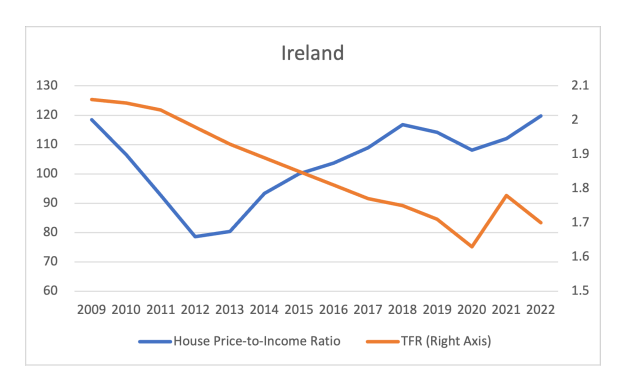
The above
chart shows a steady decline in fertility rates in Ireland regardless of the
price of housing. (Ignore the blip during the Covid pandemic which was an
exceptional period). In simple terms, fertility rates did not increase when
housing became more affordable.
House
prices in Ireland fell very sharply between 2009 and 2012. Yet, despite this
decline in prices, fertility rates kept falling and have not rebounded, even
though Ireland’s economy began recovering in 2010 and unemployment levels
improved by 2016. This suggests falling property prices alone does not
necessarily lead to higher birth rates.
As
the report says: “At the same time [as housing
became more affordable], Ireland’s fertility rate fell – and it kept falling.
It is hard to attribute this effect to the recession and austerity that Ireland
experienced in this period. Ireland returned to growth in 2010 and by 2016,
unemployment was at reasonable levels. Despite this, with much more affordable
housing, fertility rates continued to fall.”
One could
argue that it is not just the affordability (price-to-income ratios) of housing
that matters, but also the availability of homes on the market. A sudden
increase in population, such as that experienced by Ireland in recent years due
to immigration, can reduce housing availability, even when affordability has
not changed significantly.
Beyond
Ireland, the Policy Exchange study also considered Lithuania and found again no
evidence of a correlation between fertility rates and house affordability. This
might appear counterintuitive, which explains why polls often cite the housing
crisis as a key factor in delaying family formation and having children.
However, polls capture opinions and perceptions, not data based on empirical
evidence.
Indeed,
across Europe, regardless of housing affordability, fertility rates are low and
mostly falling.
This
indicates something else is at work, and that is probably values, as recent paper of the Iona Institute argues. What do
people prioritise? If, in your 20s, you value your freedom above all, and
therefore avoid the major commitments involved in raising a family, then even
if you can afford a home, you will delay having children anyway, and the longer
you leave things into your 30s, the less likely you are to have children, or at
least the number you had in mind. Hence our falling marriage and fertility
rates and our rapidly ageing population.

Nessun commento:
Posta un commento