Visualizzazione post con etichetta united states. Mostra tutti i post

venerdì, dicembre 12, 2025

More good news on the ‘quiet revival’ front


After decades of steady decline, the proportion of Americans who identify as Christians appears to have stabilised, according to a major new survey by the Pew Research Center. Moreover, the youngest age group surveyed – the 18 to 24-year-olds – seems to be somewhat more religious than age groups immediately above them. This is similar to polling finding here in Ireland, both in the North and the South.

The survey is called the ‘Religious Landscape Study’ (RLS). It is a vast project involving almost 37,000 adults. Becaure the US census does not collect information on religion, the RLS is the country’s most authoritative measure of religious composition.

An important finding is that for the first time in years, the youngest adults in the United States are more likely to identify as Christians than other young people. Fifty-one percent of Americans aged 18 to 24 identify as Christian compared with 45pc of those aged 24 to 34.

Aside from the two polls commissioned by the Iona Institute, a recent survey from Britain showed the same pattern.

These findings challenge the assumption that each new age cohort will be less religious than the one before, suggesting instead that a plateau in secularisation may have been reached.

Even more striking is a subtle but significant gender shift within these younger groups. Historically, across every age cohort, American women have tended to be more religious than men. Yet among today’s young adults, this pattern has reversed, according to the Pew Center survey. Young men are slightly more likely than young women to say that religion is “very important” in their lives. This reversal, if it continues, would mark a major cultural change in the gender profile of American religiosity.

Despite the stabilisation among Christians, a substantial minority of the population say they have no religion. Nearly three in ten Americans now call themselves atheists, agnostics or “nothing in particular”, up from 23pc in 2014 and just 16pc in 2007. However, the rate of growth is slower than in recent years. The shift is visible across the political spectrum, but it is much more pronounced among liberals than among conservatives. A large majority of conservatives still identify as Christian, according to the survey.

Within American Christianity itself, Protestants remain the largest group, making up 40pc of adults, while Catholics account for 19pc. Both proportions have declined significantly since 2007. However, the Protestant share has held relatively steady since 2019, and the Catholic share has shown little change since 2014, with only minor year-to-year fluctuations.

The survey also highlights demographic differences that may shape future trends. Christians report an average completed fertility rate of 2.2 children per respondent, compared with 1.8 among the religiously unaffiliated and 1.8 among followers of non-Christian religions. Higher birth rates among Christians may help keep numbers steady, but what also matters in the long run is whether children raised Christian stay Christian as adults.

Together, these findings suggest that the long decline of Christianity in the United States may have paused, and that the youngest generation, far from accelerating secularisation, may be playing a part in this unexpected stabilisation.

sabato, novembre 09, 2024

Some good and bad pro-life news from the US elections


In this week’s US election, citizens voted not only in the presidential and two congressional elections but also in numerous referendums, including several on pro-life issues. In three states, attempts to make abortion laws more liberal were rejected, while seven states passed pro-choice ballot measures.

The most significant pro-life victory occurred in Florida, where an effort to extend the legal abortion limit from 6 to 24 weeks of gestation did not reach the required quota of 60pc of the vote.

Pro-life advocates, led by Governor Ron DeSantis, successfully blocked Amendment 4, a proposed constitutional amendment aimed at establishing a “right” to abortion. The amendment would also have allowed abortions after 24 weeks for “health reasons”, which are always vague, like in Britain.

If passed, Amendment 4 would have nullified Florida’s current six-week abortion limit and potentially override parental consent requirements, threatening parental rights.

Despite over $40 million in support from out-of-state pro-abortion organisations, the amendment fell three short of the 60pc threshold needed to pass constitutional amendments in the state.

Pro-life advocates celebrated significant wins also in Nebraska and South Dakota, as voters rejected proposed constitutional amendments aimed at expanding abortion access.

Nebraska had two papers on the ballot. The current law prohibits abortions after the first trimester (12 weeks), except for medical emergencies or cases related to rape or incest.

An attempt to lift the 12-week limit was rejected by voters, while they approved by 55pc a competing ballot measure to enshrine the current limit not only in legislation but also in the state constitution.

In South Dakota abortion is banned except to save the life of the mother. A constitutional right to abortion was opposed by 58.6pc of voters.

These results are extremely important for the prolife movements. In 2022, the Supreme Court found that there is no right to abortion in the US Constitution, and left every state to regulate this issue in its constitutions or in legislation. In the meantime, the pro-life side has lost one vote after another, until the various referendums this week.

Another important pro-life victory was achieved in West Virginia, where voters approved a constitutional amendment to prohibit assisted suicide and euthanasia. They were already illegal but now the ban is now in the state constitution.

Unfortunately, radical pro-choice amendments passed in seven states.

Colorado voted to create a ‘right’ to abortion in the state constitution and allowing the use of public funds for it. Its law was already one of the most extreme as it does not restrict abortion after a specific point in a pregnancy. Babies can be killed up to birth. In 2020, voters rejected an initiative that would have banned abortions after 22 weeks.

A similarly radical amendment passed with a large support (61.5pc) in the state of New York, where abortion is already allowed up to birth.

In MarylandMontana and Nevada, where abortion is already legal up to viability (24 weeks), voters added a new article to the Constitution’s Declaration of Rights establishing a “right to reproductive freedom”.

Missouri voters also made abortion ‘a fundamental right’ to its Constitution by a small margin (51.7pc). The pro-choice campaign spent almost $29 million compared to a mere $1.3 million of pro-life side.

In Arizona, where abortion is legal for any reasons up to 15 weeks of gestation, 61pc of voters supported an amendment to the state constitution establishing that the state may not interfere with ‘the fundamental right’ to abortion before the point of foetal viability.

These result show how radical the pro-choice movement has become in the US. They always push the limits and, even when the law has no gestational limits to abortion, they push it to make a ‘fundamental constitutional right’.

These recent pro-life victories are encouraging but the disappointing results in many states show that fight for the right to life is far from over.

lunedì, luglio 29, 2024

Ever more people simply don’t want to have children


Personal choice more than circumstances is the reason why younger generations are not having children, a new study reveals. 

Recent figures from the Central Statistics Office showed that fewer children are being born in Ireland and the fertility rate is well below the replacement level. Understanding the reasons why people choose not to have offspring is crucial for comprehending the shifting demographics and future family structures.

new study from the Pew Research Center on U.S. adults without children offers a detailed examination of the various reasons why this is the case, highlighting significant trends and differences across age groups.

The survey is based on two distinct cohorts: adults aged 18-49 and those aged 50 and older.

Lifestyle choice is a predominant reason for the decision not to have children, especially among younger adults.. Over half (57pc) of childless adults under 50 state they simply do not want to have kids. This figure is notably higher than among older adults (ages 50 and above), where only 31pc cite the same reason. This indicates a generational shift towards valuing personal autonomy and lifestyle choices over traditional expectations of parenthood.

Comparing these findings with past surveys reveals a clear move towards more people opting out of parenthood by choice rather than by circumstance. The share of non-parents under 50 who say they are unlikely to have children has increased by seven percentage points since 2018.

Thirty-nine percent of older adults report that having children "just never happened," indicating that circumstances and timing played a certain role for them. This contrasts with younger adults, where the primary reason is a deliberate personal choice. Additionally, 33pc of older adults cite not finding the right partner as a major reason, whereas younger adults are more likely to mention wanting to focus on other aspects of life, such as their careers or personal interests.

Infertility and other medical reasons also play a role for both age groups, but they are more significant among older adults compared to younger ones.

Financial concerns are another major factor. About 36pc of adults under 50 indicate that they cannot afford to raise a child, compared to just 12pc of older adults who give this reason. 

Among adults under 50, women (64pc) are more likely than men (50pc) to say they do not want children as the reason for not being a parent.  Additionally, women are more likely to mention negative experiences with their own families as a factor in their decision, highlighting the personal and emotional dimensions influencing their choice.

Among the older age cohort, women (42pc) more than men (27pc) felt pressure from society to be parents.

Men, on the other hand, are more likely than women to cite financial concerns (14pc vs 9pc) and the state of the world (15pc vs 10pc) as major reasons for not having children. This reflects a broader societal expectation on men to be financial providers.

Education also impacts these decisions. Among older adults, those with higher educational attainment are more likely to cite career focus and personal choice as reasons for not having children. In contrast, those with less education are more likely to point to financial concerns and the state of the world.

This research reveals that the decline in fertility rates is driven not just by economic factors but also by significant cultural shifts. Especially among younger adults, the preference for personal autonomy and lifestyle choice is a predominant factor. This reflects a broader societal shift towards individualism and self-fulfilment, often without considering the consequences for the common good.

A similar shift in values is probably happening here in Ireland as well. It is not just economic factors that have driven down our fertility rate to just 1.5.


Image by DianaZG from Pixabay

venerdì, ottobre 13, 2023

A clash of worldview at the ‘assisted dying’ hearings


The Oireachtas committee on ‘assisted dying’ has met three times in the last two weeks. As usual, the hearings offered useful insights into the thinking of both sides of the divide. What follows are some highlights from the meetings.

Session One

The first session held on Tuesday 3rd October was dedicated to ethics.

Dr Thomas Finegan, assistant professor at Mary Immaculate College Limerick and member of the board of the Iona Institute, told committee members that euthanasia is a violation of the value of life. When introduced in the healthcare system, euthanasia goes against the primary healthcare norm which prohibits the intentional killing of a patient.

“Even if all such future choices were safeguarded from coercion, it would still be the case that the central purpose of healthcare is being overturned or at least severely qualified”, he said.

Euthanasia is often presented as a choice and defended in the name of personal autonomy but if we accept this principle, all attempts to draw a limit in terms of when or by whom it can be accessed will appear as unfair discrimination to someone who is excluded, he claimed.

“Consistency demands that if euthanasia were to be legalised, it would be available on virtually all medical grounds, including, for example, chronic illness, conditions closely associated with disability, experience of suffering – which is inherently subjective and not limited to physical suffering – and mental disorders, once capacity remains,” he said.

Dr. Annie McKeown O’Donovan, from University of Galway, believes that assisted suicide should be permitted but only when death is “imminent”, and the intent is to reduce harm. She also believes that no one apart from the patient should administer the lethal substance, and so she opposes direct euthanasia, which is when the substance is administered by a third party such as a doctor.

Dr Finegan replied that the logic of seeking to minimise harm means that assisted suicide should be offered even more to those who suffer chronic illness and therefore have more suffering ahead of them than those near death.

Dr Kevin Yuill, representing ‘Humanists Against Assisted Suicide and Euthanasia’, reminded the committee that “the inherent problem with any assisted dying legislation is that it is based on a subjective idea of suffering, what it means and who is suffering.” He mentioned the case of a Canadian man who sought ‘medically assisted dying’ because he was homeless.

This prompted a harsh reaction from Deputy Gino Kelly, who accused Dr Yuill and Dr Finegan of using “deeply distasteful and very selective language, to say the least.”

He also demanded evidence on the spot from Dr Yuill to back up his claim about the homeless person, and when Yuill said he could not do immediately, saying he would do so later, Deputy Kenny angrily accused him of not being credible.

But the case Dr Yuill was referring is well known. Mr Amir Farsoud, a disabled 54-year old, applied for ‘medically assisted death’ because was about to be made homeless and had no money. His request was approved by his GP although it needed a second doctor to approve it. It did not go ahead, but from next year in Canada, people suffering from mental suffering will be able to apply for ‘assisted dying’.

In this interview he clearly says: "I don't want to die. But I don't want to be homeless more than I don't want to die".  

https://toronto.citynews.ca/video/2022/10/13/choosing-death-over-homelessness/

Similar cases are emerging, here is another example: https://www.orilliamatters.com/local-news/homeless-hopeless-orillia-man-to-seek-medically-assisted-death-6415189 

recent survey showed that 28pc of Canadians believe that homelessness should be a ground for access to assisted dying.

Also, a recent article in the New Atlantis revealed conversations between Canadian practitioners of euthanasia who believe the procedure should be made available for non-physical suffering.

Session Two

The second session of the hearings last week was devoted to the experience of the United States.

Dr Mark Komrad, a clinical psychiatrist at Johns Hopkins Hospital and a clinical assistant professor of psychiatry at the University of Maryland, told the committee that assisted suicide is not widespread in the US, and there have been 270 failed attempts to introduce such legislation in many states. Nine states have passed laws inoculating themselves against such legislation ever being introduced there in the future, he said.

Where legal, those practices can go terribly wrong. In Colorado, patients with anorexia were prescribed lethal drugs. In Oregon, at least nine patients survived after having taken such drugs.

The other two experts, Dr Tom Jeanne and Prof. Margaret Battin who both support assisted suicide, were a representative of the Oregon Health Authority and a professor of philosophy respectively.

Oregon has been presented as a good model by some who spoke to the committee in the past. Rates seems to be lower than countries such as Canada or the Netherlands, even if the numbers of those who died by assisted suicide have increased more than fourfold in the last five years.

The law allows only terminally ill patients to kill themselves through the self-administration of a lethal drug prescribed by a doctor. Most of them die at home. This seems to make a big difference to numbers because people are much more reluctant to self-administer a poison than to have a doctor do it for them.

Dr Komrad noted that the drugs are not monitored after they are provided to those who have requested them. In one case they were stored in a house for more than four years, with the risk that others might have taken them.

He commented: “The experience with assisted suicide in the US has demonstrated inadequate and mutating guidelines that eventually push beyond the limited scope of the original laws; flimsy safeguards; zealous physicians who do not follow the law … Leading medical organisations have declared this bad medical ethics, and the majority of American legislators have concluded that it is poor public policy. I hope Ireland can learn from our bad example”.

Senator Ronan Mullen mentioned a very recent study from the British Medical Journal which found that 46pc of those who opted for ‘assisted death’ were concerned about being a burden to others.

It also found that in Oregon, whereas in the past most (80pc) of those accessing assisted suicide were using private insurance to cover their expenses, now public insurance is mainly (80pc) covering costs. Assisted suicide in Oregon is covered by Medicaid, the government program that provides health insurance for those with limited income. This change from predominantly private to mostly public funding could explain the growth in number of cases of assisted suicide in Oregon, particularly among the less wealthy.

Session Three

This week, the Oireachtas heard from four witnesses from Ireland.

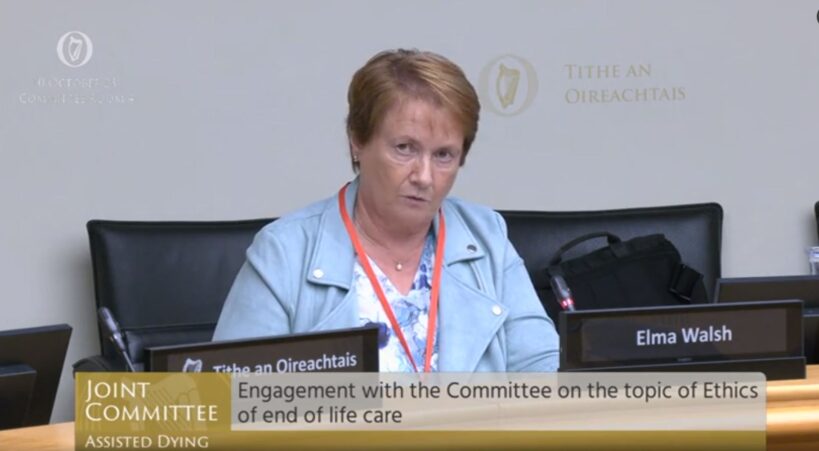
Elma Walsh (pictured), whose son teenage Donal became known in 2013 for his battle with cancer, told the Oireachtas committee of his good experience with palliative care, which allowed him to live the last months of his life as an inspiration for his peers. He visited schools and spoke against suicide, encouraging young people to value life.

Donal died with dignity, the mother said. She cautioned that by removing the present legal ban on euthanasia/assisted suicide the value of life will be significantly reduced.

The other three witnesses support assisted suicide and/or euthanasia to varying degrees.

John Wall, who was diagnosed with a terminal illness, believes that assisted suicide should be available when “it is blindingly obvious that the end is very nigh”.

Tom Curran, whose late partner Marie Fleming lost a Supreme Court case to access assisted suicide in 2013, favours the Swiss model, where a legal drug can be administered by non-medical professionals. He believes that anyone of a sound mind should have that choice, for any reason.

“It is not about aid or about end of life. It is about a choice as to when you feel that your life had ended”, he said.  In the past, he admitted that he had helped Irish people in Switzerland to access assisted suicide.

Garret Ahern, another witness, told the Committee about his late wife Vicky Jannsens who legally took her life in native Belgium, this April after having suffered from breast cancer for ten years. He lamented that it could not have happened here.

Mrs Walsh expressed fear that even a law for limited cases will be extended in the future. “Society must promote hope” she said, “assisted suicide is a statement of no hope. Palliative care allowed Donal to spread a message of hope and reduce the number of suicides. Telling young people that their life is valuable, no matter how uphill it may seem at the time, is important. As Donal said, “Everybody has their own mountain to climb.” Legalising assisted dying is to bring about a clash in society. Life is valuable no matter our age or circumstances. We can all help to fight against suicide by turning our back on assisted suicide.”

Committee hearings continue.

martedì, agosto 15, 2023

Why men and women stay at home to mind their children


26% of mothers and 7% of fathers in the US are stay-at-home parents, according to a new research. Over the past 30 years, the share of fathers who were not working has increased while the share of unemployed mothers has slightly decreased. However, men and women stay at home for different reasons. While one every five mothers said they stay at home because they wanted to take care of their family, only one every sixty fathers claimed to same.

The Pew Research Center conducted an analysis to examine the employment status of parents in the United States and to understand the differences between stay-at-home parents and those who work for pay. The study used data from Current Population Survey (CPS), conducted by the U.S. Census Bureau and the Bureau of Labor Statistics. The CPS is a monthly survey of around 70,000 households and serves as the official source of unemployment statistics.

For this analysis, parents were defined as individuals aged 18 to 69 who lived with at least one of their own children under the age of 18. Stay-at-home parents were those who had not been employed for pay in the year leading up to the survey.

The study found that the proportion of parents in the U.S. who were not employed remained relatively stable over the past five years, with 18% of parents not working for pay in 2021, a figure consistent with 2016. However, there was a significant gender disparity in the prevalence of stay-at-home parents, with 26% of mothers and only 7% of fathers falling into this category.

The analysis revealed somewhat shifting trends over the past three decades. The percentage of mothers not employed decreased slightly from 28% in 1989 to 26% in 2021, while the corresponding figure for fathers increased from 4% to 7%. Consequently, dads now represent 18% of stay-at-home parents, up from 11% in 1989.

The reasons cited for not working differed substantially between stay-at-home mothers and fathers. A significant majority of stay-at-home mothers (79%) reported taking care of home or family as their reason for not working, whereas around one-in-ten cited illness, disability, being students, inability to find work, or retirement. On the other hand, stay-at-home fathers had a more diverse range of reasons, with 23% staying home for family care, 34% due to illness or disability (noticeably down from 56% in 1989), 13% retired, 13% unable to find work, and 8% attending school.

This means that one out of five of all mothers mentioned the care for their family as their reason to stay at home, while only one out 60 of all fathers did the same.

Demographically, stay-at-home fathers differed from those in paid work. They were less likely to have completed a bachelor's degree (22% compared to 42% of working dads) and were more likely to live in poverty (40% compared to 5% of working fathers). Stay-at-home fathers tended to be older, with 46% aged 45 or older compared to 35% of working fathers. Employed fathers are more likely to be married (85%) than those who stay at home (68%).

Dads who mentioned taking care of their family as the main reason to stay at home show distinct difference compared to those who stay for other reasons (illness, disability, unemployment, etc.) They are better educated, tend to be older, and 73% of them are married, whereas 66% of those with varied reasons share the same marital status.

In conclusion, the Pew Research Center's analysis of U.S. Census Bureau data highlighted the changes in the proportion of parents who are not employed, but also underscored the gender differences in stay-at-home parenting.

---


Photo by Kelli McClintock on Unsplash

venerdì, agosto 11, 2023

More Americans are unhappy because fewer are married


Happiness levels are declining in the United States, according to a new study, and one big factor seems to explain this, namely falling marriage rates. Conversely, married people are significantly happier than the unmarried. 

Sam Peltzman, professor of Economics at the University of Chicago, has studied trends and differences in happiness among the US population based on the General Social Survey (GSS) which has been collecting data about US adults since 1972.

Overall happiness levels are markedly down today compared with 50 years ago and the decline has been particularly steep since the early 2000s.

What is more, happiness levels differ by sex. Women were considerably happier than men in the 1970s after which point their happiness went into decline and declined more sharply than among men. The happiness level of both sexes is now about equal, but the question is, why were women happier in the early 1970s than today? Feminism should have had the opposite effect, surely?

According to the study, marriage stands out as the foremost indicator of happiness. The data collected since the 1970s reveal a consistent trend: the married population has been regularly 30 points happier than those who are unmarried. Notably, this pattern holds true for both men and women.

Among the unmarried categories including widowed, divorced, separated, and never married individuals, all of them exhibit significantly lower levels of happiness compared to the married population. Among these groups, separated individuals appear to be the least happy of all.

It is important to note that the study’s findings should not be simplistically interpreted as implying a direct cause-and-effect relationship, such as the notion that marriage inherently leads to happiness. It is plausible that individuals who are already unhappy might encounter challenges in finding a partner or maintaining a harmonious coexistence.

Nonetheless, the author of the research suggests that marriage and happiness share some common sources and the decline of marriage is linked to the trends in people’s contentment more than any other factor.

Marriage rates have fallen sharply in the US. In 1972, there were 10.9 new marriages per 1,000 adults, but this had plunged to just 6.5 in 2018. If marriage increases overall happiness levels (notwithstanding high divorce rates in the US), then it stands to reason that if marriage rates are falling, then so will average happiness.

Prof Peltzman comments: “The happiness landslide comes entirely from the married. Low happiness characterizes all types of non-married. No subsequent population categorization will yield so large a difference in happiness across so many people”.

Other socio-demographic characteristics are also significant but not to the same extent as marital status.

Income emerges as the second most important factor. As expected, the rich are happier than the poor. However, the richest band in US society is not happier than 50 years ago, even though it is wealthier. (This is because affluent people get used to their class status and do not appreciate marginal improvements.)

With regards to age, in the past happiness used to be higher for the over 45 group, with no significant difference between men and women, but this gap is disappearing. White people are happier than black, but the distance between them is narrowing. College graduates and those resident in the Northeast of the US are happier than the rest of the population. Conservatives are 10 point more satisfied than liberals but slightly less than politically moderates.

It is a pity that this study does not consider the role of religion. Other surveys have shown that religious faith and practice are positively associated with life satisfaction.

Prof. Sam Peltzman concludes that “any general analysis of happiness that ignores marital status is unlikely to be satisfactory.” He believes that research has focused too much on socio-demographic characteristics such as age, sex and education but this approach is unlikely to say much about significant trends within a society. Research and policies should concentrate instead on the positive role of marriage for individuals and for society.

venerdì, settembre 03, 2021

Some good news on the pro-life front in the US


Some good news from the US; a new law in Texas bans abortion from six weeks of pregnancy.  This is a so-called ‘heartbeat law’ because it is at six weeks or so that the foetal heart starts developing and beating.

The law, which will still allow terminations in case of medical emergencies, was signed in May and took effect this week after the Supreme Court in Washington rejected an emergency petition from abortion clinics to put the legislation on hold.

Twelve other US states have passed similar legislation protecting life from the initial heartbeat – North Dakota being the first in 2013 – but those laws were struck down by the courts and are not in effect. Texas is the first state successfully implement this measure.

This is significant not only because Texas is the second largest state in America, with a population of more than 29 million, but also because their original and successful legal approach will inspire other states to follow a similar route.

Here is what makes this legislation different from other ‘heart-beat’ laws: it will allow any private citizen, from anywhere in the US, to sue anyone who carries out or helps facilitate abortion in Texas after the six-week limit. The pregnant woman cannot be sued.

This is a novel approach as citizens, rather than state officials, will enforce the ban. In the past, pro-choice groups have stopped foetal heartbeat bills by suing the state but as there is no state official enforcing the Texas law, this time there is no one to sue.

To prevent potential court cases, state officials are barred from enforcing the law. As a consequence of this new approach, many abortion clinics are likely to close, rather than risking being inundated by lawsuits.

The pro-life movement in the US is gaining significant achievements. The pro-choice Guttmacher Institute said that 2021 is “already the worst legislative year ever for US abortion rights”.

Almost one hundred pro-life measures have been enacted since the beginning of the year, although they are often not in effect because of legal challenges. A new South Dakota law, that is in  effect, makes it illegal to terminate the lives of babies with Down Syndrome.  Arizona outlawed abortion of disabled children suffering from a foetal anomaly. This is also in effect.

Four states – Texas being one of them – have adopted bans at six weeks of pregnancy. Only the one in Texas was able to survive a blocking move in the courts. The one in Oklahoma, which is due to take effect in November, has been just challenged by pro-abortion organisations.

This autumn, the Supreme Court will consider a key case involving Mississippi’s 15-week abortion ban. The Court will decide if it is constitutional to ban abortion before viability, when the child can survive outside the womb. The decision could have a profound impact on future pro-life legislation.

The decision by the Supreme Court not to block the Texas law isn’t the end of the matter. The substance of the law is being challenged by pro-choice groups and by President Biden. It will probably make its way back to the Supreme Court eventually and then we will see what happens, but for now, it’s good news, and we will take that. The Irish pro-life movement should take inspiration.

lunedì, novembre 02, 2020

How ‘science’ was used to victimise unmarried mothers


In Ireland in the past, unmarried mothers and their children were harshly treated as a result of a potent brew of Victorian values and a strict application of Catholic morality. But as we will see, in other countries such as Britain and Sweden, the ‘science’ of eugenics was often applied instead, with fearsome results.

This emerges, for instance, when we consider the debate around the Mental Deficiency Act that in 1913 created the legal categories of “feeble-minded person” and “moral imbecile” in the UK. Those categories related more to the ability to behave according to social expectations, particularly with regard to sexuality, than to abnormal psychological traits. This law was not repealed until 1959.

Alfred Frank Tredgold was the most influential ‘mental deficiency’ specialist of the time. A leading member of the Eugenics Society, he wrote the ‘Text-book of Mental Deficiency (Amentia)’, the “generally accepted standard work”, according to the British Medical Journal.

In this book Tredgold presents a number of working-class young women as case studies for the diagnosis of mental deficiency. This diagnosis is clearly related, in most of the case studies, to sex and pregnancy outside marriage.

Under the Mental Deficiency Act, thousands of young women who had children outside marriage were incarcerated or put in institutions because of fears that they would otherwise become pregnant again.

As Carolyn Oldfield explains in her PhD thesis entitled, ‘Growing up Good? Medical, Social Hygiene and Youth Work Perspectives on Young Women, 1918-1939’: “While this incarceration could extend throughout women’s fertile years and after, authorities directed their efforts towards identifying and segregating adolescent and young adult women, in order to prevent what was expected to be a cycle of repeated pregnancies and short-term recourse to the workhouse”.

Josiah Wedgwood, the main opponent of the Act in the British Parliament, maintained that the legislation purposely targeted women who went into workhouses to have children. (The workhouses were often the alternative to mother and baby homes in Britain as well as Ireland).

Outside the Parliament, one of the few opponents was G. K. Chesterton, who also fought eugenics (human selection) throughout his life. He seized on the subjectivity and almost infinite elasticity of terms like ‘defective’ or ‘lunacy’.

He called the Bill “a scheme to impose all the segregation, ‘control,’ and loss of citizenship which are the tragic consequences of lunacy on a very large class of people who are not lunatics.  … the new Bill will enable officials to treat as defective infants a vast and vague multitude of grown-up people who have suffered from any one of a million unnamed accidents of daily life; a number not only indefinite but infinite. They can be seized upon any excuse or none.”

In early twentieth century, proponents of eugenics were particularly focused in identifying the “defectives” as they believed that mental deficiency could be passed from one generation to another, and consequently deteriorate the quality of the overall population.

In the UK, the eugenicists failed to secure the sterilisation of mental defectives – which Winston Churchill had advocated – due to the opposition coming from sectors of the medical profession, the Catholic Church, and the labour movement.

They succeeded instead in the Nordic countries, particularly in Sweden, and in some American states. About 170,000 forced sterilisations were performed between the 1920s and the late 1970s in Scandinavian countries. For this purpose, the Swedish Institute for Racial Biology was set up at Uppsala University in 1922. Together with sterilisation, the Nordic governments enacted marriage limitation, castration and abortion laws.

Cambridge historian Professor Véronique Mottier writes that among the victims of these policies were “socially deviant groups such as unmarried mothers”.

Tellingly, she says that while “feminists were to be found on both sides of the debate – supporting and opposing eugenics – most opposition came from liberals, who rejected state intervention in private life, and Churches, particularly the Catholic Church.”

She points out: “Social democrat reformers were amongst the pioneers of eugenic ‘science’ as well as policy practices in Europe. A number of eugenic policies such as forced sterilisation of ‘degenerates’ were strongly promoted by the Left and were first applied in countries such as Switzerland and Sweden.”

Eugenic policies also included “education programmes, non-voluntary incarceration in psychiatric clinics, removal of children from parental homes, prohibition to marry, as well as measures that specifically targeted vagrants, ‘gypsies’, and, more generally, socially deviant groups such as unmarried mothers, ‘sexual deviants’, or people with physical or mental impairments”, Prof. Mottier says.

In Canada, in 1928 the province of Alberta created a Eugenic Board that approved more than 5,000 procedures of involuntary sterilisations on people classified as “mentally deficient”, mostly women. This happened with the participation of leading scientists of the time.

In the United States, compulsory sterilisation laws were adopted by over 30 states and affected more than 60,000 individuals who were mentally disabled or belonged to socially disadvantaged groups. (See here for a comprehensive account.)

The most famous of them was Carrie Buck, a teenager who became a test case for Virginia’s new eugenics legislation, in 1924. Carrie was raped by a member of her foster family, then declared feebleminded and “probable potential parent of socially inadequate offspring”. The request for her sterilization went up to the Supreme Court of the US. Justice Oliver Holmes famously said that “three generations of imbeciles are enough”, and Buck’s case opened the floodgates of eugenics and led to involuntary sterilization of thousands of people.
 

As mentioned, sterilisation was never legislated for in the UK. Following the Mental Deficiency Act, detention in institutions was the chosen road.

Once a clear association between young women’s sexual activity and their identification as ‘mentally defective’ was established, they would be practically incarcerated without any trial or recourse to the adult penal system.

The marriage of pregnant ‘mentally defective’ girls was also discouraged because it would make them more likely to bring up their children themselves, rather than giving them for adoption. But also because the stability of marriage would encourage them to have more children and, in this way, to pass on them their “defective genes”.

The fact that those practices were common at the time does not justifies them. Nonetheless, the consideration of the broader international context helps us understanding that the institutionalisations of young unmarried mothers took place not only in Ireland and not only where the Catholic Church had influence. 

We imagine that once religion was removed from the picture, unmarried mothers would be treated humanely but when ‘science’ was applied instead, we got eugenics and huge levels of cruelty.