Visualizzazione post con etichetta Pope Francis. Mostra tutti i post

mercoledì, aprile 23, 2025

Pope Francis on the right to life and the family


Often overlooked in coverage of the pontificate of Pope Francis (RIP) were his strong comments on the family, the right to life, the dangers of gender ideology and the emerging demographic crisis. Here we have collated some of his thoughts on these important issues.


The family

The family – as God wants it, composed of a man and a woman for the good of the spouses and also the generation and education of children – is deformed by powerful contrary projects supported by ideological colonisation.

(To members of Equipes Notre Dame, September 2015)

https://www.catholicnewsagency.com/news/32599/marriage-%E2%80%93-between-a-man-and-a-woman-%E2%80%93-is-under-attack-pope-francis-says

The family is the foundation of co-existence and a guarantee against social fragmentation. Children have a right to grow up in a family with a father and a mother capable of creating a suitable environment for the child’s growth and emotional development. This is why, in the Apostolic Exhortation Evangelii Gaudium, I stressed the ‘indispensable’ contribution of marriage to society, a contribution which ‘transcends the feelings and momentary needs of the couple’ (n. 66). And this is why I am grateful to you for the emphasis that your colloquium has placed on the benefits that marriage can provide children, the spouses themselves, and society.

(To attendees of The Complementarity of Man and Woman, November, 2014)

https://www.vatican.va/content/francesco/en/speeches/2014/november/documents/papa-francesco_20141117_congregazione-dottrina-fede.html

Disregard for families has another dramatic effect – particularly present in some parts of the world – namely, a decline in the birth rate.  We are experiencing a true demographic winter!  This is a sign of societies that struggle to face the challenges of the present, and thus become ever more fearful of the future, with the result that they close in on themselves.

(Address to the diplomatic corps, 2018)

https://www.vaticannews.va/en/pope/news/2018-01/pope-francis-to-diplomatic-corps–full-text.html

We must not accept that our society gives up on generating life and degenerates into sadness. When there is no generation of life, sadness steps in, which is an ugly and gray sickness.

https://www.cbsnews.com/news/pope-francis-italy-birth-rate-europe-demographic-winter/


Throwaway culture

We are living in a throwaway culture. What is useless is discarded. Old people are disposable material: they are a nuisance. Not all of them, but in the collective unconscious of the throwaway culture, the old… the most terminally ill, too; the unwanted children, too, and they are sent to the sender before they are born.

(Radio interview, September 2021)

https://www.vaticannews.va/en/pope/news/2021-09/pope-after-operation-it-never-crossed-my-mind-to-resign.html

At the origin of this ‘throwaway culture’ is a gross lack of respect for human dignity, the promotion of ideologies with reductive understandings of the human person, a denial of the universality of fundamental human rights, and a craving for absolute power and control that is widespread in today’s society. Let us name this for what it is: an attack against humanity itself.

https://www.catholicnewsagency.com/news/45974/in-un-message-pope-francis-decries-abortion-and-family-breakdown


Abortion

Abortion is a grave injustice. It can never be a legitimate expression of autonomy and power. If our autonomy requires the death of others, then that autonomy of ours is nothing more than an iron cage. I often ask myself two questions: Is it right to eliminate a human life in order to solve a problem? And is it right to hire a hitman in order to solve a problem?

https://ionainstitute.ie/pope-francis-outspokenness-on-abortion-ignored/

At a distance of seventy years, it is painful to see how many fundamental rights continue to be violated today.  First among all of these is the right of every human person to life, liberty and personal security. It is not only war or violence that infringes these rights.  In our day, there are more subtle means: I think primarily of innocent children discarded even before they are born, unwanted at times simply because they are ill or malformed, or as a result of the selfishness of adults. 

(Address to the diplomatic corps, 2018)

https://www.vaticannews.va/en/pope/news/2018-01/pope-francis-to-diplomatic-corps–full-text.html


Euthanasia

The right to care and treatment for all must always be prioritized, so that the weakest, particularly the elderly and the sick, are never discarded. Indeed, life is a right, not death, which must be welcomed, not administered. And this ethical principle applies to everyone, not just Christians or believers.

https://www.catholicnewsagency.com/news/250333/at-general-audience-pope-francis-says-the-dying-need-palliative-care-not-euthanasia-or-assisted-suicide


Gender ideology

I ask myself if the so-called gender theory is not, at the same time, an expression of frustration and resignation, which seeks to cancel out sexual difference because it no longer knows how to confront it. Yes, we risk taking a step backwards. The removal of difference in fact creates a problem, not a solution.

https://www.vatican.va/content/francesco/en/audiences/2015/documents/papa-francesco_20150415_udienza-generale.html

Today the worst danger is gender ideology, which cancels out differences. I asked for studies to be made on this ugly ideology of our time, which erases differences and makes everything the same; to erase difference is to erase humanity. Man and woman, on the other hand, stand in fruitful ‘tension’.

https://www.vatican.va/content/francesco/en/speeches/2024/march/documents/20240301-convegno-uomo-donna.html

lunedì, marzo 08, 2021

Bringing hope to the persecuted Christians of Iraq


Pope Francis has just returned from an historic visit to Iraq where Christians have been savagely persecuted and driven from their homes. His trip was a very necessary act of solidarity. He will have also seen the work done by organisations like Aid to the Church in Need in helping Christians to rebuild their lives there.

Before the US invasion of 2003 and the fall of Saddam Hussein, there were about 1.4 million Christians in Iraq, corresponding to 6pc of the overall population. This is now estimated to be just 250,000. Among all Christians, Chaldean Catholics are the biggest denomination (67%). They have been there since almost the earliest days of Christianity. They are the descendants of the pre-Arab peoples of the area.

Under Saddam Hussein, a brutal dictator otherwise, Christians were tolerated so long as they didn’t get in his way. One of them, Tariq Aziz, was his deputy and Foreign Minister.

It is almost impossible to list all the attacks that Iraqi Christians have suffered in recent times.

In August 2004, six churches in Baghdad and Mosul were bombed simultaneously by Sunni militants. Thirty more churches were attacked later. Sayidat al-Nejat Syriac Catholic Cathedral in Baghdad, one of the churches bombed, was visited by Pope Francis on the day of his arrival in Iraq.

In 2007, Ragheed Aziz Ganni, a Chaldean Catholic priest who had studied at the Irish seminary in Rome, and three deacons, were killed in Mosul after the celebration of Mass.

In June 2014, Mosul, the second biggest city in Iraq, was taken by ISIS, which also announced a new Caliphate. Christians were forced to convert to Islam or to leave the city.

Mosul had previously been the city in Iraq with the largest number of Christians but currently only 70 Christian families are still there, down from 2,000 pre-ISIS, with the majority too scared to return. When Pope Francis visited the destroyed cityhe was welcomed by the last remaining priest in Mosul, Fr Raid Adel Kallo of the Syriac Catholic Church.

In August 2014, ISIS invaded the Nineveh Plains in northern Iraq and about 120,000 Christians fled to areas controlled by the Kurds. With the end of ISIS in 2017, some have returned to their original cities but, still nowadays, most of the remaining Iraqi Christians are in Kurdish-controlled areas, which are considered safer. An estimated 330,000 went to Syria.

Aid to the Church in Need (ACN) is an organisation that has helped the local populations to go back to their homes. ACN had been working in Iraq since 1972 and between 2011-2020, ACN provided 49.5 million euro in aid to the Church there. 

ACN donated €48.23 million to reestablish the Christian presence in Iraq, helping particularly the three main Christian denominations (Chaldean, Syriac Catholic and Syriac Orthodox) to create the Nineveh Reconstruction Committee with the purpose of assisting them to return to their original communities.

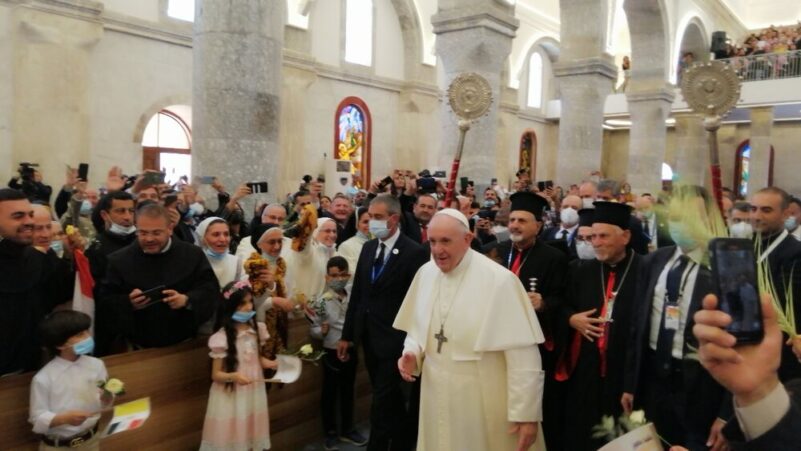
The symbol of this reconstruction is the Syriac Catholic Cathedral of the Immaculate Conception in the city of Qaraqosh, near Mosul, that Pope Francis visited on Sunday. The church had been severely damaged by members of ISIS. When they left in 2016, they burnt all the furniture, plus the ancient prayer books and manuscripts. They blasted the watch tower and damaged the ceiling of the cathedral.

ACN helped with the reconstruction not only of the church but also of the houses of the local Christians, to support them in recreating the local community.

ACN also decided to invest in the future of young Iraqi Christians, pledging 1.5 million euro in a new programme for the Catholic University of Erbil.

Erbil is the capital of the autonomous Kurdish region of Iraq, where much of the remaining Iraqi Christian population now live.

ACN’s new programme is hoped to offer 150 scholarships to the Catholic University of Erbil over the next four years. The Catholic University of Erbil serves the whole community, not only Catholics. 72pc of the students are Christians, of different denominations, but 18pc are Yazidis, a religious minority from the North of Iraq that was particularly targeted by ISIS.

Head of Projects for ACN is Irish-born Regina Lynch who traveled with the Pope. She reported the scenes of celebration: “The joy of the people was catching. Thousands lined the streets to see the pope as he drove past. I saw religious sisters dancing. These were people who had come back after being forced to leave their homes because of ISIS. What the pope saw here were truly the living stones of the Church in Iraq.”

The visit of the Pope in these troubled areas has brought hope to those who are working to re-establish the Christian presence in Iraq after so much suffering.

martedì, settembre 04, 2018

Leo Varadkar must not use science to hide his pro-choice ideology


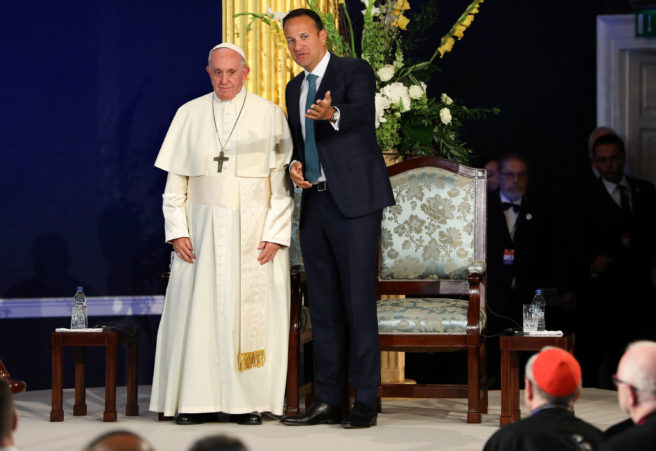
Leo Varadkar believes publicly-funded hospitals should be imbued with “a civic and scientific ethos.” So he said in his Dublin Castle address to Pope Francis. But that term, “scientific ethos”, needs a lot of explaining.
Science deals with physical reality, while ethos deals with the moral character of an institution, its values and goals. One describes how physical things are, the other prescribes the principles that should inspire decisions and actions.
A hospital must be based on the scientific disciplines of physics, chemistry, biology, anatomy, physiology, etc, but science does not tell us what is morally right or wrong. For instance, science tells us how to perform an abortion but does not tell us if and when it is morally just to do so. Science is not immoral but, rather, amoral in the sense that knowledge can be used for right or wrong purposes, depending on the ethical character of the person or of the institution.
Nonetheless, medicine is an inexplicably value-laden endeavour. It is intrinsically ethical because it is based on the assumption, which is not scientific but rather moral, that health is a good thing and has to be preserved. Medicine combines scientific knowledge with ethical purposes.
A hospital where patient-care is not based on science is guilty of quackery. But equally, when a hospital uses medical knowledge and expertise to actively harm patients (for example, through abortion or assisted suicide), it is no longer practicing medicine at all.
Moral neutrality in public policy is often a mask for some hidden ideology. Leo Varadkar is correct in affirming that publicly-funded hospitals should be imbued with a “civic ethos”, in the sense that they are at the service of the common good. But the expression “scientific ethos” is here inappropriate. It appears to be an attempt by the Taoiseach to propose a more ‘rational’ and ‘progressive’ substitute for the older “religious ethos”, but unfortunately it is based on a profound misunderstanding of the relationships between science and ethics.
Scientific knowledge is morally neutral. It must be guided by ethical principles which are external to it and derived instead from philosophies, ideologies, traditions, including religious ones. On the other hand, an ethos is never neutral as, by definition, it endorses specific values, and this is why there is no such a thing as a “scientific ethos” per se.
At the end of the day, our Taoiseach seems to want our hospitals to be governed by an ethos of choice first and foremost, rather than the preservation of life, and he has decided to cloak his favoured ethos in the clothes of ‘science’. This is a misuse of the concept.