Visualizzazione post con etichetta Atheism. Mostra tutti i post

mercoledì, ottobre 16, 2024

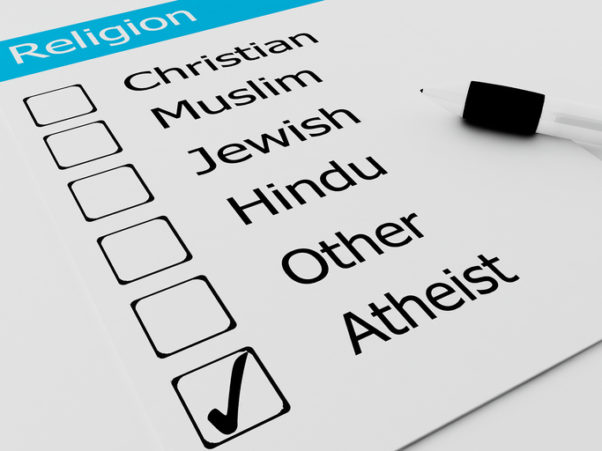
Just how many people are really atheists?


A recent survey has found that, for the first time, atheists in the UK outnumber those who believe in God. Or do they? Because an awful lot depends on exactly what people are asked.

The “Explaining Atheism” project is a global research initiative led by Queen’s University Belfast and recently released interim findings appearing to show that atheism is now more widespread than theism in the UK.

The study surveyed approximately 25,000 individuals across six countries, including Brazil, China, Denmark, Japan, the UK, and the USA. It draws upon data from the British Social Attitudes Survey, the World Values Survey, and an earlier project by the same team, “Understanding Unbelief” (2017-2021).

According to the British Social Attitudes Survey (BSAS), belief in God in the UK dropped from 41.8 pc in 2008 to 37.4 pc in 2018. During the same period, the percentage of people who say they do not believe in God rose from 35.2 pc to 43pc.

However, a survey conducted by the International Social Survey Programme (ISSP) put the number of atheists in Britain at 26pc, not 43pc.

Why the difference? It seems to come down to how the question is asked. The BSAS asked people point-blank whether they believed in God or not. But the ISSP asked a wider range of questions from emphatic atheism to emphatic theism and everything in between.

A similar phenomenon was observed in Ireland, where the wording of the Census 2022 question “What is your religion?” was modified to “What is your religion, if any?” The first response option was “no religion”, whereas this had been the last option in the 2016 Census. This change led to a big increase in “no religion” responses. No surprise there.

Prof. Stephen Bullivant, a sociologist of religion at St Mary’s University in London, noted that in some countries, the term ‘atheist’ carries a degree of stigma, and people may avoid identifying as such, even if they do not believe in God or practice any religion. Conversely, in other cultures, atheism or secularity has become the norm, leading respondents to self-identify as atheists, even if they still hold some belief in God.

Interestingly, the “Explaining Atheism” study also found that “non-belief in God does not necessarily rule out belief in other supernatural phenomena, as most atheists and agnostics express some type of supernatural belief.”

By the way, the findings indicate that belief, or non-belief, in God is predominantly influenced by socialisation, rather than by factors such as education, fear of death, or a need for structure. Parental upbringing and societal expectations about religion were identified as the most significant factors. For instance, those not exposed to religious practise by their parents during childhood were more likely to identify as atheists.

In other words, we are very conventional. If the broad social convention is religious, then we are more likely to be religious, and if the convention is broadly secular, we are more likely to be secular, or even atheistic. We don’t seem to think as much about our beliefs as we might like to imagine.

lunedì, maggio 11, 2020

Religious practice reduces ‘deaths from despair’

A new study from Harvard University has found that the frequent attendance of religious services dramatically reduces so-called ‘deaths from despair’, such as suicide, and drug or alcohol abuse. This finding seems more relevant than ever given the current pandemic that has resulted in untold job losses and a very uncertain future for many people. Economic slumps are always associated with a rise in ‘deaths from despair’, so if religion acts as a protective against this, then we need to pay attention.

The study followed a large cohort of more than 100,000 health care professionals in the US, over a long period of time (1999 -2016). 

The investigators started with the hypothesis that a weakening in traditional social support systems such as marriage and the family, leads to an increasing sense of hopelessness in many, leading in turn to a rise in “deaths of despair”.

One of the leading examples of such a weakened support system is the decline in religious participation, and therefore the investigators wanted to establish the link between despair and the declining attendance of religious services.

They found that nurses and physicians who attend a religious service at least weekly are less likely to die as a result of suicide or drug or alcohol abuse than their peers who do not attend.

The incidence of ‘deaths from despair’ among health professionals is more than double that of the general population, as a result of stress and trauma, but among those who attend a religious service at least once a week it drops by 68pc among women, and 33pc among men.

As the educational attainment of health professionals is higher than the average, despair in them is associated more with factors such as loss in meaning in life, rather than material deprivation.

Religion often fosters a sense of peace and positive outlook to life, it promotes social connectedness and encourages engagement in prosocial activities, such volunteering. “In the context of trauma, such resources may provide healthy stress-coping strategies and revive a sense of meaning in difficult times and thereby counteract various processes associated with despair.”, the study claims.

This is something to be pondered, particularly in the current difficult times when the general populations is experiencing unusual stress and trauma.

Even if churches are closed for public worship, people are still praying. A poll commissioned by the Iona Institute found that in Ireland 18pc said that they are praying more than they usually would.

Another new poll commissioned by Tearfund, a Christian relief and development agency and a member of the Disasters’ Emergency Committee, found that in the UK one in twenty (5pc) adults say they have started praying during the lockdown but they didn’t pray before.

Eighteen percent of UK adults have asked someone else to say a prayer for them and 19% say they have read a religious text during lockdown. Prayer is a vital part of life for the public, and among those who pray a third say that they have prayed since the COVID-19 lockdown because they believe it makes a difference.

There is a solid body of evidence highlighting the benefit of religion for mental health and the new Harvard study confirms that.

Professor Patricia Casey produced for the Iona Institute a paper called “The Psycho-Social Benefits of Religious Practice”, showing how a large number of scientific papers have established that religious practice reduces the risk of depression, suicide, marital breakdown, alcohol and drug abuse, pregnancy among teenagers. It also helps cope with bereavement effects.

Worship is, for those who believe, a source of consolation and hope, strength and motivation. A church is also a place where they can experience the support of a community and are encouraged to engage in activities that are useful to themselves and to others.

This new Harvard study shows that believers often respond better to the struggles of life, and it brings further evidence to fact that both their religious beliefs and the enhanced social connection that worshiping involves, are good for our health. This is something that secularists often forget.

venerdì, dicembre 13, 2019

Dominion: how Christianity has shaped even its critics for the better


In his new work “Dominion; The Making of the Western Mind“, historian Tom Holland highlights the gigantic and often unacknowledged role Christianity has played in shaping Western civilisation. That includes shaping the thinking of some of Christianity’s greatest critics. Often, when they attack Christianity, they are drawing on Christian values without even knowing it.
Holland, who might be described as a sympathetic non-believer, shows how core western values such as the belief that we are all of infinite and equal moral worth derive from the Judeo-Christian tradition.  The book presents how secular principles such as equality, freedom, justice, etc. come from a long history in which religion has played a decisive role.
Philosopher and atheist, John Gray, in his view of Dominion for The New Statesman says: “As Holland shows, the triumph of Christianity was a rupture in Western civilisation. There is nothing at all self-evident about the equal intrinsic worth of all human beings or the inherent preciousness of individual persons. These values – which secular thinkers nowadays take for granted – were placed at the heart of the Western world by Christianity…In the final analysis, liberal humanism is a footnote to the Bible.” (More here).
In a review for the religious publication, Position Papers, James Bradshaw says :”There is much to admire in this book, not least the fact that an irreligious historian has taken such time to examine Christianity’s positive role in creating a kinder, gentler and more loving world than could otherwise have existed.”
He quotes Holland: “The more years, I spent immersed in the study of classical antiquity, the more alien I increasingly found it. It was not just the extremes of callousness that unsettled me, but the complete lack of any sense that the poor or the weak might have the slightest intrinsic value.”
Bradshaw writes: “The examples of the abuse of the weak and powerless are widely-known among anyone familiar with Greco-Roman history: public execution of slaves, gladiatorial combat for the amusement of spectators, the widespread abandonment of baby girls in refuse dumps, and so on. Not all of this was stamped out by Christianity immediately (the continuation of slavery being an obvious and sad example), but over time, the moral principles of Christianity became so deeply embedded within European societies that the greatest abuses of ancient Rome and Greece became unthinkable.
“Without the conversion of Europe, this could not have happened. As Holland explains, there was nothing in Greco-Roman polytheism which would give pause to a Roman nobleman considering raping his slave girl, or to a general about to order his legionaries to annihilate a defeated tribe.” 
Holland, like Professor Larry Siedentop (another sympathetic non-believer) in his magisterial ‘Inventing the Individual’, is big enough to see that Christian moral beliefs are coded into the West’s DNA, as it were, and if we excise them, the cost might be very great indeed. If we cease believing that we are all morally equal because we are made in the image and likeness of God, then what will we base the notion of moral equality on? Nature certainly won’t supply it.

giovedì, giugno 20, 2019

The beliefs of the unbelievers


What are the beliefs of those who do not believe in God? A new survey presents some counterintuitive and contradictory findings, such as the belief in supernatural phenomena.

An ongoing research project called “Understanding Unbelief” aims at mapping the nature and diversity of non-believers (both atheists and agnostics) across different national settings. It involves participants from six countries and three continents (Brazil, United States, Denmark, United Kingdom, China and Japan). 

The survey comprises about 1,100 representatives per country and its interim findings were presented in Rome recently.
Those who do not believe in God, both because they think he does not exist or because it is not possible to know anything about it, were asked if they considered themselves to belong to a particular religion. Many of them answered positively. For instance, 28% of unbelievers from Denmark labelled themselves as Christians. What they probably mean here is that they come from a Christian background and this heritage is still somehow significant for them. 

A majority of atheists and agnostics from Western countries were brought up in a Christian tradition while nonreligious upbringing prevails among Chinese (82%) and Japanese (70%) unbelievers, according to the study.
Belonging without believing may appear a contradiction if we consider religion only in terms of convictions but being part of a tradition persists even when those convictions are lost.

Participants were asked then how they would identify themselves. ‘Non-religious’ was the most popular designation in every country except China, where instead ‘atheist’ is preferred.
With regard to supernatural phenomena such as reincarnation, astrology, karma, it would be expected that atheists and agnostics do not agree with their existence. Instead, the opposite is the case. Even if to a lower degree, when compared with the rest of the population, a substantial percentage of unbelievers accept supernatural phenomena. More than half of Chinese agnostics believe in astrology, for instance. They are strikingly more like to accept supernatural phenomena than those from other countries and this is a peculiarity shared with the rest of the population.
Moreover, “the belief that there are ‘underlying forces’ of good and evil, that ‘there exist a universal spirit or life force,’ and that ‘most significant life events are meant to be and happen for a reason’ are the most endorsed among unbelievers globally”. (p. 14)

Among atheists, Brazilian and Chinese are the most ‘supernaturally inclined’ while the Japanese are the least. Absolute naturalists, who would deny any existence of supernatural beings or phenomena, are a minority among non-believers in every country surveyed.
These findings prove that a sense for the supernatural, which is part of being human, remains in non-believers and it is channeled into different directions, according to their background culture. For instance, where a certain credence is accepted by the general population, such as the existence of forces of good and evil which prevails among Brazilians, it appears to be similarly prevalent among the atheists or the agnostics of that country.

Does the universe possess any meaning or purpose for those who do not believe in God? Yes, according to the study. “With the exception of Brazil, where 47% endorse such a view, only around a third of unbelievers in each country regard the universe to be ultimately meaningless. While unbelievers are admittedly more likely to take this view than the population at large, curiously this is not so in Japan.” (p. 16)

This Japanese exception is something worth exploring. The interim results offer no explanation yet as they are based simply on statistical surveys while the second part of the research will focus on in-depth, face-to face interviews and might help with the interpretation of data.

Participants were asked to find the most important items, from a list of 43 words, to them for finding meaning in the world and in their own life. There was no substantial difference between unbelievers and general populations concerning the answer, ‘family’ and then ‘freedom’ ranking highly for all, according to the study.

The research also found no consistent difference between unbelievers and the general population with regard to the objectivity of moral norms or of human rights.  While unbelievers are more likely to endorse the claim that ‘what is right and wrong is up to each person to decide’ in China and the United States, members of the general population are more likely to endorse it in Brazil, Denmark, Japan, and the United Kingdom.

It appears that cultural differences rather than religious faith, or lack of it, explain cross-national variations better. The study shows that being an unbeliever is complex and does not exclude many counterintuitive and often contradictory beliefs.