Visualizzazione post con etichetta Northern Ireland. Mostra tutti i post

venerdì, novembre 28, 2025

A far-reaching ruling on religious education in State schools in Northern Ireland


The UK Supreme Court has delivered an important judgment on religious education in a Northern Ireland primary school, ruling that the current way religion is taught amounts to ‘indoctrination’, and that the right to withdraw a child from religious education class should not be unduly burdensome on the child. The ruling does allow that religious education class can give a special place to Christianity in view of Northern Ireland’s history, but that religion must be taught in an “objective, critical and pluralistic” manner. This will be tricky to pull off, because done the wrong way, you can easily end up relativising religion, and that would not be “objective, critical and pluralistic” at all. There is really no neutral way to teach religion.

The case in question involved a young girl from Belfast and her father. Both argued that their school’s Christian-centred religious education and daily worship practices failed to respect their non-religious beliefs, breaching their rights under the European Convention on Human Rights. These include the right to education that respects a family’s convictions, and the right to freedom of religion or belief.

The school followed Northern Ireland’s “core syllabus”, a statutory curriculum that focuses heavily on Christianity for obvious historical reasons. The RE course was devised by the four main Churches in the North. The parents did not object to learning about religion, but said the teaching was not ‘objective’ or ‘pluralistic’ enough for a publicly funded school.

A key point in this case was the statutory “right to withdraw”. In both Northern Ireland and the Republic of Ireland, parents can request that their child be exempted from religious education or worship. But the parents said this right was unworkable in practice. Their daughter would have been the only child to leave the classroom, creating a risk of embarrassment or social isolation. No meaningful alternatives existed, the court said, and the burden fell on the parents to negotiate arrangements with the school. The courts accepted that this made the right more theoretical than real. (Interestingly, no-one ever seems to worry about the embarrassment a child might feel when they are withdrawn from sex education class).

The Supreme Court ultimately found that the school’s approach breached the family’s human rights. It agreed that the teaching was not “objective, critical and pluralistic”, and that the right of withdrawal, although formally available, was practically ineffective. As mentioned, is such a way to teaching religion achievable in practice, or do you automatically end up relativising all religions?

However, the Court was careful not to condemn the entire Northern Irish system. It did not declare that all schools are discriminatory. Instead, it confirmed that in this specific school, for this particular family, the arrangements did not comply with human-rights standards. The warning is gentle but unmistakeable: publicly funded religious education must be educational, not devotional, and withdrawal must be easy and non-stigmatising. 

Could this case have been avoided simply by accommodating the family’s right to withdraw? In a narrow sense, yes. If the school had offered a respectful, practical alternative that did not single the child out, the court might well have found no breach. But the ruling also highlights a deeper point: withdrawal alone cannot fix a curriculum that lacks pluralism. Religious education itself must be delivered in a way that respects diverse beliefs, regardless of who opts out.

Although the Supreme Court issued a strong judgment, the reliefs granted remain purely declaratory. This means the Court formally stated that the family’s rights were breached, but it did not strike down any legislation or require the government to change its policies. The responsibility for reform now lies with the Department of Education and school authorities.

In the North, 48,896 Protestant children and only 6,281 Catholics attend these State-funded, State-run schools. Another 25,453 are from other religions (including non-denominational Christianity) or have no religion.

The North’s Education Minister, Paul Givan, has promised to ensure that a Christian ethos in the region’s public schools is maintained. We will see what happens.

The ruling may also resonate south of the border. Irish courts are not bound by UK decisions, but they often regard them as persuasive, especially on shared human-rights principles. As both societies become more religiously diverse, the case is likely to fuel wider conversations about how faith is taught in publicly funded schools.

mercoledì, marzo 26, 2025

Northern Ireland also headed for a demographic cliff-edge


Just like in the South, the population of Northern Ireland is ageing rapidly. A recent report from the Northern Ireland Statistics and Research Agency (NISRA) projects that by mid-century there will be one pensioner for every 2.5 people in the workforce compared with one for almost four people of working age now.

NISRA expects the population to peak at around 1.95 million by mid-2033 before going into a very gradual decline. The only thing preventing a steeper decline will be immigration, but net immigration into the North is expected to be small.

However, it is the changing balance between generations, rather than the total population size, that raises the greatest concerns.

A notable milestone is expected by mid-2027 when the number of people aged 65 and over is projected to exceed the number of children aged 0–14. This marks a clear sign of the rapid ageing of Northern Ireland’s population. The number of people aged 85 and over is forecast to more than double over the next 25 years.

While the number of people in the older age groups is relatively easier to predict because anyone who will be aged over 65 by mid-century is already born, future fertility rates, and therefore the number of children being born, are more uncertain.

NISRA presents a range of possible scenarios based on various assumptions, though long-term projections are inherently difficult. The figures in its summary report are based on the assumption that the total fertility rate (TFR), which is now 1.65 in Northern Ireland, will remain constant over the next 50 years. This is already considerably below replacement level fertility which is two children per couple.

However, the figure of 1.65 might be optimistic because fertility rates have been falling faster than predicted almost everywhere. In the Republic of Ireland, for example, the TFR has already dropped to 1.50 and is predicted to fall further. A continued decline in fertility would further accelerate the ageing trend and deepen its impact.

Under a lower-fertility variant, which is more realistic, the ratio of pensioners to those of working-age could easily worsen even more, creating even bigger challenges for public services and economic sustainability. Between 2022 and 2047 (25 years), the number of children aged under 15 is projected to fall by 23pc while the number aged over 65 is projected to rise by 36pc. This is not a healthy situation.

Both in the North and the South we are basically sleepwalking towards a very bad and unprecedented demographic scenario.

venerdì, febbraio 21, 2025

Number of abortions in Northern Ireland continues to surge


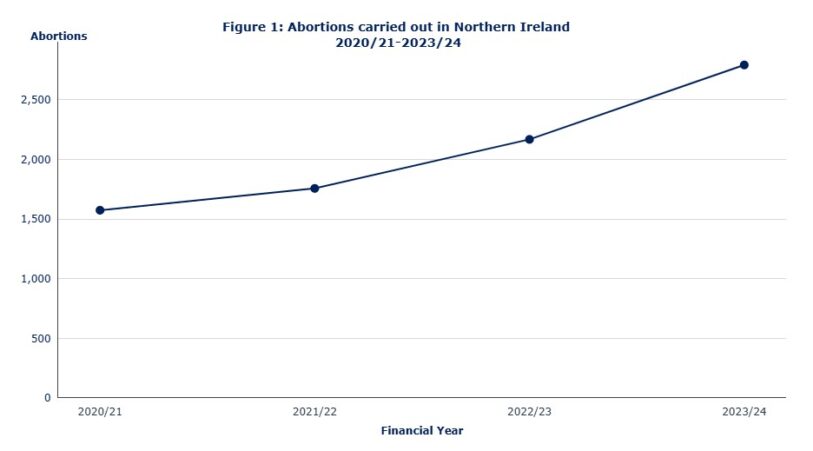
The number of abortions being carried out in Northern Ireland has increased by a massive 29pc in a single year, according to official statistics published by the Department of Health. The figure of 2,792  is three times the number of Northern Ireland women who went to England for abortions before the law in the North was liberalised in 2019. This mirrors what is happening in the South where 10,000 abortions were carried out in 2023.

The new figures indicate that the number of abortions in Northern Ireland rose from 2,168 in the financial year 2022/23 to 2,792 in 2023/24. Notably, 97pc of these procedures were carried out under Ground A, which permits abortion for any reason before 12 weeks of gestation.

In Northern Ireland, abortion was decriminalised in October 2019. Before this, it was only permitted in limited circumstances, such as when it was necessary to save the life of the mother or prevent permanent and severe harm. As a result, the number of abortions performed in Northern Ireland was extremely low. Only 22 cases were recorded in 2019.

In the same year, 1,014 women from Northern Ireland travelled to England for abortion procedures, which were funded by the UK government. In cases of financial hardship, travel costs were also covered.

With the introduction of new liberal regulations in March 2020, abortions in Northern Ireland expanded significantly, resulting in over 10,000 terminations in total since the legal change.

Compared to the first year of the new regulatory regime, there has been a 77pc increase of abortions taking place in Northern Ireland hospitals, the recent statistics show. However, once we include also abortions carried out abroad, the overall picture is even more shocking.

To the recently released figures, which are underestimated according to the report, one must add the number of Northern Ireland residents who had abortion in England – 172 according to the latest statistics referring to 2022 – and also those carried out in the Republic (9 in 2023).

This brings the total number of abortions involving Northern Ireland residents to approximately 3,000 per year—three times higher than the 1,014 terminations recorded in England in 2019, the final year before the introduction of the new regulations.

Unlike reports on abortion services in England and Wales, the Northern Ireland Department of Health does not provide details about marital status, previous abortions, or other demographic information. This is because such details are only recorded in a notification form if voluntarily disclosed by the woman.

However, the most recent data from Northern Ireland residents who had abortions in England reveal that only 12pc were married and 14pc had one or more previous abortions.

The recent statistics form the Department of Health confirm that restrictive legislation keeps abortion figures down. A threefold increase in only five years should prompt politicians to reconsider the current legislation.

martedì, marzo 14, 2023

The West is sinking deeper into moral individualism


A new worldwide poll survey shows how much social attitudes across a whole range of issues differ by country. It also demonstrates, unsurprisingly, that Western countries are moving in a more liberal direction all the time, although a sizable enough minority of people with more traditionalist views remains in most of those countries.

Starting with the issue of abortion, we see that the most liberal society in the world is Sweden, where 74pc of people thinking abortion is always, or nearly always justified, which is incredible when you think about it. It means, de facto, that for three-quarters of Swedes the embryo is of basically no moral status whatever.

At the other end of the scale are countries like Egypt, Nigeria, China and South Korea where only 1pc to 3pc of people think abortion is always, or almost always justified. The Chinese and South Korean results are a bit surprising, because abortion is widespread in both of those countries. On the other hand, they must think that abortion is only justifiable in certain circumstances.

In Britain, which is now one of the most socially liberal countries on the planet, 47pc said abortion is always, or nearly always justifiable. This is up from 14pc forty years ago.

We see the same movement in Britain and other Western countries on issues like divorce, homosexuality, euthanasia and casual sex.

Swedes are also ultra-liberal on divorce. Seventy-nine percent say it is always, or nearly always justified. In Britain, the figure is 63pc, in Italy it is 40pc, whereas in South Korea it is just 11pc.

Do Swedes really mean what they say? Because if they do, it means that when someone divorces them, it is almost always justified, in their opinion. It’s doubtful that is truly what they think.

There are significant regional differences within the UK. For example, only 25pc of respondents in Northern Ireland think that abortion is always or nearly always justifiable, while the percentage is almost double that in Scotland (49pc) and England (48pc).

France has the highest percentage of respondents (19pc) who believe that suicide is justifiable, followed by the United Kingdom and Germany, both at 18pc.

With regards to the moral permissibility of casual sex, the most liberal countries in the world are Australia (48pc), Spain (46pc), Canada (45pc) and the UK (41pc).

The World Values Survey registered significant differences not only between different countries but also between religious and non-religious respondents in the same country.

The percentage of British people who find casual sex acceptable is 53pc among the non-religious and 27pc among the religious. Thirty-five percent of religious people would accept euthanasia, compared to 56pc of non-religious, while the survey found no difference with regard to the death penalty.

The non-religious are also more likely to find it justifiable to avoid paying a fare on public transport, and cheating on taxes.

Overall, the survey confirms that Western societies place huge store by personal autonomy, and this is getting more pronounced over time. Westerners want huge free to divorce when they please, have abortions when they please, and increasingly to resort to euthanasia when they please. The harmful effects to children (born or unborn), the elderly and infirm, to other adults, and ultimately to themselves, are barely considered.

lunedì, luglio 12, 2021

Northern Ireland sees a big jump in the number of abortions


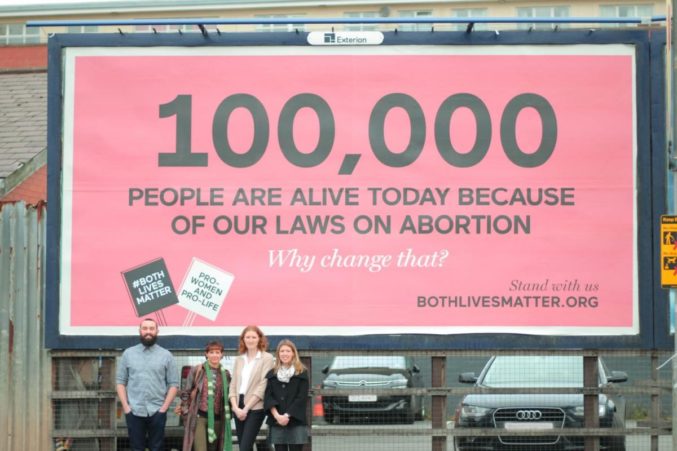
“100,000 people are alive today because of our laws on abortion, why change that?”, said a Northern Ireland-based billboard campaign in 2017. The Advertising Standard Authority found the claim was largely accurate. Now we can see how accurate the ad was, because a radical liberalisation of the North’s abortion law in March of last year has led to a big increase in the number of terminations there.

The previous, largely pro-life law was overturned by Westminster. From March 2020 until the beginning of June, the Department of Health received 1,624 notifications of abortions. This is a huge increase.

The abortion landscape in the North has changed tremendously over the last few years.

In 2016, 724 women from Northern Ireland had an abortion in England. But in June 2017, the British Government announced that it would fund abortions for women ordinarily resident in Northern Ireland and there has been a significant growth since the funding announcement: there were 919 cases in 2017 and 1,053 in 2018.

In 2019, for the first time abortion was offered in the Republic and 67 women from Northern Ireland availed of it while 1,014 went to England. The total for 2019 was 1,081.

As the North’s mainly pro-life law was then suppressed, the numbers took a massive jump.

The latest figures (1,624) from the Department of Health refer to the March 2020 – May 2021 period. If we take into consideration that it covers 14 months, it is the equivalent of 116 average per month or 1,392 per year. A clear surge when compared to the past. This figure refers only to women who has abortions in the North. You need to add in those who went either to England or to the South for terminations.

Last year, 371 went to England and 36 to the Republic. This comes to 407. Adding that to 1,392 or so who had abortions in the North in the first 12 months of the operation of the new law, we arrive at a total of about 1,800. This represents a 66.5% increase in one year. This is the dramatic effect of the liberalisation.

In 2016, abortions amounts to 3pc of live births in Northern Ireland. In 2020, the figure was 8.6pc. There were more abortions and fewer births.

Even if we take into consideration that a number of abortions were not recorded, as they involved the use of illegal pills, it is implausible to deny that with liberalisation the rates went up.

We don’t have demographic details from the Department of Health of Northern Ireland, but the England and Wales report tells us that 89% of women who travelled there were single (50.8% single with partner). 15.1% of them had an abortion before, and 54.4% had given birth before.  40.3% identified as White British and 45.3% as White Irish. The official report of the Republic has no demographic details.

That billboard campaign was right. Thousands of lives were saved before Westminster imposed an extremely liberal abortion last year and, if the trend continues, many thousands more will die.

The 8th amendment also saved many lives.

giovedì, aprile 08, 2021

Londra impone l’aborto a Stormont Il governo Conservatore viola accordi e devolution per instaurare un nuovo regime abortista


Il governo Conservatore viola accordi e devolution per instaurare un nuovo regime abortista

Il governo Conservatore britannico ha imposto l’aborto nell’Irlanda del Nord, sorpassando sia l’assemblea legislativa sia l’esecutivo locali. Lo ha fatto concedendo il potere al ministro per l’Irlanda del Nord, Brandon Lewis, di imporre alle autorità sanitarie nordirlandesi un regime abortivo estremamente permissivo.

Nel 2016 una chiara maggioranza nell’Assemblea dell’Irlanda del Nord aveva confermato la legge allora esistente, che consentiva l’aborto solo nel caso di pericolo per la salute fisica o mentale della madre. Poi, nel 2019, la Camera dei Comuni del parlamento britannico ha introdotto un nuovo regime che liberalizza l’aborto. Questa imposizione da parte di Londra venne giustificata con il fatto che in Irlanda del Nord in quel periodo non vi era esecutivo in funzione. Infatti uno stallo nelle negoziazioni fra i diversi partiti ha rinviato la formazione del governo locale fino a gennaio 2020.

Il nuovo regime imposto da Londra è entrato in vigore nel marzo 2020, ma senza il supporto del governo locale e dell’Assemblea di Stormont. Ora il governo di Londra, tramite il ministro per l’Irlanda del Nord, costringe di fatto il Servizio sanitario locale a seguire la legislazione imposta da Londra, anche se questa, secondo gli accordi di pace, è materia di competenza locale.

Con il nuovo regime l’aborto è consentito fino alla nascita per ogni genere di disabilità e fino a 24 settimane se la gravidanza comporta più rischi dell’aborto per la salute fisica e mentale della madre. In pratica si tratta di aborto a richiesta fino alla ventiquattresima settimana. L’aborto viene inoltre depenalizzato completamente, a differenza del resto del Regno Unito e della Repubblica d’Irlanda dove rimane un reato se effettuato al di fuori dei limiti di legge.

Alban Maginness, stimato politico locale ed ex sindaco di Belfast, ha commentato: «In questo modo Lewis dà priorità all’aborto rispetto ad altri servizi sanitari, come la cura del cancro, che in questo momento sono rinviati a causa della pandemia. Inoltre si fa beffa degli accordi sul decentramento. […] L’aborto è una questione divisiva, controversa, che richiede l’accordo del nostro esecutivo decentrato. E, come in altri casi, su una questione così delicata l’esecutivo non ha ancora raggiunto il consenso»

Contro la decisione del governo britannico si sono schierate tutte le Chiese. La Chiesa presbiteriana ha espresso «grave preoccupazione», definendo la scelta un indebolimento del processo di devolution e un’interferenza diretta del centro sul governo locale. I presbiteriani hanno persino chiesto che vengano ritirati i nuovi poteri al ministro Lewis.

Per la Chiesa metodista, la scelta usurpa il ruolo dell’esecutivo nordirlandese e il vescovo anglicano di Armagh, John McDowell, ha affermato che la proposta rivela mancanza di democrazia.

Dal canto proprio i vescovi cattolici giudicano la decisione del governo di Londra di sorpassare strutture decentralizzate che sono il frutto di accordi internazionali di pace come un’imposizione invisa alla popolazione, che mina smaccatamente il diritto alla vita dei bambini non ancora nati.

Ma non ci sono solo notizie cattive. L’Assemblea di Stormont ha infatti quasi contemporaneamente votato favorevolmente per la proibizione dell’aborto in caso di disabilità non letali e ora la proposta è passata al vaglio della Commissione competente. Sostenuta da diversi partiti, la proposta di legge ha buone possibilità di essere approvata. Pur dichiarandosi contrario, il Sinn Fein, il maggior partito repubblicano, si è astenuto al momento del voto. Ovvia e giustificata l’esultanza del mondo pro life. Certo, se la legge passasse sarebbe una piccola vittoria nella battaglia più ampia per contrastare l’imposizione del nuovo regime abortista, ma nessuno si sogna di denigrarla.

giovedì, marzo 25, 2021

Axe is set to fall on the right to life in Northern Ireland


The UK Government is moving to impose abortion in Northern Ireland, bypassing the local Assembly and Executive. In the meanwhile, a Bill to ban abortion in cases of non-fatal disability is progressing in Stormont.

The UK Conservative Government has recently introduced regulations to Parliament to give Northern Ireland Secretary, Brandon Lewis, power to force the local Northern Ireland authorities to set up an extremely permissive abortion regime.

In 2016, a clear majority of the Northern Ireland Assembly upheld the law on abortion. In July 2019, the House of Commons voted to introduce abortion in Northern Ireland. The justification for this imposition was the absence of a functioning Executive in Northern Ireland and these new regulations theoretically came into force in March 2020, although not in practice because of local opposition.

Under the new regime now about to be imposed, abortions are available up to the point of birth for all disabilities, and practically on demand up to 24 weeks, if the pregnancy would involve greater risk than abortion for the physical and mental health of the mother. Abortion will also be completely decriminalised, unlike in the rest of the UK, or in the South.

The UK Government has now given Northern Ireland Secretary, Brandon Lewis power to compel the North’s Health Service to rollout the regime over the heads of the Executive or of the Assembly.

Alban Maginness, a former senior SDLP member of the Local Assembly, commented: ”By doing so, Lewis is prioritising the provision of abortion above other health services, such as outstanding cancer treatments, postponed because of the need to deal with the pandemic. Worse still he is making a mockery of the devolution settlement. … the provision of abortion is a cross-cutting, controversial issue that requires the agreement of our devolved Executive. As on other issues, the Executive has not reached agreement on this contentious matter.”

All the major Christian churches have also voiced their opposition to the Government’s decision.

In a statement on Friday last week, The Presbyterian Church in Ireland expressed ‘grave concern’, said the move would represent a serious undermining of devolved rule and called for the powers to be withdrawn.

“The regulations laid before Parliament today drive a coach and horses through Northern Ireland’s hard won and finely balanced devolved constitutional settlement. These powers not only devalue Northern Ireland’s purposely unique system of negotiated government, they also give the Secretary of State the freedom to interfere directly, and at will, with every single department of devolved government”, said the Moderator of the Presbyterian Church in Ireland, Dr David Bruce.

The Methodist Church in Ireland voiced its concern, saying the move would ‘usurp’ the role of the Northern Ireland Executive.

The Church of Ireland Archbishop of Armagh, The Most Revd John McDowell, said the proposal would heighten the sense of a democratic deficit.

The Northern Catholic Bishops said the move is an effort to bypass internationally agreed devolved structures, to foist a law on an unwilling populace, that blatantly undermines the right to life of unborn children.

Meanwhile, a Bill to prohibit abortion in cases of non-fatal disability passed a vote of the Assembly last week and it has now gone to the Health committee for further discussion.

This progress has been welcomed by pro-life groups.

Tracey Harkin of our sister organisation in the North said the current controversy has been a wake-up call about the radical nature of the abortion measures.

Commenting on the move to ban abortion in cases of disability, she said: “It’s good that it received majority support because it’s not the type of culture the people want in Northern Ireland.”

Ms Harkin is hopeful that the move will be the first step on the road to removing the abortion law in its entirety.

“We would like obviously to extend protection to as many people as possible,” she said. “We think it’s important to support any row-back on abortion legislation, but you have to bring people along with you and make our politicians realise how important this issue is.”

Among political parties, the strongest support for the Severe Fetal Impairment Bill came from the DUP.

DUP MLA Paul Givan said he wants to change the abortion regulations to show people with disabilities are “equally valued”.

Sinead Bradley of the SDLP supported the proposal and said the issue is one of discrimination against those with disabilities.

Sinn Fein opposed the Severe Fetal Impairment Bill, but abstained from voting on it.

martedì, giugno 09, 2020

More light thrown on religious practice in a lockdown

Prayer and online religious practice have increased in the island of Ireland during the Covid-19 pandemic, according to a new report.

“Many faith leaders described an increase in religious practice, linked to moving online. They observed surprising numbers of people tuning in for worship services and other events, noting that people who would not have entered their church building were accessing online services. Some from evangelical traditions wrote of people being ‘saved’ or converting to Christianity during the pandemic.”, said the principal investigator of the survey, Dr Gladys Glaniel from Queen’s University Belfast, in the report.

The survey was carried out between May 6th and 22nd. Faith leaders sent 439 usable responses, from every county on the island. Thirty-five pc of respondents were Catholic (23pc diocesan priests or deacons and 12 pc religious), 18 pc Church of Ireland, 14 pc Presbyterian, 9 pc Methodist, 23 pc ‘Other’ Christian, and 1 pc from ‘Other’ religions.

55 pc of the responses came from the Republic of Ireland while 45 pc were from Northern Ireland. (This means that a greater proportional response came from Northern Ireland and from non-Catholics).

Many faith leaders were surprised by the number of people tuning in for worship services and other events.

“As a scattered, small church it is a pleasure how many people are glad about our online services: we reach significantly more people than before. It is obvious that physical meetings and services are more appreciated, but the new online paths will remain in addition to the physical ones. Another aspect is the increased sense of being responsible for each other.” Wrote a Lutheran representative from the Republic of Ireland.

Before the restrictions, 44pc of respondents did not provide online services or resources, 24pc offered livestreaming and 20pc recorded sermons or services. Protestant churches were much less likely to have online worship opportunities, while Catholics offered mostly Mass livestreaming.

All this changed dramatically in March and now only 13pc of faith communities do not offer online worship, according to the respondents.

Catholics are more likely to provide opportunities once a day or several times per day, while Protestants are more likely to provide once a week or several times per week. This reflects the different kind of worship (daily Mass and rosaries vs Sunday service) of those Christians denominations.

Some faith leaders commented that moving online had sometimes improved interactions within their faith communities and created new opportunities for pastoral care.

Others noted an increased interest in religious practice during the pandemic and a renewed respect for churches and their own ministries:

“Knowing that having gone through the terrible years of abuse within the church globally and feeling slightly irrelevant, that the Church matters more than we fully really realised. Given great hope for the future.” Said a Catholic diocesan priest from Northern Ireland.

Before the pandemic, 31pc of faith communities had no one responsible for online worship while now it is only 7pc. It will be interesting to see how this will continue when the pandemic will be over.

The most common source for guidance about providing online resources was “personal research”. This shows that the churches were not prepared for this drastic change and leaders had to rely on their own initiative rather than proper training and planning. (Methodists were an exception as 93pc said that had received advice or guidance from their denomination).

With regard to the impact of stress on those who were somehow working on the frontline, 46pc said that their ministry had been more stressful than usual, 33pc said it had been the same, and 21 pc responded that it had been less stressful than usual. The difference between the denominations was significant. Methodists (58pc) were most likely to say their ministry had been more stressful than usual, while Catholic Religious (34pc), which includes male and female religious, were most likely to say their ministry had been less stressful than usual. Probably most of the religious are over 70 and were cocooning.

The most stressful experiences were “comforting the bereaved” and “conducting funerals”. 51pc of the respondents said they have conducted a funeral during the pandemic. It should be noted that in the Republic, the Church of Ireland prohibited funeral services in the churches. This element and the limitation in the number of people allowed to attend, were probably the cause of much stress for faith ministers.

When asked how people in their communities have experienced mental health difficulties during the pandemic, 40pc replied that they had experienced mental health difficulties ‘more than usual’.

Some Catholic priests complained about the insufficient pastoral care for clergy. “My Parish is very supportive – my diocesan leadership is not – only two phone calls in two months. Letters were written to school Principals and students – but none to clergy. Sense of value diminished.”, said a Catholic priest.

The results of this survey are in line with a similar one commissioned by the Iona Institute in April, which found that during the pandemic many pray more and value family more.

“When these observations are taken together and set alongside earlier examples of an increase in prayer, it could be argued that there is evidence of a renewal of faith during the pandemic. At the same time, the depth of interest in faith and commitment to greater service and involvement is not clear. In particular, some aspects of online faith could be quite superficial and ephemeral, fading as the pandemic subsides.”, commented Dr Gladys Glaniel in her report.

venerdì, aprile 03, 2020

Northern Ireland horrendous new abortion regime gets underway


The new abortion law that came into force in Northern Ireland on Tuesday is so extreme than it is even more permissive than the current legislation valid for the rest of the United Kingdom, or in the Republic. The horrible irony is that while the North attempts to save people from Covid-19, this law will lead to the deliberate killing of the very youngest human beings.
The new legislation allows abortion on demand up to 24 weeks of gestation and up to birth if the baby is disabled. It also decriminalises the practice, something the rest of the UK or Ireland has not done.
The regulation distinguishes between 12 weeks, when abortion is available “without conditionality”, and 24 weeks, when it is permitted “where the continuance of the pregnancy would involve risk of injury to the physical or mental health of the pregnant woman or girl, greater than the risk of terminating the pregnancy”.
But this is an insignificant distinction because, in practice, abortion on the mental health ground is effectively abortion on demand.
The Abortion Act 1967, which is valid in Britain, has a similar ground and we know that no woman has been denied access to abortion on this basis, which actually counts for 98% of all abortions, 200,000 in all.
The newly published regulations actually specify that, “No diagnosis of a prescribed mental health condition is required in order to access the risk to mental health ground.” (Page 9)
How can a health condition be a ground for abortion and, at the same time, no diagnosis of it is required? If no medical assessment is necessary, won’t any request be granted by default? If so, the health ground is simply an excuse to extend abortion on demand from 12 to 24 weeks.
What makes the Northern Ireland legislation even more permissive is the fact that not only doctors but also nurses and midwives can carry out the procedure, while in the Republic and in the rest of the UK it can only be performed by a registered medical practitioner.
Another substantial difference is that in the rest of the UK and in the Republic, two doctors have to certify that the pregnancy has not exceeded 12 weeks of gestation while in Northern Ireland only one healthcare professional is required, and they don’t have to be doctors.
When the Abortion Act was introduced in Britain, in 1967, 24 weeks of gestation was considered the point of viability but with the progress of medicine we know that nowadays babies can be born and survive before that. A lower gestational limit could have been introduced but the British Government preferred to ignore scientific progress.
Another horrific provision of this new legislation regards children with disabilities. In the Republic, an abortion can be performed when it is believed that the baby won’t survive more than 28 days.
In Northern Ireland, when there is a disability the baby can be aborted even if the condition is not terminal. Babies who are physically or mentally impaired but nonetheless could survive, can be killed at any moment before birth.
In Northern Ireland there is a still strong prolife culture and until now, for instance, 90% of children diagnosed with Down Syndrome were born, while in England about the same percentage are aborted.
We know that a change in the law has an impact on culture. The liberalisation of abortion will make it more acceptable and also more common. Making disability an explicit ground for abortion will also inevitably change the attitude towards those who are disabled, reinforcing the derogative prejudice that their lives are less worth living.
There are many other provisions in the new law that deserve a longer commentary. For instance, it allows sex-selection, it doesn’t address coercive abortions, it doesn’t require parental consent for minors, etc. A detailed analysis can be found here but I want to address one last issue as it is relevant to a debate ongoing here in the Republic.
During the consultations on the proposal for the new legislative framework, the British Government has considered the introduction of so-called ‘exclusion zones’, which would preclude vigils outside venues where abortions are performed. The Government has decided not to include any powers to establish exclusion zones in Northern Ireland and to keep this matter under review once what they call “abortion services” have been commissioned and operational for some time.
“This decision has been made on the basis that services should be given time to embed so that service providers can assess any response required based on evidence and the Northern Ireland experience. The Government does not want to preempt situations that may arise, or ask that the relevant Northern Ireland  departments exercise new powers.”, the UK Government response says.
This is probably the only positive element in an otherwise horrendous law.