Visualizzazione post con etichetta marriage. Mostra tutti i post

mercoledì, maggio 06, 2026

Why Boys Need Fathers


Boys today are caught in a downward spiral, according to a new report by the UK Centre for Social Justice (CSJ). They are spending more time on screens, less time with other people, and less time outdoors. Many feel lonely, cut off and unsure of themselves. They are also doing less well at school and are less likely to flourish later in life.

Behind many of the statistics now emerging lies a simple and uncomfortable truth: too many boys are growing up without the guidance of a father or another stable male role model.

The CSJ’s recent report, Lost Boys: Mentors and Role Models, paints a troubling picture of the state of many boys’ lives in Britain. It notes that the happiness of children has fallen sharply in recent years. In 2010–2012, 36pc of boys aged 10 to 15 said they were completely happy with life, compared with 33pc of girls. Today, those figures have fallen to 27pc and 18pc respectively.

The report is based in part on consultations with dozens of charities working directly with boys and young men. Those charities described boys who are increasingly isolated, disconnected and lacking in direction. They also stressed that many are growing up without strong male role models. According to the report, 2.5 million children in Britain now live in a home without a father.

This is where family structure enters the picture. Too often, it is treated as an awkward subject, something best avoided. But it is impossible to understand the problems facing many boys without looking at the weakening of family life. Stable families do not guarantee success, and family breakdown does not doom a child to failure. But family structure plainly matters. Children generally do best when they grow up in secure, committed homes, and boys in particular often seem to suffer when that stability is missing.

This point is reinforced by another CSJ study, which found that just two in ten poor white children live with married parents, compared with almost six in ten poor children from ethnic minority backgrounds. That is a striking gap. Stable family life does not solve every problem, but it gives children a far stronger foundation. Where fathers are present, involved and committed, boys are much more likely to thrive.

The charities consulted by the CSJ repeatedly identified fathers as the most likely and most influential role model for boys. This is not to diminish the remarkable work done by mothers, including the many who raise sons alone with great devotion. But fathers often offer something distinctive: a model of male identity, and an example of how to channel strength, anger, responsibility and emotional struggle in constructive ways.

This matters because boys are looking for an example of what kind of man they should become. Fathers help shape that picture. They are central to a boy’s sense of identity. A loving and steady father-son relationship can help a boy grow in confidence, emotional balance and self-discipline. Research cited in the report suggests that boys with positive relationships with their fathers are more likely to do better in education, work and relationships later in life. (1)

The reverse is also true. When fathers are absent, boys are more likely to struggle. Studies have found worse outcomes in education, employment, mental health and family life for boys who grow up without their fathers.

There are echoes of this problem in Ireland as well. The Watch Them Grow report on children’s experiences of parental separation shows how difficult family breakdown can be for children and how important it is that both parents remain meaningfully involved in their lives wherever possible. We may not discuss this issue enough, but that does not make it any less real.

If we are serious about helping boys, we cannot focus only on schools, screens or mental health services, important though these are. We also need to speak again about fathers, commitment and family stability. Boys need love, discipline, encouragement and example. Above all, they need men in their lives who are present, dependable and willing to show them how to become good men.


NOTE

(1) Sarah McLanahan et al, The Causal Effects of Father Absence, Annual Review of Sociology (2013); Hine et al, Teachers’ experiences of the impact of fatherlessness on male pupils (2022).

sabato, maggio 02, 2026

The Strange Rise of ‘Spiritual’ Weddings in Ireland


Two years ago, while examining data on marriage in Ireland, I noticed a rise in what the Central Statistics Office (CSO) classifies as ‘Other religious’ wedding ceremonies.

At first, I assumed these ceremonies were being conducted mainly by Muslim, Hindu or other minority-faith clergy, reflecting Ireland’s changing population. But when I asked the CSO for a more detailed breakdown, the picture turned out to be very different.

Many of these ceremonies were not being conducted by recognisable religious communities at all. They were being performed by groups that, in many cases, have no congregations in the ordinary sense, no parish life, and little resemblance to what most people would understand by a religion. They are, rather, ceremony providers, often offering highly personalised weddings as part of a wider commercial ecosystem around hotels and reception venues.

At the time, I wrote a number of blog posts on the subject, and Breda O’Brien later produced a paper for The Iona Institute based on my research. Since then, I have continued to look into the issue, and in this piece I want to bring that work together.

This week, the CSO released publicly, for the first time, some of the more detailed figures it had previously supplied to me on request. I welcome the fact that this topic is receiving official attention, but I also find the new CSO release perplexing in two respects.

First, it compares 2024 with 2014, even though the CSO is due to publish the overall 2025 marriage figures on 5 May. It would surely have made sense to wait and include the most recent data. Second, the comparison is not always like with like. The CSO’s headline 2024 figures combine opposite-sex and same-sex marriages, while 2014 necessarily refers only to opposite-sex marriages. The CSO’s own data page links separately to datasets for opposite-sex and same-sex marriages, and that distinction matters. 

In the analysis that follows, unless otherwise stated, I compare like with like and refer to opposite-sex marriages.

One of the most surprising discoveries was the scale of the Spiritualist Union of Ireland. In 2024, it performed 1,374 opposite-sex marriage ceremonies. For comparison, that is more than seven times the number of Church of Ireland ceremonies, which stood at 193.

But what is the Spiritualist Union of Ireland?

The organisation was set up by Tom Colton, a self-described spiritual medium. Colton has a serious criminal history. The Irish Times reported that he was disqualified from acting as a company director following a 2014 conviction for the theft of €322,000 from an elderly couple while acting as their accountant, with the trial judge describing his conduct as “extraordinarily dishonest and fraudulent”. That conviction triggered an automatic disqualification from acting as a company director.

However, according to the Irish Times, Tom Colton later pleaded guilty to breaching that disqualification by acting as a director and legal secretary of Grá Agus Solas ULC, a company providing celebrant services for weddings, funerals and baby naming ceremonies, while disqualified. He received a nine-month suspended sentence and consented to a ten-year directorship disqualification. 

Grá Agus Solas, trading as Spiritual Ceremonies, is not the same legal entity as the Spiritualist Union of Ireland. The Spiritualist Union is a separate company and solemnising body. However, the two are closely linked in practice: Grá Agus Solas/Spiritual Ceremonies operates as a ceremony-services platform, its celebrants include officiants of the Spiritualist Union of Ireland, and company records place Grá Agus Solas at the Spiritualist Union’s address.

Despite Colton’s convictions, Spiritualist ceremonies continue to form a major part of Ireland’s marriage landscape, but they are only one part of a much broader and rapidly expanding ecosystem of pseudo-religious ceremony providers.

Over the past few years, my research has documented the emergence of a wide range of organisations offering what might loosely be called ‘alternative spiritual’ ceremonies. These groups present themselves as religious or spiritual bodies, but in most cases they do not resemble traditional religions in any meaningful sense.

Among the most prominent are organisations such as Entheos and OneSpirit Ireland, which together officiate at a large and growing number of weddings each year. OneSpirit Ireland says its interfaith ministers have been active in Ireland since 2008 and that they offer ‘unique and bespoke legal weddings’, funerals, naming ceremonies and spiritual counselling. It also states plainly: ‘We Have No Church.’

What is typically being offered is not membership in a religious community, but a service: a personalised ceremony, tailored to the couple’s preferences, and frequently designed to fit smoothly into the wedding venue and reception.

Some organisations go further still. In earlier work, I highlighted a group that offers not only weddings and funerals, but also ceremonies linked to abortion. This illustrates how far the category of ‘religious’ or ‘spiritual’ ceremony has expanded in practice.

Individuals associated with this broader sector are also involved in wider political causes. Karen Dempsey, the founder of Entheos Ireland, was involved in the Repeal the 8th campaign. In 2017, she was one of about 25 women dressed as red handmaids, inspired by ‘The Handmaid’s Tale’, who marched to the Dáil in an event hosted by Socialist feminist group ROSA.

Another celebrant of Entheos is Janie Lazar, the founder and chair of End of Life Ireland, a group campaigning for euthanasia and assisted suicide.

The Temple of Plants is an especially bizarre example. Its rites now appear in the CSO marriage data. The organisation describes itself as ‘non-religious, multi-racial, multi-cultural and multi-dimensional’, while also speaking of honouring ‘the Goddess, our Divine Cosmic Mother’. It says: ‘We are united in our love for the Earth and all Her realms. Plants are central to our work and seen as an expression of the Divine Feminine.’

Such language gives a sense of the highly eclectic and loosely defined belief systems that now fall within the scope of legally recognised solemnising bodies. If they define themselves as ‘non-religious’, why are they functioning as a recognised provider of religious marriage ceremonies under Irish law?

The fact that such rites can appear in the State’s marriage statistics as part of the ‘Other religious’ category shows how elastic that category has become.

Now let us look at the data. They confirm that something significant has changed in a relatively short period of time. Ireland is not simply moving from religious weddings to secular ones. Instead, a large and growing number of couples are choosing ceremonies that are religious or spiritual, but outside the mainstream Churches.

Between 2014 and 2024, the total number of marriages fell by 7.7pc, from 22,045 to 20,348, even though Ireland’s population grew substantially over the same decade. Catholic ceremonies fell far more sharply, from 13,071 in 2014 to 6,425 in 2024, a drop of almost 51pc. Civil ceremonies are now the most common form of marriage when opposite-sex and same-sex marriages are counted together. 

Among opposite-sex couples, however, Catholic ceremonies still remain the largest category, but only just. In 2024, Catholic ceremonies accounted for 6,425 out of 19,680 opposite-sex marriages, or 32.6pc. Civil ceremonies came to 6,392, and Humanist ceremonies to 1,439.

A caveat is needed. Some civil weddings are not necessarily secular in substance. A couple may, for example, have a religious ceremony abroad and then complete a civil registration for legal purposes in Ireland. Likewise, some minority religions do not have State-registered solemnisers, or couples may simply choose a civil registration for convenience.

The decline in church weddings is not confined to Catholics. Smaller Christian denominations have declined even more steeply in percentage terms. Church of Ireland weddings fell from 443 in 2014 to 193 in 2024, a decline of 56pc. Unitarian ceremonies fell by 55pc.

But the most striking development is the continued growth of ‘Other religious’ ceremonies. Among opposite-sex couples, these reached 3,806 in 2024. Adding the Spiritualist Union of Ireland, broadly alternative religious or spiritual ceremonies accounted for over a quarter of all opposite-sex weddings.

Some are difficult to classify. They are not denominations in the ordinary sense. Some are spiritualist, some interfaith, some pagan or nature-based. What unites many of them is not doctrine, worship or community, but personalisation. They allow the couple to design a ceremony around themselves.

That is precisely the point. The broad trend is unmistakable. Traditional church weddings are declining, while hotel-based, personalised, spiritual ceremonies are growing. Ireland is not simply becoming more secular. In some respects, it is becoming more pagan, more eclectic, and more willing to treat spirituality as a consumer preference.

One big reason is convenience. Weddings can now be celebrated in hotels and other approved venues, and alternative spiritual ceremonies are often offered as part of the overall wedding package. Couples can have the ceremony and reception in the same place, without going near a church.

The law, in effect, has reshaped the market. By allowing a wide range of bodies to register solemnisers, and by permitting ceremonies in approved venues, it has created the conditions for a new type of provider to emerge, one that combines spirituality, personalisation and commercial service.

The State should be more honest about what is happening. It is misleading to treat every eclectic, bespoke, self-invented ceremony provider as if it were a denomination in the ordinary meaning of the word. Some of these bodies may be perfectly sincere, but sincerity alone does not make a religion.

mercoledì, febbraio 18, 2026

The devastating decline of marriage in Britain


Marriage is in very poor shape in Britain, a fact very starkly revealed in a new report from the Centre for Social Justice (CSJ). The reports points to a long-term and historically unprecedented decline in marriage across the country.

In England and Wales, the number of marriages has fallen from 400,000 in 1973 to 224,402 in 2023, despite the population rising from 56 to 67 million. Apart from the Covid years, this is the lowest annual total since records began in the 19th century. Ireland has experienced a comparable shift. The marriage rate has declined steadily over the past two decades and is now below the EU average and at its lowest level outside the pandemic years. In both countries, population growth has not translated into more marriages, suggesting a deep cultural change rather than a temporary fluctuation.

The retreat from marriage is especially evident among the young. In Britain, 62pc of men had married by age 25 in 1970. By 2000 this had fallen to 11pc, and today it is just 2pc. More men are married for a second time by age 40 than have ever married by age 25. Ireland shows the same pattern of postponement.

This shift is reflected in rising ages at first marriage. In England and Wales, the median age at marriage has reached 34.8 for men and 33.0 for women, compared with 25.8 and 23.2 respectively in 1980. Ireland is following a similar trajectory, with family formation taking place later in life.

These changes have clear demographic consequences. In the UK, if a woman has not had a child by age 30, there is roughly a 50pc chance she will never become a mother, and fertility rates among ever-married women are markedly higher than among those who never marry, according to the report.

The wider social context of relationships has also changed in Britain. The CSJ report notes that cohabiting relationships are more likely to end in separation and are associated with higher levels of domestic abuse and loneliness compared to marriage.

Religious marriage has declined sharply in Britain, falling from half of all weddings in 1992 to just 15pc in 2023. Ireland still differs somewhat, with church ceremonies accounting for just 35pc of marriages in 2024 compared with 95pc in 1994.

Despite all this, the desire for marriage, while much weaker, has not disappeared. Among those under 30 in Britain, 80pc of unmarried men and 86pc of unmarried women still say they hope to tight the knot one day. The real question, then, is why something so widely desired is happening less often and later in life.

As Dan Lilley, Programme Lead at the Centre for Social Justice, says: “This [the huge decline in marriage] is devastating news. Marriage is one of the most important foundations of society with clear benefits across our country. Better outcomes for children, less loneliness, greater prosperity and birth rates. This is without mentioning the productivity and other economic benefits”

“People want to get married. We need to be helping foster good relationships and an environment where marriage is much easier.”

These trends closely mirror developments here in Ireland described in the Iona Institute’s recent paper On the Wrong Course.

mercoledì, luglio 09, 2025

Ireland today: fewer marriages and more divorce


New figures show that the number of people applying to divorce has fallen somewhat, seeming to reverse a previous upward trend, but look closer and you will see that divorce is becoming more common in Ireland, relatively speaking, that is, when compared with the numbers marrying each year, which is in steep decline.

In fact, relative to the number of couples getting married each year, the percentage of couples filing for divorce has gone up by nearly 30pc since 2010, a short time period.

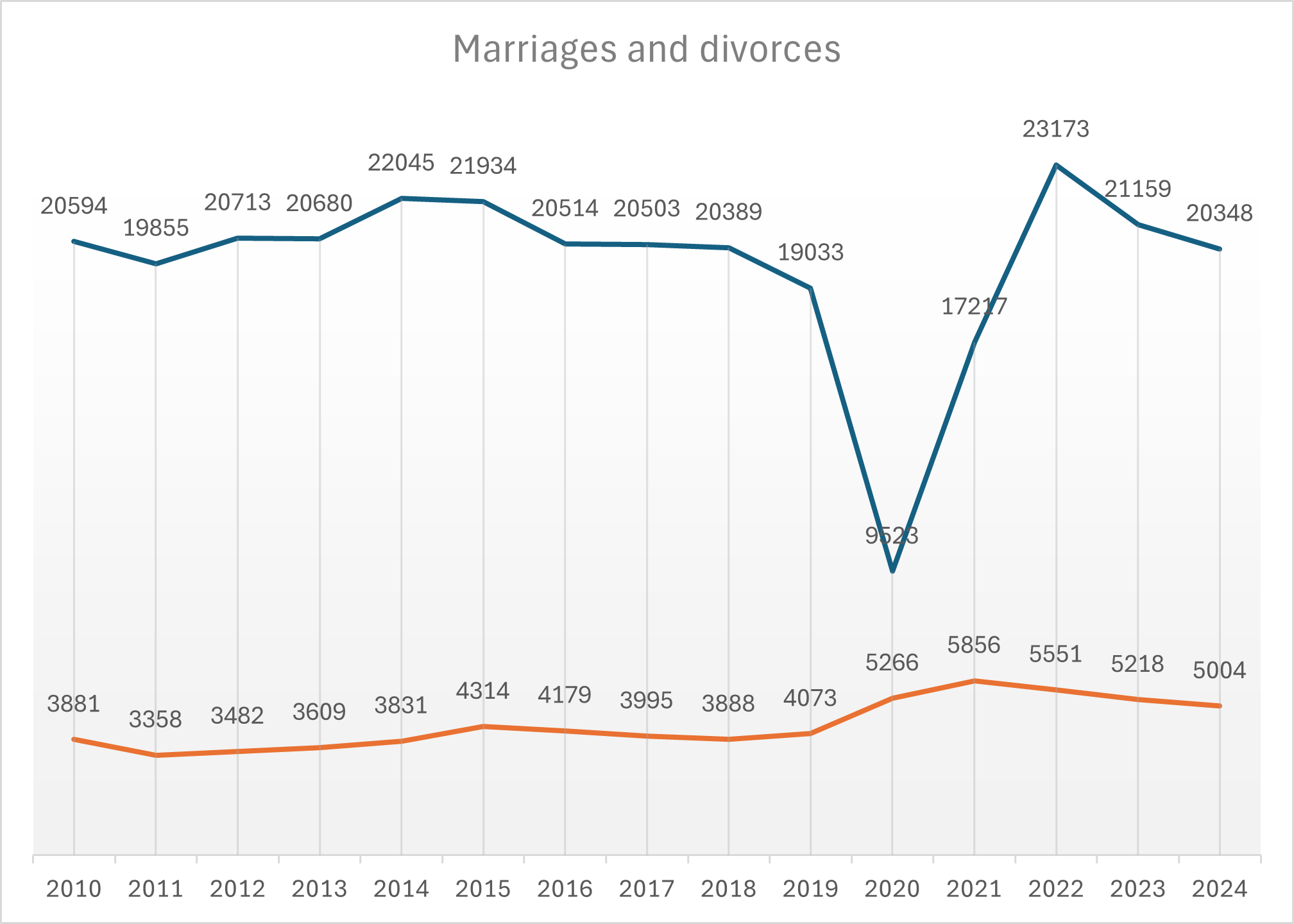
The newly published Courts Service Annual Report shows that last year there were 5,004 applications for divorce, down on the previous two years. But those two years are not representative of present trends, for two main reasons.

One is that the Family Law Act 2019 halved the required separation period before filing for divorce from four years to two, meaning there was a rush of applications. This legislative change was introduced following a referendum.

The COVID-19 pandemic also played a role, disrupting both marriage and divorce patterns: marriages were postponed or cancelled, while household tensions during lockdowns may have led to a spike in divorce applications, post-lockdowns.

But if we look at the past 15 years, when the population grew approximately 20pc, the trend is quite clear: marriage rates have declined, while divorce applications have remained consistently high, if not rising overall. This is a pattern that predates the pandemic. In 2010, there were 20,594 marriages in a population of approximately 4,470,700. By 2024, that number had dropped to 19,680 (opposite-sex only) or 20,348 including same-sex couples, in an estimated population of 5,380,300. In contrast, divorce applications have increased by about 29pc, moving in the opposite direction.


There are many ways to measure divorce rates. For instance, we often hear that the divorce rate in Ireland is quite low and stable, compared to other countries. The crude divorce rate, a commonly cited figure, is expressed as a percentage of every 1,000 people and it is about 0.7 in Ireland. In other words, last year there were 7 divorces every 10,000 people.

But the crude divorce rate can be misleading, especially in societies where fewer people are marrying. It includes the entire population, married or not, making it a blunt tool for understanding real marital dynamics.

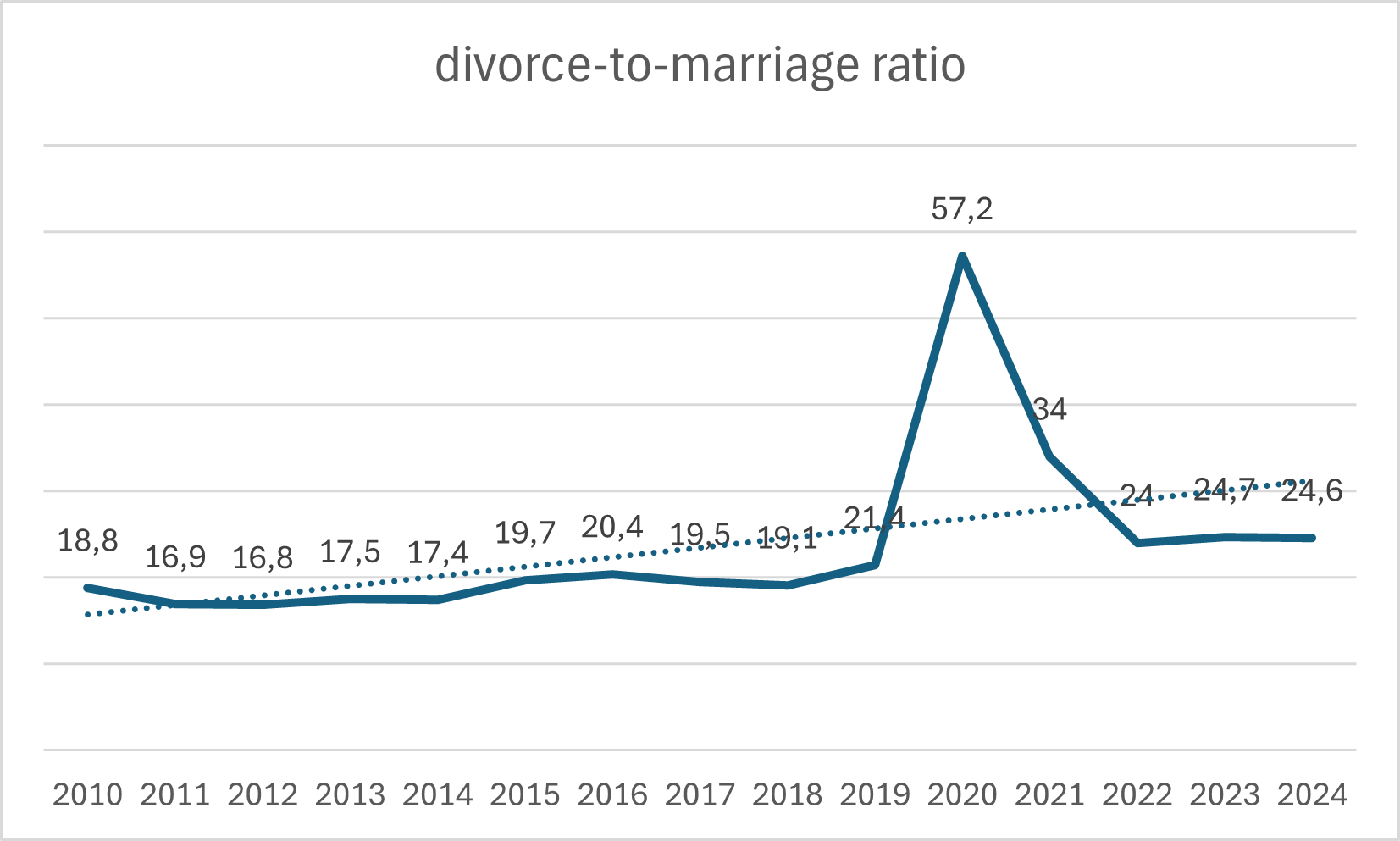
A more revealing statistic is the divorce-to-marriage ratio, which more accurately reflects the dramatic changes of the past 15 years in Ireland.

In 2010, there were 3,881 divorce applications and 20,594 marriages, giving a ratio of 18.8pc. By 2024, that ratio had increased to 24.6pc, with 5,004 divorce applications and 20,348 marriages recorded. In other words, in 2010 there was roughly one divorce application for every five new marriages; today, it is one for every four.

Interpreting this ratio also requires caution. The figure does not measure how many marriages eventually end in divorce; rather, it compares two parallel social trends: fewer newlyweds and more marital breakdowns, relatively speaking. (The blip in 2020 is due to Covid and few people marrying that year which artificially increased the divorce to marriage ratio).

Those two trends going in opposite directions is an unequivocal indication of malaise that the Irish couples are suffering.

The long-term negative effects of those trends not only the individuals involved but on society in general, deserve serious attention, public discussion, and thoughtful policy response.

mercoledì, maggio 28, 2025

Another study highlights how divorce can harm children


The harmful effects of divorce on children is something we are extremely reluctant to discuss probably because it is too close to the bone for many people, especially the adults involved. But if it affects children, then we should discuss it or we are only burying away the problem. A major new study from the US tracking the lives over time of five million young American confirms that the divorce of your parents can indeed causes problems in later life, and immediately.

The paper is from the National Bureau of Economic Research (NBER) and is titled Divorce, Family Arrangements, and Children’s Adult Outcomes. It offers a compelling and methodologically robust examination of how parental divorce impacts children’s long-term outcomes.

Using detailed records from over five million children born in the U.S. between 1988 and 1993, the researchers compared siblings within the same families who were different ages when their parents divorced.

Why is that so important? Because by looking at brothers and sisters, the researchers are controlling for all the factors that make families different from one another: social background, values, income, even parenting style. They are isolating the one variable that matters here: how old the child was when the parents split up.

And the results are striking. Children whose parents divorced before they turned five earned, on average, 13pc less by their late twenties than their older siblings. This means the younger you were when your parents divorced, the more of an impact it had on you. This drop in earnings is roughly equivalent to the economic impact of losing an entire year of education.

But income is only part of the story. These children were also 73pc more likely to become pregnant as teenagers, 43pc more likely to be incarcerated, and 35pc more likely to die by the age of 25. These are not small effects. They are deep and lasting.

So, what drives this damage? The study points to three main factors: a significant fall in household income (typically due to the loss or reduction of a parent’s financial support), relocation to lower-income neighbourhoods, which often means changing schools and social environments, and reduced parental involvement, especially as the custodial parent juggles more responsibilities alone. These factors explain between 25pc and 60pc of the negative effects seen in the data, according to the study.

The researchers warn that the consequences of divorce may be even more severe for families already under financial strain. As they put it, “because divorce has negative effects on children’s outcomes and is more common among low-income families, marital instability likely perpetuates disadvantage across generations.” (p. 6)

Of course, many parents do their best to protect their children through divorce but what this study shows is that divorce, especially early in a child’s life, can inflict real and lasting harm. It doesn’t just change the structure of a family, it reshapes the trajectory of a life, sometimes in lasting ways.

We may not have large-scale longitudinal studies in Ireland to match this level of evidence, but the warning signs are clear. Divorce is not merely a private decision, but it carries serious public consequences, for the next generation and beyond.

People may object that is it better for children if the parents are fighting a lot and they go their separate ways, but most marriages that end in divorce and separation are what they call ‘low conflict’, that is, there is little fighting that is obvious to the children, never mind violence and therefore the break-up can come as a complete surprise.

Also, there is no getting away from the fact that divorce or separation will almost certainly mean less available income, the children possibly having to move into a poorer area, moving schools, having to go back and forth between the two parents, plus the emotional pain of witnessing your family breakup. None of this is good and any sensible person will want the amount of divorce and separation reasonably minimised. Certainly, we should care about rising marital breakdown. As at Census 2022, about 320,000 adults living in Ireland had been through a divorce or separation, plus all the children involved. In 1986 (when we had legal separation, but not divorce), the figure was 40,000.

This new research forces us to address the consequences of divorce for children honestly. We can’t keep avoiding the conversation.

martedì, maggio 27, 2025

As marriages rates collapse who is getting married?

Ireland’s marriage rate has now reached its lowest ever level, not including the years of the pandemic, according to new data from the Central Statistics Office.  At 3.8 marriages per thousand adults last year, the rate has fallen below the EU average and is very likely to fall even lower.

In 2024, there were 19,680 opposite-sex marriages registered in Ireland, marking a 4.1pc decrease from 2023’s total of 20,513. The marriage rate for opposite-sex couples now stands at 3.7 per 1,000 adults. The current EU average is approximately 4.0 per 1,000.

What going on? For a start, the population is ageing, meaning the number of people of typically marriageable age is declining as a share of all adults. This alone will reduce the marriage rate.

But when we zero in on those who are of typically marriageable age (20-40 years old), what is happening?

Well, the marriage rate among those in their early to mid-20s has dropped hugely in the last ten years alone. For males aged 20–24, the rate dropped from 4.1 to just 1.8 per 1,000, and for females in the same age group, from 8.1 to 2.6 per 1,000.

You might consider this a good thing, if you think getting married in your early to mid-20s is too soon.

But we have also seen a big decline in marriage rates among those in their mid to late-20s. Among males aged 25–29 it has dropped from 29.7 per 1,000 to 13.9 since 2014, and among females in this age cohort from 39.8 to 21.8 per 1,000.

If marriage rates among those in their 20s are declining, then maybe there is a pickup by the time people reach their thirties? Yes, far more people marry in their 30s than in their 20s, but not by enough to increase marriage rates overall.

Among the 30–34 age cohort marriage rates have barely budged in the last ten years. Males experienced a slight decrease from 49.3 to 43.5 per 1,000, while females saw a marginal increase from 44.3 to 44.9 per 1,000.

For the 35–39 cohort, male marriage rates slightly decreased from 24.1 to 23.7 per 1,000, whereas female rates increased from 17.5 to 17.8 per 1,000.

Therefore, two things seem to be happening. First, people are waiting much longer to marry, but secondly, fewer people are marrying, full stop. We can expect this trend to continue. Fertility rates almost always follow marriage rates on a downward course and Ireland’s fertility rate is now just 1.5, well below the replacement level of 2.1.

These are awful trends if you care about the future of Irish society.

The new marriage data from the CSO confirm a trend that has emerged over the past few years: the rise of “New Age” weddings and the decline of traditional religious ceremonies.

Catholic ceremonies remained the most popular form of marriage, but only just, accounting for 32.6pc of opposite-sex marriages in 2024, though this represents a notable 11.5pc decline compared to 2023. The decline in Church of Ireland ceremonies was even more dramatic with a fall of 20.2pc last year. Conversely, “Other Religious” ceremonies increased significantly (+16.2pc) and now represent almost 20pc of all ceremonies.

To this must be added ceremonies conducted by the ‘Spiritualist Union of Ireland’ which accounted for 7.1pc of the total. This means that cohort of weddings accounted for around 26pc of all wedding ceremonies last year.

Among non-religious ceremonies, humanist weddings declined by 10.8pc year-on-year, while civil ceremonies also saw a slight decrease in numbers (-1.3pc).

Civil ceremonies include Christians who marry abroad, and also Muslim or Hindu couples, for example, who do not have a religious solemniser recognised by the State here.

Wedding ceremonies in Ireland have undergone substantial changes since 2007, the year when civil ceremonies were first permitted outside registry offices. Today, many hotels offer religious ceremonies performed by solemnisers belonging to new ‘religious organisations’, explaining the explosion of “other religious” ceremonies.

Alternative religious ceremonies are also growing in popularity among same-sex couples. In 2024, almost 40pc of same-sex marriages were religious ceremonies. Both Spiritualist and “Other Religious” ceremonies are now more popular than Humanist ceremonies, which dropped by 30pc in 2024 among same-sex couples.

This trend suggests that Ireland is not becoming more secular, but arguably more pagan.

mercoledì, maggio 14, 2025

Who is getting married in Ireland and when?


Ireland’s marriage rate has now reached its lowest ever level, not including the years of the pandemic. At 3.8 marriages per thousand adults last year, the rate has fallen below the EU average and is very likely to fall even lower.

In 2024, there were 19,680 opposite-sex marriages registered in Ireland, marking a 4.1pc decrease from 2023’s total of 20,513. The marriage rate for opposite-sex couples now stands at 3.7 per 1,000 adults. The current EU average is approximately 4.0 per 1,000.

The new marriage data from the CSO confirm a trend that has emerged over the past few years: the rise of “New Age” weddings and the decline of traditional religious ceremonies.

Catholic ceremonies remained the most popular form of marriage, but only just, accounting for 32.6pc of opposite-sex marriages in 2024, though this represents a notable 11.5pc decline compared to 2023. The decline in Church of Ireland ceremonies was even more dramatic at -20.2pc last year. Conversely, “Other Religious” ceremonies increased significantly (+16.2pc) and now represent almost 20pc of all ceremonies.

To this must be added ceremonies conducted by the ‘Spiritualist Union of Ireland’ which accounted for 7.1pc of the total. This means ‘New Age’ weddings accounted for around 26pc of all wedding ceremonies last year.

Among non-religious ceremonies, humanist weddings declined by 10.8pc year-on-year, while civil ceremonies also saw a slight decrease in numbers (-1.3pc).

Civil ceremonies include Christians who marry abroad, and also Muslim or Hindu couples, for example, who do not have a religious solemniser recognised by the State here.

Wedding ceremonies in Ireland have undergone substantial changes since 2007, the year when civil ceremonies were first permitted outside registry offices. Today, many hotels offer religious ceremonies performed by solemnisers belonging to new ‘religious organisations’, explaining the explosion of “other religious” ceremonies.

Last year, The Iona Institute produced a paper looking at the rise in ‘New Age’ weddings in Ireland and the steep decline in traditional religious ceremonies. You can find the paper here.

In our next blog we will look more closely at current marriage trends, including marriage rates by age, age of marriage, and the differences between the type of marriage ceremony individuals marrying for the first or a second time opt for.

venerdì, novembre 15, 2024

How marriage protects against depression


A major new study shows that unmarried individuals are much more likely to experience depression than those who are married. The study looks at seven different countries, including Ireland.

The research revealed that unmarried individuals - including those who are single, divorced, separated, or widowed - exhibit significantly higher risks of depressive symptoms compared to those who are married. Specifically, the analysis found that unmarried status is associated with an overall 86pc higher risk of depressive symptoms. This increased risk appears particularly pronounced among divorced or separated individuals (99pc). It is instead 79pc higher in single and 64pc in widowed individuals, when compared to married people. 

The study involved over 100,000 participants. The other countries examined along with Ireland were the United States, the United Kingdom, Mexico, South Korea, China and Indonesia.

In Ireland, the risk of depression was notably higher for divorced or separated individuals, who faced a 160pc increased risk, and for widowed individuals, who had a 115pc increased risk, compared to their married counterparts. In other word, for every 100 married individuals experiencing depressive symptoms, in Ireland there would be approximately 260 divorced or separated individuals and 215 widowed individuals experiencing similar symptoms.

The research suggests that marriage provides protective mental health benefits, possibly through mechanisms such as emotional and social support, economic stability, and the positive influence spouses can have on each other’s well-being.

Importantly, the study also highlights that the association between marital status and depression is influenced by demographic and cultural variables. The authors suggest that the more pronounced link in Western countries, including Ireland, reflect cultural differences in social expectations and support systems surrounding marriage. “Eastern cultures tend to tolerate higher levels of emotional distress before it becomes problematic, which may partially explain the lower risk of depressive symptoms in unmarried participants from these countries”, they say. The authors admit that further research is needed to understand the observed cultural differences.

Gender and education level influence in the relationship between marital status and depression. The study found that unmarried men are 25pc more likely to experience depressive symptoms than unmarried women. This risk was even higher among single men (48pc) while the research did not observe a significant difference between men and women among divorced/separated or widowed.

“Females tend to have larger and stronger social support networks than males, particularly among never-married individuals”, the authors note.

Additionally, those with higher educational attainment showed a greater likelihood of depression when unmarried compared to those with lower educational levels. This could reflect variations in social expectations and pressures, where individuals with higher education may feel a stronger sense of isolation or failure if they remain unmarried.

In conclusion, this study reinforces the link between marital status and depression, expanding previous understandings by including a more diverse global sample. Marriage, as highlighted by this research, provides significant mental health benefits, reducing the risk of depressive symptoms. It offers emotional support, economic stability, and shared responsibilities, fostering resilience against stress. These are all good reasons why marriage should be promoted and strengthen in public policy and legislation.

venerdì, maggio 03, 2024

The huge rise of ‘New Age’ weddings in Ireland


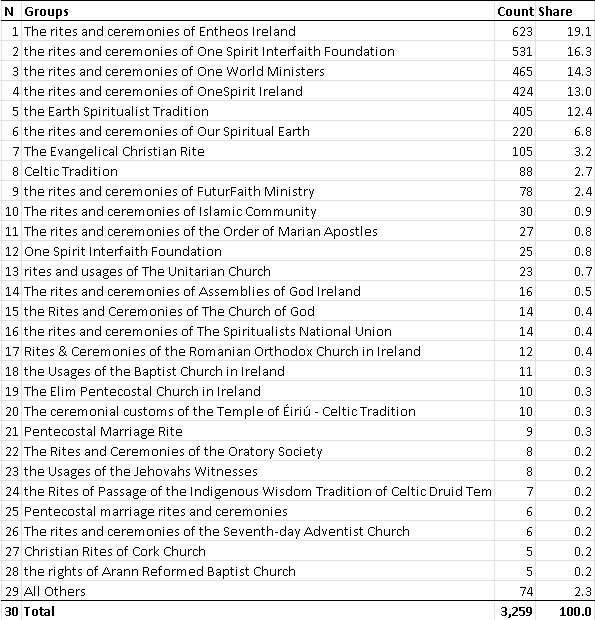
While the number of Catholic marriages in Ireland is steeply declining, new data released by the Central Statistics Office (CSO) highlights the rise of ceremonies belonging to “other religious denominations”, to use the CSO’s term. Now, you might think this means Muslim ceremonies, or perhaps those that take place in African Pentecostal churches, but these account for only a tiny fraction of the total (see table below). The vast majority of the ceremonies, in fact, really belong under the very broad heading ‘New Age’. They increased from 5.3pc of the total in 2018 to 15.8pc last year, growing from 1,009 to 3,259 in absolute numbers — a three-fold increase in just five years. 

The ceremonies incorporate elements from many different religions, as a couple choose. They can be extremely eclectic. There is no particular coherence to them in that they don’t come from a systematic religious worldview that can be called ‘Christian’, or Buddhist’, or ‘Muslim’ or ‘Hindu’. This is why the term ‘New Age’ might be most appropriate, even if some who act as the celebrants themselves, or even the couples involved, might resist the label. We use it here for short-hand.

To the category “other religious ceremonies” must be added ‘Spiritualist’ ones, which were nonexistent ten years ago and are not included in the “other religious” cohort by the CSO. These now account for 7.9pc of all marriages and also borrow from any and all religions depending on the taste of the couple.

This means what can very broadly be termed ‘New Age’ or ‘spiritual’ wedding ceremonies now account for almost a quarter of all weddings in Ireland.

The majority of these ceremonies are conducted by brand new organisations, the Spiritualist Union of Ireland being one. 

Another is ‘Entheos Ireland’, which only registered with the HSE three years ago. According to data provided to the Iona Institute by the CSO, Entheos ministries officiated at 623 marriages in 2023. They currently have 81 solemnisers approved by the State, compared with only five Muslim solemnisers and about 20 from various Orthodox churches.

Spiritual groups such as Entheos and One Spirit tailor their religious ceremonies to the preferences of the spouses, presenting themselves as 'inclusive, embracing people of every faith and none,' without referencing any specific deity or belief system unless requested.

Entheos says it was founded “to serve people who have been ostracised, marginalised or otherwise left behind by traditional faith paths on the basis of gender, race, sexual orientation, ability, nationality, parental / family status or any other reason.”

Another group is ‘One Spirit Interfaith Ministers’. They describe themselves as “ordained interfaith ministers embodying a vibrant and meaningful response to the changing spiritual needs of our times.” They say they are “of service to people of all faiths and none.”

There are many other similar groups offering their services to engaged couples including ‘The Earth Spiritualist Tradition’, ‘One Spirit Ireland’, and ‘One World Ministers’.

Many of the ‘New Age’ wedding ceremonies involved couples or individuals entering a second or third marriage. Data provided to the Iona Institute by the CSO reveal that the number of first marriages among “other religious” ceremonies is significantly lower than among traditional Christian denominations, likely because these groups also offer ceremonies for divorced individuals, which may partly explain their growing popularity. They are also very popular among same-sex couples. Of the 646 same-sex marriages celebrated in 2023, 145 (22pc) were with “other religion” ceremonies and 70 (11pc) with Spiritualist ones.

The rise of non-denominational religious ceremonies is a new trend that reveals the need to mark important events in life with some form of non-institutional religious rituals. Those who feel they do not belong to a religion, often still have religious beliefs of some sort and these new organisations (which charge €600 on average for a wedding) are emerging to satisfy their needs.

As for the broader picture, last year there were 20,513 opposite-sex marriages in Ireland, and 646 involving same-sex couples. Of the opposite-sex ones, 86pc were first marriages, a slight decline from 88pc in 2013. Our marriage rate last year was 4.0 per 1,000 adults—one of the lowest rates in Europe and a decrease from 4.5 ten years ago.  In other words, fewer people are getting married but the percentage of those who remarried after a divorce has increased.

The proportion of marriages conducted through religious ceremonies has obviously decreased, representing 60pc of all marriages last year, down from 70.5pc in 2013. Notably, Catholic marriages have dramatically declined from 62.5pc a decade ago to just 35.3pc in 2023.

Among first marriages, 40pc were celebrated in a Catholic church.

The face of marriage in Ireland is indeed changing very rapidly and the rise in ‘New Age’ ceremonies reflects the drift away from institutional religion of all types. At the same time, there is still clearly a taste for wedding ceremonies to have religious or ‘spiritual’ trappings of some sort and therefore we are not becoming as secular as some people think.

– – –

“Other religious” solemnisers

lunedì, settembre 25, 2023

The liberal prejudice against marriage revealed


Two-parent families are beneficial for children. This is common sense, but when Melissa S. Kearney, a professor of economics at the University of Maryland, wrote a book showing empirical evidence for this simple claim, she experienced hostility and rejection.

“The Two-Parent Privilege” is a recent study proving that, all things considered, the best place for children to grow up is in a family led by a married couple.

Melissa S. Kearney has researched the economics of families for over 20 years. Having sifted through the evidence, she concluded that two parents offer their kids more resource advantages that one parent alone. If we want to reduce poverty and social inequality, we should promote marriage, she says.

“This is not to judge, blame, or diminish households with a single parent”, she writes, but data and rigorous studies prove that a married couple is more beneficial for children, and also for society.

Even before the book was published, she received pushback. She comments: “I happen to know that behind the scenes [at her publishing company] there were definitely some people who were less keen or had strong reactions to the topic”.

Since the publication, things have only got worse. Prof. Kearney has received two kinds of hostile responses to her book: firstly, she is accused of wanting to force people to marry or to stay trapped in an unhappy marriage, which is something that she explicitly rejects in her work.

We're in the midst of a conservative push, aided by the mainstream media, to bully women into young marriage. We're told it will cure everything from male loneliness to child poverty”, tweeted a journalist of the liberal website The Salon.

“I am quite clear that just telling women to marry undesirable partners is not helpful”, Kearney replied.

The second kind of response is more defeatist: there is no point trying to address the decline of marriage as nothing can be done about it anyway.

The problem with this response is that social trends are the outcomes of policies and also of the ideology behind them. Too often, it is impossible to have an honest discussion about the value of marriage without being labelled and ostracised. This is particularly the case in the academic world.

In her book, Prof. Kearney recalls a conversation with a fellow economist who told her that she sounded “socially conservative” and so she wasn’t academically serious. The merits of her studies were easily dismissed.

In our liberal societies we don’t like to sound judgemental about people’s life choices, Kearney reckons, but avoiding conversation about empirically supported data is counterproductive. We need to address uncomfortable questions.

She asks why so many parents are now raising children outside of a marital union, why marriage is becoming a privilege.

The decline of share of people getting married is common in all advanced economies. In Ireland, for instance, 50 years ago the marriage rate was 7.4 per 1,000 thousand people. It dropped to 4.1 in 2019. (Statistics during the pandemic and immediately after it are not significant as many marriages were postponed).

As a consequence, there has been a decline in the share of children living with married parents, particularly outside the educated class. The well-off are more likely to get married.

This has a tremendous impact on the lives of those children in terms of opportunities and achievements, prof. Kearney’s book shows.

“The number of parents in a home is a crucial determinant of a child’s experiences and life trajectory. Debates about this issue should not be relegated to the culture wars. Family structure is an urgent policy matter, and we should treat it that way.”, she writes.

The reactions to her publication demonstrate how difficult is to defend the institution of marriage in the public arena, where prejudice prevails even when all the evidence is offered.

It’s not that they are against marriage per se, but they strongly resist the idea is that it matters to society. This is despite the fact that they are far more likely to be married than those less well educated than them are.

martedì, agosto 15, 2023

Why men and women stay at home to mind their children


26% of mothers and 7% of fathers in the US are stay-at-home parents, according to a new research. Over the past 30 years, the share of fathers who were not working has increased while the share of unemployed mothers has slightly decreased. However, men and women stay at home for different reasons. While one every five mothers said they stay at home because they wanted to take care of their family, only one every sixty fathers claimed to same.

The Pew Research Center conducted an analysis to examine the employment status of parents in the United States and to understand the differences between stay-at-home parents and those who work for pay. The study used data from Current Population Survey (CPS), conducted by the U.S. Census Bureau and the Bureau of Labor Statistics. The CPS is a monthly survey of around 70,000 households and serves as the official source of unemployment statistics.

For this analysis, parents were defined as individuals aged 18 to 69 who lived with at least one of their own children under the age of 18. Stay-at-home parents were those who had not been employed for pay in the year leading up to the survey.

The study found that the proportion of parents in the U.S. who were not employed remained relatively stable over the past five years, with 18% of parents not working for pay in 2021, a figure consistent with 2016. However, there was a significant gender disparity in the prevalence of stay-at-home parents, with 26% of mothers and only 7% of fathers falling into this category.

The analysis revealed somewhat shifting trends over the past three decades. The percentage of mothers not employed decreased slightly from 28% in 1989 to 26% in 2021, while the corresponding figure for fathers increased from 4% to 7%. Consequently, dads now represent 18% of stay-at-home parents, up from 11% in 1989.

The reasons cited for not working differed substantially between stay-at-home mothers and fathers. A significant majority of stay-at-home mothers (79%) reported taking care of home or family as their reason for not working, whereas around one-in-ten cited illness, disability, being students, inability to find work, or retirement. On the other hand, stay-at-home fathers had a more diverse range of reasons, with 23% staying home for family care, 34% due to illness or disability (noticeably down from 56% in 1989), 13% retired, 13% unable to find work, and 8% attending school.

This means that one out of five of all mothers mentioned the care for their family as their reason to stay at home, while only one out 60 of all fathers did the same.

Demographically, stay-at-home fathers differed from those in paid work. They were less likely to have completed a bachelor's degree (22% compared to 42% of working dads) and were more likely to live in poverty (40% compared to 5% of working fathers). Stay-at-home fathers tended to be older, with 46% aged 45 or older compared to 35% of working fathers. Employed fathers are more likely to be married (85%) than those who stay at home (68%).

Dads who mentioned taking care of their family as the main reason to stay at home show distinct difference compared to those who stay for other reasons (illness, disability, unemployment, etc.) They are better educated, tend to be older, and 73% of them are married, whereas 66% of those with varied reasons share the same marital status.

In conclusion, the Pew Research Center's analysis of U.S. Census Bureau data highlighted the changes in the proportion of parents who are not employed, but also underscored the gender differences in stay-at-home parenting.

---


Photo by Kelli McClintock on Unsplash

venerdì, agosto 11, 2023

More Americans are unhappy because fewer are married


Happiness levels are declining in the United States, according to a new study, and one big factor seems to explain this, namely falling marriage rates. Conversely, married people are significantly happier than the unmarried. 

Sam Peltzman, professor of Economics at the University of Chicago, has studied trends and differences in happiness among the US population based on the General Social Survey (GSS) which has been collecting data about US adults since 1972.

Overall happiness levels are markedly down today compared with 50 years ago and the decline has been particularly steep since the early 2000s.

What is more, happiness levels differ by sex. Women were considerably happier than men in the 1970s after which point their happiness went into decline and declined more sharply than among men. The happiness level of both sexes is now about equal, but the question is, why were women happier in the early 1970s than today? Feminism should have had the opposite effect, surely?

According to the study, marriage stands out as the foremost indicator of happiness. The data collected since the 1970s reveal a consistent trend: the married population has been regularly 30 points happier than those who are unmarried. Notably, this pattern holds true for both men and women.

Among the unmarried categories including widowed, divorced, separated, and never married individuals, all of them exhibit significantly lower levels of happiness compared to the married population. Among these groups, separated individuals appear to be the least happy of all.

It is important to note that the study’s findings should not be simplistically interpreted as implying a direct cause-and-effect relationship, such as the notion that marriage inherently leads to happiness. It is plausible that individuals who are already unhappy might encounter challenges in finding a partner or maintaining a harmonious coexistence.

Nonetheless, the author of the research suggests that marriage and happiness share some common sources and the decline of marriage is linked to the trends in people’s contentment more than any other factor.

Marriage rates have fallen sharply in the US. In 1972, there were 10.9 new marriages per 1,000 adults, but this had plunged to just 6.5 in 2018. If marriage increases overall happiness levels (notwithstanding high divorce rates in the US), then it stands to reason that if marriage rates are falling, then so will average happiness.

Prof Peltzman comments: “The happiness landslide comes entirely from the married. Low happiness characterizes all types of non-married. No subsequent population categorization will yield so large a difference in happiness across so many people”.

Other socio-demographic characteristics are also significant but not to the same extent as marital status.

Income emerges as the second most important factor. As expected, the rich are happier than the poor. However, the richest band in US society is not happier than 50 years ago, even though it is wealthier. (This is because affluent people get used to their class status and do not appreciate marginal improvements.)

With regards to age, in the past happiness used to be higher for the over 45 group, with no significant difference between men and women, but this gap is disappearing. White people are happier than black, but the distance between them is narrowing. College graduates and those resident in the Northeast of the US are happier than the rest of the population. Conservatives are 10 point more satisfied than liberals but slightly less than politically moderates.

It is a pity that this study does not consider the role of religion. Other surveys have shown that religious faith and practice are positively associated with life satisfaction.

Prof. Sam Peltzman concludes that “any general analysis of happiness that ignores marital status is unlikely to be satisfactory.” He believes that research has focused too much on socio-demographic characteristics such as age, sex and education but this approach is unlikely to say much about significant trends within a society. Research and policies should concentrate instead on the positive role of marriage for individuals and for society.

lunedì, maggio 08, 2023

Marriage in Ireland still declining despite a bumper 2022


The number of marriages that took place in 2022 saw a significant increase on 2021, but this was mainly due to the postponement of weddings during the Covid pandemic. Overall, the marriage rate in Ireland remains low compared with a few decades ago.

In all, 23,173 marriages were registered last year, according to the Central Statistics Office (CSO).

This is the highest number in Ireland’s history and represents a 14pc increase compared with 2019, the last full year before the pandemic. The marriage rate per thousand adults was 4.4 last year while it was 4.1 in 2019.

What will the rate be next year when all the postponed weddings have already taken place? It is very likely to drop back down again.

In 2012, the rate was 4.5 per 1,000 adults, and in the 1970s, it was 6 or even 7 per thousand.

Today, the marriage rate is around the EU average, and the EU average is at near historic lows.

It is also worth noting that data about divorces for 2022 are not yet available, but there has been a consistent increase in divorce applications in the past four years.

In terms of the type of ceremonies chosen by the couple, last year the most popular form of celebration for opposite-sex spouses was a Catholic ceremony (42pc), followed by a civil ceremony at 26pc.

While the percentage of civil ceremonies hasn’t changed much in the last ten years, from 28pc to 26pc, Catholic ceremonies have seen a sharp decline: in 2012 they were 65pc of marriages.

In 2022, ceremonies conducted by a religious celebrant accounted for 64pc of all marriages, including same-sex unions. Besides the traditional churches, couples have more options nowadays. Only 1.6pc of weddings were celebrated by the three main Protestant denominations combined (Church of Ireland, Methodists, Presbyterians).

Many will be surprised that the Spiritualist Union of Ireland, which is counted among the religious celebrants by the CSO, performed almost 10pc of ceremonies.

9.3pc of couples opted for a Humanistic ceremony, which is considered non-religious.

In 2022, 618 same-sex marriages were celebrated, representing the 2.7pc of the total. This percentage continues to decline.

People are getting married at an older age. In 2022 the average age of grooms was 37.4. Ten years ago the average was 34.7. The average age of brides was 35.4 last year, compared to 32.6 in 2012.

Covid had a detrimental impact on the marriage rates. While the number of marriages registered last year has seen a temporary increase, this rise was mainly due to the weddings postponed during the Covid pandemic. Marriage in Ireland is still declining.