Visualizzazione post con etichetta sex education. Mostra tutti i post

martedì, settembre 17, 2024

The controversial content of an SPHE textbook for young teenagers

Last week, a publisher issued an apology for the stereotypical portrayal of an Irish family in a textbook. The volume, which was withdrawn following public outrage, was produced for the new Junior Cycle course on Social, Personal, and Health Education (SPHE) introduced last year by the Department of Education.

A closer examination of these SPHE textbooks reveals even more serious concerns. One such example is “My Wellbeing Journey”, a text from a major publisher, authored by prominent SPHE teachers.

One of the authors is Eoghan Cleary, Assistant Principal at Templecarrig Secondary School, Co. Wicklow, who is often invited to comment on sex education on radio and television.

The second volume of “My Wellbeing Journey”, aimed at students aged 13–14, includes a lesson dedicated entirely to masturbation. In one of the exercises, labelled a "pairs activity", students are presented with images of eleven animals and asked to guess, together with their classmates, how many of these animals engage in masturbation. This activity is undeniably shocking, yet the book is freely available online for anyone to verify: https://online.flippingbook.com/view/814709122/128/#zoom=true

Is animal behaviour really a good guide to human behaviour? Humans have reason and a moral sense. Animals do not.

Young students are also told that “Even babies and young children know it feels good to touch their own genitals.” This appears to be presenting babies and toddlers as sexual beings.

Another author of “My Wellbeing Journey” is Pam O’Leary, an SPHE teacher at Cork Educate Together secondary school.

In an interview about sex education some years back, Pam O’Leary stated: “I’m interested in teaching students about safety and health. Morality shouldn’t come into Relationship and Sex Education. It’s not about what students should do in any moral sense”. Would most parents agree with this view?

Accordingly, the “My Wellbeing Journey” textbook makes no direct reference to moral values, focusing instead on the concepts of ‘healthy boundaries’ and ‘safe spaces’. It suggests that choices and behaviours are acceptable as long as they are deemed "healthy and safe". However, it is impossible to teach human relationships and sexuality without referencing ethical principles. Human beings inherently base their decisions on values and principles.

Even more perplexing is the attempt to use animal behaviour as evidence that certain actions are normal or natural. Animals are driven by biological imperatives and instinct, whereas humans are free to act according to what they believe is right and just. Forced copulation or aggressive mating, for example, is not uncommon in the animal kingdom but the authors, obviously, do not mention this in their chapter about consent because we are more than animals, we are moral beings. So why do they cover masturbation among animals in a textbook for young teenagers?

The textbook also makes no mention of marriage, which is perhaps unsurprising given that the National Council for Curriculum and Assessment, with the blessing of the Department of Education, removed references to marriage and parenting from the SPHE curriculum.  

Textbooks and teachers are granted a certain degree of flexibility in covering topics outlined in the NCCA curriculum, nonetheless, there is no promotion of commitment or long-term relationships. These concepts are never presented as preferable to casual or short-term relationships. Instead, the message remains: it is all acceptable if it is "healthy and safe". Again, what do parents think?

Unsurprisingly, the curriculum includes lessons on "gender identity", which is presented as fact rather than as a contested ideology that separates being male or female from biological reality. The volume is so steeped in gender ideology that some of the expressions used sound ridiculous.

For example, in the section on puberty in Volume 3, the authors say: “Most typically, people with female-typical anatomy generally begin puberty at 11 years of age, and those with male-typical anatomy begin at 12 years of age”.

Girls are thus referred to as “people with female-typical anatomy”, and boys, of course, as “those with male-typical anatomy”. These convoluted expressions are used in the name of ‘inclusivity’, as, according to gender ideology, not all individuals with female-typical anatomy are women.

They are whatever ‘gender’ they identify as and remember, nobody knows how many genders exist.

Many parents likely disagree with this gender ideology. Are they aware that it is now the dominant philosophy framework taught in SPHE classes?

Are they aware of what else is in these SPHE textbooks, and also the key aspects of life that are missing?

lunedì, agosto 05, 2024

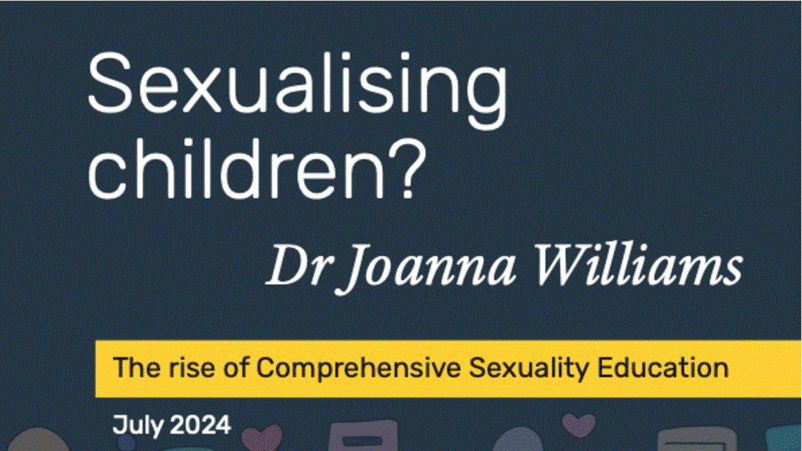
A new critique of ‘Comprehensive Sexuality Education’


major new paper criticises so-called “comprehensive sexuality education”, raising concerns about its content, effectiveness, impact on parental rights, and psychological effects on young people.

Comprehensive Sexuality Education (CSE) focuses on the broader concept of ‘sexuality’ rather than just ‘sex’. It is promoted by international institutions such as the UN, the World Health Organisation (WHO), and the European Parliament, and also by major international NGOs.

CSE has also inspired the most recent updates of Relationships and Sexuality Education here in Ireland. (See for instance the 2022 background paper for Senior Cycle SPHE)

The report from Dr Joanna Williams, a British academic and former director of the Centre for the Study of Higher Education at University of Kent presents a detailed critique of CSE, expressing numerous concerns about its implementation and impact.

Dr Williams argues that CSE promotes values and behaviours that may conflict with the cultural, religious, or moral beliefs of many families and communities, as it goes beyond providing basic knowledge about human sexuality and reproductive health, serving as a tool to advance a specific political agenda.

CSE is often expressed in the language of political activism. For instance, Planned Parenthood, the main abortion provider in the US, claims that CSE can “provide an important forum for building solidarity between young people with varying degrees of access to privilege and sexual rights. It can also strengthen active citizenship skills for working towards a sexual culture that is more just and equal.”

A primary concern highlighted by Dr Williams is the age-appropriateness of the material in CSE programs. She argues that children are exposed to complex sexual information at a very young age, potentially leading to confusion and inappropriate behaviour.

For example, in its paper “Standards for Sexuality education in Europe”, the WHO states: “In this document, it was deliberately decided to call for an approach in which sexuality education starts from birth. From birth, babies learn the value and pleasure of bodily contact, warmth and intimacy. Soon after that, they learn what is ‘clean’ and what is ‘dirty’. Later, they learn the difference between male and female, and between intimates and strangers. The point is that, from birth, parents in particular send messages to their children that relate to the human body and intimacy. In other words, they are engaging in sexuality education.”

This is clearly an extremely broad concept of ‘sexuality education’. Why use this term to describes activities that have nothing at all to do with sex?

Dr Williams stresses the importance of protecting children’s innocence and argues that parents should play the primary role in educating them about sex, according to their maturity and readiness.

Dr Williams also questions the effectiveness of CSE in achieving its stated goals, such as reducing teenage pregnancies and sexually transmitted infections. She presents data and studies suggesting that CSE may not be as successful as its proponents claim. This is backed up by ESRI data from Ireland. An ESRI report from 2020 said there is “little relationship between receiving Relationships and Sexuality Education (RSE) or not and young people’s sexual behaviour and competence”.

Concerns about the infringement of parental rights and family autonomy in children’s education are also discussed. Dr Williams argues that CSE programs often bypass parental consent and involvement, imposing a one-size-fits-all approach that does not consider the diverse values and beliefs of families.

Another critical point raised is the potential psychological impact of CSE on children and adolescents. The exposure to explicit sexual content and discussions about sexual diversity at a young age can lead to psychological distress, confusion about gender identity, and an increase in risky sexual behaviours, she argues. Dr Williams calls for more research and evidence to assess the long-term impacts of CSE on mental and emotional health.

She also criticises the philosophy behind this approach, maintaining that CSE is rooted in a particular worldview that emphasises sexual freedom and autonomy, and promotes a relativistic approach to morality, where all sexual behaviours are seen as equally valid.

lunedì, maggio 27, 2024

Religion and spirituality receive short shrift in new primary school curriculum


The National Council for Curriculum and Assessment (NCCA), an advisory body for the Minister of Education, is currently tasked with reviewing the 1999 Primary School Curriculum. One of the proposed changes is the almost complete removal of spirituality and religion as an aspect of human existence from the ‘wellbeing’ course.

In this blog I will highlight some significant differences between the current curriculum and the draft proposal.

The 1999 curriculum, in the chapter “Key issues in primary education”, includes a section on “the spiritual dimension” that states: “The curriculum takes cognisance of the affective, aesthetic, spiritual, moral and religious dimensions of the child’s experience and development. For most people in Ireland, the totality of the human condition cannot be understood or explained merely in terms of physical and social experience.”

It goes on: “The spiritual dimension of life expresses itself in a search for truth and in the quest for a transcendent element within human experience. The importance that the curriculum attributes to the child’s spiritual development is expressed through the breadth of learning experiences the curriculum offers, through the inclusion of religious education as one of the areas of the curriculum, and through the child’s engagement with the aesthetic and affective domains of learning.” (p. 27)

In the draft new curriculum, the above section on the “spiritual dimension” has disappeared.

The new curriculum has seven key competencies, one of which is “being well”, defined in the framework as: “This competency develops children’s understanding and appreciation of wellbeing and their ability to be as healthy as they can be – physically, socially, emotionally, and spiritually.   … It also recognises the spiritual dimension of living, which enables children to experience a sense of awe and wonder and to know that life has a meaning”. (p. 11)

However, this general mention of spirituality in the framework disappears after a few pages. The seven key competencies, which are broad and general, are developed into different subjects.

The “Wellbeing” subject includes Physical Education (PE) and also Social, Personal and Health Education (SPHE). As per the description above, spirituality should be included in the Wellbeing subject, and this was the case in the 1999 curriculum.

But the new draft states: “Wellbeing supports children’s social, emotional, and physical development now and into the future.” (p. 17) Note the exclusion of spiritual development.

In the new draft specification of the “Wellbeing” course there is no activity or learning experience linked to spiritual wellbeing.

This is despite all the evidence that religious practice contributes to wellbeing. (Professor Patricia Casey produced for the Iona Institute a paper on this topic, called “The Psycho-Social Benefits of Religious Practice.)

As Dr Amalee Meehan, a professor of education from DCU, says in a submission to the NCCA at an earlier stage in the process: “There is a difficulty with the conception of wellbeing as a distinct curricular area. The research shows that every aspect of education, at its best, can foster wellbeing. It is important to note the strong research base identifying a direct correlation between participating in a religious tradition and wellbeing.”

While schools develop their religion and ethics education courses according to their own patrons, the positive effect that spirituality has on mental health and wellbeing should be taught in every school, and this was the case in the old curriculum.

As part of the consultation, the NCCA asked parents and educators to comment on the draft framework and some of them have noticed the removal of spirituality. Here are some examples of their comments:

“Please do not dumb down the importance of religion and spirituality in the education system – surely when you’re trying to provide a holistic education you can’t disregard the emotional benefits of spirituality.”

“I believe this new framework is being used as an opportunity to further degrade the role of religion and spirituality in a child’s life. Explain how this will contribute to their well-being?”

“There is talk in the 1999 curriculum of the spiritual, moral and religious side of the child, there is a holistic perspective on the child – this view is much less in the current curriculum and there is no reason given for this shift, while the vast majority of the population in Ireland belong to a religious tradition. Navigating difference is going to be very important in the future but knowing and appreciating one’s own identity is essential in this process and the religious, spiritual and moral is an important aspect of the identity of the child – this does not appear to be reflected in the document and this is worrying.“

The NCCA has proposed a reduction in time allocated for religious education while the allocated time for the “Wellbeing” subject has been doubled in comparison to the 1999 curriculum, and new areas of learning have been introduced, such as consent, diversity in family structures, and media/digital wellbeing.

Whilst removing spirituality, the new wellbeing curriculum also fosters political activism at primary level. A new strand of the course is called “community and belonging”. Under the heading of “Inclusive education and diversity”, this is what is presented as examples of wellbeing: “Fostering a culture based on human rights, democracy, equity, equality, and social justice. Challenging stereotypes and misconceptions, and promoting empathy, respect, and multi-perspectivity. Recognising and celebrating the diversity present within the classroom and in wider society”. (p. 2)

Besides the consideration whether this is appropriate for primary school students, this strand overlaps with another course called “Social and environmental education”.

The substitution of spirituality in the wellbeing course with political activism is an ideological shift that overlooks the substantial evidence demonstrating the importance of spiritual cultivation for overall wellbeing, both individually and collectively.

The consultation process is open until June 7 and submissions can be made via this link.

venerdì, settembre 01, 2023

New sex education programmes completely ignore long-term commitments and marriage


The new sex education programmes in Irish schools completely ignore long-term commitments and marriage. They promote the bare minimum, i.e. consent, rather than what is necessary for a goo relationship, i.e. commitment.

Sex education programmes are constantly updated at the different levels of the Irish education system. The Social, Personal and Health Education (SPHE) curriculum for junior cycle (age 12-15) has been recently changed and will start in September this year.

While contraception is explicitly mentioned in one of the learning outcomes it is extraordinary that a course about sexuality and relationships nowhere refers to pregnancy, birth, parenthood, or raising children, which are natural consequences of a sexual relationship.

The course specification also never mentions marriage and or long-term commitment. The emphasis is on the bare minimum, i.e. consent, rather than on what makes relationship lasting, i.e. commitment, long-term plans, mutual obligations, etc.

One of the eleven learning outcomes is about consent and says that students should “appreciate the importance of seeking, giving and receiving consent in sexual relationships, from the perspective of building caring relationships and from a legal perspective.”

While consent is a basic and necessary element of a sexual relationship, it is not sufficient.

The Senior Cycle sex education course is also currently being redeveloped. Consultation is ongoing and the new course will start in September 2024.

When assessing the review documentation generated by the NCCA up to this point in comparison to the curriculum framework that has been in effect since 2011, it becomes evident that the identical criticisms of the Junior Cycle review still hold true.

For instance, the 2011 framework has a section about parenting and one of its aims is to discuss the role of commitment and relationship skills in marriage and other committed relationships, that help to support lasting relationships and family life”. (p. 28)

There is no mention of marriage or other committed relationships in the new draft specification. It has been deliberately removed.

Lasting relationships, family life, marriage, or commitment are all absent from the consultation report as well.

The background paper presents an analysis of international practice, focusing on New Zealand, Ontario and Canada. In the overview of key concepts and topics it mentions “long-term commitment and parenting” and one of the key ideas proposed to be discussed is “marriage and long-term commitments can be rewarding and challenging”. (p. 23)

This proposal, coming from a comparison with international practice, has found no place in the new draft specification by the Department of Education. As consultations are still ongoing, it is possible that a future draft will be amended to include marriage and long-term commitment but their removal from the current curriculum, should be noted.

This minimal-value approach which inspires the SPHE courses fails to promote proper relationship education. A good relationship is more than “healthy”, particularly when we consider the unhealthy psychological but also physical consequences of consensual promiscuity, casual sex, etc.

Consent education is not enough without commitment education.

martedì, maggio 30, 2023

New sex education programme all about gender ideology


The new Social Personal and Health Education (SPHE) programme for Junior Cycle pupils (aged 12-15) has been approved by the Minister for Education. It incorporates Relationships and Sexuality Education, but incredibly, the new curriculum specification never mentions pregnancy or babies, and ‘men’ and ‘women’ are treated as almost alien terms.

Instead, the curriculum heavily emphasises topics such as ‘gender’ and ‘sexuality,’ which raises questions about its underlying ideological agenda. This is an extremely ideologically loaded programme.

A simple analysis of the language and the concepts used in the official documents shows the priorities of the Department of Education and of the National Council for Curriculum and Assessment (NCCA).

In the 28-page document, the word ‘birth’ appears only once and not in relation to pregnancy, which is a natural consequence of sex. No, the word “birth” occurs only in the definition of gender identity, with the bizarre expression “sex registered at birth”.

The NCCA document says: “Gender identity: a person’s felt internal and individual experience of gender, which may or may not correspond with the sex registered at birth.”

It seems to suggest that the sex of a newborn is noticed and registered not according to science, in an objective manner, but by some arbitrary or curious cultural practice.

It also says: “when children are born, their sex is largely decided or ‘assigned’ on the basis of their external genitalia, which generally – but not always – reflects their internal hormonal and chromosomal make-up.” These cases exist but are extremely rare.  Why do young students need to be told about rare anomalies rather than what normally happens?

While in the 2016 version of the same document, “gender” appeared only 5 times, in the updated Curriculum Specification it is used 19 times – a huge increase – while there is no mention of “woman” or “girl” at all. “Boys and girls” also seems to be a politically incorrect expression nowadays, maybe not sufficiently inclusive of all other identities, and it is avoided by the Department of Education.

The word “female” is used only three times by the NCCA, two of which appear in the definition of ‘gender’: “Gender: Refers to the social and cultural factors influencing what it means to be male and female, i.e. the socially constructed roles, behaviours, activities and attributes that a given society considers appropriate for men and women. It is important to distinguish gender from ‘sex’ which refers to the biological and physiological characteristics that are defined as being male and female.”

This is also the only occurrence of the word “women” in the whole document.

It is pretty obvious that the updated SPHE course focuses not much on sex, i.e. the differences between being a boy or a girl according to science, but on the ideological notions of gender identity and gender expression. These are the priorities of the Department of Education and of the NCCA.

Instead of sex education, the new course should be renamed as “gender ideology education”.

martedì, gennaio 24, 2023

NCCA confirms worst suspicions of parents about gender ideology


Many Parents have expressed serious concerns about proposed changes to the Relationships and Sexuality Education (RSE) curriculum for junior cycle students (age 12-15). These are stated in response to a consultation process initiated by the National Council for Curriculum and Assessment (NCCA). Their primary issues are about how ‘gender identity’ and pornography will be taught in schools.

The revision of the junior cycle RSE programme is part of an overall review of the Social, Personal and Health Education (SPHE) curriculum, which includes RSE.

Last year, the NCCA called for comments from the public through surveys, submissions and focus groups, and a report on the consultation has just been published.

Over 4,300 parents, 102 teachers and 142 students responded to the online survey. Others presented their views through letters or emails.

(The Iona Institute’s submission that can be found here)

The report acknowledges that the most common cause of concern among parents was the reference to “gender identity” in the draft, which says that pupils should “appreciate that sexual orientation, gender identity and gender expression are core parts of human identity and that each is experienced along a spectrum”.

Proponents of ‘gender identity’ claim that being a boy, or a girl, is only one of countless variations of gender, which itself is independent of one’s bodily reality. Our ‘gender‘ is based on self-identification, not our actual biology. We might be physically male but identify as something different.

Some parents objected that this radical philosophy should not be in the curriculum as “it may lead to questioning, confusion and even harm for some adolescents.”

These parents said “the NCCA is seeking to promote ‘gender ideology’ by refusing to acknowledge the binary nature of gender.”

The NCCA now seems to have confirmed those parents’ worst suspicions. The report claims that “these respondents are strongly of the view that we are born as either male or female and that sex is binary and immutable”, as if this is somehow a fringe belief.

This comment is quite astonishing. The report presents as a “view” what is a scientific truth. It is not an opinion but a fact that we are all born as male or female, and sex is binary and immutable. Being male or female is written in every single cell of our body and there is no way to change that. Only a very radical ideology would deny this fact, but it appears to be one the NCCA accepts, which is deeply worrying.

Another cause of concern for many parents is the reference to pornography in the draft curriculum. These parents, says the NCCA, “fear that students would be exposed to pornography as part of classroom teaching and learning.”

The parents believe that putting the topic in the RSE curriculum is not appropriate for pupils aged 12-15 and this would “result in sexualization and harm of children”.

Parents also criticised “the lack of reference to morality, moral teachings or family values and would like to see the specification reflect a school’s right to teach topics in a manner that aligns with the school’s ethos and values.” Some even stated that they would withdraw their children from all SPHE classes if the proposed updates are accepted.

The NCCA might dismiss many of these parents as over-traditionalist in their outlook and not reflective of wider public opinion, but even parents who no longer fully subscribe to Christian teaching on sexual morality are likely to be annoyed at what is being considered.


Photo by Taylor Flowe on Unsplash

mercoledì, luglio 27, 2022

The radical approach to sex education backed by the HSE


Pornography to be studied in class”, said the front page of the Irish Independent last week, which is alarming at first glance, but much depends on how this is done because some HSE-backed researchers believe porn can be both ‘ethical’ and ‘positive’.

The National Council for Curriculum and Assessment (NCCA) is currently redesigning the Relationships and Sexuality Education (RSE) curriculum for school, starting with Junior Certificate level.

Some of what is being taught in classrooms is already deeply concerning, and hopefully the Minister for Education will reject this approach.

The approach is exemplified by Sexual Health West, an organisation based in Galway, primarily funded by HSE West. The WISER (West of Ireland Sexuality Education Resource) team provides youth and community education on sexual health.

Grace Alice O’Shea is Relationship and Sexuality Educator at WISER and she recently authored “Sex Educated”, a guidebook for sexual education in schools and elsewhere, with extensive contributions from other members of WISER.

The book is based on “over thirty-years’ experience of delivering sex education in Ireland, working with tens of thousands of young people” and is addressed to teenagers and their educators.

On the back cover page there is the HSE logo and the endorsing words of President Michael Higgins: “I have no doubt that this publication will be an invaluable resource for our younger citizens, and for all those charged with their health and well-being”.

The main message of the book is that any kind of sexual activity is ok as long as it is consensual and ‘safe’.

The author has no objection to having multiple sexual partners. As she says: “It is not bad to have a ‘high’ number of sexual partners. This number is subjective anyway, and what one person considers a ‘low’ number may seem ‘high’ to someone else. What matters is that all sexual encounters are fully consensual and as safe as possible. You may have only one sexual partner for your life, or you may have many. There is nothing wrong with this, and there should be zero shame attached. The only person you need to talk to about your number of sexual partners is a medical professional if they ask, e.g. during a STI check. Apart from that, it is no one’s business but yours, and it certainly does not define your worth”. (p. 255)

Is this the message pupils should hear? What do their parents think?

The book has no objection to polyamory. “Some people have multiple intimate partners and everyone involved has agreed to this situation. This is known as polyamory, and it has been around for long time. … Monogamy can be perfect for some people but may not suit other people and their relationships. There are many different types of non-monogamous relationships. For example, people may engage in ‘open’ relationships, in which partners can typically have sex with other people but not have romantic relationship with others. Again, this must all be talked through in detail between the two people in the relationship, with everyone’s wishes and feelings being heard and considered.” (p. 377)

The authors of the guidebook also believes that there is nothing wrong with porn as such, and it can be used in a ‘safe’ and ‘healthy’ way.

She says: “Watching porn does not have to be bad. If someone watches porn and enjoys the experience, knows that porn is not like real sex, understands that it is all acted out and unrealistic, and knows when to switch off and look for help if they see something that felt wrong or they are worried about something, then that is a great starting point for looking at porn in a safe and healthy way. Watching porn can become a problem if someone uses it a sex education tool, feels under pressure to re-enact, feels bad, ashamed or distressed in any way during or after watching it, pressures others to watch it, or feels that their experiences of body image, masturbation, orgasm, or sex is negatively affected. In a nutshell, watching porn can be bad for someone, depending on how it is affecting them, but watching porn in itself is nothing to feel ashamed about.” (p. 183)

The book also defends so-called “ethical porn”, i.e. “porn made legally, respecting the rights of performers, with good working conditions, shows both fantasy and real-world sex and celebrates sexual diversity.” (pp. 183-84).

(In a previous blog we have covered the defense of “ethical porn” by Kate Dawson, one of the contributors of this book. See here https://ionainstitute.ie/teaching-children-that-porn-can-be-ethical-and-positive/)

These views are presented by people who have been teaching RSE in schools for over thirty years. They are funded by the HSE and endorsed by the President of Ireland.

Is this the kind of sex education parents want for their children? Why is the approach funded by the HSE? What does the NCCA and the Department of Education think?

domenica, dicembre 01, 2019

Teaching children that porn can be ethical and positive

Is ‘porn literacy’ something we should be teaching in schools? If so, at what age? What is ‘porn literacy’? Is there such a thing as ‘ethical porn’? To what extent will these things be part of the planned new Relationships and Sexuality Education (RSE) course?

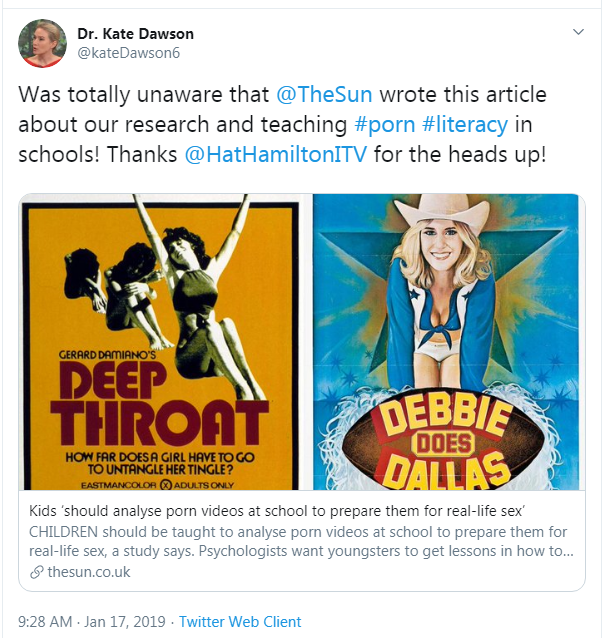
For clues, we might look to Kate Dawson who is a doctoral student at NUI Galway. She believes in ‘porn literacy’ and in ‘ethical porn’. Sometimes she goes into schools to give children her views on sex, porn and relationships as part of the HSE funded WISER (West of Ireland Sex Education Resource) programme.

‘Porn literacy’ is, of course, a highly ambiguous term. It could simply mean teaching students about the negative effects of consuming porn but in a recent article, written with two other academics from NUI Galway, Dawson clearly states that one of the learning outcomes of porn literacy is to “reduce shame and increase acceptability” (p. 7). Why should we increase the acceptability of watching porn among school children?

In the same article we read: “A variety of teaching methods could be employed within a porn literacy intervention, including … the use of activities or video content on digital and social media platform” (p. 11).


Recently, Dawson has appeared in various media defending “porn literacy” or criticising the attempts made in different countries to ban online porn that can be accessed by children.  She wants pupils shown porn videos so as to help them understand such films are “scripted and dramatised” and to “reduce the shame” of watching. Is this something their parents would feel comfortable about? It seems that she has no principled objection to porn per se. Moreover, as mentioned, she believes in “ethical porn”.

In October 2016, she was one of the authors of the “Porn as Pedagogy” (PAP) event at Tate Modern, in London, where participants were shown a 45 minute selection from “ethical porn” movies. A discussion followed.

One might wonder what “ethical porn” is. From a report she produced we can learn that the organisers at the Tate wanted to “expose the audience to the beauty and variety that exists within the porn industry that is often dominated by heteronormative, sexist and racist content. We knew that all performers involved in the footage were protected and cared for in their working environments and were paid the same rate, regardless of race, gender and sexuality. We knew that safer sex was pre-negotiated between performers for all of their scenes and that they choose what they want to do on screen.”

It is interesting to note that the only moral concern expressed about porn is about how it is made. It is “ethical” as long as it is produced according to certain moral standards. Aside from that, porn is seen as morally neutral, if not actually a good thing.

Dawson comments: “Personally, the experience [at Tate] was transformative. I feel privileged to have learned from these films, and to have had the opportunity to share the work in such a setting. It is safe to say that Pink & White Productions have changed my perspective on porn. This really is porn as it should be.”

What does she want taught in schools? Here you can find some examples of the very explicit language  on porn offered to teenagers by Dawson.

It is important to note that we are not talking about some fringe group with extreme views.  The WISER programme, in which Ms Dawson in involved, is funded by the HSE. We are therefore entitled to ask, is this what the State wants taught in our schools?

Last year, an NUI Galway report on porn was launched by Minister for Higher Education Mary Mitchell O’Connor. Kate Dawson, who contributed to the report, commented: “it is not good enough to just say that ‘porn is bad’ because it is not, people really enjoy watching it, there are a lot of positive uses, but people need to have the skills to make their own mind up about the content they see because porn is so varied.”

Does Minister O’Connor agree that porn in itself is not bad? To what extent should this kind of “porn literacy” be officially included in the RSE programme aimed at school-age children? Should pupils be taught about ‘ethical porn’? Parents deserve answers to these questions.

sabato, febbraio 23, 2019

Little evidence that sex education programmes actually work

A big review of the way Relationships and Sexuality Education is underway, led by the National Council for Curriculum and Assessment. Yet, an absolutely crucial question that needs to be considered in all this is whether RSE-type programmes even work. What outcomes are they seeking, and are those outcomes being achieved? International data suggests, probably not.

The efficacy of sex education can be assessed on such measurables as whether they lead to reductions in the numbers of unplanned pregnancies after the teaching of RSE courses, a reduction in sexually transmitted diseases, an increase in teenage sexual delay, etc.

major review of peer-reviewed journal articles, published by Cochrane (a global network of 13,000 health researchers) in 2016, evaluated six school-based programmes across eight countries aimed at improving the sexual and reproductive health of adolescents. The authors found that the programmes “had no demonstrable effect on the prevalence of HIV, or other STIs. There was also no apparent effect on the number of young women who were pregnant at the end of the trial.” The authors concluded that “there is little evidence that educational curriculum-based programmes alone are effective in improving sexual and reproductive health outcomes for adolescents.

In another study Dr Daniel Wight, of the Medical Research Council Social and Public Health Sciences Unit in Glasgow, evaluated the efficacy of three different school-based sex education programmes across 77 schools in Britain. He found that the various programmes had minimal effect on reported behaviour. “The studies with more objective sexual health outcomes found no impact on conceptions or terminations by age 20”.

He realised that there are personal and social influences on sexual behaviour that school sex education has big difficulty overriding. The impact of those sex education and relationships programmes is insignificant compared with much more persuasive influences such as expectations coming from one’s family, friends, mass media, peers, etc.

He concluded that “the broader social factors shaping behaviour seem too influential” and any improvement in the current programmes is unlikely to have a greater impact than present initiatives.
It is true, of course, that teenage pregnancy rates have fallen in the UK, and they have in Ireland also, but wider social factors are at work here, as Wight says.
In fact, when spending on school sexual health programmes, including provision of contraception, was cut in Britain during the recent recession, there was a further drop in teenage pregnancy.

One factor behind the fall in teenage pregnancy appears to be social media. Young people are spending more and more time online and are physically meeting one another less.
An article published in the British Medical Journal in 2009 studied the effects of the Young People’s Development Programme (YPDP), an initiative of the Department of Health. It concluded that “no evidence was found that the intervention was effective in delaying heterosexual experience or reducing pregnancies, drunkenness, or cannabis use. Some results suggested an adverse effect.”

With regard to pregnancies, significantly many more cases were reported among young women in the YPDP group than in the comparison group, while there were no significant differences in the proportion of young men who reported awareness of causing a pregnancy. The researchers admitted that the results were unexpected, and they could not find an explanation for these outcomes.

The most recent review of 103 school-based studies in 44 countries, presented by the Institute for Research and Evaluation last October, concluded that “comprehensive sex education has not been an effective public health strategy in schools around the world, has shown far more evidence of failure than success, and has produced a concerning number of harmful impacts.”

The Oireachtas Library & Research Service has produced a long document with the title ‘School-based relationships and sexuality education: lessons for policy and practice.’ The author acknowledges that the “evidence base for school-base sex education is contradictory and contested”.

In support of the hypothesis that sex education improves sexual health outcomes she refers to two sources, which are both inconclusive with regard to measurable outcomes. The first study “What is the best practice in sex and relationship education?“, funded by the UK National Institute for Health Research, claims that “school-based sexual health services appear to be effective at reducing sexual activity, numbers of sexual partners and teenage pregnancies, according to reviews of reviews”. There is little elaboration on this and it is hardly a definitive conclusion.

The second study is the UNESCO Review of the Evidence on Sexuality Education (2016), which says that “The 22 systematic reviews that were analysed reported mixed results of CSE programmes (i.e. some positive, some null or showing no effect, and some, but not many, negative results)”. So, there is no conclusive evidence of their efficacy. “Unfortunately, there are still relatively few high-quality trials of school-based CSE that measure biological outcomes, such as rates of STIs or HIV, making it difficult to draw strong conclusions”, the review admitted.

All these documents are not a reason to reject sex education altogether, but they should make policy makers far more cautious and sceptical. What they prove is that other factors such as family (especially family breakup), religion, economic circumstances are much more important in terms of sexual behaviour than time spent in a school-based sex education programme. It is outside the school that the real sex and relationships education of our children takes place.

In fact, in response to a question from Mattie McGrath TD about the efficacy of RSE-style programmes, Education Minister Joe McHugh, responded in a manner that was little more than hand-waving.

In a written response he said: “Research in Ireland and abroad indicates that a great majority of parents welcome the support of schools in helping them to fulfil their obligation regarding RSE and other aspects of SPHE.

“The 1995 Report of the Expert Advisory group on RSE which was set by the then Minister for Education, found that various studies have been conducted on the implementation of Social, Personal and Health Education (SPHE) which includes RSE in Ireland.  These studies uncovered overwhelming support for school-based RSE among both teachers and parents.
“In 2007 a research report produced by the Crisis Pregnancy Agency in partnership with the Department of Education and Skills entitled: Relationship and Sexuality Education (RSE) in the context of Social, Personal and Health Education (SPHE): An Assessment to the Challenges of full implementation of the programme in Post Primary Schools, found that RSE is an important part of the education of young people, and that schools provide a safe context within which young people can learn about themselves and the wider world. This study showed that young people find it difficult to talk to their parents about sex and relationships. This makes access to RSE in schools all the more important.
“The report also found that parents viewed the home as the most appropriate place to teach students about relationships and sexuality but they also recognised that not all children received home-based sexuality education. Many also felt that there were many advantages to children learning about relationships and sexuality in the company of their peers under the guidance of trained teachers and facilitators. Overall, there was overwhelming support among parents for school-based sex education and it is in this context that RSE provided in schools coupled with education provided at home by parents is associated with the best outcomes for students.”

Not a word of that is relevant to the most important question; what measurable impact do these programmes have? Surely the Minister for Education and his officials can do better. Or can they?

venerdì, febbraio 01, 2019

New report on RSE only pretends to be ‘objective’


Earlier this week the Joint Committee on Education presented a report on Relationships and Sexuality Education (RSE). This report has two main flaws: it undermines the role of the school ethos in RSE and it fails to address the question of what the purpose of RSE should be. Both of those flaws are based on a confusion between facts and values.
The report recommends that “the Education Act 1998 be amended or at least reviewed, so that ethos can no longer be used as a barrier to effective, objective and factual teaching”. (p. 28)
Such a recommendation proceeds from anti-religious assumptions, even if in the document they are not so well articulated. There is a clear bias here towards the idea that Catholic schools can offer proper RSE which at the same time is faithful to their principles. The ethos of schools is presented, without evidence, as “a barrier to effective, objective and factual teaching”. Is this always the case?
The report acknowledges that under the current Act, “the ethos should not affect the content of what is taught” (p. 25). If this true, there is no need to amend the existing legislation and the recommendation is void. But it also says that the ethos “may affect the resources that are used, the approach that is taken and that this may affect the consistency of delivery to school” (p. 25). What it is meant here is not clear. How does the ethos affect the resources but not the content?
A healthy pluralist State welcomes the contribution made by religions, and thus by religiously inspired education, towards values and norms. Instead, a secularistic approach, the one which clearly inspires this report, seeks to eradicate religious influence from the public square.  (See T. Cooling, A Christian Vision for State Education)
RSE, more than any other subject, is value-laded because it deals with the way we understand ourselves in relation with others. It will always be controversial and to deny its true moral dimension is simply dishonest.
Students and families have a variety of views on what is appropriate or not with regard to sex. A morally neutral discourse on relationships and sexuality is impossible. It is inevitable that in presenting and discussing human beings, and their actions, we immediately include values and norms.
There are three main values that usually inspire RSE programmes: welfare, freedom, and virtue.
These values are not mutually exclusive and should all be present in RSE teaching, but the different emphasis on one or another value may vary.
An approach could focus on welfare, health, well-being, avoiding risk factors, unplanned consequences, etc. A different delivery, instead, could focus more on autonomy, informed choices, consent, self-determination, etc. A third alternative approach, inspired by virtue, will emphasise long-term stable commitments, the complementarity of sexes, the natural orientation towards procreation of the conjugal act, the public dimension of romantic relationships, etc.
No one of these approaches is more “factual and objective” than the other, as they differ not on facts but on values.
Values permeate every aspect of sexual education, given that it encourages or discourages certain choices and behavior. A non-directive approach to RSE is not more (or less) objective than one which is inspired by an explicitly Christian understanding of the good. Different RSE programmes can be perfectly factual and still deeply disagree on the question whether our scientific knowledge should be used to promote autonomy, to maximize well-being or to prepare for marriage.
In a pluralistic society, the role of the State is not to tell parents what is morally appropriate for their children. Instead, the state should enable parents to express their preferences so that even RSE is somehow an articulation of their values.
The report wants to limit this choice, in the name of objectivity. It inaccurately presents the ethos of a school as a barrier to facts. But in confusing facts with values, it effectively advocates for the state the role of determining what the purpose of RSE should be, and what values should inspire it. There is little factual and objective here, this is an ideological report.
PS. It would be too easy to point out that some of the factual assertions in the report are not objective at all. How is gender ideology objective? If, as the report says, there is a spectrum of gender identities, can anyone “objectively” tell us how many there are? Five, ten, fifty-two?