Visualizzazione post con etichetta Mary McAleese. Mostra tutti i post

sabato, novembre 09, 2019

Do Mary McAleese and We Are Church believe John Paul II condoned rape?


Mary McAleese has been attacked for using an out-of-context quote from Saint John Paul II which, on its own, can easily give the impression that he condoned rape. Mrs McAleese and her defenders say her critics are the ones doing the misrepresenting. But there is an easy remedy for them; come out and say they do not believe the late Pope was condoning rape.

She was speaking last Saturday at an event organised by We Are Church Ireland, the Trinity College School of Religion and Voices of Faith.
During a panel discussion about the role of women in the Church, Mrs McAleese said the following:
“If you’ll just bear with me, can I just read a little section from the writings of Pope John Paul II? This is a recent Pope so we’re not talking about the dark ages, we are talking about a recent Pope from his book “Love and Responsibility”. This is his description of marriage, of sex in marriage. It’s a short thing. ‘It is in the very nature of the act that the man plays the active role and takes the initiative, while the woman is a comparatively passive partner, whose function it is to accept and to experience. For the purpose* of the sexual act it is enough for her to be passive and unresisting, so much so that it can even take place without her volition while she is in a state in which she has no awareness at all of what is happening – for instance when she is asleep or unconscious.’
She went on: “This is how we are treated in the Church, expected to be asleep unconscious while men get on with doing what they have to do. And here is the sequel to that: when Father Seán Fagan called Pope John Paul out on that and said the obvious, he asked a question, he said can this really be the Catholic church teaching?, he said, it sounds like rape. What happened? Pope John Paul becomes a saint, Seán Fagan becomes silenced. That’s our Church.” (You can watch what she said here. Listen out for members of the audience gasping at what John Paul was imputed by McAleese to mean).

Love and Responsibility is wonderful book written by Karol Wojtyla in the late 1950s, before he became a Pope, and it is based on his experience as a leader and confidant of a group of about 200 young people called “Rodzinka”, the “little family”. The main topic is, as the title says, responsible love.

Karol Wojtyla belonged to a philosophical tradition called phenomenology. 
Rather than deducing conclusions from abstract and general principles, when addressing a particular issue phenomenologists look at how something appears in reality, at how it manifests itself.

And this is precisely what Wojtyla does in his work, benefitting from his long familiarity with young people. He presents the different dimensions of personal relationships, including an account of the mere biology of the sexual act - this is the part Mary McAleese quotes from - and from that, he elaborates a rich interpretation of conjugal life and other forms of love, including friendship.

When quoting that particular passage, Mary McCaleese claimed that it is “a description of sex in marriage” according to John Paul II. Anyone who is vaguely familiar with his teaching knows that this quote in no way represents what responsible love should be. John Paul II would never approve a sexual act with a woman without her volition or when she is asleep or unconscious.

Mrs McAleese did not tell the audience what else John Paul said in that same book in the same section as the above quote. (Chapter 5) While did he said it is physically possible for a man to have sex with a sleeping or unconscious woman, he then said this should never happen. On the contrary, he said both husband and wife must be active and equal participants when making love.

For example, in the same chapter he says: “From the point of view of another person, from the altruistic standpoint, it is necessary to insist that intercourse must not serve merely as a means of allowing sexual excitement to reach its climax in one of the partners, i.e., the man alone, but that climax must be reached in harmony, not at the expense of one partner, but with both partners fully involved. This is implicit in the principle which we have already so thoroughly analysed, and which excludes exploitation of the person, and insists on love. In the present case love demands that the reactions of the other person, the sexual ‘partner’ be fully taken into account”.

Therefore, in no way, shape or form was he condoning rape or anything like it.
After been called out by a number of people including Baroness Nuala O’Loan, she defends herself via a letter in today’s Irish Times. She writes: “It was explicitly stated by me that I was not talking about the sex act at all”.
However, the transcript and the video indicate the opposite. She explicitly says that John Paul in the quoted passage was talking about sex and marriage.
In addition, she quotes the late Fr Sean Fagan who surmised that the late Pope was condoning rape.

Also, We are Church, one of the organisers, approvingly tweeted an article in which the writer also clearly believes Saint John Paul II was condoning rape.
Referring to the quote used by Mary McAleese, the writer says: “This clearly harks back to Aquinas and the male seed being the sole progenitor of life. Or put in more current terms it advocates, or facilitates, behavior for which men are currently being locked up, i.e. rape.”

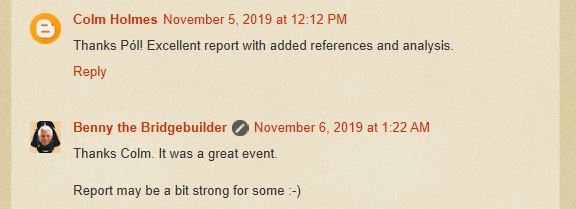
Moreover, Colm Holmes, spokeperson for We Are Church Ireland, who was Master of Ceremonies at the conference, wrote in the comments section of the blog: “Thanks Pól! Excellent report with added references and analysis.”
We Are Church defended the McAleese comments in a statement on its website. Should they not distance themselves from this interpretation? Unless this is a genuine one.

But to repeat what I said at beginning, both Mrs McAleese can easily come out and say that they do not believe John Paul II was condoning rape and they regret such an impression was given. This shouldn’t be such a hard thing to do.

venerdì, novembre 08, 2019

Mary McAleese’s deeply flawed view of baptism and child autonomy


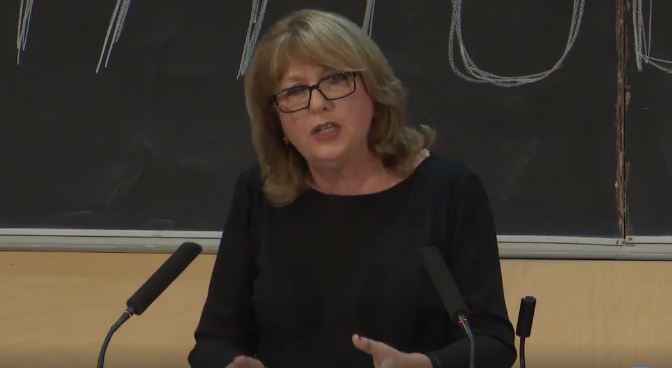
Former President and newly elected Chancellor of Trinity College Dublin, Mary McAleese, has trained her sights once again on infant baptism and the consequent rights and obligations of Christian parents to raise their baptised children as Christians. She did so while delivering the annual Edmund Burke lecture in Trinity the other night.

Dr McAleese advances a model of child autonomy that would curtail these rights and obligations and ‘free’ the child at an earlier age to accept or reject the religion of their family.

Crucially, what she doesn’t make clear is at what age a child should gain this right, and what should happen if the parents don’t accede to their child’s demands. Should the State intervene when the child is say 14, and no longer wants to attend religious service? If that is so, then she wants to make the State very powerful indeed. This would have Edmund Burke turning in his grave as he was hugely critical of the way the French Revolution made the State all-powerful in its drive to enforce its vision of society.

In her talk, Dr McAleese drew heavily on the UN Convention on the Rights of the Child (CRC). She said that parents in the past “had the right to baptise, raise and educate their children according to their own faith, convictions and rituals but now [under the CRC] they had an obligation to do so in a manner which respected and facilitated the child’s right to form its own independent and different views when capable of doing so … for their children are and must be free to choose for themselves when capable of doing so.”

She said that the Catholic Church (for some bizarre reasons she calls it the Latin Catholic Church) is refusing to undertake a review of its canon law and to be in full compliance with the CRC.

Dr McAleese claimed that she has no problem with infant baptism per se but she has issues with its consequences under Church (canon) law. Some of those consequences, she asserts, “are not consistent with the child’s right to freedom of conscience, thought and religion including the right to change religion. These rights are understood today differently and that changed understanding has yet to be reflected in canon law.” Unfortunately, she does elaborate on this last point so we don’t really know how canon law should be made more ‘respectful’ of children’s rights.

She focuses on the fact that canon law includes “the imposition of lifelong membership which can never be rescinded”. She compared baptism to a contract, saying that onerous contractual obligations might be rendered to be voidable by the child when he has the maturity to do so, with full knowledge and consent, while the Church offers no such option to adults or to children.
But we all know people who have left the Church, even at a young age, embracing another faith or no faith at all. They didn’t breach any contract and they have no obligations towards their former Church. This happens every day with no legal consequences of any sort.

Dr McAleese correctly states that canon law has a complex system of tribunals, trials, penalties and, in theory, even children between the age of 16 and 18 can be imposed some form of mitigated penalties. But, seriously, how many children does she know in Ireland that have been tried and found guilty of schism, heresy or apostasy?

Canonical trials generally only take place when the person has a specific public role in the Church. For instance, if someone is a priest, or lectures in theology, and publicly repudiates the Catholic faith.

It is not clear if McAleese is expecting canon law to facilitate the process of apostasy for children, maybe through some formal recognition, which would be an absurd demand. But, in any case, the Church has no means to stop someone from leaving and it would be against its teaching to force anyone not to follow their conscience.

Mary McAleese's attack is problematic in many respects. Firstly, one wonders if this constant criticism of the religious beliefs of a large part of the Irish population fits appropriately with the dignity and the responsibility of a former president of Ireland.

Moreover, her attack to Catholics can be easily extended to other religious faiths, as all of them educate their children according to beliefs of the parents. Is teaching the Koran and expecting young believers to follow the tenets of Islam a breach of the human rights of young Muslims?

Unless she is targeting only Catholics, what she writes about baptism and catechesis is true also for any other form of cultural initiation and education of children, including non-religious education.

Nonetheless, she presses on and states: “When canon law says an infant can be held to the fiction of [baptismal] promises it did not make and never had an opportunity to evaluate, validate or repudiate when capable of doing so, human rights law says ‘no’ it cannot. The current extensive catechesis of obligation whether at home or school or church is problematic as a result”.

Children do not choose to be baptised, of course, but what else do they choose at the beginning of their lives? Nothing significant. Later, as they become more mature, it is the role of their parents to make them more responsible and to involve them in decisions.

Claiming that canon law is ‘imposed’ on them is not different from saying that language, or citizenship, or legislation, or any other expression of a particular culture, are inevitably ‘imposed’ on them because of the choices made by their parents or their community. One day they will be able to reject or accept those choices but how this is a breach of human rights it is a mystery, and it is even more mysterious what Mary McAleese proposes as an alternative, other than giving the State far more powerful to interfere in the lives of religious families and communities.