mercoledì, aprile 18, 2018

The ultra-liberal abortion regime favoured by leading members of Together for Yes


What kind of abortion law does Together for Yes really want? Or to put it another way, what do some of its leading members want? While Together for Yes wants repeal of the 8th amendment and supports the Government’s proposed abortion law as “workable and reasonable”, its leaders want to go even further than this. Some of them support abortion for any reason at any stage of pregnancy.
The Together for Yes campaign is led by three organisations: Abortion Rights Campaign (ARC), the National Women’s Council of Ireland (NWCI), the Coalition to Repeal the 8th Amendment (CR8A). The three co-directors of the campaign come from each one of these three organisations. The Irish Family Planning Association is also a major part of it.
Let’s have a look at what kind of abortion laws these bodies advocated before forming the Together for Yes campaign.
ARC wants abortion available without limit.
Last December, commenting on the recommendations of the Joint Oireachtas Committee, the Abortion Rights Campaign said: “We welcome the recommendation to allow access to abortion without restrictions as to reason. However restricting this to only the first 12 weeks of pregnancy is far from the barrier-free access required to provide women and pregnant people in Ireland with proper, compassionate care. …. ARC’s advocation of free, safe, legal access means no such restrictions or classifications are necessary.” (Our italics).
In their FAQ section we can read: “Should abortion be available on demand?”
“Abortion should be available to any woman who asks for one. The reason, be it health concerns, rape, fatal foetal abnormality, or simply not wanting to remain pregnant, should be an issue only for the pregnant person, her doctor and anyone she wishes to tell.”
So, they want abortion on demand with no gestational limits. This couldn’t be more extreme but we can’t find it on the Together for Yes website.
It is not difficult to find similar positions with among representatives of the Coalition to Repeal the 8th Amendment.
Sinead Kennedy, who was their secretary and is now one of the eight members of the Executive for Together for Yes, was interviewed on Morning Ireland in March. Here is an extract:
Interviewer: “But no protection in law specifically for the unborn up until the point of birth?”
Sinead Kennedy: “Yeah, I think it seems to be a very reasonable proposal, again, putting trust where it belongs”.
So, this representative of Together for Yes believes that the unborn should have no protection in law up to birth. Again, their position couldn’t be more extreme but you won’t see it clearly presented on their website.
The Irish Family Planning Association is part of the International Planned Parenthood Federation, which is a huge provider of abortions worldwide.
On its website the IFPA says: “The IFPA supports the choices of women and girls with an unplanned or crisis pregnancy in all circumstances.”
The National Women’s Council does not appear to support abortion on demand throughout pregnancy but under the regime it seeks (which is very similar to what the Government seeks), very few abortions would be refused in practice.
The public really have a right to know that the leaders of Together for Yes support an extremely liberal abortion regime, and some of them support no limits on abortion at all. The more the public come to know this, the less likely they will be to vote for Repeal.

mercoledì, marzo 28, 2018

It is false to say restrictive laws lead to more abortions


Pro-choice campaigners like to say that the public must be ‘protected’ against misinformation from the pro-life side. But they themselves are guilty of spreading misinformation, for example the claim that countries such as Ireland, which have restrictive abortion regimes, have rates of abortion higher than countries with liberal regimes.
Last week, the Guttmacher Institute, a pro-abortion organisation, released a long report which repeated this misleading claim. It is misleading for reasons I explained in a previous blog post.
The claim is very important in the context of the Irish abortion rate, because if a more restrictive law really did lead to a higher abortion rate, that would be a strong argument against our present law. But, to repeat, in respect of Western countries at any rate, the claim is false.
Guttmacher are definitively wrong with regard to Europe. No European country which has a permissive abortion law has a rate of abortion that is lower than countries with restrictive laws.
Abortion rates are complex phenomena depending on many factors. The legal status of abortion is only one of these factors and there is absolutely no evidence that liberalisation per se brings rates down.
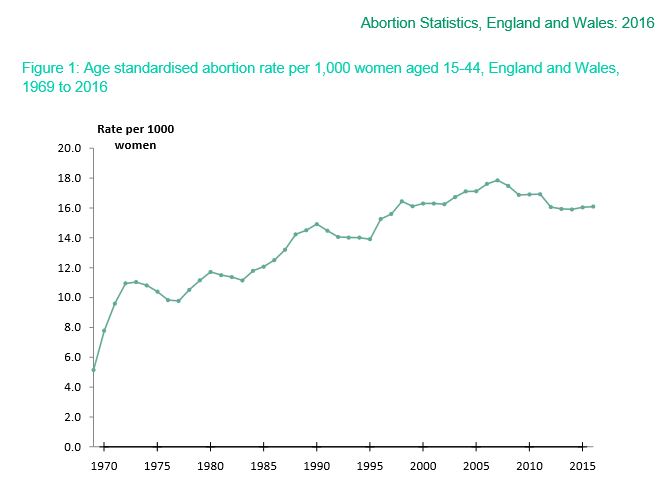
What happened in England and Wales, for example, is quite typical: after legalisation, rates increased rapidly until a certain point and then have been fluctuating slightly. Current rates are more or less the same as 10 years ago, and are higher than 20, 30 or 40 years ago.
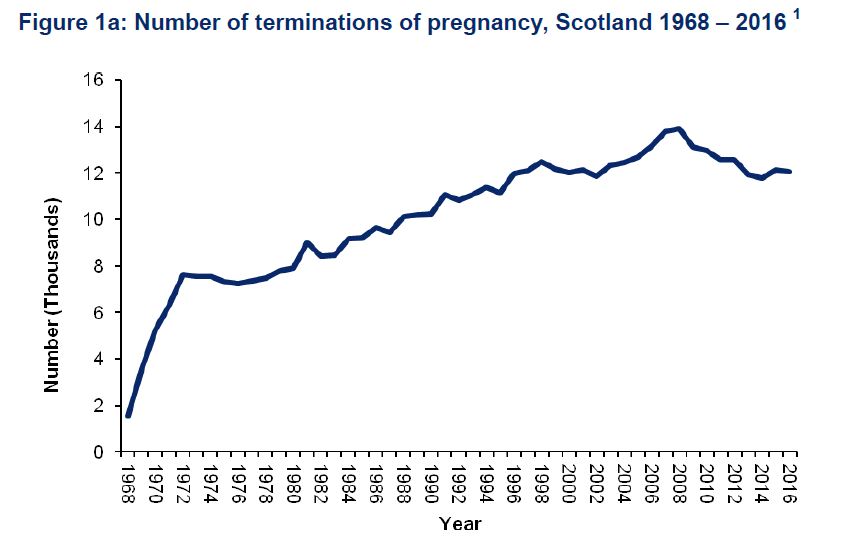
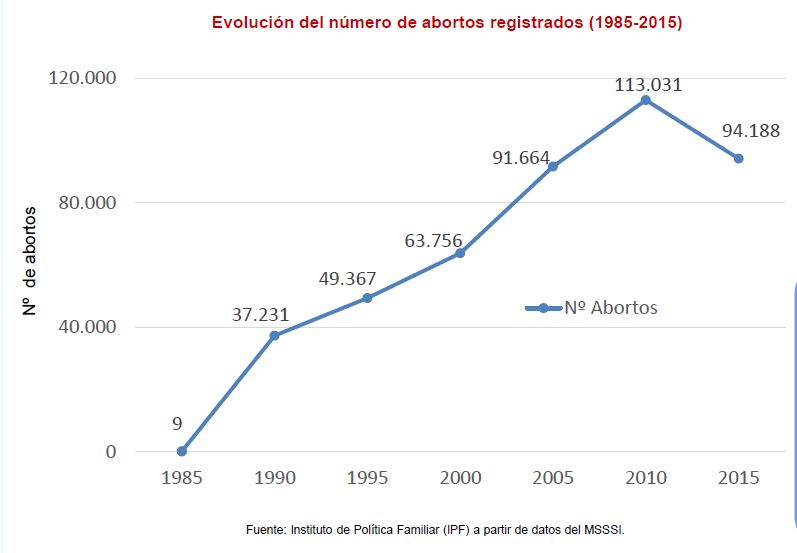
Something similar happened in Scotland, Spain and the Netherlands.
Scotland abortion rates statistics
Spain abortion rates statistics
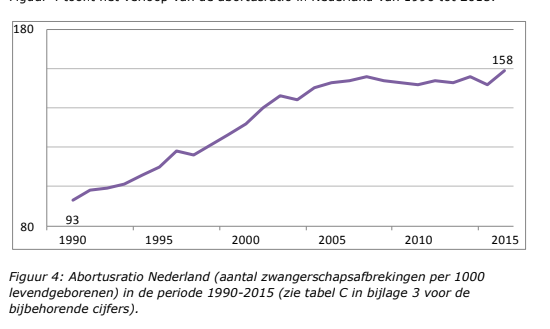
In the Netherlands, there has been a constant increase in the 1990s and since then rates are stable.
abortion ratio netherlands live births
Abortion rates are going down worldwide, particularly in countries that are experiencing economic development.
In the Soviet Union and its satellite allies, for instance, abortion was a form of birth control and their rates were much higher than the rest of Europe. Since the collapse of Communism rates have gone down significantly. Nonetheless, the communist legacy is still present and only Poland, where the current law is quite strict, has now rates lower than the rest of Europe.
In their study, The Guttmacher Institute also perpetuate the erroneous claim that there is some causal link between the availability of contraception and lower abortion rates.
Recent research has proved this is not the case in Nordic countries.
The same claim was presented by the Oireachtas Committee on the Eighth Amendment in their final report where they said that “the introduction or liberalising of abortion in France, Italy and Turkey had reduced the number of terminations, mainly because of post-abortion contraception”.  (3.12)
The official data from the Italian Minister for Health prove the opposite.
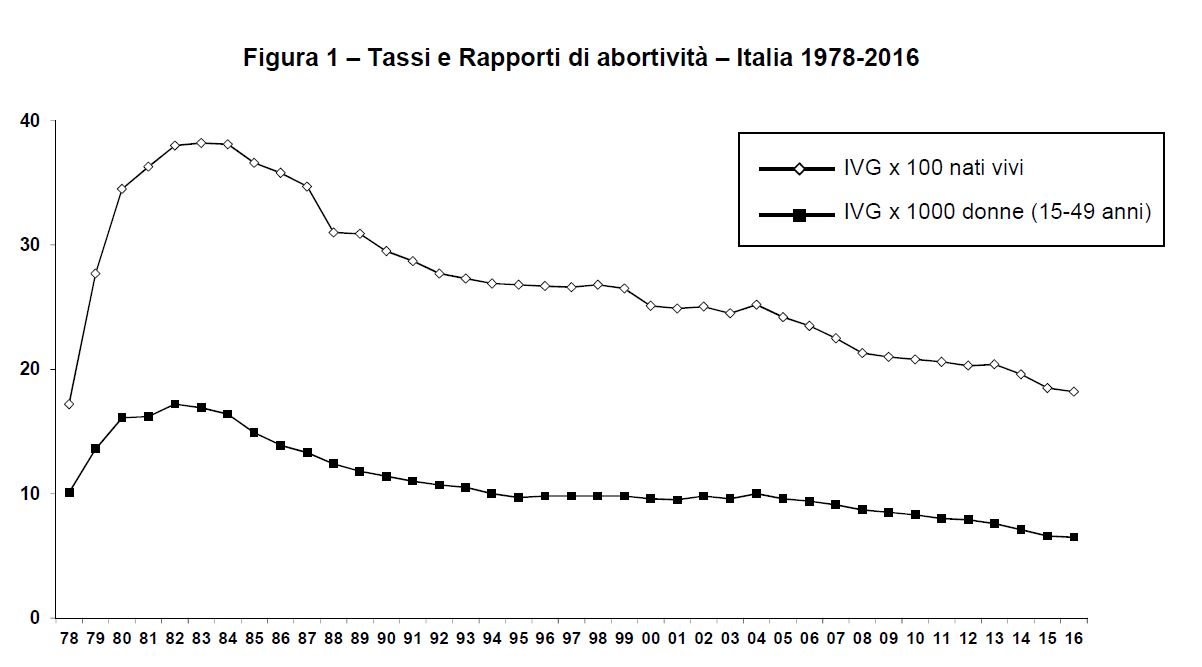
It is true that in Italy, after a peak in the 1980s, abortion rates are going down but there is no correlation with the use of contraceptives.
Italy abortion rates statistics
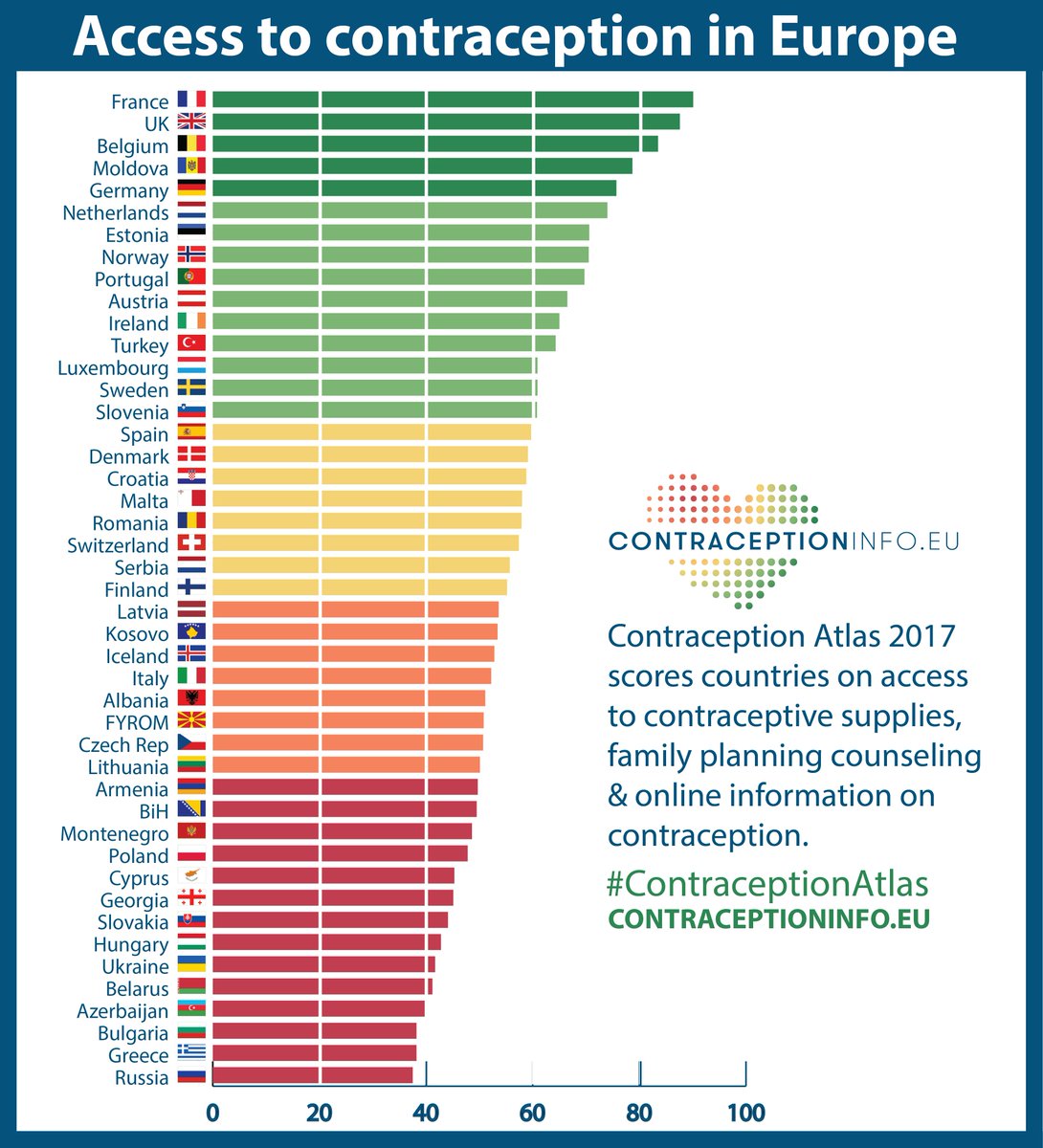
Compared with the rest of Europe, access to contraception in Italy is low. Note how high the UK is in the table below, and also how high its abortion rate is (one pregnancy in every five).
Italy contraception Europe

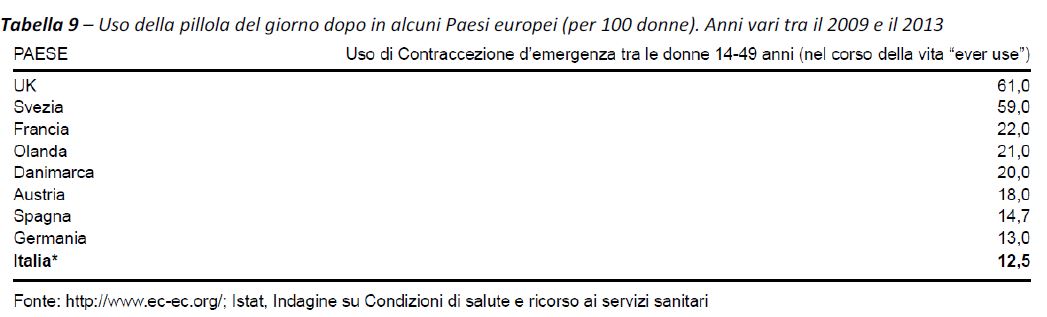
According to a table from the report of the Italian Minister of Health, only 12.5% Italian women used emergency contraception (the morning-after pill), compared to 61% in the UK and 59% in Sweden. If the number of abortions went down since the 1980s is not because of contraception.
Emergency contraception Europe Italy
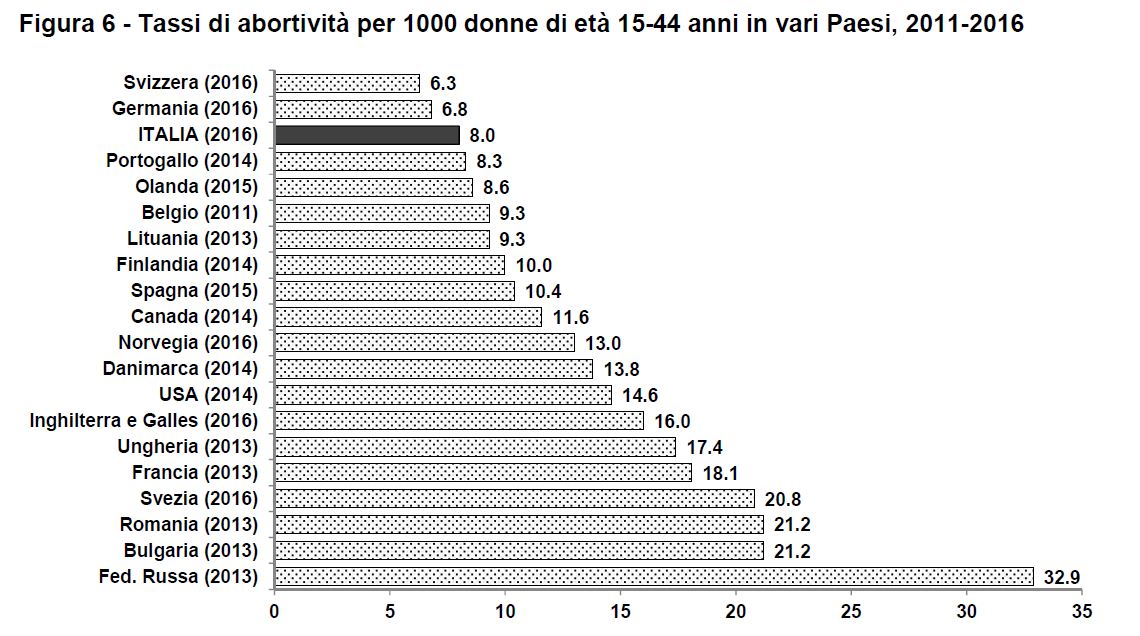
If we exclude countries with restrictive abortion laws (Ireland, Poland, Malta), Italy has among the lowest rates in Europe. Lower than the Netherlands, than the UK, significantly lower than the Scandinavian countries that are always presented as models.
Italy abortion Europe
So why are the Italian abortion rates significantly lower than those of countries where contraception and contraception information is more accessible?
There are many cultural and sociological factors to be considered but family structure seems to play an important role.
The official report (p. 128) suggests that young people are somehow protected from risky behaviour as they leave their homes later, compared to other countries. Cohabitation, which means more precarious family arrangements, is also less prevalent.
Italy has also a very high percentage of conscientious objectors (more than 70% of doctors), a sign that a significant portion of society rejects abortion.  (See https://ionainstitute.ie/abortion-rights-activist-target-conscientious-objection-with-false-information/)
If the Irish Government really wants to reduce the need for abortion, they should not rely on policies that have failed elsewhere but rather promote a strong family model.

mercoledì, marzo 14, 2018

The goal of medicine: heal, never harm


On his radio show last week, Sean O’Rourke hosted two doctors with opposing views on abortion. The debate went right back to medical first principles; what is medicine for?
Dr. John Monaghan, a recently retired obstetrician who delivered more than 10,000 babies over his career, said that everyone in his position had to terminate pregnancies for strictly medical reasons, sometime in their work. This is permitted by the law. The 8th amendment is not an impediment to interventions aimed at saving the life of the mother, even if the inevitable and unintended consequence is the death of her child.
Dr Mark Murphy, a GP representing “Doctors for Choice”, supported the Government’s proposal to allow abortion with no restriction as to reason and claimed that there are hundreds of health care professionals who are willing to facilitate the new regime.
Dr Monaghan replied that “the first rule of medicine is primum non nocere”. (‘First, to do no harm’).
He said: “If a woman requests an abortion which is not medically indicated, then I don’t think the doctors are the people that should be undertaking that. It’s not health care.”
Dr Monaghan believes that doctors should do only what is medically indicated. Their role is not to satisfy a patient’s demands, particularly if there is another patient involved. Terminating a pregnancy, and therefore a life, for non-medical reasons is not medicine and doctors shouldn’t be involved at all.
The discussion moved to the issue of conscientious objection, and whether doctors who don’t agree with abortion should be obliged to refer the woman to a pro-choice practitioner, which is a form of indirect participation.
“What he [Dr Murphy] is talking about is not health care.” Dr Monaghan said, “this is a termination of pregnancy in a healthy woman and a healthy child. The difference between Dr Murphy and myself is that I am allowing rights to the unborn child, as we just found out the only thing that gives child rights is the constitutional amendment that we are talking about removing.  But I allow rights to the unborn child and Dr Murphy doesn’t.  …. To oblige a doctor to refer a perfectly healthy woman with a normal pregnancy, to another doctor, who would provide her with an abortion, to me is ethically repugnant.”
To this Dr Murphy replied, in effect, that these women are not healthy because they are “in crisis”.
This is a strange definition of health. Is stress really to be counted as an illness? Is performing an abortion an adequate and proportionate response to this? Is it necessary? Is it the only thing possible? It seems that at the core of the abortion debate different conceptions of medicine are opposing to each other.
What we see here is the definition of ‘health’ being stretched beyond breaking point in order to present abortion as a form of ‘healthcare’. But it is a form of ‘healthcare’ that cannot point to an actual diagnosable illness that can be cured in no way other than by abortion, and as such is not healthcare at all. Given that the ‘cure’ is the killing of another human being, it simply cannot be counted as medicine.

venerdì, marzo 09, 2018

No Catholic with a well-informed conscience could vote for abortion


Can a Catholic with a well-informed conscience vote in favour of abortion? A question of this kind was put to Bishop Alan McGuckian, on Wednesday on RTE’s Morning Ireland. The short answer is no.
The teaching of the Catholic Church on abortion is clear. Direct abortion is always wrong because, as the Catechism says, “human life must be respected and protected absolutely from the moment of conception.” (2270)
Abortion is wrong, not simply as a personal choice but also for society and this is why it should not be tolerated. The Catechism unmistakably claims that “the inalienable right to life of every innocent human individual is a constitutive element of a civil society and its legislation”. (2273) Without the right to life there is no proper civilization and no justice.
The teaching of the Church on abortion has been reaffirmed in many documents and contains no ambiguity or room for dissent. The direct and intentional killing of an innocent human being before birth is always wrong and should not be permitted by the law. The Second Vatican Council calls it an abominable crime.
Some Catholics, particularly politicians, support legislation that permits abortion. In some cases, they even support abortion as a right.
Can they do in good conscience? No.
By conscience we mean the sense of right and wrong, but also the obligations that follow from our understanding of what is right and wrong.
The Catholic Church teaches that conscience must be well informed, which means that Catholics (and everyone else) have to do what is possible to educate themselves in order to understand what is just and what is not. It also means that Catholics should search proper guidance, follow good examples and listen to the legitimate authorities.
Nobody should be forced to act against their conscience, the Church teaches, and it is true that a person could carry out a wrongful act with a clear conscience because they have mistakenly concluded that the act is right. But no one with a properly informed conscience could do this because they would know what they were considering is wrong.
Conscience has rights because it has duties, Cardinal Newman famously said, and one of them, for those who claim to be Catholic, is to follow the principles of natural law and of Christian ethics.
A Catholic who is well-formed and has properly understood the doctrine of the Church on abortion can’t appeal to freedom of conscience to dissent from a clearly defined teaching. It is a matter of consistency.

mercoledì, febbraio 28, 2018

Why our abortion law would be more permissive than the British law

Our new video points out that the abortion law currently being proposed by the Government goes even further than the already very permissive British law. The British law means one in every five pregnancies there ends in abortion each year. Here we will set out exactly how what’s on offer in Ireland is more permissive than the British law.

To summarise before going into the detail; at no point in Britain is abortion permitted “with no restriction as to reason”. Here in Ireland the proposed law would permit abortion for any reason up to 12 weeks. It is during the first 12 weeks of pregnancy that more than 90pc of abortions take place.
After 12 weeks, our law would strongly resemble the British law which, as mentioned, is so permissive that one in five pregnancies end in abortion in Britain annually.
Now for the detail. In Britain, abortion is permitted until 24 weeks of gestation on five grounds:
  1. The life of the mother is at risk;
  2. To prevent grave permanent injury to the physical or mental health of the mother;
  3. There is a risk of injury to the physical or mental health of the mother;
  4. There is a risk of injury to the physical or mental health of any existing children of the family:
  5. When the child suffers of physical or mental abnormalities.
In 2016, 97% of abortions in England and Wales were performed on ‘mental health’ grounds. Two percent were for abnormalities.
(Here the official report: https://www.gov.uk/government/statistics/report-on-abortion-statistics-in-england-and-wales-for-2016 )
In extreme circumstances, which accounted for 0.1% of the total number of abortions in 2016, terminations are also permitted after 24 weeks on grounds A and B.
Let’s compare this with what the Irish government has proposed.
Health Minister Simon Harris’s proposal follows the recommendations of the Joint Committee on the Eighth Amendment to the Constitution. The big recommendation is that abortions should be permitted “with no restriction as to reason [our italics] provided that it is availed of through a GP-led service delivered in a clinical context as determined by the law and licensing practice in Ireland with a gestational limit of 12 weeks”. (2.40)
The Bill would allow abortion on physical and mental health grounds, if “the foetus has not reached viability”. This is not dissimilar to the British law which permits abortion on ‘health’ grounds up to 24 weeks.
The Bill, following the Committee recommendations, would also allow abortion without any limit if “there is present a condition affecting the foetus that is likely to lead to the death of the foetus either before birth or shortly after birth”.
In one respect only is the proposed law less permissive than the British one; it does not list non-fatal disabilities as a ground for abortion. But this is smoke and mirrors. As in countries like Germany, those abortions will be performed on the ‘mental health’ ground, with no gestational limits.
The proposed law also says that before 12 weeks there should be a waiting time of 72 hours between a woman seeing a doctor and having an abortion. This waiting period does not exist in the UK.

venerdì, febbraio 23, 2018

Proposal for a GP-led abortion ‘service’ is impractical as well as unjust


Minister Simon Harris wants GPs in Ireland to be the main providers of abortion, and to prescribe the abortion pills to women ‘with no restriction as to reason’ in the first 12 weeks of pregnancy. The vast majority of abortions take place during this time frame.
It is hard to believe he has thought this through properly because his proposed system seems to be unique both in terms of the extent to which it will be GP-led and how late into the pregnancy GPs will be able to prescribe the abortion pill.
The Netherlands is a country that is often portrayed as a model by the pro-abortion side. Last November the Dutch government withdrew a bill that would have permitted the prescription of those pills until six weeks and two days of gestation. After that period, according to the Dutch Department of Health, “the effectiveness [of the abortion pills] decreases and the chance of complication increases”. Only hospitals and clinics currently provide abortion pills.
The bill was rejected on the basis that it would have increased the abortion rates, which have already gone up since 1990. A new similar bill has been proposed again this week by opposition parties, but there seems to be no intention from the government to support it.
In Sweden, which is another country often presented as a model by pro-choice activists, the abortion pill can be given out only in clinics or hospitals, as they have to carry out an ultrasound beforehand and ascertain the age of the unborn child to make sure that a medical abortion is suitable.
In Australia, since 2012, accredited GPs can prescribe abortion pills up to nine weeks gestation but only 1.5% of them have obtained a certification to do this. A recent study investigates the reason for such a low participation.
Apart from obvious ethical motives, there are practical reservations. Some were concerned about it dominating their work or about the “negative impact provision may have on their practice reputation and how this might change the family-focused practice they aspired to run”. Some practitioners didn’t want to be known as the “abortion doctors” and being inundated by requests, particularly coming from patients they wouldn’t know.
Seventy-five percent of the doctors who participated in the study believed that existing abortion clinics should continue to provide the ‘service’.
Some GPs noted that it is too complicated to provide a proper assistance due to logistical constraints with accessing the pills, coordinating ultrasounds and setting up links with hospital for referral. Doctors “had practical experience of the difficulties establishing procedures and accessing supporting services such an ultrasound in general practice settings”.
They found it arduous “to organise an ultrasound in a timely manner and order anti-D immonuglobulin for women who were Rhesus negative.”
These reservations were expressed in a context where abortion is already provided extensively by hospitals or clinics. One can easily imagine how unworkable would be the model proposed by Minister Harris, where GPs are the primary providers.  A model that doesn’t exist in other countries.
The impression is that this Government, and Minister Harris in particular, have not really considered the full implications of their proposal. In the rush to have a piece of legislation available before the referendum, they simply are implementing the recommendations of the Joint Committee.
It’s no wonder the National Association of General Practitioners has strongly objected to Minister Harris not consulting with them on the proposal.

mercoledì, febbraio 07, 2018

A conscience provision must fully protect pro-life doctors


Minister Simon Harris has pledged to allow doctors to conscientiously object to providing abortion pills, in the event of the pro-life amendment going. But how much protection is he willing to allow? For example, will doctors opposed to abortion be forced to refer women who doctors who don’t oppose abortion, which is a form of facilitation?
Minister Harris said the provision would be based on the Protection of Human Life During Pregnancy Act 2013. What protection of conscience does this provide?
Conscientious objection has been variously defined but it is based on the principle that a medical professional should not be forced to participate, directly or indirectly, in procedures to which they object for reasons of conscience.  Conscientious objection is a human right internationally acknowledged and its provision is a regular feature of laws regulating abortion.
It could be said that conscience is at the foundation of the medical profession and every action should be inspired by a well-formed moral conscience. Conscience-based refusals are particular instances of the exercise of conscience and require a particular protection. In accommodating them, the State recognises that certain issues are highly divisive both in society at large, and among health care professionals in particular.
The Protection of Life During Pregnancy Act (PLDP) 2013 recognises conscientious objection but only up to a point. Article 17.1 says: “nothing in the Act shall be construed as obliging any to carry out, or to assist in carrying out, any medical procedure …. to which he or she has a conscientious objection.“
So far, so good, but two subsections on, there is the requirement to refer. It says an objector should “make arrangements for a transfer of care of the pregnant woman concerned as may be necessary to enable the woman to avail of the medical procedure concerned.” (17.3)
Let’s consider first the positive elements, with regard to conscientious objection, of the PLDP Act 2013.
The provision is broad in scope and regards anyone who potentially might be involved in an abortion. Let’s recall that the Act permits a termination of pregnancy where the life of the mother is in danger (which was permitted under the 8th amendment anyway), but extends this to include women deemed to be suicidal.
Article 17 doesn’t specify precisely which health professionals exempted but it refers to “any”. Also, “medical procedure” is a broad expression and could include the prescribing of any drug, including lethal ones like the abortion pill.
It is good that it does not limit conscientious objection to doctors, or nurses, but to anyone who might be potentially involved. Medicine, nursing and pharmacy are interdependent in health care, and conscience protection should be extended to as many classes of professionals as possible, including students.
However, there are at least two highly problematic elements in this piece of legislation. Firstly, conscientious objectors are obliged to refer to other doctors, when they don’t want to perform abortions. This is a case of indirect participation in abortion that many would find not acceptable. Secondly, the right of conscientious objection is given only to individuals, and there is no way an institution can opt out, including pro-life hospitals, Catholic or otherwise.
In the unfortunate event that the referendum to repeal the 8th amendment passes, the State should assure that the accommodation of access to abortion does not adversely affect those who don’t want to be directly or indirectly involved. Obliging doctors, or any other professional, to provide information of where the service is performed or, even worse, to make arrangements for a transfer of care, means forcing them into an indirect participation to the procedure. (Should a doctor who will not give a person a lethal injection be forced to refer to a doctor who will, if assisted suicide is ever introduced?)
To those who claim that accommodating health care professionals’ conscience-based refusals should not prevent a patient from receiving the procedure they have requested I answer that it is the State, rather than the conscientious objector, that should be responsible for assuring that this happens.
No matter what happens to the 8th amendment, doctors and other medical professionals must be allowed to practice only medicine that truly heals and which does not result in the death of one patient, in this case the unborn child.

mercoledì, gennaio 24, 2018

Down Syndrome and abortion; the facts


The issue of Down Syndrome (DS) and abortion is obviously going to loom large in the referendum debate with justifiable concerns raised that in a growing number of countries a large majority of  babies are aborted once DS is diagnosed in the womb. The concern is that more Irish women will opt to do this if we repeal the 8th amendment. Let’s dig a little deeper into the international situation.
Fintan O’Toole in his Irish Times column this week essentially argues that this concern is overblown.
He says it leaves out the 30-40pc of pregnant women in Britain “who choose not to be screened”. He claims the increase in screening has not wiped out the births of children with DS , and he says the number of Irish women taking this option is “strikingly small”.
In his article he refers to figures from the England and Wales (he says ‘the UK’, but he appears to mean only England and Wales) and the Netherlands. Let’s consider England and Wales first.
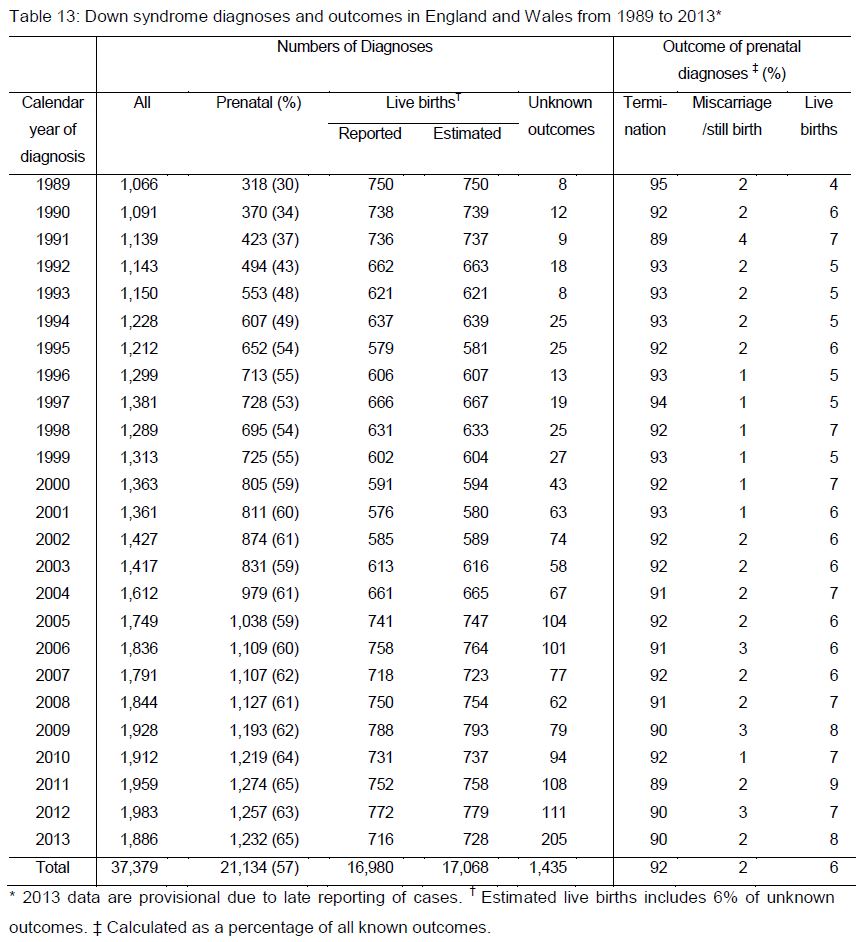
The National Down Syndrome Cytogenetic Register for England and Wales tells us that while the percentage of DS children who are aborted following a prenatal diagnosis has remained stable at about 90pc (a huge figure), their absolute number has significantly increased because the percentage who are being screened has also increased greatly. Fintan O’Toole does not point this out.


In 1989, 70 percent of children diagnosed with Down Syndrome were born. By 2013, this had dropped to 37pc. What happened to cause such a drastic drop in the percentage born alive? The answer is more screening and more abortion. The percentage who opted to abort a child with DS may have been more or less static since 1989 (a year O’Toole refers to in his article), but the number being screened greatly increased from 30pc then to 65pc in 2013 and the number of abortions went from 302 to 1108!
A similar trend can be observed in Denmark, a country with the highest rate of screenings in Europe. In 1989 the number of children with DS born alive came to 62% of the total, which includes postnatal diagnoses. By 2000 this had dropped to 42%, and by 2013 it had fallen to just 14.5%, meaning more than 85pc were aborted (95pc of those diagnosed in the womb) or miscarried. (Here are the official tables from the Dansk Cytogenetisk Centralregister.)
O’Toole notes that in England they decreased from 92% to 90%, without mentioning the absolute numbers, as this is somehow significant, and as a proof that the increase of screenings hasn’t wiped out Down Syndrome children. So 90% is not a wipe out. Do we need to wait until it is 100%, as in Denmark in 2015?
O’Toole also refers to the Netherlands because their case was presented at the Joint Oireachtas Committee on the 8th Amendment.
He points out that the screening rate there is 35%, much lower than the European average. There are historical reasons for this, well explained in this article, but the non-invasive prenatal testing was extended to every woman only in April 2017, after a long public debate, and it is too early to assess its impact.
The Dutch expert told the Committee that the number of children born with Down Syndrome is stable. But, in spite of a lower screening rate compared to other European countries, the percentage of DS children aborted following a diagnosis is still close to 90pc.
Why do some women choose not to have a prenatal test? O’Toole speculates it is because these women “have already decided even if they test were positive they would continue with their pregnancy anyway”.
This may be the case sometimes, but there are other reasons, such as the concern that some prenatal tests will cause a miscarriage. New forms of non-invasive prenatal testing overcome this fear, but we still have to see how the number opting for a prenatal test increases.
Finally, Fintan O’Toole claims that the number of Irish women having abortions in England under Ground E (disability) is small. This is true compared with the very high rate in other countries, but why would we think this will not increase with more prenatal testing and with abortion freely available in Ireland?

See also
Removing the pro-life amendment will lead to widespread eugenics
Official figures badly underestimate number of Down Syndrome abortions
In Denmark 97pc of babies found to have Down Syndrome were aborted last year

giovedì, gennaio 18, 2018

The use of abortion pills by Irish women


The issue of illegal abortion pills was raised a number of times in recent debates following the publication of the Report of the Joint Committee on the Eighth Amendment of the Constitution. How spread is this phenomenon?
Even if some Irish politicians seem to have discovered only recently the availability of abortifacients, those pills have been offered by online services for twelve years, since 2006.  There are two main websites selling abortion pills and I will call them WOW and WHW, to avoid publicising them. What do we know about their use?
The very few studies published on this issue have one great limitation: they are co-authored by the providers of the abortion pills and so their data cannot be verified independently.
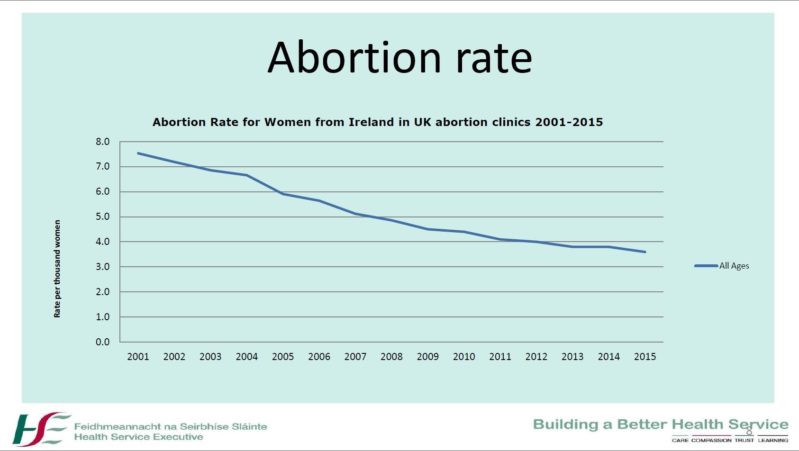
Based on those studies, pro-abortion activists talk of three women per day, about 1,000 per year, taking those pills in Ireland, although estimates vary.  In one of my previous blog entries I have shown that even if we assume double this number of Irish women are using the abortion pill nonetheless the Irish abortion rates would still be significantly lower than nearby countries with liberal laws.
How are those pills accessible? After an online consultation, the two drugs (mifepristone and misoprostol) are dispatched by mail. This might result in seizure by the Irish customs authorities. Although obtaining those two drugs is not illegal under Irish law, using them to procure an abortion is a criminal offence. No one has ever been prosecuted, however.
There is an assumption that the abortifacients will be consumed by women in a crisis pregnancy, but they could be obtained also by a disgruntled partner, an abuser, or a sex trafficker, with the intent of procuring an abortion without the woman’s knowledge or consent.
According to WOW, the main website offering abortions pills, in recent years the number of pills ordered online has grown, and in 2016 there have been 1,748 online consultations from Ireland and Northern Ireland combined. (Note: the fact that they were ordered does not necessarily mean they arrived and were used effectively.)
This upward trend is somehow in contrast with data provided to the Medical Independent by a more reliable source, i.e. the Health Products Regulations Authority (HPRA). According to those figures, the number of tablets detained in 2016 (536) was almost half of those detained in 2014 (1,017). In 2015 the number was 850. It is that the number of pills ordered has, in fact, declined, or it is that the authorities are not so diligent anymore about apprehending them?
It is interesting to note that according to the statistics based on self-reports, the majority (54.3%) of requests come from women who have used contraception. The final Report of the Joint Oireachtas committee noticed this (even if they got the figure wrong) while at the same time, paradoxically, recommended free contraception to avoid crisis pregnancies.
The alleged growing use of abortion pills has been presented as an argument to regulate the practice, rather than to prohibit it. But the same could be said about any kind of illegal substance currently available on the internet or from criminal dealers. Obviously, their administration would be safer under medical control, but should we then decriminalise any kind of drug, knowing that they are harmful? Apart from the fact that they cause abortion, and therefore always harmful for the one who is killed, there are concerns for the health of the women that use them. (See this comment of the Lozier Institute about of their safety:   https://lozierinstitute.org/rewires-reckless-push-for-mail-order-mifeprex/)
Moreover, according to the Medicines and Healthcare products Regulatory Agency (MHPA), the number of illegal abortifacients seized in the UK has risen exponentially since 2013. This proves that even if Ireland had the same abortion regime of the United Kingdom, the problem of illegally obtaining abortion pills won’t necessarily disappear. In fact, the main organisation that sends abortifacient pills to Ireland (WOW) offers the same service even in countries where abortion is legal, such as the UK.
BPAS, the main abortion providers in the UK, are campaigning to make the domestic use of those pills legal. If abortion is normalised in Ireland, soon or later there will be a similar call here.

mercoledì, dicembre 06, 2017

In Denmark 97pc of babies found to have Down Syndrome were aborted last year


In Denmark in 2016, 133 out of 137 babies found before birth to have Down Syndrome were aborted. That is 97pc of all diagnosed cases. Carsten Sondergaard, the Danish ambassador to Ireland, has written to the Oireachtas Joint Committee on the Eighth Amendment to tell them Denmark does not have an official policy to eradicate Down Syndrome, but given that rate of abortion, they might as well have.
The Ambassador told the Committee that “in 2016 there were four children born in Denmark with Down Syndrome after prenatal diagnosis and there were 20 children born with Down Syndrome diagnosed after birth”.
But he did not tell the Committee that while four were born following a diagnosis of Down Syndrome, 133 were aborted, a huge omission.
Last year a total of 157 women in Denmark became pregnant with a Down Syndrome baby. As the ambassador points out, 20 were born because no prenatal diagnosis was received, and another four were born despite the prenatal diagnosis.
To put it another way, while 97pc of babies found to have Down Syndrome while still in the womb were aborted, 85pc were aborted overall, still a staggering total.
In 2015, only one baby found to have Down Syndrome while in the womb was born out of the 144 scanned, so 99.3pc were aborted!
(Here are the official tables from the Dansk Cytogenetisk Centralregister, Aarhus University Hospital.)
Today 97 per cent of pregnant women have a prenatal test for a chromosomal abnormality (not just Down Syndrome) and 95 per cent of them choose to have an abortion when such an abnormality is found.
The figure is official and can be seen on page 6, (note 4) in the 2017 Guideline for Foetal Diagnosticproduced by the National Board of Health.
These data speak for themselves and are utterly damning and the members of the Committee on the Eighth Amendment should be aware of them and not fixate on whether the elimination of babies with fetal abnormalities is official Danish policy or not.