
giovedì, ottobre 26, 2017

Peter Boylan is wrong about abortion rates going down when law liberalised


Two doctors, one of them being Peter Boylan, told the Oireachtas Committee on the Eighth Amendment last week that when a country’s abortion law is liberalised, abortion rates decline. This is not true.
Abortion rates and trends vary considerably by geographic region. In discussing Ireland, we should look at countries that are socially and culturally closer to us and base our expectations on what happened there.
This might true in some developing countries but in Western countries there are plenty of examples that show the opposite.
Let’s consider our neighbours. In England and Wales following liberalisation of the law in 1967, abortion rates grew enormously as the chart below shows.
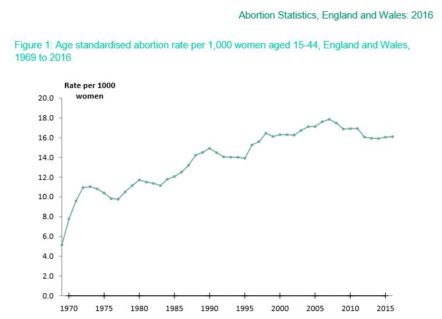
Source: UK Department of Health, accessible here.
The same happened in Scotland. Rates jumped enormously at the time of liberalisation.
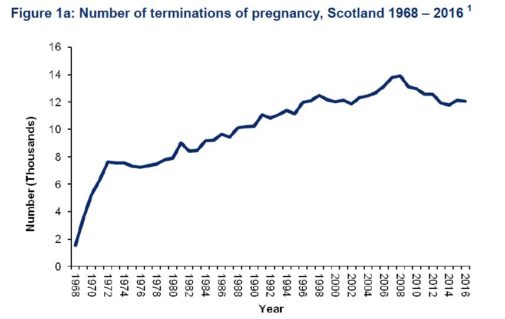
Source: NHS National Services Scotland, accessible here.
The Netherlands is a country that is often presented by pro-choice advocates as a good example in term of abortion rates, sexual education and access to contraception.
Dr. Meabh Ní Bhuinneáin, answering a questions after her presentation, claimed that the Netherlands is one of those countries “where abortion rates have fallen.”
That is not correct. Quite the opposite, in the last 15 years the abortion rate has gone up, according to the official report.
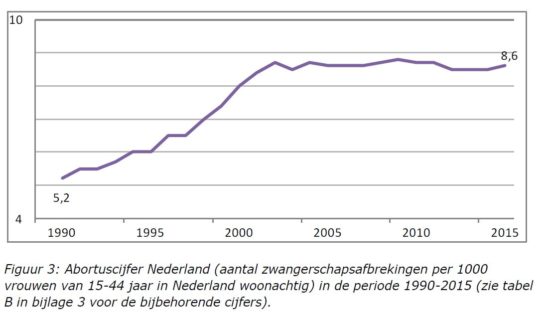
Source: Minister of Health, accessible here.
Abortions rates are falling in some countries, for a variety of reasons, but not because of a more liberal regime. No country with liberal laws has an abortion rate lower than countries such Ireland, Poland and Malta, which have restrictive laws. (I have covered this topic here).
It is not the first time Dr Boylan makes incorrect claims about abortion statistics.
For instance, in a recent interview with Eamon Dunphy that you can listen here he said: “The interesting thing is that in countries that we regard perhaps as the most liberal legislation, places like Denmark and the Netherlands, they have extremely low rates of termination by comparison with the instances that you have mentioned.” He and Eamon Dunphy had been discussing Britain and the United States.
The percentage of pregnancies ending in abortion is actually higher in Denmark than in Britain or in the United States. Here you can find a comprehensive comparative table.
Denmark, as other Northern countries like Sweden or Norway, provides the kind of sexual education and access to contraception that pro-choice advocates favour and still has higher abortion rates than Italy, Portugal, Germany or Switzerland. The Scandinavian countries can be hardly taken as good examples.
These doctors need to revise their claim that liberalisation of the law leads to lower abortion rates when the facts show something very different.


mercoledì, ottobre 18, 2017

Masters of two main maternity hospitals want law to permit abortion of disabled babies


The Masters of the two biggest maternity hospitals in the country have both declared their support for abortion where a child suffers either from a fatal or a non-fatal foetal abnormality. If implemented, this would mean that unborn children suffering from conditions such as Down Syndrome could be aborted in Irish hospitals.
The two Masters were Professor Fergal Malone of the Rotunda Hospital Dublin, and Dr Rhona Mahony of the National Maternity Hospital. Last week they appeared before the Joint Committee on the Eighth Amendment.
Professor Malone doesn’t want any limits placed on the type of foetal abnormalities that can lead to abortion, or any limits placed on the point in the pregnancy when an abortion for such conditions can take place. He wants abortion in this context decriminalised.
He said it would not be appropriate to provide a list of spe­cific foetal diagnoses that should be considered “eligible” for an abortion but, instead, that “the individuals best placed to make such a decision are the patient and her doctor, without the direct involvement of external agencies”.
Moreover, he did not consider it appropriate to specify a precise gestational age limit in weeks beyond which a pregnancy termination would be illegal because, he said, the definition of foetal viabil­ity is not precise and is likely to change. According to him, the mother and her doctor only should make such a decision, without a legal cut-off.
This practically means abortion on request for any foetal abnormality, without gestational age limit. One couldn’t think of a more liberal regime.
Fine Gael Deputy Peter Fitzpatrick found it “disturbing that the witness refers to the abortion procedure as ‘care’ as it is certainly not care.”  He noted that: “what is meant by ‘care’ is a proce­dure that would lead to the ending of a baby’s life”. He asked at what point it is decided that the baby is no longer the patient. In answering this question Professor Malone continued to refer only to the mother as “the patient”, never mentioning the other patient, namely the unborn child.
Dr Mahony also supported decriminalisation. She didn’t specify on what grounds but quoted without any qualification the Royal College of Obstetricians and Gynaecologists in the UK which recently voted by a large margin in favour of removing criminal sanctions that still cover some abortions in Britain, for example, late term abortions except in cases of disability.
She claimed that an error in clinical judgement regarding the real and substantial risk to the life of a woman, which would qualify for a legal abortion in Ireland, is potentially punishable by a custodial sentence of 14 years for both the mother and her doctor if an identified risk is deemed not substantial enough.  “I believe that the definition of substantial risk to life can provide problems for doctors who are worried that if they make a wrong clinical decision, a custodial sentence of 14 years is hanging over both them and their patient.”
But when challenged by Senator Ronan Mullen, she admitted there has been no case law of doctors being prosecuted in Ireland and “one or two cases where doctors have been accused of inappropriate termi­nation of pregnancy” in Northern Ireland, were not on their assessment of risk but on a completely different ground.

venerdì, ottobre 06, 2017

Professor Binchy defends equal worth of every human being before Oireachtas Committee on abortion


Professor William Binchy appeared before the Oireachtas Committee on abortion yesterday.  Professor Binchy, an expert in constitutional law, is one of the main architects of the pro-life clause of our Constitution. In his testimony to the committee, he defended the right to life of the unborn and challenged the idea that under our international law commitments, we must liberalise our abortion regime.
Human rights, he explained, are based on the inherent and equal worth of every human being. “Human beings have human rights, not because they are given by legislators or courts, but by reason of their humanity.” Commenting on the recommendations of the Citizens’ Assembly, he claimed that, if accepted, they would make lawful to take the life of a child on request, with no restriction as to reasons, and also where the child has a significant foetal anomaly. If human rights are to have any meaning, one human being should not be entitled to choose to end the life of another, innocent and defenceless, human being. The idea that our law should authorise the taking of a child’s life with “no restriction as to reasons” is, frankly, abhorrent to any civilised society.”
Speaking of children with disabilities, professor Binchy remarked that “terminating the life of a disabled child because of the child’s disability is not consistent with respect for the child’s equal right to life.” Our society has been founded on the value that no one has the right to choose to hurt, let alone kill, another innocent human being – professor Binchy claimed -but the “right to choose” philosophy, fully embraced by the Citizens’ Assembly implies, the right to take the life of another human being, with “no restriction as to reasons”, on the basis of the supremacy of choice.
The international human rights treaties which Ireland has ratified do not provide for a right to abortion, according to the Trinity academic. If they were in conflict with the Irish Constitution they would not have been ratified. Any comment from the monitoring committees of the international treaties does not change the meaning of the treaties. Their members, Professor Binchy maintained, are earnest supporters of the “right to choose” philosophy and Ireland doesn’t have to change its Constitution to get it in line with their views.
Commenting on the submission of the Irish Human Rights and Equality Commission, of which he was a member for two terms, he noted that if the proposals were implemented, they would involve abortion with little or no restrictions in practice, i.e. a regime of abortion on demand. “Throughout its Policy Document, the Commission never addresses the entitlement of children before birth to be protected from having their lives ended. It offers no reasons why such a profound discrimination against them should be proposed. Alarmingly, it presents no objections from a human rights perspective to late term abortions.”

martedì, settembre 26, 2017

How ‘safeguards’ aimed at limiting assisted suicide are collapsing


“Is it time we talked about euthanasia?”, an Irish Time article asks. Yes, it is and it is also time to show what happens when a country legalises euthanasia or assisted suicide. We can see, for example, how the number of deaths by assisted suicide has been rapidly escalating in Belgium and the Netherlands.
We can, in addition, see that euthanasia or assisted suicide are usually introduced on seemingly very limited grounds and in a short matter of time these grounds are widened to non-terminal conditions such as “unbearable pain and suffering”. This is a common pattern.
These developments should be taken note of in months to come when they are presented with a Private Member’s Bill by John Halligan TD in favour of assisted suicide.
In the Netherlands, the number of cases of assisted suicide increased by 10% in just one year in 2016 with 6091 reported deaths by euthanasia/assisted suicide.  Since 2006 there has been a huge 317% rise in cases of assisted suicide. In recent years the rate of increase has accelerated. This is true not just for the overall number but also for non-terminal cases.
In 2016, 141 people were killed because of dementia (564% increase since 2010), 60 for psychiatric reasons (428% increase since 2012) and 244 for “advanced age”. Non-voluntary euthanasia, without an explicit request from the patient, is also permitted.
In Belgium euthanasia was legalised in 2002 and in 2014 it was extended to children!
The rate of euthanasia increased significantly between 2007 and 2013, from 1.9 to 4.6% of overall deaths, and it is now significantly higher than the Netherlands where it represents 4.1% of deaths. Both the number and the proportion of the requests granted has increased.
These trends have raised serious concerns regarding the changing role of health care professionals, who are now required to kill rather than cure and take care. Moreover, there is a suspicion that in some cases euthanasia is performed with the purpose of getting organs from the patient. For instance, in Belgium almost a quarter of transplanted lungs are from euthanised patients.
In Belgium and Switzerland mental illness can itself be a basis for euthanasia or assisted suicide. A study published in 2015 in the British Medical Journal shows that of 100 patients who requested euthanasia for psychiatric reasons not even one was terminally ill. They suffered of mood disorders, post-traumatic stress disorders, eating disorders, autism, etc. The most frequent diagnosis was depression.
The official report from Oregon shows that the most frequent end of life concerns cited by people requesting assisted suicide are psychological rather than medical. They relate to disability and increased dependence. Being a burden on others is more significant than fear of pain.
The problem with euthanasia is that once we accept the idea that we have a right to die, which in fact means a right to be killed, it becomes difficult to limit this right.  Moreover, what is the point of campaigning against suicide, in school for instance, if the state offers it as an opportunity?
These laws “normalise” suicide and they are in fact associated with an increase of suicide in the general population because they tell them that it is an appropriate response to the burdens of life. With time, those practises becomes acceptable, creating social pressure and also expectations on the most vulnerable patients and families.

More information about euthanasia can be found here.

venerdì, settembre 22, 2017

Irish Government happy to promote gay rights abroad but not religious freedom


A delegation from the Irish State’s foreign aid organisation, Irish Aid, is currently in Vietnam promoting gay rights. Interestingly, Irish Aid seems to have nothing to say about the suppression of religious freedom in the Communist dictatorship, never mind other crucial freedoms. Why?
The Socialist Republic of Vietnam controls all aspects of the lives of its citizens, including religion. Government oversight and repression of religious activity, and persecution is very common. Last year, for example, 108 protestant pastors were imprisoned.  Vietnam’s most famous religious leader, Cardinal Nguyên Van Thuán was arrested in 1975 and spent 13 years in prison – including nine years in solitary confinement.
Vietnam’s appalling record on human rights includes no right to life for the unborn.  Vietnam ranks first in Asia for abortions, and among the top five in the world. Every year one million abortions are carried out, corresponding to a rate of 59 cases to 100 live births.
According to its website the purpose of Irish Aid fight global poverty and hunger. It also promotes “equality and respect for human rights”. As an article on its website explaining its visit to Vietnam promoting gay rights says: “Equality and respect for human rights are key values of Ireland both at home and abroad, and remain at the heart of the work of Irish Aid and the Department of Foreign Affairs and Trade. Vietnam is one of Ireland’s key partner countries receiving support through the Irish Aid programme. As part of Irish Aid’s Civil Society support programme, Ireland has been supporting a number of initiatives to facilitate the realisation of rights of the LGBTI community in Vietnam.”
The question arises: if Irish Aid sees fit to promote LGBT rights in Vietnam, why not the rights of religious believers there? Why is Irish Aid being so selective? Are human rights divisible?
Another question arises: why is it that a single-party, authoritarian State like Vietnam finds it less threatening to promote gay rights than freedom of religion? It permitted gay marriage in 2015. The Vietnamese Government knows this will make it appear ‘modern’ and ‘tolerant’ to the Western world. It is part of the official propaganda and Irish Aid certainly seems to be taken in by this.
LGBT rights don’t challenge the hegemony of the State whereas religion does by pointing to a source of moral authority independent of the State. The Vietnamese Government will be well aware of the role religion played in helping to bring about the fall of European communism. Indeed, the Catholic Church also helped to bring down military dictatorships in South Korea and the Philippines.
Little happens in Vietnam that is not approved and controlled by its dictatorial State. It is very wrong of Irish Government agencies to go along with the agenda of the Vietnamese regime in promoting what suits it while continuing to suppress fundamental human rights.

mercoledì, settembre 06, 2017

Katherine Zappone’s madly contradictory views on Church and State


Following a meeting between Catholic bishops and Government representatives last week, Children’s Minister Katherine Zappone, who was not present, told the Catholic Church that it has no right to determine our laws, and that its own teachings ought to recognise a right to abortion. That is quite a double whammy.
According to The Times Ireland Edition, she said: “I absolutely do want to see a referendum on the Eighth Amendment, I think it is really integral to a social justice agenda in order to enable women to have greater choice in relation to the issue of their pregnancy. The Catholic Church has a very strong social justice tradition, and so I would think that in our negotiations discussion with them we need to draw on that social justice tradition to ensure it extends to women’s ethical choices in relation to their reproductive capacity. I respect the tradition, I think they need to voice their views, but I also believe and know that those views were to influence their own members. They cannot determine the laws of the land,” Ms Zappone said.
These comments raise a number of questions.
If Ms Zappone believes that the Bishops should influence only their own members, why were they invited by the Taoiseach to present and discuss their views with representatives of the Government, including the Taoiseach. Does she believe the meeting should never have happened?
Would Minister Zappone tell any other part of civil society that they cannot attempt to influence the laws of the land? Would she say it to Amnesty Ireland, for example, which is campaigning to have abortion made legal on wide-ranging grounds? If not, why single out the Churches? Are religious groups less entitled than others to contribute to democratic debate?
Additionally, if the Minister wants the separation of Church and State then it is not her role to tell the Catholic Church what to believe. (On the other hand, as citizens we all have a right to seek to determine our laws, whether we are religious or not). To demand that the Catholic social justice tradition should extend to women’s ‘ethical choices in relation to their reproductive capacity’, which is another name for abortion, is an unjustifiable interference in contradiction with the principle of separation.
Moreover, suggesting that the Catholic social justice tradition could somehow justify the legalisation of abortion negates the long established Catholic teachings on the profound injustice that abortions imply.
It is at the same time ironic but also tragic that the person calling on Catholic bishops not to stand up for unborn children is the Minister for Children.
In the USA, the country of origin of Ms Zappone, abortions can be performed until birth. As she is actively promoting a referendum to liberalise abortion, it would be interesting to know if this is the model that Minister Zappone is advocating.

giovedì, agosto 24, 2017

Leo Varadkar should have challenged Justin Trudeau about Canada’s barbaric abortion law


When Taoiseach Leo Varadkar met his Canadian counterpart, Justin Trudeau in Montreal this week, Trudeau presumed to lecture Varadkar on Ireland’s abortion law. There was no evidence of pushback from our Taoiseach despite the fact that in Canada there is no law preventing abortion taking place for any reason right up to birth.
Trudeau said: “On the issue of reproductive rights, I shared our perspective that reproductive rights for women are integral to women’s rights in general, and women’s rights are human rights. And I encouraged him to look at it as a question of fundamental rights for women and we had a good discussion on that.”
Well, we encourage our Taoiseach to look at the Canadian abortion regime carefully. He will realise that it is among the worst examples possible.
In 1988 the Supreme Court of Canada removed abortion from the criminal law because it was deemed an unconstitutional restriction on civil liberty. As a result, it is now possible to have an abortion at any stage up to birth and for any reason. Yes, at any stage and for any reason.
There are professional codes of conduct that in some cases appear to limit abortion-on-demand to 24 weeks and after that permit it only in cases of a risk to the life of the mother or a serious disability, but in practice these codes are easily circumvented.
By way of proof, here is an interview with a woman who had five abortions, one at 26 weeks. Neither she nor her child had any health problem. (She attended a state clinic specialised in handling pregnancies of more than 24 weeks).
There are plenty of other cases of late abortions, when the child could easily survive outside the womb.
In December 2016, a woman sought an abortion at the McGill University Health Centre but the hospital ethical committee denied her request because her pregnancy was at 30 weeks and there was “no threat to the health of the mother or the future child.” No matter, she ended up getting a termination elsewhere in the same province. Her lawyer complained: “Nobody has to assess the merit of her grounds to approve her decision”, asking the college to review their ethical guidelines. In other words, McGill is not liberal enough!
Margaret Somerville, a former professor of Law at McGill University in her book ‘Bird on an Ethics Wire’ recalls two shocking, late-term abortion cases (34 weeks and 32 weeks): “In one, an unmarried graduate student from a Middle Eastern country was thirty-four weeks pregnant with a healthy unborn child and wanted an abortion to save her from ‘disgracing her family.’ In the other, a married couple learned at thirty-two weeks gestation that their unborn child had a cleft palate – correctable with routine surgery – and ‘didn’t want a defective baby’. In both cases, the unborn child was killed in utero and delivered dead, making the intervention that of abortion and not first-degree murder, as it would have been had the killing taken place after birth”. (p. 219)
This is what happens in Canada where abortion is a ‘fundamental right’.
A letter to the Irish Times today claims that in Canada the law states: “No physician in Canada can terminate a pregnancy over 24 weeks without serious indications that the life of the mother is at risk or that the foetus has very serious malformations”. That is not true. It is not the law. It is a quote from a politician who was referring to a professional code of conduct which can, as mentioned, be easily circumvented without consequence.
So, Canada’s abortion law is one of the most barbaric there is. In cases of late-term abortion such as those detailed here, the pregnancy can easily be ended by delivering the baby alive but the law permits these babies to be killed just prior to delivery.
This is the law Justin Trudeau boasts about. It is the law he supports. It is the law he requires all members of his party to support. We do not need to take lectures on ‘human rights’ from this man and Leo Varadkar should have told him so.

martedì, agosto 22, 2017

The ethics of showing pictures of aborted foetuses in public


Some pro-life groups show pictures of aborted foetuses in public. I will try to address three questions: Is this legal? Is it appropriate? Is it effective?
First of all, we need to clarify that the Director of Public Prosecutions has confirmed in a letter that showing the reality of abortion is not illegal under the Public Order Act. 4. Pictures showing aborted human foetuses lying in pieces are extremely disturbing but it is not a crime to use them to inform the public about the real consequences of introducing abortion.
Those images are shocking, indeed, because abortion is shocking. This is precisely the point that those who exhibit them are trying to make. The truth is upsetting, pictures don’t lie. They are not euphemisms or easy slogans. Abortion cannot be sanitised.
Any attempt to normalise a termination of life is easily invalidated by the spontaneous reaction of any ordinary person at the sight of the outcome of that termination, i.e. a dead body. If we still feel disgust there is still hope, it means that our sense of humanity has not been totally suppressed by ideology.
Those who defend the choice of abortion can’t campaign for something so abhorrent and then demand to keep its graphic representation totally outside of the public debate. You can’t be pro-choice and at the same time seek to hide the reality of choosing abortion. Despite this, however, I think there are good reasons for only showing these pictures in public places very sparingly.
It is undeniable, for example, that pictures of aborted foetuses will cause distress to some women who have had abortions themselves. It will also upset others, particularly children.
I believe the only appropriate display of those images is when they are used as part of an information board and their scale is sufficiently small so that only those who are really interested will see them. They can be used to educate the general public but only when the potential viewers have been made aware of what they should expect.
I have seen those pictures shown in large scale at roundabouts or walking paths. I don’t think it is appropriate. It might provoke some discussion and sometimes those conversations change minds but usually it will upset and shock people.
The use of such pictures is also considered by some pro-life groups to be counterproductive. They are generally perceived as extreme by the general public and they don’t serve the cause. This is true. A referendum on the eighth amendment will be won only if those who have middle-of-the-road views can be persuaded and I am not convinced that large picture along the street of aborted foetuses will achieve much. Reasonable arguments, personal stories, positive experiences are, instead, more effective way to persuade.

lunedì, luglio 31, 2017

Medicine is intrinsically ethical

There is no medicine without ethics. Hospitals don’t need to be under church or religious influence but they cannot exist without an ethos.
Medicine has three main purposes: to prevent and cure diseases, and to take care of patients. It is not simply a science but also a practice inspired by ethical values. So, what is the difference with other sciences? Take for instance mineralogy. It is the description of the chemical and physical properties of minerals. Medicine, instead, aims not simply at describing what a human body is but it is also based on the assumption that there is a natural order, which we call health, and the purpose of the medical practice is to keep or to restore this order. There is an intrinsic good (health) that we discover through science and we preserve and reestablish through practice.
For instance, anatomy and physiology tell us what is the proper function of the eyes, i.e. to see. This is not simply a description but it also contains a prescriptive element because the ideal eye is also the normative model that the doctor uses when she acts to keep the patient’s eyes healthy or to prevent their diseases.
This understanding of medicine doesn’t require a particular religious faith but it is nonetheless intrinsically ethical. It is inspired by a certain conception of the good (health) that we find in human nature through the correct use of reason. The principle of “do not harm”, which has guided health care since ancient times, has the form of an ethical imperative.
Not everything that happens (or might happen) in a hospital or a clinic is necessarily medicine, unless it aims at preventing and curing diseases, and also at the same time at taking care of patients.
Not all interventions that alter our bodies surgically or chemically are medicine, even if a scientist (medical expert) might be involved. Getting your facial features surgically changed to look more like your music idol is not medicine. Killing the unborn because she was unplanned or is disabled is not medicine. Augmenting your muscles through drugs to win a weightlifting contest is not medicine. Removing a perfectly healthy organ to adjust your body to your perceived gender is not medicine. Facilitating suicide is not medicine.
In all these examples a certain level of scientific knowledge is necessary but they lack what makes medicine more than a science: the ethical value of health. They might involve someone who has a proper knowledge of the human body but his purpose, in these examples, is not to restore or preserve the good of the functioning body.
They are instances of scientific techniques without ethics.
There is a growing pressure by certain ideologies to transform medicine, which is necessarily lead by an objective good that we call health, into the satisfaction of the subjective requests of the patient.
If bodily autonomy (my body, my choice), rather than health, is the ultimate value then there is no reason why doctor should not amputate a healthy arm or leg, when requested, or administer a dangerous substance, for recreation or self-harm. Without the guiding principle of health, practitioners become simply the executors of someone else’s desires. Obviously, people can do what they want with their bodies but this is not medicine.

There is no medicine without ethics. Hospitals don’t need to be under church or religious influence but they cannot exist without an ethos, without values. When their core value is not health – an intrinsic good indicated by human nature- they don’t serve medicine anymore but trends, ideologies, business.

venerdì, luglio 28, 2017

KINGS KALEIDOSCOPE - Felix Culpa


Turn the lights on, look at what I have See the twisted trophies of a dead man Countless stories, tell of sin and pain But they sing the sweetness of my savior’s grace I’m a torn man, spirit fighting flesh There’s a battle raging deep in my chest But all that haunts me, all that leaves a stain Only sings the sweetness of my savior’s grace A fortunate fall, my sins are stories of grace to recall A fortunate fall, I glory in my sins forgiven Jesus bought me, and now I am His Dying with Him, in His death I now live All my vices, to which I was chained Only speak the sweetness of my savior’s grace And still I’m a wicked, wretched man, I do everything I hate I am fighting to be god, I seethe and claw and thrash and shake I have killed and stacked the dead, on a throne from which I reign In the end I just want blood, and with His blood my hands are stained See the God who reigns on high, He has opened His own veins From His wounds a rushing torrent that can wash it all away Grace upon grace, upon grace upon grace