mercoledì, ottobre 25, 2023

‘Assisted dying’ against best medical practice leading doctor tells committee


Doctors were before the Oireachtas Committee on ‘assisted dying’ last week, representing a group in favour, a group fully against, and a group mainly against. It’s important to note that while this gives the impression that doctors are more or less evenly divided on the matter, easily the biggest representative body in attendance, namely the Royal College of the Physicians of Ireland (RCPI), is totally opposed to euthanasia/assisted suicide.

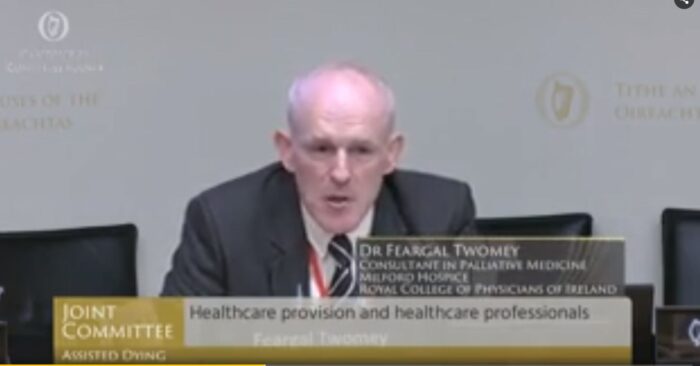
Dr Feargal Twomey [pictured] spoke on behalf of the RCPI, and he told the committee that assisted suicide and euthanasia are contrary to best medical practice. The only true safeguard for seriously ill people is that the law does not change, he said.

The RPCI has more than 11,000 members and is the largest postgraduate medical training and professional body in the country.

He stated: “RPCI opposes the introduction of legislation for assisted suicide because, in our view, it is contrary to best medical practice. It is our view that the potential harms outweigh the arguments that can be made in favour of assisted suicide”.

He claimed that such legislation would undermine the efforts of doctors, nurses and healthcare professionals who deliver compassionate and expert care, “risking a shift away from funding, development and delivery of new and existing palliative care services”.

Dr Twomey reminded the committee that recent analysis of data from countries where so-called “assisted dying” is available shows a progressing broadening of the limits that were initially established by the law. In Canada, safeguards have been systemically eroded. In the Netherlands the extension of eligible groups now includes very sick new-born infants, while euthanasia is available in Belgium to children of any age.

Dr Twomey, who works in palliative care, said that the relaxation of restrictions in Canada and the erosion of safeguards have been frightening. Jurisdictions begin with what is presented as a conservative or moderate approach and then go down a slippery slope.

“My concern about the inability for safeguards to be maintained leads me to say the only way true safeguard is that the law does not change”, he commented.

Dr Gabrielle Colleran and Prof. Robert Landers, representing of the Irish Hospital Consultants Association (IHCA) also expressed concerns about legislative changes. “Ethical considerations must always be paramount in health. The ethical dilemma posed by intentionally ending the life of a patient challenges our fundamental commitment to preserving life and could potentially erode the trust that patients place in our care”, Prof. Landers said.

The IHCA has 3,500 members. Dr Colleran invited the committee to consider a report from the ethics committee of the Danish Parliament earlier this month that recommended against allowing euthanasia because, when it becomes an option, it also becomes an expectation aimed at special groups in society.

A small group called ‘Irish Doctors supporting Medical Assistance in Dying’ also addressed the committee. They claim to have about 100 members, out of 16,000 registered medical doctors in Ireland.

Presenting on their behalf, Dr Brendan O’Shea said that both euthanasia and assisted suicide should be available to adults who are within six months of death or have an incurable terminal condition causing progressive physical deterioration. This last criterion is potentially very broad and has no time limits. Would it include people with MS or Parkinson’s Disease who might be years away from death? Presumably it would. What about dementia patients? Ultimately, it is terminal also. In fact, Dr O’Shea specifically mentioned dementia in his presentation. He spoke about a dementia patient who applied for ‘assisted dying’ in Canada. He was approved. Dr O’Shea did not say he was opposed to this. “At the moment [our italics], we are not recommending that dementia be considered a primary qualifying condition on its own”, he said.

Dr O’Shea estimates that about 1,000 to 1,500 people would avail of ‘assisted dying’ over the next three to four years, if introduced in Ireland. This is guesswork, of course. It could be less, or it could be more. His figure would account for around 1pc to 1.5pc of all deaths in Ireland.

Commenting on the non-medical motivations that could lead to a request for assisted suicide, Dr O’Shea said that “for ourselves, we have to consider the legitimacy of not wishing to be a burden. It is certainly an imperative of a kind society that nobody should have to consider this, but, for me, it is a personal decision.”

This would seem to indicate ‘assisted dying’ should be available on very wide grounds indeed.

venerdì, ottobre 20, 2023

Oireachtas committee hears about Canada’s extreme euthanasia regime


Doctors and disability rights campaigners have presented the grim reality of the Canadian “Medical Assistance In Dying”(MAID) regime to the Oireachtas committee that is considering the introduction of such legislation in Ireland.

In Canada, euthanasia was introduced for the terminally ill only, which is the main proposal currently on offer here, but the ground expanded extremely quickly.

“Do not be Canada”, said Dr Heidi Janz of the Health Ethics Centre of the University of Alberta. Dr Janz is wheelchair bound. She told the committee that MAID was initially legalised in 2016 for people with ‘irremediable medical conditions’ but in 2021 the eligibility was expanded to people with disabilities, whose natural death is not reasonably foreseeable. From next year, those with mental illness as the sole underlying condition will qualify for MAID. All these changes were introduced on the basis that these are all forms of suffering and it would count as discrimination to offer euthanasia only to those who suffer physically or only to those who are dying soon.

“Canada is thus continuing its rapid descent down a slippery slope which many still claim does not exist. And so, I sit before this Committee today to implore you, for the sake of preserving true dignity and true choice for disabled, ill, old, and other structurally vulnerable people in Ireland, do not be Canada.”

Dr Leonie Herx, clinical professor of palliative medicine at the University of Calgary, explained that in more than 99.9pc of cases in Canada the lethal drugs are administered by a clinician. Assisted suicide, when the patient takes the drugs themselves, is extremely rare.

She claimed that MAID has had a profound effect on palliative care. “All healthcare facilities are expected to provide MAID, including hospices, whose core palliative care philosophy does not include hastening death. In Quebec, MAID legislation now requires all hospices and palliative care units to provide MAID. There are no euthanasia-free safe spaces”, she said.

Once legalised, it progressively becomes normal and is seen as a solution for virtually any form of suffering, she told the committee.

An increasing number of Canadians are receiving euthanasia “due to fear, loneliness and depression, social deprivation and isolation, lack of access to supports and adequate care needed for living, lack of access to parole for some prisoners, high cost of care and poor conditions at residential facilities.”

She quoted a former minister for disability inclusion who said that “in some places in our country, it’s easier to access MAID than it is to get a wheelchair”.

Prof. Trudo Lemmens, chair in Health Law and Policy at the University of Toronto, initially supported the first law but now he is troubled by having seen death being offered to patient with chronic illness or disability, often in a context of social disadvantage.

Canada is currently the country with the highest number of euthanasia deaths: more than 10,000 per year.

There are several reasons for this, according to Prof. Lemmens. The access criteria were vague in the legislation and have been interpreted excessively broadly by courts, leading to a constant expansion of those who qualify. Moreover, the fact that the lethal substances are administered by healthcare professionals, gives the false impression that it is part of medical care and makes it more acceptable. Regimes that allow only assisted suicide, such as Oregon, seem to have a lower uptake.

Also, Prof. Lemmens said, MAID is explicitly not treated as a last resort in Canadian law. “Healthcare providers do not need to agree that no other options remain. There is no obligation to make care or support available and try it first. Death has been transformed into first-line therapy for often only remotely disease-related suffering”, he said.

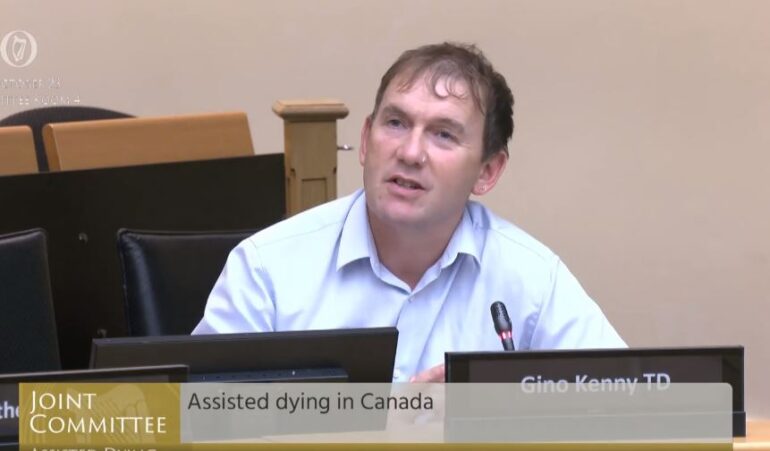
At the previous week’s hearings, pro-euthanasia TD, Gino Kenny (pictured), lambasted one of the witnesses about some of his claims about the Canadian regime. What was he thinking deep down this week after hearing the latest evidence?

venerdì, ottobre 13, 2023

A clash of worldview at the ‘assisted dying’ hearings


The Oireachtas committee on ‘assisted dying’ has met three times in the last two weeks. As usual, the hearings offered useful insights into the thinking of both sides of the divide. What follows are some highlights from the meetings.

Session One

The first session held on Tuesday 3rd October was dedicated to ethics.

Dr Thomas Finegan, assistant professor at Mary Immaculate College Limerick and member of the board of the Iona Institute, told committee members that euthanasia is a violation of the value of life. When introduced in the healthcare system, euthanasia goes against the primary healthcare norm which prohibits the intentional killing of a patient.

“Even if all such future choices were safeguarded from coercion, it would still be the case that the central purpose of healthcare is being overturned or at least severely qualified”, he said.

Euthanasia is often presented as a choice and defended in the name of personal autonomy but if we accept this principle, all attempts to draw a limit in terms of when or by whom it can be accessed will appear as unfair discrimination to someone who is excluded, he claimed.

“Consistency demands that if euthanasia were to be legalised, it would be available on virtually all medical grounds, including, for example, chronic illness, conditions closely associated with disability, experience of suffering – which is inherently subjective and not limited to physical suffering – and mental disorders, once capacity remains,” he said.

Dr. Annie McKeown O’Donovan, from University of Galway, believes that assisted suicide should be permitted but only when death is “imminent”, and the intent is to reduce harm. She also believes that no one apart from the patient should administer the lethal substance, and so she opposes direct euthanasia, which is when the substance is administered by a third party such as a doctor.

Dr Finegan replied that the logic of seeking to minimise harm means that assisted suicide should be offered even more to those who suffer chronic illness and therefore have more suffering ahead of them than those near death.

Dr Kevin Yuill, representing ‘Humanists Against Assisted Suicide and Euthanasia’, reminded the committee that “the inherent problem with any assisted dying legislation is that it is based on a subjective idea of suffering, what it means and who is suffering.” He mentioned the case of a Canadian man who sought ‘medically assisted dying’ because he was homeless.

This prompted a harsh reaction from Deputy Gino Kelly, who accused Dr Yuill and Dr Finegan of using “deeply distasteful and very selective language, to say the least.”

He also demanded evidence on the spot from Dr Yuill to back up his claim about the homeless person, and when Yuill said he could not do immediately, saying he would do so later, Deputy Kenny angrily accused him of not being credible.

But the case Dr Yuill was referring is well known. Mr Amir Farsoud, a disabled 54-year old, applied for ‘medically assisted death’ because was about to be made homeless and had no money. His request was approved by his GP although it needed a second doctor to approve it. It did not go ahead, but from next year in Canada, people suffering from mental suffering will be able to apply for ‘assisted dying’.

In this interview he clearly says: "I don't want to die. But I don't want to be homeless more than I don't want to die".  

https://toronto.citynews.ca/video/2022/10/13/choosing-death-over-homelessness/

Similar cases are emerging, here is another example: https://www.orilliamatters.com/local-news/homeless-hopeless-orillia-man-to-seek-medically-assisted-death-6415189 

recent survey showed that 28pc of Canadians believe that homelessness should be a ground for access to assisted dying.

Also, a recent article in the New Atlantis revealed conversations between Canadian practitioners of euthanasia who believe the procedure should be made available for non-physical suffering.

Session Two

The second session of the hearings last week was devoted to the experience of the United States.

Dr Mark Komrad, a clinical psychiatrist at Johns Hopkins Hospital and a clinical assistant professor of psychiatry at the University of Maryland, told the committee that assisted suicide is not widespread in the US, and there have been 270 failed attempts to introduce such legislation in many states. Nine states have passed laws inoculating themselves against such legislation ever being introduced there in the future, he said.

Where legal, those practices can go terribly wrong. In Colorado, patients with anorexia were prescribed lethal drugs. In Oregon, at least nine patients survived after having taken such drugs.

The other two experts, Dr Tom Jeanne and Prof. Margaret Battin who both support assisted suicide, were a representative of the Oregon Health Authority and a professor of philosophy respectively.

Oregon has been presented as a good model by some who spoke to the committee in the past. Rates seems to be lower than countries such as Canada or the Netherlands, even if the numbers of those who died by assisted suicide have increased more than fourfold in the last five years.

The law allows only terminally ill patients to kill themselves through the self-administration of a lethal drug prescribed by a doctor. Most of them die at home. This seems to make a big difference to numbers because people are much more reluctant to self-administer a poison than to have a doctor do it for them.

Dr Komrad noted that the drugs are not monitored after they are provided to those who have requested them. In one case they were stored in a house for more than four years, with the risk that others might have taken them.

He commented: “The experience with assisted suicide in the US has demonstrated inadequate and mutating guidelines that eventually push beyond the limited scope of the original laws; flimsy safeguards; zealous physicians who do not follow the law … Leading medical organisations have declared this bad medical ethics, and the majority of American legislators have concluded that it is poor public policy. I hope Ireland can learn from our bad example”.

Senator Ronan Mullen mentioned a very recent study from the British Medical Journal which found that 46pc of those who opted for ‘assisted death’ were concerned about being a burden to others.

It also found that in Oregon, whereas in the past most (80pc) of those accessing assisted suicide were using private insurance to cover their expenses, now public insurance is mainly (80pc) covering costs. Assisted suicide in Oregon is covered by Medicaid, the government program that provides health insurance for those with limited income. This change from predominantly private to mostly public funding could explain the growth in number of cases of assisted suicide in Oregon, particularly among the less wealthy.

Session Three

This week, the Oireachtas heard from four witnesses from Ireland.

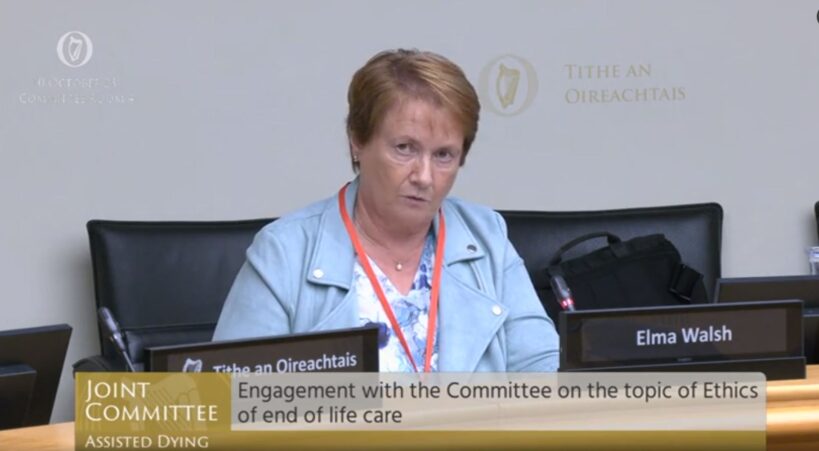
Elma Walsh (pictured), whose son teenage Donal became known in 2013 for his battle with cancer, told the Oireachtas committee of his good experience with palliative care, which allowed him to live the last months of his life as an inspiration for his peers. He visited schools and spoke against suicide, encouraging young people to value life.

Donal died with dignity, the mother said. She cautioned that by removing the present legal ban on euthanasia/assisted suicide the value of life will be significantly reduced.

The other three witnesses support assisted suicide and/or euthanasia to varying degrees.

John Wall, who was diagnosed with a terminal illness, believes that assisted suicide should be available when “it is blindingly obvious that the end is very nigh”.

Tom Curran, whose late partner Marie Fleming lost a Supreme Court case to access assisted suicide in 2013, favours the Swiss model, where a legal drug can be administered by non-medical professionals. He believes that anyone of a sound mind should have that choice, for any reason.

“It is not about aid or about end of life. It is about a choice as to when you feel that your life had ended”, he said.  In the past, he admitted that he had helped Irish people in Switzerland to access assisted suicide.

Garret Ahern, another witness, told the Committee about his late wife Vicky Jannsens who legally took her life in native Belgium, this April after having suffered from breast cancer for ten years. He lamented that it could not have happened here.

Mrs Walsh expressed fear that even a law for limited cases will be extended in the future. “Society must promote hope” she said, “assisted suicide is a statement of no hope. Palliative care allowed Donal to spread a message of hope and reduce the number of suicides. Telling young people that their life is valuable, no matter how uphill it may seem at the time, is important. As Donal said, “Everybody has their own mountain to climb.” Legalising assisted dying is to bring about a clash in society. Life is valuable no matter our age or circumstances. We can all help to fight against suicide by turning our back on assisted suicide.”

Committee hearings continue.

martedì, ottobre 03, 2023

Insurance companies could easily offer euthanasia in the future


The Oireachtas Committee on ‘assisted dying’ continues to hear expert testimony on the matter. Last week it heard from a Dutch academic who was once a supporter but has now turned into a critic. He spoke of how insurance companies in his country are already funding the procedure for one provider, which is a chilling possible glimpse of the future.

The Dutch expert, Theo Boer, who is a professor of healthcare ethics, said the legalisation of euthanasia in the Netherlands has turned our view of suffering, ageing and taking care upside down. The numbers are speeding up and the biggest increase is now in illnesses that are not terminal.

He was initially supportive of euthanasia legislation and now, having reviewed 4,000 cases on behalf of the Dutch government, has become critical of it.

He told the committee that in 20 years the numbers availing of it in his country have quadrupled and, in some neighbourhoods, medically assisted euthanasia account for 15pc to 20pc of all deaths. These figures are underestimated, he said, as a governmental evaluation has found that between 10pc and 15pc of doctors do not report their participation in the programme.

He noted that there has been an expansion in the reasons for euthanasia — from those at the end of a terminal illness, to people today fearing loneliness, alienation and care dependency. Once euthanasia is introduced, why should it be provided only for terminally-ill patients, or for those suffering from physical illness and pain, he asked. Sometimes it is the absence of hope that provokes the suffering, he said.

“That is why we have now a law in parliament that legalises euthanasia for all people over 74 years, with or without an illness. Their age is the only reason they can have assisted dying. That in turn is why we now have a regulation that allows parents to request euthanasia for their young children aged from zero to 11 years old. I am convinced it is only a matter of time before we take the next hurdle, namely, allowing children of dementia patients to request euthanasia for their demented parents”, he told the committee.

The second expert who spoke was Silvan Luley, representing Dignitas, a group that facilitates assisted suicide in Switzerland, where it has been legal since 1942. Currently, about 1,700 per year avail of it. He claimed that Dignitas has almost 100 Irish members and 12 people from Ireland have been helped to kill themselves by his organisation.

Dignitas offers assisted suicide not only to those who are terminally ill but also to anyone who has an “endurable incapacitating disability” or suffers ‘unbearable pain’. Mr. Luley told the committee that fewer than 50pc of those who avail of their assistance are terminal. He explained that they offer a professional alternative to violent suicides.

It is about having an emergency exit door that provides emotional relief and can prevent people from using rough, violent do-it-yourself suicide methods. The people in Ireland should have what everyone deserves: a legal way to exercise the human right of freedom of choice on all options of professional care to soothe suffering and end life at their home” he said.

Luley was challenged by Prof Boer who referred to new studies presented at a congress of 250 psychiatrists he attended recently. One study found that since the Netherlands allowed euthanasia for reasons of psychiatry, dementia and long-term chronic illnesses, the number of violent suicides has risen against expectations by 35pc, while it went down by 10pc in neighbouring Germany.

Moreover, another new study showed that “in places where there is more euthanasia, there is also a slightly higher suicide rate. … It cannot be proven that if one provides euthanasia, it will bring the suicide numbers down”, according to Prof Boer.

(Previous research from the Anscombe Bioethics Centre found similar results https://ionainstitute.ie/assisted-suicide-does-not-reduce-overall-suicide-rate-says-new-study/)

Prof Boer said that there is a general societal pressure that makes feel the patients a burden to their families and to their country.

He also pointed out that in the Netherlands, one organisation, funded by insurance companies, offers euthanasia. The cost is €3,300, of which the performing physician receives €2,000. “For some of these physicians it is kind of a profit thing. I have heard several of them say that they need this money for several reasons, even though most of them are retired. However, it is officially not for profit. … they only offer euthanasia. They do not offer any other help. They do not offer psychiatric or social help. They can only refer the patient back to where they came from.”

The Swiss group Dignitas, which is also not-for-profit, charges the equivalent of about €11,500, plus VAT, for the complete service, which includes funeral and administrative costs.

As the population ages, and healthcare costs mount, it is easy to envisage insurance companies offering to pat their customers for euthanasia. Think of all the money they would save.

lunedì, settembre 25, 2023

The liberal prejudice against marriage revealed


Two-parent families are beneficial for children. This is common sense, but when Melissa S. Kearney, a professor of economics at the University of Maryland, wrote a book showing empirical evidence for this simple claim, she experienced hostility and rejection.

“The Two-Parent Privilege” is a recent study proving that, all things considered, the best place for children to grow up is in a family led by a married couple.

Melissa S. Kearney has researched the economics of families for over 20 years. Having sifted through the evidence, she concluded that two parents offer their kids more resource advantages that one parent alone. If we want to reduce poverty and social inequality, we should promote marriage, she says.

“This is not to judge, blame, or diminish households with a single parent”, she writes, but data and rigorous studies prove that a married couple is more beneficial for children, and also for society.

Even before the book was published, she received pushback. She comments: “I happen to know that behind the scenes [at her publishing company] there were definitely some people who were less keen or had strong reactions to the topic”.

Since the publication, things have only got worse. Prof. Kearney has received two kinds of hostile responses to her book: firstly, she is accused of wanting to force people to marry or to stay trapped in an unhappy marriage, which is something that she explicitly rejects in her work.

We're in the midst of a conservative push, aided by the mainstream media, to bully women into young marriage. We're told it will cure everything from male loneliness to child poverty”, tweeted a journalist of the liberal website The Salon.

“I am quite clear that just telling women to marry undesirable partners is not helpful”, Kearney replied.

The second kind of response is more defeatist: there is no point trying to address the decline of marriage as nothing can be done about it anyway.

The problem with this response is that social trends are the outcomes of policies and also of the ideology behind them. Too often, it is impossible to have an honest discussion about the value of marriage without being labelled and ostracised. This is particularly the case in the academic world.

In her book, Prof. Kearney recalls a conversation with a fellow economist who told her that she sounded “socially conservative” and so she wasn’t academically serious. The merits of her studies were easily dismissed.

In our liberal societies we don’t like to sound judgemental about people’s life choices, Kearney reckons, but avoiding conversation about empirically supported data is counterproductive. We need to address uncomfortable questions.

She asks why so many parents are now raising children outside of a marital union, why marriage is becoming a privilege.

The decline of share of people getting married is common in all advanced economies. In Ireland, for instance, 50 years ago the marriage rate was 7.4 per 1,000 thousand people. It dropped to 4.1 in 2019. (Statistics during the pandemic and immediately after it are not significant as many marriages were postponed).

As a consequence, there has been a decline in the share of children living with married parents, particularly outside the educated class. The well-off are more likely to get married.

This has a tremendous impact on the lives of those children in terms of opportunities and achievements, prof. Kearney’s book shows.

“The number of parents in a home is a crucial determinant of a child’s experiences and life trajectory. Debates about this issue should not be relegated to the culture wars. Family structure is an urgent policy matter, and we should treat it that way.”, she writes.

The reactions to her publication demonstrate how difficult is to defend the institution of marriage in the public arena, where prejudice prevails even when all the evidence is offered.

It’s not that they are against marriage per se, but they strongly resist the idea is that it matters to society. This is despite the fact that they are far more likely to be married than those less well educated than them are.

sabato, settembre 23, 2023

The European Parliament launches a new attack on the right to life


 Last week the European Parliament paved the way for the commercialisation of human embryos and foetuses when, by an overwhelming majority, it passed a regulation of “Substance of Human Origin” intended for human use. This text has far-reaching implications as it regards not only blood, tissues or cells but also embryos and foetuses. Moreover, the regulation imposes genetic selection and the destruction of embryos with genetic anomalies, such as Down Syndrome.

The Catholic Bishops in the EU and also the European Federation of Catholics Families have expressed serious ethical concerns about this proposal.

All in all, the proposal, which now goes before the European Council and the European Commission, is a terrible piece of work that thoroughly disrespects human life at its earliest stages. The regulation was better before it reached the amendment stage.

While the purpose of the “Substance of Human Origin” (SoHO) regulation is to set standards for new forms of processing and use of human organic material, as we can see, it makes no proper distinction between human blood, cells and tissue on the one hand, and human beings themselves on the other, in this case embryos and foetuses, , as well as non-viable prenatal life. They are all regarded as products for scientific and medical use with an embryo put on the same moral plane as a blood cell.

If the proposal becomes law, it will allow human embryos created in laboratories specifically for research purposes, or ‘spare’ embryos left over by the IVF process, to be used for commercial scientific research. In other words, they will be for sale. It might even include naturally conceived unborn children.

This broad categorisation reduces unborn human life to the status of a mere substance, equivalent to saliva, skin cells or blood plasma, which disregards its inherent dignity.

The Catholic bishops’ office in Brussels (COMECE) has expressed concern that the regulation equation could extend to other areas of law, undermining the protection of unborn life in the EU Member States, which is already weak in most cases.

The EU Parliament vote also raised allegations of promoting genetic selection and eugenics.

The SoHO regulation establishes that clinics should “achieve a high level of assurance that genetic conditions are not transmitted to recipients or offspring from medical assisted reproduction” (art. 58) The Bishops’ document questioned how this would be possible without testing embryos or foetuses for such conditions for the purpose of selection. This means that embryos with some genetic anomalies, including Down Syndrome, for instance, have to be destroyed. Genetic selection is a violation of human dignity.

“Does the European Parliament want to promote eugenics?”, asked Vincenzo Bassi, the president of the European Federation of Catholic Family Associations.

The COMECE document highlights the indivisibility of human life, emphasising that an embryo is a human being continually developing without qualitative breaks. “Already with the fusion of the nucleus, an individual human being with own unique DNA comes into being”, it says.

The draft regulation reduces fertilised human eggs and embryos to “mere raw materials without human quality”, potentially compromising their consideration in ethical and legal assessments.

The value and dignity of human life remains unchanged, regardless of whether it is created within a laboratory, through medical intervention or naturally. Human life has inherent value and needs protection, especially in contexts involving research and pharmaceutical production.

The COMECE document emphasises the need to respect the ethical decisions of EU Member States regarding the use or restriction of certain types of ‘substances of human origin’. Additionally, it advocates for Member States’ rights to refuse recognition of authorisations granted by other Member States when they conflict with national regulations.

The regulation approved by the EU Parliament is not final yet, but it will represent the position of the European Parliament in the upcoming negotiations with the EU Commission and the EU Council. To address the aforementioned concerns, the negotiations should produce a new text that will scratch unborn human life from the definition of “substance of human origin” and respect its dignity.

martedì, settembre 12, 2023

Sensationalist claims about Canadian ‘mass graves’ prove unfounded


Two years ago, claims emerged in Canada that mass graves of indigenous children were found in residential schools run by Catholic and other religious groups. There was an instant outburst of public anger, some of it implicitly endorsed by Canadian Prime Minister, Justin Trudeau, and in the aftermath of the claims, at least 83 churches have been burned or vandalised.

Nevertheless, since then, not one single mass grave has been discovered, despite several excavations. It appears that initial reports were grossly exaggerated.

At the time, horrific announcements were based on the unsubstantiated presupposition that some anomalies in the soil at the sites of the old schools detected by ground-penetrating radars were unmarked mass graves.

The Catholic and the Anglican Church, which administered those schools on behalf of the Canadian government, were accused of genocide. Protests and violence erupted in the country and abroad.

After three weeks of attacks on churches, Prime Minister Justin Trudeau said that the vandalism was wrong but “understandable given the shameful history we are becoming more aware of”.

However, no human remains had been unearthed then, and the most recent dig in the basement of a Catholic church in Manitoba also yielded no remains. This is the third excavation case that has turned up no results.

Jacques Rouillard, a professor emeritus in the Department of History at the Université de Montréal commented: “I don’t like to use the word hoax because it’s too strong but there are also too many falsehoods circulating about this issue with no evidence.”

There is no dispute among historian that the conditions of those residential schools were poor, some terrible abuses took place, and the mortality rates were significantly higher than among pupils in regular schools, due to malnutrition and infectious diseases that spread easily in such environments.

Documentation regarding the burial of these children frequently went missing over the years. However, there is no evidence to suggest sinister intentions or the existence of mass graves. Nevertheless, a wave of hysteria swept through, with those advocating for a balanced historical perspective on the schools being labelled as "genocide deniers."

James C McCrae, a former attorney general for Manitoba, had to resign from a government panel after he wrote a piece which questioned the sensational approach employed by campaigners.

He said: “The evidence does not support the overall gruesome narrative put forward around the world for several years, a narrative for which verifiable evidence has been scarce, or non-existent. … anyone who asks any questions or presents real evidence that might bring some relief and peace to indigenous families across Canada is silenced and/or shamed. Is the real truth not ugly enough? Everyone knows of the existence of the schools. Everyone knows there was abuse at some of the schools. Everyone knows there were criminal acts perpetrated against some unfortunate students. Everyone knows the schools played a regrettable part in the history of our country. It is not credible to deny those parts of our history. Why then, is it necessary to exaggerate and tell tales that make the history uglier than it already is?”.

Something similar happened here in Ireland, where many were led to believe that 800 children died in the Tuam mother and baby home that was run by the Bons Secours order and were dumped in a sceptic tank, even though the excavation to establish the truth is yet to begin.

The notion of sinister religious figures responsible for the deaths of children in their care through malnutrition or violence, and disposing of them in undignified ways, might make for a gripping plot in a horror movie. However, while tragic episodes have undeniably occurred in history, concrete verification consistently refutes sensationalistic approaches.

As in the case of the Canadian residential schools, the worst claims about the mother and baby homes in this country have run ahead of the evidence.

Indeed, the official report into those homes ordered by the Government did not fit the most lurid claims about them and not did heap all the blame for their existence or how they were run on to the Catholic Church or the nuns.

Now we must wait for the results of the excavation at the former mother and baby home at Tuam and put the most sensationalist claims about what happened there on hold in the meantime.

mercoledì, settembre 06, 2023

A report from a meeting of pro-‘assisted dying’ leaders


End of Life Ireland (EOLI), a group campaigning for the legalisation of euthanasia, held a public meeting in Dublin last week to present their views. It was a revealing insight into their objectives and how to get there.

The main speaker was Greg Mewett, a palliative care doctor from Australia who believes that patients have a right to end their lives. He admitted that this view is quite “heretical” among palliative care circles. (The Irish Association for Palliative Care is opposed to ‘assisted dying’. You can find their document on the matter here).

Dr Mewett said that “voluntary assisted dying” should not be seen in opposition to palliative care as more than 80% of patients who wish to end their lives have gone through some form of palliative care before.

He stressed the importance of language in trying to convince people, saying that euthanasia or assisted suicide are bad terms, while the word “voluntary” is key.

He wants the law in Australia changed so that doctors can offer patients the option of assisted suicide.

One of the local speakers was John Wall, an Irish campaigner who said he was able to convince the Government to change the definition of ‘terminal illness’ and, as a consequence, to extend the eligibility for a medical card to those who are given a prognosis of up to 24 months.

He believes that ‘assisted dying’ is simply a matter of choice, and it should be available even for prognoses longer than 24 months. He claimed that the life span of 6 months or shorter, which is common in other jurisdictions that allow euthanasia, is too short. “How long do you want me to suffer?”, he asked.

Another speaker was Dr Brendan O’Shea, a GP from Kildare. He is former head of the Irish College of General Practitioners and was representing on this occasion a group of about 100 healthcare professionals, mainly GPs, working with End of Life Ireland. They call themselves ‘Irish Doctors supporting Medical Assistance in Dying’ and believe that ‘patient autonomy’ should be always respected, even when patients wish to be killed.

All the Irish medical bodies that have taken a public position on this topic are of the opposite view.

Doctors are probably the major opponents to changes in legislation in this area. When, during the debate, someone pointed out that the Hippocratic Oath clearly rejects euthanasia, Dr O’Shea replied that nowadays Hippocrates would have written a different oath. We cannot know this, of course, and it is hard to see why, as suffering is a permanent feature of the human condition and pain was far less treatable by doctors in Ancient Greece than it is today.

EOLI on their website acknowledge that “it can be difficult for healthcare professionals to publicly support providing Medical Assistance in Dying.” To help their campaign an anonymous register of healthcare professionals has been created.

Another speaker was Tom Curran from Exit International, which is probably the most radical pro-assisted suicide organisation in the world, as they believe that it should be available to any mentally competent adult, for whatever reason.

Mr Curran, partner of the late Marie Fleming whose request for assisted suicide was rejected by the Supreme Court, told the audience of how he helped to draft legislation in this area.

Justin McKenna, a solicitor that deals with health cases, also spoke. Michael Nugent of Atheist Ireland, who could not attend, sent a video showing full support for the event.

The public meeting was attended by about 60 people, mostly sympathetic with the aims of the organisers. During the debate following the presentations only a couple of interventions showed some concern. A man suggested caution and mentioned how the slippery slope has operated in other countries, such as Canada, after assisted suicide has been legalised.

The organisers are very confident that the general population and most politicians are on their side and will hold similar events in the future. In 2024 they will host the World Federation of Right to Die Societies conference.

Those opposed to assisted suicide needs to be as well organised as its proponents.

venerdì, settembre 01, 2023

New sex education programmes completely ignore long-term commitments and marriage


The new sex education programmes in Irish schools completely ignore long-term commitments and marriage. They promote the bare minimum, i.e. consent, rather than what is necessary for a goo relationship, i.e. commitment.

Sex education programmes are constantly updated at the different levels of the Irish education system. The Social, Personal and Health Education (SPHE) curriculum for junior cycle (age 12-15) has been recently changed and will start in September this year.

While contraception is explicitly mentioned in one of the learning outcomes it is extraordinary that a course about sexuality and relationships nowhere refers to pregnancy, birth, parenthood, or raising children, which are natural consequences of a sexual relationship.

The course specification also never mentions marriage and or long-term commitment. The emphasis is on the bare minimum, i.e. consent, rather than on what makes relationship lasting, i.e. commitment, long-term plans, mutual obligations, etc.

One of the eleven learning outcomes is about consent and says that students should “appreciate the importance of seeking, giving and receiving consent in sexual relationships, from the perspective of building caring relationships and from a legal perspective.”

While consent is a basic and necessary element of a sexual relationship, it is not sufficient.

The Senior Cycle sex education course is also currently being redeveloped. Consultation is ongoing and the new course will start in September 2024.

When assessing the review documentation generated by the NCCA up to this point in comparison to the curriculum framework that has been in effect since 2011, it becomes evident that the identical criticisms of the Junior Cycle review still hold true.

For instance, the 2011 framework has a section about parenting and one of its aims is to discuss the role of commitment and relationship skills in marriage and other committed relationships, that help to support lasting relationships and family life”. (p. 28)

There is no mention of marriage or other committed relationships in the new draft specification. It has been deliberately removed.

Lasting relationships, family life, marriage, or commitment are all absent from the consultation report as well.

The background paper presents an analysis of international practice, focusing on New Zealand, Ontario and Canada. In the overview of key concepts and topics it mentions “long-term commitment and parenting” and one of the key ideas proposed to be discussed is “marriage and long-term commitments can be rewarding and challenging”. (p. 23)

This proposal, coming from a comparison with international practice, has found no place in the new draft specification by the Department of Education. As consultations are still ongoing, it is possible that a future draft will be amended to include marriage and long-term commitment but their removal from the current curriculum, should be noted.

This minimal-value approach which inspires the SPHE courses fails to promote proper relationship education. A good relationship is more than “healthy”, particularly when we consider the unhealthy psychological but also physical consequences of consensual promiscuity, casual sex, etc.

Consent education is not enough without commitment education.