domenica, novembre 15, 2009

Jaki on Polkinghorne

Jaki on Polkinghorne: "

John Polkinghorne is the famed physicist turned Anglican minister who has written several books on science and religion such as “Quantum Physics and Theology: An Unexpected Kinship”, “Exploring Reality: The intertwining of Science and Religion” and “Serious Talk: Science and Religion in Dialogue”.

.

However, Polkinghorne’s fondness for “quantum” theology only earned him a serious talking to in Fr. Jaki’s works. With direct reference to Polkinghorne, Jaki writes:

Almost a crude lack of perceptiveness is at work in a Christian who sees in that “quantum mechanical” world an ally of Christian faith, a deliverance from ironclad mechanical determinism. For one, such a Christian fails to see that physical determinism, discovered freely and investigated freely, can never be any threat to human freedom. For another, such a Christian fails to see anything significant in the fervent espousal of that random world by a post-Christian world. The fervour is largely fuelled by the “liberating vistas” of moral randomness, the worst counterfeit of true freedom.
[The Only Chaos and Other Essays p.257]

Jaki criticises Polkinghorne’s attempts at theo-scientific monism through the Copenhagen interpretation and its end results, such as taking “quantum mechanical chance for a proof that God handed over to the universe the work of creation.” [God and the Cosmologists p.152] According to Jaki, only a play of words “lies at the basis of any explanation of physical reality as a particle play” [ibid p.139], such as the one outlined in Polkinghorne’s The Particle Play, his popularisation of Quantum Mechanics.

.

Jaki had little sympathy for Polkinghorne’s stance as a “critical realist” and for his “dual aspect monism”. In God and the Cosmologists (p.152), Jaki notes Polkinghorne’s rejection of Aquinas’ argument “that only an immaterial organ can carry on with the act of understanding”, and comments:

.

“When a Christian clergman does not see why this has to be so, he obviously can but be disturbed by the age-old Christian belief that the soul survives bodily death.”

.

I conclude this piece with some long excerpts of Jaki’s review of Polkinghorne’s Christian apologetic, “The Way the World Is” in the National Review (22 March 1985). Next week I will consider Polkinghorne on Father Jaki’s writings.

.

~ Jakian Thomist

.

~~~~~~~~~~~~~~~~~~~~~~~~~~~~

WORLDS FRAGMENTED

Stanley L Jaki

The Way the World Is, by John Polkinghorne

(Eerdmans, 144 pp., $4.95)

The book is mostly on theology, an area in which the author considers himself a novice, not necessarily out of false modesty. Only three years elapsed between his resigning his Cambridge professorship in physics and his writing this booklet. In that interval he studied theology as a preparation for 'ordained ministry,' as he puts it, in the Church of England. Judging by this book, the theology he assimilated was heavy on New Testament criticism, a field more complex than theoretical physics. Still more importantly, the sciences and theology are very different fields—a claim that may turn one nowadays into a loner.

.

Polkinghorne doesn't mention Kuhn, though twice he approvingly recalls Popper, the architect of falsificationism. He fails to suspect that on that basis also fragmentation is in store for his theological venture aimed at securing reasonableness for the main tenets of the Christian religion. He is not only galloping across the crucial issues of Christian theology (the status of the New Testament, of Jesus, His divinity and Resurrection) but also riding the wrong horse. It would be a bad horse even if it were a good scientific methodology, which can hardly be said about the Copenhagen interpretation of quantum mechanics, the author's chief intellectual arsenal. For all its computational wizardry, quantum mechanics is not (as the Copenhagen interpretation claims it is) a proof of the proposition that one can know only aspects but not things in which aspects presumably inhere. Countless books to the contrary—including The Particle Play, Polkinghorne's popularization of fundamental particle physics—if one is to probe the play of particles one must have particles or things. It still remains a colossal fallacy in logic to argue, with an eye on Heisenberg's uncertainty principle, that if an interaction cannot be measured exactly, it cannot take place exactly. The fallacy is the confusion of the operational and ontological levels.

.

Ontology, of which the author could not learn through his studies of New Testament criticism, is indispensable even in Biblical theology. There one has to come face to face with such statements as 'I AM WHO IS' and 'Before Abraham existed I AM,' and 'I AM the Way, the Truth, and the Life,' to mention only three. The second and third are not cited by Mr. Polkinghorne, whose notion of truth is probabilistic, harking back to his quantum- mechanical upbringing. Truth he confuses time and again with 'knockdown demonstration.' No wonder that he has no use for dogmatics, not even for the hallowed dogmatics of Nicea and Athanasius's defense of it, although it failed to 'knock down' either the Arians and semi-Arians or their present-day liberal progeny.

.

Polkinghorne is unconvincing in his efforts to make his reader accept something divine in Jesus, Whose strict divinity he leaves to the mercy of the phenomenological approach, where it is largely ignored. According to Polkinghorne, that approach may liberate one 'from the hectoring and self-confident tone of the Quicunque vult.' Such is the worst kind of liberation theology conceivable. For it imprisons one in that probabilistic subjectivism for which the deepest ontological questions of theology—such as the homoousion and its chief corollary, the constant beatific vision enjoyed by Christ, the man—do not carry any significance.

.

It is doubtful that on the basis of this book one might hope for a calming of the latest Anglican storm stirred up by the new Bishop of Durham's [David Edward Jenkins] 'scientific' onslaught on Christ's miracles and His Resurrection. Tellingly, the bishop rejects the bodily Resurrection of Christ. Once more, things— bodies—are the ultimate touchstone of truth. This book is hardly about the way the world is, physical and spiritual, and it certainly does not provide those worlds. In fact, both are potentially fragmented in this book. It may titillate Christians eager to make a misconstrued theology appear respectable to a scientific forum chronically misunderstanding itself.

"

venerdì, novembre 13, 2009

Chesterton teologo

Chesterton teologo: "
New light on writer who converted CS Lewis | Aidan Nichols,GK Chesterton'
Quello che vedete qui a fianco è un nuovo volume che affronta il pensiero e l'opera di Chesterton dal punto di vista teologico.
Il domenicano Aidan Nichols mostra che dietro il paradosso chestertoniano e la pirotecnicità delle parole e delle immagini troviamo in realtà una salda formazione teologica.

Una parte del libro è dedicata alla vita e ai tempi di Chesterton. La seconda affronta cinque temi di natura teologica: gli argomenti chestertoniani sull'esistenza di Dio, la sua antropologia teologica, la sua cristologia, la sua morale e la sua ecclesiologia o in senso più ampio il senso della Chiesa Cattolica e della fede.

Una teologia attraverso gli scritti di Chesterton, possiamo definire questo volume. Padre Aidan Nichols è un domenicano di Cambridge, e lettore nella università della famosa città inglese, uno dei più prolifici scrittori di teologia di lingua inglesi.

Il volume è in lingua inglese, of course...
"

martedì, novembre 10, 2009

Jaki in Italian 2

Jaki in Italian 2: "Last time I presented a list of Jaki's works published in Italian. Today we will see what is available on line.

Let's start with Cristianità, the official journal of Alleanza Cattolica, an Italian catholic association. Two interviews with Jaki and a long review of his God and the Cosmologists (1989) were published.
In October 1994 Jaki was in Rome for a meeting of the Pontificial Academy of Sciences and was interviewed on various aspects of his work. The interview appeared in 1995 with the title Fede e razione fra scienza e scientismo (Faith and reason between science and scientism). Initially Jaki presents the reason why he spent his life studying the history and philosophy of science, then he summarizes the limits of Greek science. In the third question he is asked to comment on his thesis that Christ is the saviour of science.
Among the other things he says that
'Newton's argument that the fall of the apple and the movement of the moon in its orbit are governed by the same laws would have be unconceivable for the ancient Panteists, Aristotle included. Newton himself didn't realised how much he was in debt with the vision of the world that follows from the Christian Creed, at the centre of which there is Christ Pantocrator.'

Then he talks of Hawking, Sagan and Davies, claiming that the simplest way to unmask their sophisms is to observe that the presuppositions of their reasoning cannot be proved scientifically.
After this he discusses the development of cosmology, and the principle of causality, chaos and quantistic mechanics.
When asked to comment on science among Catholics he laments that the new trends in Catholic philosophy and theology are too personalistic and they tend to ignore the demarcation between quantitative and non quantitative concepts. People influenced by those trends are generally unequipped with those ontological and epistemological tools which are necessary to deal with science and its limits.
Finally he is asked about Duhem and his relevance:
'Duhem excellence as a thinker lies in the fact that he recognised with clear arguments the incapacity of the scientific method of saying something about ontological problems or metaphysics. This incapacity is shown not only through an analysis of the scientific method but also profiting from the teachings coming from the history of science. In all this Duhem made his best to respect the requirements of the principles of logic and of the history of science. In fact, his respect for science brought him to engage with the heroic task of bringing to light the true origins of classical mechanics. With his big surprise, he discovered this origin in the medieval scientists of the XIV century, particularly from the Sorbonne, like Oresmes and Buridan. What stroke me about Pierre Duhem was not only his dedication, which is natural, to the scholarly work that reached the limits of heroism, but also that he experienced what it means to be a prophet whose voice seems to disappear in the desert. Even the Catholic intellectuals establishment wasn't able to appreciate him for his right value. He came to his own home, and his own people received him not. I have devoted a work to this subject: Pierre Duhem. Homme de Science et de Foi (Beauchesne, Paris 1992).
Duhem was a martyr in the arena of intellectuals, this is a reality that Catholic scholars could never meditate enough. They should also try to imitate him in his indifference for academic honours, awards and career. Female Catholic intellectuals could find abundant reasons for meditation in the heroic enterprise, carried out for thirty years, by Duhem only daughter, Hélène, on whose fragile and unprepared shoulders fall the almost overhuman task of finishing the publication from the sixth to the tenth volume of his immortal work Le systeme du monde. Histoire des doctrines cosmologiques de Platon à Copernic (A. Hermann et Filles, Paris 1913). I have told the incredible story of Hélène in Reluctant heroine, the life and Work of Hélène Duhem (Scottish Academic Press, Edinburgh 1992).'


Angelo
"

lunedì, novembre 09, 2009

Traducción y Filosofía, Filosofía de la Traducción

Il mio blog sulla filosofia della traduzione ha avuto un'impennata di visite la scorsa settimana. E' comparso su un paio di mailing specializzate ed è stato ripreso da tre blog:


Philosophy of Translation
A nice blog worth checking out. A recent post points towards an interesting article by Andrew Haas.


Blos sobre Filosofía de la Traducción

De alguna parte me robé un link para un blog de Filosofía de la Traducción. Para mis amigos que están interesados en el tema, aquí les dejo un vínculo. Muy bueno.


Traducción y Filosofía

Angelo Bottone edita un blog (en ingles) dedicado a los aspectos filosóficos de la traducción. El blog reune artículos y comentarios de diferentes corrientes del pensamiento contemporaneo. Entre las entradas del mes de noviembre un comentario sobre Rawls se codea con una entrada sobre Heidegger y los griegos y otras sobre el logicista Quine.
Esta amplitud de miras no es habitual, y merece ser tenida en cuenta.

sabato, novembre 07, 2009

Crocifissi

7 anni fa su questo blog scrivevo:


Per quanto mi riguarda io i crocifissi li metterei non solo a scuola ma dovunque: nei vagoni dei treni, nelle cabine telefoniche, nelle celle carcerarie, negli ascensori dei ministeri, nelle sale studio dell'università, nella mensa scolastica, all'imbocco dell'autostrada, nelle aree di servizio, sulle macchine della polizia, sulla porta dell'esattoria comunale, sulla fascia del sindaco e anche sulla banconote.
Ovunque, anzi proporrei che nelle notti di mezza luna un fascio laser a forma di croce venga proiettato in cielo in tutti i comuni d'Italia, a ricordo delle radici cristiane dell'Europa.
Non solo, a tutti gli stranieri che entrano in Italia sia regalato un crocifisso, per ricordare su quali basi si fonda la nostra civiltà e la nostra identità. (o in allegato al foglio di via per i clandestini espulsi)
E a quelli che muoiono prima di arrivare sul nostro suolo, venga assicurata una bara con sopra un crocifisso ben visibile.

Mettiamoli dovunque questi crocifissi, saranno la nostra condanna quando alla fine dei tempi il Signore ci chiederà: ero forestiero, mi hai ospitato? E noi risponderemo: veramente pensavo a difendere l'identità cristiana appendendo crocifissi.

BYOJL #3: New Books

BYOJL #3: New Books: "Friends,

We have news of new booklets by Fr. Jaki recently published by Real View Books and reprints for our 'Building Your Own Jaki Library' series. As Dr. Thursday explained previously, these are 'books which Father Jaki refers to, and which are important for our work in science, in philosophy, and in history - and what is more delightful, books which are presently available in print'

We hope you enjoy them!

~~~~~~~~~~~~~~~~~~~


The Garden of Eden: Why, Where, When, How Long? 32pp.


From the Description by Father Jaki in 'Three More Years':


In that booklet I elaborated on the biblical story as a creditable position against polygenism. The story, as I insist throughout, is steeped in man's moral destiny, which, and this cannot be emphasized enough, cannot be an object of evolutionary science. Further, I also insist that humanness does not have its first evidence in the paintings of Lascaux and other prehistoric caves. Art is surely a signature of man, as put concisely by Chesteron, but it it is another matter, pace Chesterton, whether those paintings are truly a form of art which man alone is capable of producing. The indisputable signature of man is language, the very tool abused in the effort to make man appear to be just an animal. The chief practitioners of those efforts should remind themselves that present-day theories about the origin of language beg the question as much as they did when a century and a half ago the Academie des Sciences in Paris decided not to consider any further paper on the subject.


Available now from Real View Books: $3

~~~~~~~~~~~~~~~~~~~

The Drama of Guadalupe 36pp.

From the Description by Father Jaki in 'Three More Years':


The prompting to write a booklet on the tilma that made Guadalupe the most famous Marian shrine in the Church, came when I could join two friends of mine from Madrid in the last days of January 2009 at Anahuac University in Mexico City for a conference...


The average educated Apparitionist still has to make much of some indisputable facts, such as the stunning survival value of the tilma's textile, made of agaye cactus, and the unexpected emergence of Codex 1548. The scholars among the anti-Apparitionist systematically underplay all such evidence and at times shove it under the rug.


The Drama of Guadalupe provides a new chapter to the old story that in reference to miracles there is an ongoing drama on the purely intellectual level as well.


Available now from Real View Books: $3

~~~~~~~~~~~~~~~~~~~

Being and Some Philosophers - Etienne Gilson

Reprint of the Second Edition (PIMS, 2005)


From the Back Cover


The study of being was one of the main preoccupations of Gilson's scholarly and intellectual life. Being and Some Philosophers is at once a testament to the persistence of those concerns and an important landmark in the history of the question of being. The book charts the ways in which being is translated across history, from unity in Plato and substance in Aristotle to essence in Avicenna and the act of existence in Aquinas...


And yet Being and Some Philosophers remains not so much an historical investigation but, in the words of its author, 'a philosophical book, and a dogmatically philosophical one at that.' Its passionate vigour has proven, over many years, at once fresh and provocative.

'Time and again Gilson had turned to history to deepen his understanding of existence, and in Realisme thomiste history became the crucible in which his timeless insights into Thomist metaphysics were tempered. In Being and Some Philosophers those insights received their mature expression'


Frederick D. Wilhelmsen, Introduction to Thomist Realism and the Critique of Knowledge

Small Quantity Available now from Amazon.ca: CND $16
http://www.amazon.ca/Being-Some-Philosophers-Etienne-Gilson/dp/088844415X/

Also available from http://www.pims.ca/

~~~~~~~~~~~~~~~~~~~

Three Quests in Philosophy - Etienne Gilson (PIMS, 2008)
.
.
From the Back Cover

These seven previously unpublished lectures - Gilson termed them 'Quests' - represent his mature thought on three key philosophical questions: the nature of philosophy, 'species' and 'matter' - all pertinent issues of perennial interest to both philosophers and scientists. Gilson presents them here with his characteristic clarity, sense, and humour.


They have been published by the Pontifical Institute of Mediaeval Studies to commerate the thirtieth anniversary of Gilson's death in 1978.


Small Quantity Available now from Amazon.ca: CND $23
http://www.amazon.ca/Three-Quests-Philosophy-Etienne-Gilson/dp/0888447310/

Also available from http://www.pims.ca/

~~~~~~~~~~~~~~~~~~~

From Aristotle to Darwin and Back again: A Journey in Final Causality, Species and Evolution - Etienne Gilson (Ignatius Press, 2009)

Twenty-Five years after Father Jaki prompted John Lyon to translate Gilson's masterpiece on teleology into English, it is available oncemore from Ignatius with an introduction by Cardinal Schoenborn..


Father Jaki, in Gilson and Science:

In his From Aristotle to Darwin and Back Again, he came to grips with the question of whether it was still reasonable to look at the actions of living beings as evincing some purpose. This is not the place to give even a brief summary of that book full of sparkling phrases, a wealth of data, and rigorous analysis of some basic terms constantly used by biologists, both ancient and modern. In fact the constancy of their falling back on registering the presence of some goal which organisms seem to strive for, made Gilson conclude that one of the constants of biology is that references to purpose in biology are unavoidable.

Available now from Amazon.com: $11.50


~~~~~~~~~~~~~~~~~~~

Catherine of Siena - Sigrid Undset (Ignatius Press, 2009)

Quotations from Father Jaki's 'Sigrid Undset's Quest for Truth':
As one with deep commitment to truths that animated the Saint, Sigrid Undset came up with the best single book on her for those who prefer substance to matters secondary and circumstantial.

In reading Catherine of Siena one cannot help feeling that Sigrid Undset, so eager to remain in a state of grace after her conversion, was, in writing that work, communing with Christ, whose handmaid she vowed to be, simply because she came to the conclusion that Christ, the Son of Mary, was God and took that conclusion with utter seriousness.

Available now from Amazon.com: $11.50


http://www.amazon.com/Catherine-Siena-Sigrid-Undset/dp/1586174088/

~ Jakian Thomist
"

venerdì, novembre 06, 2009

Traduzione e giustizia in Paul Ricoeur

La prossima settimana sarò a Roma per partecipare al seminario Levi Sandri sulla traduzione giuridica.
Questo è il sunto del mio intervento.


Traduzione e giustizia in Paul Ricoeur

All’interno della recente produzione filosofica il problema della traduzione è stato trattato da un numero relativamente limitato di autori. Possiamo ricordare i contributi di Donald Davidson e Willard van Orman Quine nell’ambito della filosofia analitica mentre in quella continentale Jacques Derrida e Paul Ricoeur sono i maggiori pensatori che hanno esplicitamente tematizzato la pratica del tradurre per trarre conseguenze dal punto di vista speculativo.
Il mio intervento si concentrerà su Paul Ricoeur il quale ha affrontato la questione della traduzione in diversi interventi, presentati occasionalmente negli ultimi quindici anni della sua lunga vita e poi raccolti in due volumi: Le Juste 2 (2001) e Sur la traduction (2004).
La peculiarità di Ricoeur, rispetto agli altri filosofi appena citati, è che egli individua nella traduzione un paradigma dell’atteggiamento nei confronti dell’alterità, affermando che gli intenti etici di quella che egli chiama ‘ospitalità linguistica’ possono modello per ogni genere di ospitalità. La traduzione diventa così un modello per la riflessione etica e giuridica. Non è un caso che uno dei saggi del secondo volume che Ricoeur ha dedicato alla sua teoria della giustizia, Le Juste 2, riguardi appunto la traduzione.
Nel mio intervento intendo approfondire la relazione tra traduzione e giustizia, caratteristica del pensiero ricoeuriano, mostrando come tale relazione si configura all’interno del suo sistema filosofico.
Presenterò in modo particolare le sue riflessioni sull’atto del giudicare e sulla “distanciation”. La “distanciation”, ossia la giusta distanza tra soggetto ed oggetto, è un concetto chiave della teoria ermeneutica di Ricoeur ma è anche il principio che sta a fondamento della sua concezione della giustizia, principio che si oggettivizza nelle istituzioni giuridiche. L’atto del giudicare, invece, viene analizzato da Ricoeur non solo nell’ambito giuridico ma anche in quello medico, morale ed estetico. Egli mostra in tal modo la caratteristica precipua che accomuna, tra le altre cose, traduzione e giustizia, ossia la necessità di applicare un principio generale a casi particolari attraverso una attività pratica: l’atto del giudizio.
A partire dalle riflessioni di Ricoeur, proverò a mostrare le possibili conseguenze per quel particolare ambito di intersezione tra traduzione e giustizia che è appunto la traduzione giuridica.

giovedì, novembre 05, 2009

Tricolore irlandese dipinto su pecore ‘protestanti’

Tricolore irlandese dipinto su pecore ‘protestanti’: "

Pecore tricolori | Tricolour sheep

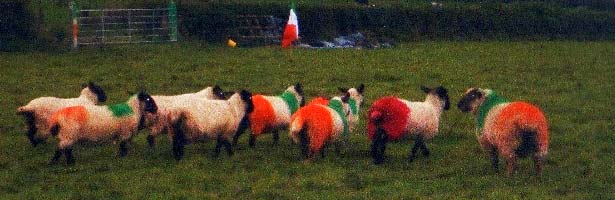
Sei pecore incinte di proprietà di un agricoltore protestante della Contea di Tyrone sono state dipinte con il tricolore irlandese in un apparente attacco settario.


Pecore tricolori | Tricolour sheepLe pecore erano state lasciare libere di pascolare in un campo isolato vicino ad Ardboe, quando i loro mantelli sono stati coperti di vernice verde e arancione, a formare il tricolore.


Secondo l’agricoltore, che non vuole essere identificato, c’è stato un incremento degli attacchi settari nelle ultime settimane.


Ha detto che le pecore erano incinte e teme che qualcuna possa perdere l’agnello come risultato dello stress sofferto durante l’incidente.


L’agricoltore riferisce che graffiti repubblicani erano stati dipinti sulle strade nelle vicinanze della sua casa, un tricolore era stato innalzato in un prato ed i cancelli erano stati lasciati aperti.


Il parlamentare dell’UUP, Billy Armstrong, che conosce l’agricoltore, ritiene l’incidente settario ed un tentativo di intimidire la gente.


“Non era uno scherzo di Halloween, era un attacco settario. C’è sempre serietà dietro a questo tipo di attacchi”, ha affermato.


"

Dress For Dinner Napkins

Dress For Dinner Napkins: "

dress for dinner napkins


Not appropriately dressed? Eating lobster? Perfect!


http://www.culturelabel.com


©2009 Design Milk | Posted by Jaime in Style & Fashion | Permalink | No comments


Sponsored Topics:
Lobster - Shellfish - Home - Fish and Seafood - Cooking"

mercoledì, novembre 04, 2009

Two more tributes: one old, one new

Two more tributes: one old, one new: "Yesterday our canonical member, Magdalen posted the link to a very good article about Fr. Jaki by Dr. Stephen Barr which appeared in First Things back in May. I thought I ought to call it to your attention. One of the interesting points for me was the comment about Peter Hodgson, whose work I will have to investigate. It is this sort of 'collecting' force of our wonderful net which makes me so grateful for it: just as Chesterton once wrote 'I have often thanked God for the telephone' [GKC What's Wrong With the World CW4:112] we of the Duhem Society must also say 'I have often thanked God for the INTERNET.' Yes, there are many dull and useless things out here in the E-cosmos, but also good and useful ones too: certainly this blogg has begun to link scholars of all kinds from all around the world... It is the sort of thing which recalls these words of our Lord: 'Again the kingdom of heaven is like to a net cast into the sea, and gathering together of all kinds of fishes. Which, when it was filled, they drew out, and sitting by the shore, they chose out the good into vessels, but the bad they cast forth. [Mt 13:47-48, emphasis added] As I have said elsewhere, echoing all our great ones, we need to have this catholic view, to learn to see things with the larger, universal view.

Another view on Jaki (and containing at least a nod to Duhem) is presented in the most recent edition of 'Gilbert!' the magazine of the American Chesterton Society, which is a kind of Chestertonian Festschrift in memory of Father Jaki. Here is the cover as it was posted on the ACS 'facebook' site:
There are essays on Father's work and on several of his essays, including one by Dale Ahlquist, president of the ACS, on the very important chapter 'Champion of the Universe' (the title of a chapter in SLJ's Chesterton a Seer of Science). There is also a rather lengthy and wandering interview of someone who had visited Father Jaki a few times in recent years, but you will have to read that for yourself if you care to do so. It may appear to be irrelevant to our work, but then it may help to shed some light on this blogg.
"