Truths turn into dogmas the instant that they are disputed. Thus every man who utters a doubt defines a religion. And the scepticism of our time does not really destroy the beliefs, rather it creates them; gives them their limits and their plain and defiant shape. We who are Liberals once held Liberalism lightly as a truism. Now it has been disputed, and we hold it fiercely as a faith. We who believe in patriotism once thought patriotism to be reasonable, and thought little more about it. Now we know it to be unreasonable, and know it to be right. We who are Christians never knew the great philosophic common sense which inheres in that mystery until the anti-Christian writers pointed it out to us. The great march of mental destruction will go on. Everything will be denied. Everything will become a creed. It is a reasonable position to deny the stones in the street; it will be a religious dogma to assert them. It is a rational thesis that we are all in a dream; it will be a mystical sanity to say that we are all awake. Fires will be kindled to testify that two and two make four. Swords will be drawn to prove that leaves are green in summer. We shall be left defending, not only the incredible virtues and sanities of human life, but something more incredible still, this huge impossible universe which stares us in the face. We shall fight for visible prodigies as if they were invisible. We shall look on the impossible grass and the skies with a strange courage. We shall be of those who have seen and yet have believed.
THE END
domenica, aprile 12, 2015

venerdì, aprile 03, 2015
When bigger isn't better
How would you rank “important” languages? If asked to rattle them off, many people start with English, but after that are reluctant to go further. Important how, they ask. One approach would be to look at people and money: surely a language is important if it is spoken by lots of people, in countries with great wealth (and presumably, therefore, power).
But in December came a new approach. A group of scholars approached the task by first looking at how languages are connected to one another, rather than viewing them in isolation. They then decided to see if this was a good predictor of how many famous people spoke a given language. If a language is well connected to others (a “hub” language with many bilinguals), its speakers will tend to be famous. And the names of the connected languages turn out to be rather interesting.
More here.

More here.

venerdì, marzo 27, 2015

martedì, marzo 24, 2015
sabato, febbraio 21, 2015
Playful in Paris: Life-Sized Interactive Street Art
Playful in Paris: Life-Sized Interactive Street Art: [ By Steph in Art & Street Art & Graffiti. ]

Everyday objects and imperfections in the urban surfaces of Paris become part of strange and unexpected scenes as French artist Levalet incorporates them into life-sized street art. A bull head sculpture becomes a minotaur, map in hand; a figure with a jackhammer goes to work on a damaged section of wall; a display box for advertisements is transformed into an x-ray machine.


Known by day as an art teacher named Charles Leval, the artist creates humorous scenes that interact with idiosyncrasies and often-unnoticed details in the fabric of the city.


The life-sized wheat paste posters take advantage of everything from pipes and spigots to false windows and concrete recesses.


Levalet walks around the city looking for the ideal spots for his work, takes measurements and creates the paste-ups at home before returning to his chosen locations and installing the work.


He told Street Art News that he considers all of the individual scenes to be part of a larger frame, “where I try to define a cosmology of a parallel world.”

Click Here to Read More »»

Click Here to Read More »»

Click Here to Read More »»


[ By Steph in Art & Street Art & Graffiti. ]
[ WebUrbanist | Archives | Galleries | Privacy | TOS ]
Everyday objects and imperfections in the urban surfaces of Paris become part of strange and unexpected scenes as French artist Levalet incorporates them into life-sized street art. A bull head sculpture becomes a minotaur, map in hand; a figure with a jackhammer goes to work on a damaged section of wall; a display box for advertisements is transformed into an x-ray machine.
Known by day as an art teacher named Charles Leval, the artist creates humorous scenes that interact with idiosyncrasies and often-unnoticed details in the fabric of the city.
The life-sized wheat paste posters take advantage of everything from pipes and spigots to false windows and concrete recesses.
Levalet walks around the city looking for the ideal spots for his work, takes measurements and creates the paste-ups at home before returning to his chosen locations and installing the work.
He told Street Art News that he considers all of the individual scenes to be part of a larger frame, “where I try to define a cosmology of a parallel world.”
Want More? Click for Great Related Content on WebUrbanist:
Cocaine Skull: Life-Sized Sculpture Made of Street Drugs
A pile of street cocaine mixed with gelatin is sculpted into a life-sized replica of a human skull in ‘Ecce Animal,’ a statement on ...Click Here to Read More »»
Wall Art Gone Wild: Fantastic Life-Sized Room Sketches
With some of her works it is hard to tell where the two-dimensional art ends and 3D objects begin, blending as they do into one semi-continuous surface.Click Here to Read More »»
Marvelous Muralist Makes Giant-Sized Street Art Illusions
Madrid-based street artist Sam3 creates massive murals covering entire multi-story buildings in cities like Vienna, Valencia, Quito, Berlin and Atlanta.Click Here to Read More »»
[ By Steph in Art & Street Art & Graffiti. ]
[ WebUrbanist | Archives | Galleries | Privacy | TOS ]
giovedì, febbraio 19, 2015

giovedì, gennaio 08, 2015
Wil Freeborn’s Coffee Spots
Wil Freeborn’s Coffee Spots:

Wil Freeborn is an illustrator and designer based in Gourock, Scotland. I mentioned his work on Lines and Colors back in 2010.
Freeborn likes to do location sketches in watercolor and/or ink. Late last year, he painted a series of watercolors of coffee shops in and around areas he visits. They were composed in a fascinatingly vertical format for a 2015 calendar.
The calendar is sold out, but I’m told more are on order. In the meanwhile, you can enjoy the watercolors on his blog and Flickr stream.
He has also recently done a commission of someone’s favorite coffee shop (above, bottom), and may sill be accepting others, I don’t know.
In addition, Freeborn is holding a competition in which he will paint the winner’s favorite cafe, and give them the original. He’s judging the winner on the basis of a great image from which to paint. Submissions can only be made by posting the photos on Instagram with the hashtag #coffeespots.
I particularly enjoy his approach to watercolor, combining firm draftsmanship with free, sketch-like composition and application of color.
Wil Freeborn is an illustrator and designer based in Gourock, Scotland. I mentioned his work on Lines and Colors back in 2010.
Freeborn likes to do location sketches in watercolor and/or ink. Late last year, he painted a series of watercolors of coffee shops in and around areas he visits. They were composed in a fascinatingly vertical format for a 2015 calendar.
The calendar is sold out, but I’m told more are on order. In the meanwhile, you can enjoy the watercolors on his blog and Flickr stream.
He has also recently done a commission of someone’s favorite coffee shop (above, bottom), and may sill be accepting others, I don’t know.
In addition, Freeborn is holding a competition in which he will paint the winner’s favorite cafe, and give them the original. He’s judging the winner on the basis of a great image from which to paint. Submissions can only be made by posting the photos on Instagram with the hashtag #coffeespots.
I particularly enjoy his approach to watercolor, combining firm draftsmanship with free, sketch-like composition and application of color.
giovedì, gennaio 01, 2015
venerdì, dicembre 12, 2014
Advent: Week 2 Day 7

"And suddenly the Lord Whom you seek shall come to the Temple... But who shall be able to stand when He comes? He shall be like the refiner's fire... He shall sit refining the silver, He will purify the sons of Levi, and refine them as gold and silver..."
Elsewhere we saw (in Jacob's Ladder) Jesus as a civil engineer: the Divine Bridge-Builder. Here we see Jesus as the Divine Metallurgist. In that amazing book from the Middle Ages called The Pirotechnia we can read about how such refining was done, in the days before OSHA and chemistry. It's rather horrifying, even if you have actually seen the real modern technologies for doing metal-working - but it worked. Basically they added a lot of lead to the mix, then boiled off the leadand scraped out the impurities. And they repeated this until the precious metal was pure. That is what the psalms mean about "gold, seven times refined". Remember, the tribe of Levi is the hereditary priesthood of the Israelites. Yes, there are still descendants alive (with names like Lewin, Levandowski, etc) who know their heritage in that family! And we know that Jesus, though of the tribe of Judah (and Son of David) was related somehow to them, for his "cousin" John (the Baptist) was son of Zachariah, who was a priest in the Temple.
But Malachi has far more to say. There is also this mystic vision of the world-wide sacrifice:
"For from the rising of the sun even to the going down, my name is great among the Gentiles, and in every place there is sacrifice, and there is offered to my name a clean oblation: for my name is great among the Gentiles, saith the Lord of hosts."
Here is the announcement of the round-the-clock offering of Holy Mass. Somewhere in the world, Mass is being offered - all the time, everywhere (except, of course, during the Triduum). It's lots better than the INTERNET - you can tap in, even without a modem or a hub/router/switch! Way cool - and unlimited bandwidth, too.
Why are people not connecting Jesus with technology more? He's not just for theologians and philosphers. Indeed - it is not only the theologian or even the philosopher for whom Jesus is the archetype, the exemplar, the model. He inspires the engineer - of all varieties from civil to metallurgical to electronic, the scientist, the laborer (was he not known as the Son of the Carpenter?) and the artist - as well as the writer and the musician. He shows us not only about God, and about truth and thought, but about learning, about doing things well, about making things beautiful AND useful... and, most importantly, about being a good friend - in fact, He exemplifies each and every aspect of being human.
IT SHOULD THEREFORE BE NO SURPRISE THAT CHESTERTON CALLS JESUS CHRIST BY THE TITLE OF "THE EVERLASTING MAN".
"So, therefore, we beseech Thee, Oh Heavenly Father, command that our voices be admitted among the number of the armies of heaven, as they sing without end..."
for
"In every place, there is offered to My Name a clean oblation, for My Name is great among the Gentiles..."
giovedì, dicembre 11, 2014
Advent: Week 2 Day 5
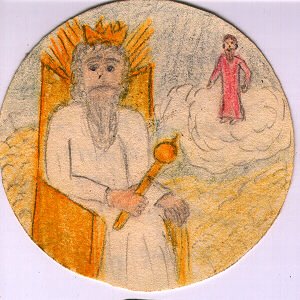
Thrones were set up and the Ancient of Days took His place. ... Then I saw One like a Son of Man, coming on the clouds... He came to the Ancient of Days, and was given authority...
Note: as was explained, late Easter afternoon on the road to Emmaus, beginning with Moses and the prophets... so we are trying to use that same plan, which happens to also be the format of the Bible.
So far, we've seen Moses and the great events of the Pentateuch (though one is deferred, as will be explained in its proper place), and we've met David, at the beginning of the Kingdom of Israel.
Now we look at the various prophets and see as they predicted details about the coming Messiah. Sometimes these were phrased in what might appear to be sheer fantasy, but each added a particular detail. Here, Daniel sees something which may be still in the future, (so similar to St. John's Apocalypse = "Revelation" are some aspects!) and yet links it together with our Lord's own designation for Himself: the "Son of Man". On this term, GKC has a very moving passage:
We often hear of Jesus of Nazareth as a wandering teacher; and there is a vital truth in that view in so far as it emphasises an attitude towards luxury and convention which most respectable people would still regard as that of a vagabond. It is expressed in his own great saying about the holes of the foxes and the nests of the birds, and, like many of his great sayings, it is felt as less powerful than it is, through lack of appreciation of that great paradox by which he spoke of his own humanity as in some way collectively and representatively human; calling himself simply the Son of Man; that is, in effect, calling himself simply Man. It is fitting that the New Man or the Second Adam should repeat in so ringing a voice and with so arresting a gesture the great fact which came first in the original story: that man differs from the brutes by everything, even by deficiency; that he is in a sense less normal and even less native; a stranger upon the earth. It is well to speak of his wanderings in this sense and in the sense that he shared the drifting life of the most homeless and hopeless of the poor. [GKC, The Everlasting Man CW2:337]
And speaking of interesting things, did you ever notice that the prophecy says "thrones"??? Ever wonder about that? Who else are they for? James and John wondered about sitting on the right and the left in the kingdom (and they were reserved, as Jesus told them!) but He also promised that the Twelve (who had left everything to follow Him) would "sit on thrones and judge the Tribes of Israel". Daniel, then, saw the stage managers at work, preparing for that coming Day...
Are we getting ready?
Iscriviti a:
Post (Atom)