Visualizzazione post con etichetta new age. Mostra tutti i post

lunedì, maggio 13, 2024

The organisation that offers abortion ceremonies


Recently, I revealed the rapid increase in what might broadly be called ‘New Age’ wedding ceremonies in Ireland presided over by various non-denominational organisations. But wedding services are not all they provide. At least one group offers ceremonies to mark abortion, divorce, and “preparation for dying”. It would have been also unimaginable until very recently that a ceremony would be offered to mark, or even celebrate, an abortion, but this is the point we have reached.

The organisation is called ‘Entheos Ireland’. It presides over hundreds of marriages per year, having been founded just three years ago.

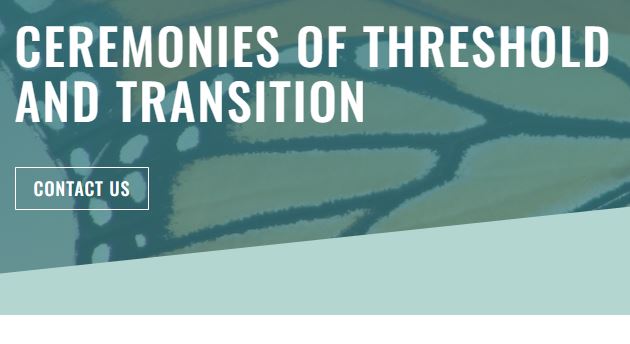
In the “ceremonies of threshold and transition” section of their website, they also outline ceremonies that “have their roots in beginnings, such as Renaming, Gender Affirmation, Coming-of-age, New Career”, in addition to ones that “stem from endings, such as Abortion, Divorce, Retirement”.

To this list must be added “preparation for dying” services, which are distinct from funerals.

Abortion or “preparation for dying” celebrations sound quite shocking, but not surprising when we explore who is behind these new ceremonies.

Entheos Ireland was launched in 2021 by Karen Dempsey. Dempsey is a pro-choice activist who was involved in the Repeal the 8th referendum campaign. At the time, she was one of the 25 women who dressed as red handmaidens (inspired by the book, ‘The Handmaid’s Tale’), and marched to the Dail in an event organised by the Socialist feminist group ROSA, one of the most radical pro-choice groups.

(She also protested against the removal of a pro-abortion mural from the Project’s Art Centre a few years ago. See here)

Entheos describes “preparation for dying” ceremonies as follows: “Our End of Life sessions create a space for the psychological and spiritual exploration needed for individuals and families facing death.  …  Actively engaging with the process of dying can be both liberating and comforting, and can help to relieve the anxiety of dying with important things left unsaid and undone.”

Interestingly, one of their solemnisers is Janie Lazar, the chair of the pro-euthanasia organisation End of Life Ireland.

We can envisage that if assisted suicide or euthanasia are legalised in Ireland, groups such as Entheos will offer ceremonies to go along with them. Some might be shocked, but in Canada there is at least one church that hosts assisted suicide ceremonies on its premises.

Entheos does not promote a specific faith, but their solemnisers are registered with the HSE as “religious”. They are akin to religious ministers without a regular congregation, performing ceremonies upon request. This is a new form of “liquid spirituality”, which requires no strong commitment or beliefs. Anything goes.

“I would rather not have the word religious involved with us,” said its founder Karen Dempsey in a recent interview. The interviewer says that “the designation as ‘religious’ is a useful loophole [in the relevant regulations]. It allows Entheos’ celebrants to incorporate elements of faith into people’s ceremonies … in a way that a totally secular officiating body could not.”

The organisation already has 65 celebrants registered with the HSE and over 80 people on the waiting list for their training sessions, which costs €2,500. This emergent market can be quite profitable, with an average fee of €600 for a wedding and €280 for funerals and other ceremonies.

The rise of these ‘New Age’ ceremonies indicates that people still want a spiritual element in the key moments of their lives. But apart from funerals, traditional religions have always offered these ‘rites of passage’ at positive moments like when a baby is born, or a couple get married. The emerging spirituality adds much less positive events like abortion and divorce to the list of possible rites of passage, and probably in time, euthanasia as well.

venerdì, maggio 03, 2024

The huge rise of ‘New Age’ weddings in Ireland


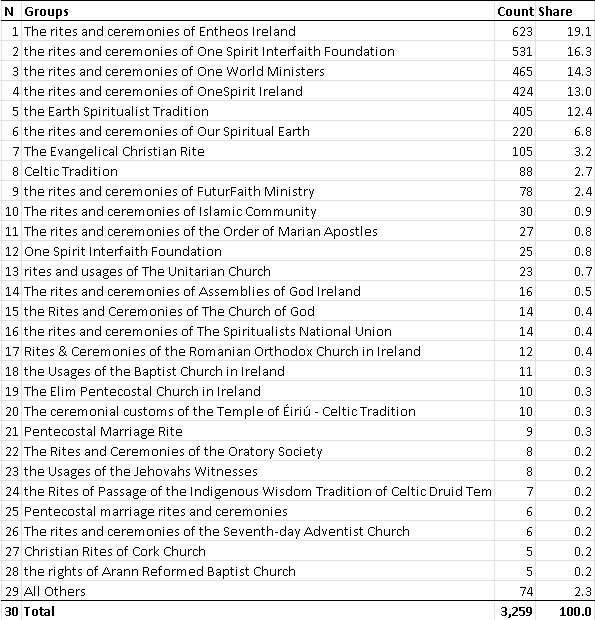
While the number of Catholic marriages in Ireland is steeply declining, new data released by the Central Statistics Office (CSO) highlights the rise of ceremonies belonging to “other religious denominations”, to use the CSO’s term. Now, you might think this means Muslim ceremonies, or perhaps those that take place in African Pentecostal churches, but these account for only a tiny fraction of the total (see table below). The vast majority of the ceremonies, in fact, really belong under the very broad heading ‘New Age’. They increased from 5.3pc of the total in 2018 to 15.8pc last year, growing from 1,009 to 3,259 in absolute numbers — a three-fold increase in just five years. 

The ceremonies incorporate elements from many different religions, as a couple choose. They can be extremely eclectic. There is no particular coherence to them in that they don’t come from a systematic religious worldview that can be called ‘Christian’, or Buddhist’, or ‘Muslim’ or ‘Hindu’. This is why the term ‘New Age’ might be most appropriate, even if some who act as the celebrants themselves, or even the couples involved, might resist the label. We use it here for short-hand.

To the category “other religious ceremonies” must be added ‘Spiritualist’ ones, which were nonexistent ten years ago and are not included in the “other religious” cohort by the CSO. These now account for 7.9pc of all marriages and also borrow from any and all religions depending on the taste of the couple.

This means what can very broadly be termed ‘New Age’ or ‘spiritual’ wedding ceremonies now account for almost a quarter of all weddings in Ireland.

The majority of these ceremonies are conducted by brand new organisations, the Spiritualist Union of Ireland being one. 

Another is ‘Entheos Ireland’, which only registered with the HSE three years ago. According to data provided to the Iona Institute by the CSO, Entheos ministries officiated at 623 marriages in 2023. They currently have 81 solemnisers approved by the State, compared with only five Muslim solemnisers and about 20 from various Orthodox churches.

Spiritual groups such as Entheos and One Spirit tailor their religious ceremonies to the preferences of the spouses, presenting themselves as 'inclusive, embracing people of every faith and none,' without referencing any specific deity or belief system unless requested.

Entheos says it was founded “to serve people who have been ostracised, marginalised or otherwise left behind by traditional faith paths on the basis of gender, race, sexual orientation, ability, nationality, parental / family status or any other reason.”

Another group is ‘One Spirit Interfaith Ministers’. They describe themselves as “ordained interfaith ministers embodying a vibrant and meaningful response to the changing spiritual needs of our times.” They say they are “of service to people of all faiths and none.”

There are many other similar groups offering their services to engaged couples including ‘The Earth Spiritualist Tradition’, ‘One Spirit Ireland’, and ‘One World Ministers’.

Many of the ‘New Age’ wedding ceremonies involved couples or individuals entering a second or third marriage. Data provided to the Iona Institute by the CSO reveal that the number of first marriages among “other religious” ceremonies is significantly lower than among traditional Christian denominations, likely because these groups also offer ceremonies for divorced individuals, which may partly explain their growing popularity. They are also very popular among same-sex couples. Of the 646 same-sex marriages celebrated in 2023, 145 (22pc) were with “other religion” ceremonies and 70 (11pc) with Spiritualist ones.

The rise of non-denominational religious ceremonies is a new trend that reveals the need to mark important events in life with some form of non-institutional religious rituals. Those who feel they do not belong to a religion, often still have religious beliefs of some sort and these new organisations (which charge €600 on average for a wedding) are emerging to satisfy their needs.

As for the broader picture, last year there were 20,513 opposite-sex marriages in Ireland, and 646 involving same-sex couples. Of the opposite-sex ones, 86pc were first marriages, a slight decline from 88pc in 2013. Our marriage rate last year was 4.0 per 1,000 adults—one of the lowest rates in Europe and a decrease from 4.5 ten years ago.  In other words, fewer people are getting married but the percentage of those who remarried after a divorce has increased.

The proportion of marriages conducted through religious ceremonies has obviously decreased, representing 60pc of all marriages last year, down from 70.5pc in 2013. Notably, Catholic marriages have dramatically declined from 62.5pc a decade ago to just 35.3pc in 2023.

Among first marriages, 40pc were celebrated in a Catholic church.

The face of marriage in Ireland is indeed changing very rapidly and the rise in ‘New Age’ ceremonies reflects the drift away from institutional religion of all types. At the same time, there is still clearly a taste for wedding ceremonies to have religious or ‘spiritual’ trappings of some sort and therefore we are not becoming as secular as some people think.

– – –

“Other religious” solemnisers