Visualizzazione post con etichetta religion. Mostra tutti i post

venerdì, aprile 17, 2026

Lessons from Italy’s catastrophic demographic decline


Last year, Italy, my country, recorded just 355,000 births in a population of about 59 million. That corresponds to a fertility rate of 1.14 children per woman of childbearing age, one of the lowest in Europe and indeed in the world. Around 650,000 Italians are now dying each year. You can see the direction of travel. It is catastrophic.

Italy, unfortunately, has a long history of below-replacement-level birth rates. Economic factors certainly matter, but a recent television programme suggested that the crisis goes deeper. Among the guests, the president of the Federation of Catholic Family Associations in Europe (FAFCE), Vincenzo Bassi, offered a compelling diagnosis: it is also about loneliness, trust, culture and the way society imagines the future.

The programme began with interviews with Italian university students. Some said they would like children, but only after their thirties. Others were unsure they would ever be able to afford a family. One young woman described lifelong commitment as an “encumbrance”; another said having children had become “almost a luxury.” Several spoke of uncertainty, not only about their own prospects, but about the state of the world itself.

Vincenzo Bassi did not deny the economic pressures, but he argued that the central problem is more existential and social. “The real problem is loneliness,” he said. A society may offer tax breaks and incentives, but if men and women feel isolated, unsupported and mistrustful, policies alone will struggle to reverse the decline.

Bassi also insisted that demography must be seen as part of any serious discussion of sustainable development. “Sustainable development is not possible without intergenerational balance,” he said. Children should not be viewed as a burden on public finances, but as part of a society’s human capital and future stability.

His remarks also carried a cultural and communal dimension. Too often, demographic decline is treated as something relevant only to families. Bassi reminds us that it affects everyone. A society without children is not simply poorer in numbers; it is weaker in continuity, solidarity and hope.

He suggested that birth rates might look different if they were measured not just across territories, but within real communities where people feel less alone. Later, reflecting on examples from Trentino-Alto Adige, the region in the North-East of Italy which has the highest fertility rate, Bassi highlighted their family-friendly environments. “Families, when they are in a network, are more stable and more generative”, he claimed.

After Bassi, the programme turned to the medical dimension of delayed parenthood with gynaecologist Maurizio Guida. His intervention was brief but blunt. Social expectations may have changed, he said, but biology has not. “The social change does not coincide with a change in human physiology.” Many young adults now imagine their thirties as the natural time to begin thinking about children. Yet Guida warned that female fertility declines sharply after 35 and falls further after 42 or 43.

Taken together, Bassi and Guida offered a powerful diagnosis. Italy’s birth crisis is not only about the economy. It is about loneliness, weak communities, cultural uncertainty, and a society that often ignores the conditions in which family life can flourish. Unless those deeper realities are faced, the country will continue to drift into demographic decline.

venerdì, febbraio 06, 2026

What draws young people to Christianity?


venerdì, dicembre 12, 2025

More good news on the ‘quiet revival’ front


After decades of steady decline, the proportion of Americans who identify as Christians appears to have stabilised, according to a major new survey by the Pew Research Center. Moreover, the youngest age group surveyed – the 18 to 24-year-olds – seems to be somewhat more religious than age groups immediately above them. This is similar to polling finding here in Ireland, both in the North and the South.

The survey is called the ‘Religious Landscape Study’ (RLS). It is a vast project involving almost 37,000 adults. Becaure the US census does not collect information on religion, the RLS is the country’s most authoritative measure of religious composition.

An important finding is that for the first time in years, the youngest adults in the United States are more likely to identify as Christians than other young people. Fifty-one percent of Americans aged 18 to 24 identify as Christian compared with 45pc of those aged 24 to 34.

Aside from the two polls commissioned by the Iona Institute, a recent survey from Britain showed the same pattern.

These findings challenge the assumption that each new age cohort will be less religious than the one before, suggesting instead that a plateau in secularisation may have been reached.

Even more striking is a subtle but significant gender shift within these younger groups. Historically, across every age cohort, American women have tended to be more religious than men. Yet among today’s young adults, this pattern has reversed, according to the Pew Center survey. Young men are slightly more likely than young women to say that religion is “very important” in their lives. This reversal, if it continues, would mark a major cultural change in the gender profile of American religiosity.

Despite the stabilisation among Christians, a substantial minority of the population say they have no religion. Nearly three in ten Americans now call themselves atheists, agnostics or “nothing in particular”, up from 23pc in 2014 and just 16pc in 2007. However, the rate of growth is slower than in recent years. The shift is visible across the political spectrum, but it is much more pronounced among liberals than among conservatives. A large majority of conservatives still identify as Christian, according to the survey.

Within American Christianity itself, Protestants remain the largest group, making up 40pc of adults, while Catholics account for 19pc. Both proportions have declined significantly since 2007. However, the Protestant share has held relatively steady since 2019, and the Catholic share has shown little change since 2014, with only minor year-to-year fluctuations.

The survey also highlights demographic differences that may shape future trends. Christians report an average completed fertility rate of 2.2 children per respondent, compared with 1.8 among the religiously unaffiliated and 1.8 among followers of non-Christian religions. Higher birth rates among Christians may help keep numbers steady, but what also matters in the long run is whether children raised Christian stay Christian as adults.

Together, these findings suggest that the long decline of Christianity in the United States may have paused, and that the youngest generation, far from accelerating secularisation, may be playing a part in this unexpected stabilisation.

venerdì, dicembre 05, 2025

Leaving faith or finding it: the human impact behind Britain’s spiritual shift


Conversion into Christianity provides meaning, positive outcomes, and social integration, while leaving a religious faith often coincides with disorientation and emotional decline, according to a new study.

“The Changing Landscape of Faith in Britain: Rebirth, Renewal and Reimagining”, a newly released report by the Institute for the Impact of Faith in Life, focuses on those who have changed their religious identity in Britain. Rather than a steady march towards secularism, the country is experiencing a re-composition of belief and belonging.

What stands out most in the report is the different emotional and social impact of leaving versus entering the Christian faith. Among those who have left Christianity, two-thirds report no positive outcomes from their decision. Very few describe improvements in emotional health, purpose, or community life: only 19pc feel emotionally healthy, just 12pc report a stronger sense of purpose, and a mere 9pc say they have gained community connection. For many, leaving faith appears to coincide with disorientation, a diminished sense of coherence, and a decline in wellbeing.

The pattern is almost reversed among new Christian converts. Their stories often begin in moments of rupture, such as a bereavement, mental health struggles, or periods of existential questioning. Yet the transition into faith brings pronounced benefits, according to the study. Forty-five percent report a stronger sense of purpose and 44pc a more positive outlook. More than a third describe improvements in emotional wellbeing, relationships, and their sense of belonging. Only 27pc say they experienced no benefits at all. Conversion to Christianity, for many, seems to offer what modern Britain struggles to provide elsewhere: meaning, coherence, and social integration.

Becoming atheist, by contrast, is often described as a desire for ethical consistency and intellectual clarity. Yet it yields few emotional gains. Over 70pc of respondents who became atheist report no significant positive outcomes. While atheism may resolve intellectual tensions, it rarely offers the frameworks of belonging, community, or purpose that religious traditions, especially Christianity, continue to embody.

The report also shows that while traditional institutional Christianity may be shrinking in cultural reach, it remains the most dynamic religion in terms of movement, attracting new adherents even as many others drift away. People move between denominations, deepen commitment, or rediscover their faith.

As the report notes, “Christianity is simultaneously contracting in broad cultural affiliation and yet showing signs of renewal through more intense, younger converts or people re-engaging with their faith.”

Islam, by contrast, is more stable, with modest inflow and very limited outflow.

Dharmic traditions, including Hinduism, Buddhism, and Sikhism, also feature modest but steady inflow, reflecting Britain’s increasing religious diversification. These faiths offer healing, personal growth, philosophical depth, and an adaptable spiritual framework, often tailored to the needs of individuals who shift away from institutional religions. 

Alongside this, more personalised and wellbeing-oriented meaning systems are emerging, such as pagan and Wiccan practices, and eclectic therapeutic worldviews.

Regional patterns may vary as well, with Wales and Northern Ireland showing notably low levels of religious movement.

venerdì, novembre 28, 2025

A far-reaching ruling on religious education in State schools in Northern Ireland


The UK Supreme Court has delivered an important judgment on religious education in a Northern Ireland primary school, ruling that the current way religion is taught amounts to ‘indoctrination’, and that the right to withdraw a child from religious education class should not be unduly burdensome on the child. The ruling does allow that religious education class can give a special place to Christianity in view of Northern Ireland’s history, but that religion must be taught in an “objective, critical and pluralistic” manner. This will be tricky to pull off, because done the wrong way, you can easily end up relativising religion, and that would not be “objective, critical and pluralistic” at all. There is really no neutral way to teach religion.

The case in question involved a young girl from Belfast and her father. Both argued that their school’s Christian-centred religious education and daily worship practices failed to respect their non-religious beliefs, breaching their rights under the European Convention on Human Rights. These include the right to education that respects a family’s convictions, and the right to freedom of religion or belief.

The school followed Northern Ireland’s “core syllabus”, a statutory curriculum that focuses heavily on Christianity for obvious historical reasons. The RE course was devised by the four main Churches in the North. The parents did not object to learning about religion, but said the teaching was not ‘objective’ or ‘pluralistic’ enough for a publicly funded school.

A key point in this case was the statutory “right to withdraw”. In both Northern Ireland and the Republic of Ireland, parents can request that their child be exempted from religious education or worship. But the parents said this right was unworkable in practice. Their daughter would have been the only child to leave the classroom, creating a risk of embarrassment or social isolation. No meaningful alternatives existed, the court said, and the burden fell on the parents to negotiate arrangements with the school. The courts accepted that this made the right more theoretical than real. (Interestingly, no-one ever seems to worry about the embarrassment a child might feel when they are withdrawn from sex education class).

The Supreme Court ultimately found that the school’s approach breached the family’s human rights. It agreed that the teaching was not “objective, critical and pluralistic”, and that the right of withdrawal, although formally available, was practically ineffective. As mentioned, is such a way to teaching religion achievable in practice, or do you automatically end up relativising all religions?

However, the Court was careful not to condemn the entire Northern Irish system. It did not declare that all schools are discriminatory. Instead, it confirmed that in this specific school, for this particular family, the arrangements did not comply with human-rights standards. The warning is gentle but unmistakeable: publicly funded religious education must be educational, not devotional, and withdrawal must be easy and non-stigmatising. 

Could this case have been avoided simply by accommodating the family’s right to withdraw? In a narrow sense, yes. If the school had offered a respectful, practical alternative that did not single the child out, the court might well have found no breach. But the ruling also highlights a deeper point: withdrawal alone cannot fix a curriculum that lacks pluralism. Religious education itself must be delivered in a way that respects diverse beliefs, regardless of who opts out.

Although the Supreme Court issued a strong judgment, the reliefs granted remain purely declaratory. This means the Court formally stated that the family’s rights were breached, but it did not strike down any legislation or require the government to change its policies. The responsibility for reform now lies with the Department of Education and school authorities.

In the North, 48,896 Protestant children and only 6,281 Catholics attend these State-funded, State-run schools. Another 25,453 are from other religions (including non-denominational Christianity) or have no religion.

The North’s Education Minister, Paul Givan, has promised to ensure that a Christian ethos in the region’s public schools is maintained. We will see what happens.

The ruling may also resonate south of the border. Irish courts are not bound by UK decisions, but they often regard them as persuasive, especially on shared human-rights principles. As both societies become more religiously diverse, the case is likely to fuel wider conversations about how faith is taught in publicly funded schools.

lunedì, novembre 10, 2025

Faith on Their Own Terms: How Young People Are Redefining Religion


Britain’s overall attitude towards faith is changing, and the younger generation appears more receptive to this shift, according to a new report.

Faith is becoming less a matter of family heritage and more a personal choice, and it is increasingly viewed as a resource to improve mental health.

Since the 1970s, the steady secularisation of Western societies has often been seen as inevitable. Yet recent polling in various countries, including Ireland (see here and here), suggests that younger generations may be showing a slight renewed interest in religion compared to the previous one, indicating a possible reversal of long-term religious decline.

The new report "The Next Generation of Faith: Journeys, Meaning and Wellbeing" produced by the Institute for the Impact of Faith in Life (IIFL), explores how attitudes towards faith are changing among young adults in Britain.

It examines the experiences of those who have moved towards religion as well as those who have stepped away, offering insight into the motivations and values shaping these shifts.

The picture emerging is not one of simple decline or abandonment, but of re-evaluation. For many aged 18–34, faith is no longer something accepted by default due to upbringing or cultural expectation. Instead, they are far more likely to make decisions about religion on their own terms. Personal authenticity carries considerable weight: beliefs must align with one’s values, sense of identity and understanding of the world. If they do not, there is little sense of obligation to remain within the tradition in which one was raised. In this way, faith is becoming more intentional rather than inherited.

This emphasis on autonomy is accompanied by a shift in what faith is perceived to be for. Many young adults now approach faith less as a fixed belief system and more as a personal resource to improve their mental and emotional wellbeing, according to the report.

“40pc of 18-34s that are moving into faith/changing religions are doing so because of a desire for personal transformation or healing. This goes down to 29pc for those older than 35”, the report says.

Younger people are far more aware of their psychological health and are attentive to practices that support reflection and self-understanding. For some, faith offers these benefits, providing space for meaning and emotional regulation. For others, faith is abandoned precisely because it is felt to lack compassion or emotional relevance.

The report also finds that younger adults engage more critically with questions of social justice and global crisis. Many struggle to reconcile such urgent challenges with religious frameworks that seem detached or inadequate.
“Of all the 18-34s that feel that global events have made them feel the world is increasingly unfair, 70pc moved away from faith. Among those older than 35, this is only 48pc”, the report notes.

Taken together, these findings highlight a movement away from socially embedded, inherited religion towards forms of belief or non-belief that are more flexible, personal and self-directed. Faith, where it persists, tends to be reflective and selectively integrated into a broader framework of identity.


mercoledì, novembre 05, 2025

Another study shows greater openness to religion among young people

People used to mainly inherit their religion, like their politics, from their parents. This is no longer the case and hasn’t been for a long time. Now people often have to acquire religion (and politics) for themselves. It is a much more individualistic thing. A new report from Britain overall highlights this fact but shows younger people are sometimes attracted to religion because of its undoubted connection to improved mental and physical wellbeing.

In fact, polling in various countries, including Ireland (see here and here), suggests growing openness to religion among some young adults, especially those aged 18-24. This indicates a possible reversal of long-term religious decline.

The new report “The Next Generation of Faith: Journeys, Meaning and Wellbeing” produced by the Institute for the Impact of Faith in Life (IIFL), explores how attitudes towards faith are changing among young adults in Britain.

It examines the experiences of those who have moved towards religion as well as those who have stepped away, offering insight into the motivations and values shaping these shifts.

The picture emerging is not one of simple decline or abandonment, but of re-evaluation. For many aged 18–34, faith is no longer something accepted by default due to upbringing or cultural expectation. Instead, they are far more likely to make decisions about religion on their own terms. Personal authenticity carries considerable weight: beliefs must align with one’s values, sense of identity and understanding of the world. If they do not, there is little sense of obligation to remain within the tradition in which one was raised. In this way, faith is becoming more intentional rather than inherited.

This emphasis on autonomy is accompanied by a shift in what faith is perceived to be for. Many young adults now approach faith less as a fixed belief system and more as a personal resource to improve their mental and emotional wellbeing, according to the report.

“40pc of 18-34s that are moving into faith/changing religions are doing so because of a desire for personal transformation or healing. This goes down to 29pc for those older than 35”, the report says.

Younger people are far more aware of their psychological health and are attentive to practices that support reflection and self-understanding. For some, faith offers these benefits, providing space for meaning and emotional regulation. For others, faith is abandoned precisely because it is felt to lack compassion or emotional relevance.

The report also finds that younger adults engage more critically with questions of social justice and global crisis. Many struggle to reconcile such urgent challenges with religious frameworks that seem detached or inadequate.

“Of all the 18-34s that feel that global events have made them feel the world is increasingly unfair, 70pc moved away from faith. Meanwhile, for those older than 35, this is only 48pc.”, the report notes.

This is a bit ironic given that the Churches tend to talk about social justice and climate issues a lot.

Taken together, the findings of the report highlight a movement away from socially embedded, inherited religion towards forms of belief or non-belief that are more flexible, personal and self-directed. Faith, where it persists, tends to be reflective and selectively integrated into a broader framework of identity.

sabato, novembre 01, 2025

Saint John Henry Newman: Doctor of the Church

Today, Pope Leo will proclaim Saint John Henry Newman a new Doctor of the Church. This is an event of immense significance for the universal Church, for educators, and for all who care about the dialogue between faith and reason. Newman’s thought, born in the intellectual ferment of nineteenth-century Oxford and matured through his years in Rome, Dublin and Birmingham, continues to speak with extraordinary vigour to our age of rapid change and fragile certainties.

To mark this occasion, I am deeply honoured to have contributed in various ways to the reflection on  Saint Newman’s legacy.

This week The Irish Catholic publishes my article “John Henry Newman: Doctor of the classroom and the soul”. The piece explores Newman’s lifelong dedication to teaching, his founding of the Catholic University of Ireland, and his vision of education as a spiritual work, a friendship of minds and hearts in the pursuit of truth.

Here below you will find the full text of that article.

I have also explored Newman’s vision in other contexts.

My article “In cammino verso l’unità interiore” was published in the Italian edition of L’Osservatore Romano on 30 October 2025, reflecting on Newman’s journey towards interior unity and the harmony of faith and intellect.

I have also contributed a chapter on “Newman’s Engagement with Locke’s Epistemology” to the new Gracewing volume "John Henry Newman the educator. His formation, philosophy and lecacy", which examines the philosophical and theological horizons of  the thought of the British cardinal.

I gave an interview to Tempi.it about Newman as “the Doctor of the Church who surrendered to truth”, later translated into Portuguese for Padre Paulo Ricardo.

A short piece, also appeared on the weekly newspaper of the Diocese of Venice, in Italy.


John Henry Newman: Doctor of the classroom and the soul”

It should come as no surprise that Pope Leo chose the Jubilee of Educators (1 November) as the occasion to proclaim Saint John Henry Newman a Doctor of the Church. Few figures in modern Christianity have embodied so completely the vocation of education as a service to truth and to the integral formation of the human person. Newman was a theologian, preacher and apologist, but above all an educator in the fullest sense of the word. In his journal he once confessed: “From first to last, education, in the broad sense of the term, has been my line.” His entire life can be read as a long, steady commitment to the art of educating both minds and hearts in the pursuit of truth.

For half of his life Newman lived and worked in Oxford, the intellectual heart of England. There he matured his deep reflection on the nature of education. As a tutor at Oriel College, he experienced first-hand the power of personal influence, the transformative encounter between teacher and student. He realised that authentic knowledge does not arise solely from books or lectures but from the meeting of two souls, from the living transmission of ideas, example and values. After his conversion to Catholicism in 1845, this conviction became the guiding principle of his educational work.

Newman’s first great project after conversion was the Catholic University of Ireland, inaugurated in Dublin in 1854. His aim was nothing less than to offer Irish Catholics, long excluded from the academic world, an institution that could unite intellectual excellence with a strong spiritual and moral formation. Later, in Birmingham, he founded the Oratory School, a secondary school intended to embody the same ideals in the education of boys.

The heart of Newman’s educational vision lies in his masterpiece, The Idea of a University, written in Dublin. For Newman, education could never be reduced to technical training or professional preparation. It was, rather, a journey towards wisdom, an inner growth that embraces the whole person. A true university, he wrote, does not exist to serve immediate or utilitarian ends, but to cultivate the intellect and to form in students a critical and generous mind. Its task is to shape men and women capable of thinking, discerning and acting with conscience.

Such a vision was strikingly counter-cultural in the nineteenth century, an age dominated by industrial expansion and the utilitarian creed of efficiency and profit. Newman looked with concern on a culture that prized usefulness over goodness and tended to fragment knowledge into technical specialisms. “Though the useful is not always good, the good is always useful,” he wrote. Knowledge, he argued, has value in itself and precisely for that reason it is also fruitful, because only a mind formed by truth and a heart directed towards the good can truly serve society.

At the centre of Newman’s philosophy stands a profound harmony between faith and reason. He saw them not as competing forces but as two converging paths towards the same truth. In his Dublin lectures he defended the place of theology within the circle of university disciplines: to exclude it, he argued, would be to mutilate the very idea of universal knowledge.

“If a University be a place of instruction where universal knowledge is professed,” he wrote, “and if in a certain University, so called, the subject of Religion is excluded, one of two conclusions is inevitable: either, on the one hand, that the province of Religion is very barren of real knowledge, or, on the other, that in such a University one special and important branch of knowledge is omitted.”

For Newman, the university was to be a home for all the sciences, including the knowledge of God.

This insight spoke directly to the Irish context of his time. The new Catholic University of Ireland was a bold attempt to reconcile modern intellectual life with the faith of a people emerging from centuries of religious marginalisation. Newman’s brief tenure as its first rector was not without frustration: he faced inadequate funding, political tension, and an educational system still recovering from the wounds of the Penal era. Yet the experiment left a lasting mark.

Among those who gave lustre to the Catholic University was the Jesuit poet Gerard Manley Hopkins, who taught Greek and Latin there in the 1880s. Hopkins’s sense of beauty, his sacramental vision of the world and his conviction that “Christ plays in ten thousand places” reflect Newman’s own belief that faith and culture should illuminate one another. One of the University’s most famous students, James Joyce, would later recall in his writings the complex intellectual atmosphere shaped by Newman’s influence.

A cornerstone of Newman’s educational thought is his emphasis on personal relationships. He was convinced that teaching must never become impersonal or mechanical. He criticised universities where contact between professors and students was minimal or purely administrative. During his Oxford years he developed a tutorial model grounded in friendship, dialogue and shared life. A tutor, he wrote, is not merely a dispenser of knowledge but a moral and spiritual guide, a mentor standing in loco parentis.

This belief shaped his later foundation, the Oratory School in Birmingham. The school was designed to unite intellectual formation with moral and spiritual growth in a family-like atmosphere. Among its most celebrated pupils was Hilaire Belloc, the future writer and Catholic apologist, whose wit and intellectual independence bore the stamp of Newman’s spirit. Another connection, though indirect, was J.R.R. Tolkien. He never attended the Oratory School, yet after his mother’s death he was raised under the guardianship of Fr Francis Xavier Morgan, an Oratorian priest and disciple of Newman’s first generation. Through him Tolkien absorbed that same vision of faith, learning and integrity which later infused his imagination.

At the root of all this lay Newman’s conviction that education is a spiritual work. A teacher does not form intellects alone but whole persons. He does not merely communicate ideas; he communicates a presence, an influence. True teaching, Newman believed, is an act of friendship, a sharing of life. The influence of a good teacher reaches beyond the classroom, shaping character and conscience.

For this reason Newman’s message remains remarkably fresh. In an age when technology tends to replace human interaction and education risks being reduced to measurable competencies, he reminds us that at the heart of teaching there is always a face, a voice, a testimony. The proclamation of Newman as a Doctor of the Church during the Jubilee of Educators is therefore far more than a symbolic gesture. It is a prophetic sign, inviting the Church to rediscover the spiritual dimension of education and to recognise that every genuine act of teaching is, in truth, an act of love.

For educators in Ireland and beyond, Newman’s legacy poses searching questions. How can schools and universities remain faithful to the whole person when social and economic pressures demand immediate results? How can teachers keep alive the dialogue between faith and reason in societies that often separate the two? How can Catholic education sustain its identity while serving an increasingly plural and secular public?

Newman does not offer ready-made solutions, but he does offer principles. He urges educators to place the person before the system, to value the slow work of formation over the rapid production of credentials. He calls us to recover the sense of education as a vocation rather than a job — a ministry of truth that involves heart as well as intellect. He challenges Catholic institutions to cultivate a distinctive ethos, one that integrates belief with intellectual rigour and that measures success not only by academic achievement but by the growth of faith and virtue.

Newman stands before us as both a classic and a contemporary. His thought bridges centuries because it speaks to what is perennial in the human condition: the thirst for truth, the need for meaning, the desire to be formed rather than merely informed. He reminds us that education is never neutral; it always shapes a vision of the human person and of the world.

For teachers, parents and all who care about the formation of the young, Newman’s example is an encouragement to persevere. He invites us to believe once more in the power of relationship, in the quiet influence of integrity, and in the patience required to nurture the seeds of faith and reason in the hearts of our students.

Education, for Newman, was a form of intellectual charity, an act of love that unites teacher and pupil in a shared search for truth. In recognising him as a Doctor of the Church, the Pope acknowledges not only a master of theology but a doctor of life: one whose wisdom continues to enlighten classrooms, universities and homes wherever the Gospel inspires the work of teaching.

In an era of instant information and fragile certainties, Newman’s voice invites us to recover the slow, humane and sacred art of educating the whole person. Only an education born from living relationships can truly become culture and, in the deepest sense, a leaven of humanity.


martedì, maggio 06, 2025

How many people stay in their childhood religion?


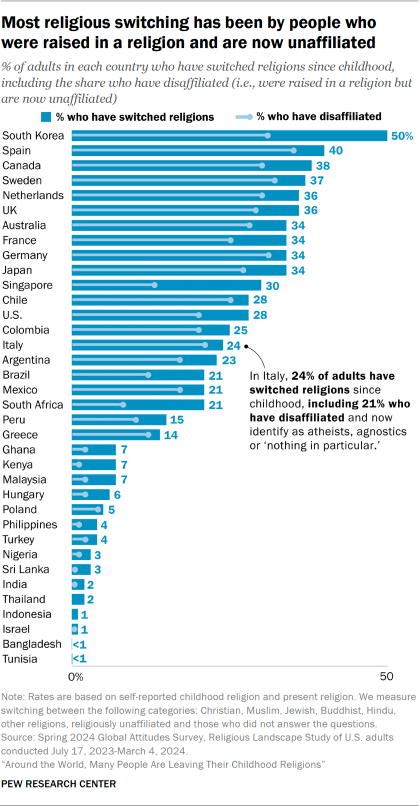
A new Pew Research Center study offers compelling insights into religious switching worldwide. ‘Religious switching’ includes ceasing to be religious or changing religion. Christianity, particularly in Western and high-income nations, is undergoing significant transformation. The study, spanning 36 countries (excluding Ireland), reveals a notable decline in Christian affiliation, primarily driven by individuals abandoning their childhood faith.

The Pew study shows that in nations like Spain, Sweden, the Netherlands, Germany, Canada, the United Kingdom, France, Australia, Chile, the United States, and Italy, about 20pc of adults no long count themselves as member of the Church in which they were raised. In the UK, it is much higher, with 38pc of those raised Christian now identifying as religiously unaffiliated. Consequently, the unaffiliated (46pc) in the UK now outnumber self-identified Christians (43pc).

The findings would seem on the surface to contradict a recent survey in Britain which shows that a mini-religious revival is taking place among some young people there. But there is really no contradiction, because in the wider society people who were nominally Christian are now saying they are not Christian at all, leading to an overall fall in religious identification, while a growing number of those who remain Christian are returning to church.

Not all religious switching involves abandoning faith; some move toward religion. Among the 36 countries examined, South Korea leads, with 9pc of adults raised without religion now identifying with a faith, including 6pc who have become Christian.

In the United States, the proportion of adults identifying as Christian fell from 78pc to 62pc between 2007 and 2023–24. However, Christianity’s decline has stabilised recently, with 29pc of adults now unaffiliated, a figure unchanged since 2021.

In countries like Spain, almost all religious switching is from Christianity (Catholicism in the vast number of cases) to no religion, or at large to no other Church, but in a country like Brazil, a large number of people switch to another form of Christianity, typically from Catholicism to Pentecostalism.

Despite losses in some parts of the world, Christianity is growing in others. Singapore, for instance, has seen a net gain in adherents. Similarly, the Philippines, Nigeria, and Hungary exhibit high Christian retention, with nearly all adults raised Christian remaining in the faith. Nigeria and the Philippines have tens of millions of Catholics.

If you look at the table above, you will see that the countries where Christianity is declining fastest, are the ones seeing their populations rapidly ageing as fewer and fewer babies are being born.

Overall, the data highlight a global shift in religious identity. While Christianity remains a major world religion, its dominance is waning in some regions, particularly the West, due to rising disaffiliation.

However, Christianity, including Catholicism, is growing in parts of the world with fast population growth, especially sub-Saharan Africa, where many conversions are also taking place.

PS. The study also looks at other religions and what is happening to them. To summarise; hardly anyone switches from Islam, Hinduism or Judaism. Many leave Buddhism in countries like South Korea and Japan but very few in Sri Lanka and Thailand.

martedì, aprile 15, 2025

The quiet religious revival taking place in Britain


‘The Quiet Revival’, a major new report from the Bible Society in the UK has found something surprising: a significant upsurge in church attendance, especially among young people, challenging previous assumptions about Christianity’s long-term decline in that country.

Based on YouGov surveys of over 13,000 people in England and Wales, the report reveals a 56pc increase in regular church attendance (monthly or more) from 2018 to 2024, rising from 8pc (3.7 million people) to 12pc (5.8 million) of the population. This growth, dubbed a “quiet revival,” by the Bible Society, is most pronounced among younger adults, particularly Gen Z (18-24) and younger Millennials (25-34), and is accompanied by greater ethnic diversity in congregations. While overall Christian identification has fallen to 39pc among the general population, those who identify as Christian are increasingly active, engaging in prayer, Bible reading, and community outreach, signalling a shift from nominal to intentional faith.

The most striking trend is the surge in church attendance among 18-34-year-olds, with Gen Z leading the charge. For 18-24-year-olds, regular attendance quadrupled from 4pc in 2018 to 16pc in 2024. The 25-34 age group also saw significant growth, rising from 4pc to 13pc. This contrasts with older generations: those 65+ increased from 14pc to 19pc, while 35-44-year-olds grew only modestly from 5pc to 8pc, and 45-64-year-olds saw a slight decline.

Notably, young men are driving this trend, with 21pc of 18-24-year-old men attending monthly last year (up from 4pc in 2018), outpacing young women, whose attendance rose from 3pc to 12pc. Among 18-34-year-olds overall, 18pc of white men attend monthly, up from 3pc, indicating the trend extends beyond ethnic minorities and is not fully explained by rising immigration.

Several factors seem to explain this rise:

  1. Quest for Community: The report emphasises that young adults, grappling with loneliness, anxiety, and post-pandemic isolation, are being drawn to churches for connection. Over 60% of churchgoers aged 18-34 report a strong sense of belonging to their local area, compared to just 25pc of non-churchgoers. Peer networks are key, with 34pc of non-churchgoing 18-24-year-olds saying they’d attend if invited by a friend.
  2. Search for Meaning: Economic pressures, mental health challenges, and disillusionment with secular liberalism help lead young people toward faith. The report notes 35pc of 18-24-year-olds over believe in a higher power, and 40pc pray monthly, the highest of any age group. Churchgoers in this bracket report higher life satisfaction and lower anxiety, particularly among young women, who show a 21-point drop in frequent depression compared to non-churchgoing peers.
  3. Spiritual Engagement: Young Christians are highly active, with 80pc of 18-34-year-olds reading the Bible weekly (compared to 71pc of 35-54-year-olds) and 80pc feeling confident discussing their faith. Curiosity about Christianity is also quite high, with 25pc of non-churchgoing 18-24-year-olds interested in learning more about the Bible.
  4. Denominational Shifts: Growth is strongest in Catholic and Pentecostal churches. Among 18-34-year-olds identifying as Catholic, Mass attendance rose from 22pc to 41pc, and Pentecostal from 10pc to 18pc, while Anglican attendance in this age group fell from 30oc to 20pc.

Immigration significantly contributes to this revival, diversifying congregations and bolstering attendance, particularly among 18-34-year-olds. One in five churchgoers (19pc) is from an ethnic minority, rising to nearly a third (32pc) among 18-54-year-olds.

The report contrasts youth-led growth with stagnation among middle-aged groups and cautions against over-optimism, noting that churchgoing doesn’t always equate to deep faith. Bible engagement is rising—12pc of the population reads the Bible weekly outside services, up from 6pc—but 79pc rarely encounter it. The revival is uneven, thriving in urban areas with dynamic churches but less evident in rural or traditional settings.

For 18-34-year-olds, the report suggests churches must nurture this interest through discipleship, as many newcomers lack theological grounding. The mental health benefits underscore churches’ social value.

‘The Quiet Revival’ documents a remarkable resurgence in UK church attendance, with 18-34-year-olds, especially Gen Z men, at the forefront. Driven by a hunger for community, meaning, and spiritual engagement, this group has quadrupled attendance in six years, favouring Catholic and Pentecostal churches.

This is a good news story showing a very welcome interruption to the long-term decline in church attendance in the UK. Hopefully it is not a mere interruption, but a sign of a genuine revival.

mercoledì, marzo 05, 2025

Decline of Christianity halts in the US


The decline in the share of Christians in the US population appeared to have stopped, according to a major new survey. This is notable because it seems to contradict the thesis that the decline of Christianity in Western countries is inevitable and irreversible.

The survey, from the Pew Research Center, says that the proportion of Americans identifying as Christians has stabilised at around 62pc. The figure was 78pc in 2007 but has stopped falling over the last five years.

The study, involving more than 100,000 respondents, finds that self-declared Protestants make up 40pc of the U.S. adult population, while Catholics account for 19pc. Of course, saying you belong to a particular religious group does not make you actually practice that religion.

Meanwhile, the religiously unaffiliated, often referred to as “nones” (atheists, agnostics, or those who identify as “nothing in particular”), now constitute 29pc of the population. After a long period of growth, this group has also stabilised in recent years.

Other measures of religious practice indicate stability. The percentage of Americans who pray daily has remained between 44pc and 46pc since 2021, while regular religious service attendance (at least monthly) has held steady in the low 30s since 2020.

However, there are notable generational differences: younger adults (18-24) are significantly less religious than older adults (over 74). Only 46pc of the youngest adults identify as Christian, compared to 80pc of the oldest cohort. Additionally, 27pc of young adults pray daily, compared to 58pc of seniors, and just 25pc of younger adults attend religious services monthly, compared to 49pc of older adults.

Family size also varies by religious affiliation. Christians of the age group 40-59 have more children (2.2) than the religiously unaffiliated (1.8) and non-Christian religious groups (1.8). However, Christians are less likely to have minor children at home due to their older average age. Just 42pc of Christian respondents are within the prime child-rearing ages of 25 to 54, compared to 60pc of the religiously unaffiliated and 56pc of those from other religious traditions.

These figures reflect self-identified Christian respondents, but the survey does not look at the number of children people have based on religious practice. Generally, fertility rates tend to be higher among those who attend religious services more frequently.

Demographer, Lynam Stone, has shown that Americans who attend religious services weekly or more, have about 2.2 children on average, compared with just 1.35 or so for those who never attend. A new paper from The Iona Institute examines the positive correlation between religious practice and larger families.

Women remain more religious than men, though the gender gap is narrowing, especially among younger generations. Among parents with under-18s at home, 42pc report engaging in religious activities such as prayer or scripture reading with their children.

Changing religious affiliation is common in the U.S., with 35pc of adults identifying with a different religion (or no religion) compared with in childhood. Christianity experiences significant losses, with six former Christians for every new convert. Catholicism is particularly affected, losing 8.4 people for every convert.

Religious affiliation continues to correlate with political and social attitudes, according to the survey. Highly religious Americans are more likely to lean Republican and hold conservative views, while less religious individuals tend to align with the Democratic Party and support liberal policies.

Among ideological groups, liberals have experienced the most dramatic shift. In 2007, 62pc of self-identified liberals were Christian; by 2024, this number had dropped to 37pc. Conversely, the percentage of liberals with no religious affiliation rose from 27pc to 51pc, making religious “nones” the dominant group among liberals. Conservatives have also seen a decline in Christian affiliation but to a lesser extent, and a majority still identify as Christian.

mercoledì, ottobre 16, 2024

Just how many people are really atheists?


A recent survey has found that, for the first time, atheists in the UK outnumber those who believe in God. Or do they? Because an awful lot depends on exactly what people are asked.

The “Explaining Atheism” project is a global research initiative led by Queen’s University Belfast and recently released interim findings appearing to show that atheism is now more widespread than theism in the UK.

The study surveyed approximately 25,000 individuals across six countries, including Brazil, China, Denmark, Japan, the UK, and the USA. It draws upon data from the British Social Attitudes Survey, the World Values Survey, and an earlier project by the same team, “Understanding Unbelief” (2017-2021).

According to the British Social Attitudes Survey (BSAS), belief in God in the UK dropped from 41.8 pc in 2008 to 37.4 pc in 2018. During the same period, the percentage of people who say they do not believe in God rose from 35.2 pc to 43pc.

However, a survey conducted by the International Social Survey Programme (ISSP) put the number of atheists in Britain at 26pc, not 43pc.

Why the difference? It seems to come down to how the question is asked. The BSAS asked people point-blank whether they believed in God or not. But the ISSP asked a wider range of questions from emphatic atheism to emphatic theism and everything in between.

A similar phenomenon was observed in Ireland, where the wording of the Census 2022 question “What is your religion?” was modified to “What is your religion, if any?” The first response option was “no religion”, whereas this had been the last option in the 2016 Census. This change led to a big increase in “no religion” responses. No surprise there.

Prof. Stephen Bullivant, a sociologist of religion at St Mary’s University in London, noted that in some countries, the term ‘atheist’ carries a degree of stigma, and people may avoid identifying as such, even if they do not believe in God or practice any religion. Conversely, in other cultures, atheism or secularity has become the norm, leading respondents to self-identify as atheists, even if they still hold some belief in God.

Interestingly, the “Explaining Atheism” study also found that “non-belief in God does not necessarily rule out belief in other supernatural phenomena, as most atheists and agnostics express some type of supernatural belief.”

By the way, the findings indicate that belief, or non-belief, in God is predominantly influenced by socialisation, rather than by factors such as education, fear of death, or a need for structure. Parental upbringing and societal expectations about religion were identified as the most significant factors. For instance, those not exposed to religious practise by their parents during childhood were more likely to identify as atheists.

In other words, we are very conventional. If the broad social convention is religious, then we are more likely to be religious, and if the convention is broadly secular, we are more likely to be secular, or even atheistic. We don’t seem to think as much about our beliefs as we might like to imagine.

martedì, luglio 16, 2024

Should we stop beginning Oireachtas sessions with a prayer?


A member of Cork City Council has called for an end to saying a prayer at the start of council meetings, appealing to the principle of the ‘separation of Church and State’. Cllr Pádraig Rice noted that more than 50 years ago, the people of Ireland voted to remove the special position of the Catholic Church from the 1937 Constitution. “That seems to have been ignored by Cork City Council. With the prayer and the crucifix, it still feels like 1930s Ireland in there,” he said.

But prayers are not just said at council meetings, they are also said at the start of sessions of the Dail and Seanad. However, the origins of this tradition are not so much a legacy of our Catholic history, and are much more connected to British parliamentary practice, which we follow.

The custom of beginning official proceedings with a prayer is found in a lot of countries that follow the British parliamentary tradition, including the UK itself, the US, Canada, Australia and South Africa.

In the UK, prayers have been a fixture in Parliament since around 1558. Every sitting of both the House of Commons and the House of Lords begins with prayers led by the Speaker’s Chaplain in the Commons and a senior bishop in the Lords.

The Northern Ireland Assembly begins with a silent period of prayer or reflection. The Scottish Parliament, instead, has a multi-religious ‘Time for Reflection’ at the beginning of each week. Ireland and Malta, which were both under British rule, are the only European countries maintaining this tradition of initial prayers.

Aside from the countries listed above, others that have prayers at the start of parliamentary meetings are Kenya, Uganda, Ghana, and Namibia, again all of which have historical ties to the UK.

In contrast, this is much less common in French-speaking African countries, with Muslim-majority Senegal being an exception. Beginning with the French Revolution, France has enforced a very strict form of secularism, often more than in the US which is almost founded on the separation of Church and State, even though religion remains a prominent feature of public life.

In Asia, the Indian Parliament traditionally begins its sessions with a short silent prayer or meditation. Pakistan and Bangladesh start their parliamentary sessions with a recitation from the Quran, while in Sri Lanka, prayers from different religious traditions are offered. Again, these countries have historical links with Britain, all being former colonies.

In South America, where Catholicism is traditionally prevalent, formal prayers at the beginning of parliamentary sessions are not customary, with these countries often emphasising the secular nature of their state procedures. Nonetheless, in Europe, some religious elements are still present in legislative bodies even if formal prayers are not common. For instance, a survey by the Oireachtas Library and Research Service found that 10 European countries have a parliamentary chapel or prayer room, and 18 offer religious services within their premises or outside, usually at the start of the year or on special occasions such as Christmas or commemorations. In the United States, both the House of Representatives and the Senate have chaplains.

While prayer before proceedings is more of a British tradition, religious iconography in public venues is prevalent in other European traditions. Crucifixes are commonly displayed in public buildings, including government offices and schools, in Italy, Poland, Austria, and some parts of Germany. An absolute ban on such displays is instead a key feature of the French concept of laïcité. Many European countries also have crosses in their flags, a heritage of Christianity, even if the religious symbolism is largely lost today.

Praying before parliamentary work has deep historical roots in many legislative bodies worldwide, and the practice varies significantly across different countries, reflecting diverse cultural and religious landscapes.

In Ireland, in 2017, after numerous calls to end the tradition, the Oireachtas decided to retain the daily prayer at the start of each business day. Additionally, a 30-second period of silent reflection was incorporated into the Standing Orders. This compromise appears to be a reasonable solution that accommodates individuals of all faiths or none. Removing the prayer entirely would not only have dismissed a long-established and deeply felt custom but also denied a brief yet meaningful moment that many consider important. This approach balances respect for tradition with inclusivity for a diverse population.

sabato, gennaio 13, 2024

The growing problem of anti-Christian persecution in Europe


Anti-Christian crimes in Europe are increasing, according to a recent report by the Observatory on Intolerance and Discrimination against Christians in Europe (OIDAC). For example, it says that arson attacks on churches increased by 75pc in 2022 compared with 2021.

In 2022, OIDAC recorded 749 anti-Christian hate crimes across 30 European countries. Notably, there were 38 physical assaults and three murders. Religious services were disrupted at least 19 times.

These numbers might be just the tip of the iceberg due to underreporting and lack of media attention.

Between 2021 and 2022, there has been a worrying increase in these crimes, especially arson attacks, which rose from 60 to 105. Many of these incidents are linked to radicalised groups, sometimes Islamist in nature, with anti-Christian sentiments.

The report highlights the ongoing debate about freedom of speech. New laws are emerging that regulate and limit speech, sometimes even extending to private conversations.

Ireland’s hate speech Bill was presented as a case in the report. The Bill is quite extreme as it criminalises possessing material deemed ‘hateful’ against certain groups, but ‘hate’ is not defined.

Another example is the creation of “buffer zones” around abortion clinics in the UK and Ireland, leading to the criminalisation of Christians for activities like silent prayer in public areas.

There are moves to eliminate conscience clauses from medical laws. This puts Christian medical professionals who refuse to participate in certain practices, like abortions, due to their religious beliefs, in difficult positions.

The report mentions concerns about vaguely formulated and expansive laws that could criminalise parents, pastors, and teachers for expressing dissenting opinions on certain controversial topics.

For instance, the UK government voted to introduce a new mandatory curriculum on sex education in Northern Ireland, which includes lessons in how to access abortion. The legislation will put pro-life parents, or schools in a very difficult position.

The reports says: “The right of parents to educate their children in accordance with their religious beliefs has continuously been threatened through legal provisions, criminalising ‘non affirmative’ communication between parents and children in regard to identity-related issues as well as through obligatory school education on ideological issues contradicting religious or moral beliefs”.

Indeed, there is also worry about potential legal repercussions for parents who, based on their religious beliefs, advise their children against undergoing hormone therapies or other similar interventions​​ in order to ‘transition’ from one ‘gender’ to another.

The OIDAC report also found that the conflict between Russia and Ukraine has significantly affected religious freedom. Russian authorities and troops have violated Christian religious freedoms by closing churches and detaining religious leaders.

The report also sheds light on the severe persecution of Christians in other parts of the world, like Nigeria, Armenia, India, and Pakistan.

The organisation calls for greater attention and action from European institutions to these issues of Christian persecution, which are often ignored by the media. But given that governments can sometimes be behind moves to crackdown on dissent from certain liberal orthodoxies, on abortion and gender ideology for instance, this might be a vain hope.

venerdì, gennaio 05, 2024

New study confirms pro-social benefits of religion


A new report called ‘Faith and Wellness’ confirms that religious people are more positive in their mentality, have more social support and are more involved in their communities.

“An estimated 160 million more adults have positive experiences than would be the case if those adults were not religious.”, says the report, which is based on data collected from 2012 to 2022 by Gallup and also on a review of academic studies.

The study highlights five key factors of spirituality that positively influence wellbeing: 1) positive coping and a sense of purpose in life; 2) faith-based social connections; 3) community and civic engagement; 4) structural stability; and 5) workplace support of holistic wellbeing.

Religion often provides individuals with effective coping mechanisms and a profound sense of purpose in life. This aspect of spirituality can be particularly helpful in managing stress and navigating life’s challenges, contributing to overall mental and emotional well-being, says the report.

(Professor Patricia Casey produced for the Iona Institute a paper on this topic, called “The Psycho-Social Benefits of Religious Practice.)

Moreover, spiritual communities often offer robust social support networks. The sense of belonging and community found in these groups can be a significant source of emotional assistance, helping individuals to feel connected and supported.

“When spiritual life is shared, you’re at an 82pc decreased relative risk of suicide, 80pc decreased risk of addiction, and a 75pc decreased risk of depression … If this was a pill, who wouldn’t take that?”, commented Lisa Miller, Professor of Psychology and Education at Columbia University.

The ‘Faith and Wellness’ report highlights the positive role of “structural stability”, which refers to the fact that many spiritual traditions offer frameworks for moral and ethical decision-making, aiding individuals in navigating complex life situations and contributing to a sense of clarity and direction.

An analysis of data from the Gallup World Poll found that people of faith scored better than non-religious in five out of nine wellbeing measures. These are: social life (having a support structure and opportunity to make friends), positive experience (self-reported well-being), community basics (everyday life in a community), optimism (positive attitude towards the future) and civic engagement (inclination to volunteer and help others).

This last measure, the relationship between religion and civic engagement, was explored by the ‘Faith and Wellness’ report.

Many religious teachings emphasise the importance of being part of a larger community, which includes caring for those around you, especially those in need. This emphasis on altruism and assisting others not only serves societal functions related to the economy and public service but also creates opportunities for social networking and personal growth. Individuals with connections to religious communities, such as having “church friends”, are found to demonstrate more altruistic behaviours.

“Several studies have found a link between volunteering or membership in a voluntary association and measures of mental health, including depression and distress, especially among older adults. For the most part, these studies indicate that caring for others generates positive emotions, which in turn increases one’s mental health and wellbeing”, says the report.

Finally, the ‘Faith and Wellness’ report addresses a striking paradox: Despite the established positive benefits of spirituality and religion to health and wellbeing, there is a notable decline in these practices in many parts of the world.

“Why are people turning away from a practice that can provide positive benefits to their lives?”, the report asks.

One contributing factor to this trend seems to be a lack of awareness. Many are not well informed about the mental and physical health benefits of a spiritual life.