Visualizzazione post con etichetta down syndrome. Mostra tutti i post

lunedì, gennaio 09, 2023

How parents of DS children are subtly directed toward abortion

There has been little reaction to the news that 95pc of babies diagnosed with Down Syndrome before birth at the Rotunda hospital are subsequently aborted in England.

The response to these horrendous figures has been silence or fatalism. For some, it is an individual “choice” to be respected. There is nothing to be worried about or, even when people find the figures regrettable, little can be done.

I don’t have a view on whether that is the right thing. We don’t advocate for it, that is just the lived experience”, said prof Fergal Malone, master of the Rotunda.

Is it true? Is it really a purely personal choice, without outside influence or expectations from others? Two recent studies on the experience of parents of children with DS indicate otherwise.

Irish research published last year interviewed eight people following the birth of a child with DS. Some praised the doctors and nurses, but others said the information they received was too medically focused and too negative. It is very hard to believe the same does not happen to couples who are told their baby has DS before it is born.

“Don’t come in with a list of negatives, all the negatives that were put in your head initially we never expected her to be this good now”, said one of the interviewed mothers.

She recalls: “We received purely negative information that she could have this or that, …”

A father said, “Doctors should show compassion when they are delivering the news, have patience and don’t be rushing in and out”.

Danish study spoke to parents who were told their babies had Down Syndrome before they were born. In Denmark, almost all children with DS are aborted.

The study notes: “Following the diagnosis, the couples were generally critical of the information provided by the hospital. Some felt that the health professionals had painted an unnecessarily grim picture of Down Syndrome based on what couples perceived as outdated information. … Some felt that there was an unnecessary focus on potential diseases and additional diagnoses when the couple was more interested in their potential for living a fulfilling life.”

Participants in the study report feeling pressure from health professionals they encountered to abort, or else that they were presented with overly negative information about their babies.

The research found that “couples felt that termination of pregnancy had been taken for granted following the diagnosis: ‘As the obstetrician sat down, she put those abortion application forms on the table in front of her’”, recalls a mother.

Even conveying apparently neutral information, such as presenting what other couples generally do, can condition parents. We tend to imitate others. Social expectations can be subtle and unconscious.

“Maybe there’s something wrong with me since I don’t just do what 98pc of all people would do”, said a Danish mother in the study, who decided to have the baby.

“The high percentage of terminations in Denmark was a source of doubt and uncertainty during the decision-making process. This left the couples feeling vulnerable”, it notes.

“Why is Down Syndrome the disability [considered] socially acceptable to terminate? And how do we come back from that?”, asks actress Sally Phillips in her documentary “Prenatal Genetic Testing” where she investigates how Non-Invasive Prenatal Tests have increased the number of babies with DS, and other genetic or chromosomal anomalies, who are being aborted. Phillips has a son with Down Syndrome.

These tests, which can take place in the first trimester of pregnancy, are becoming more affordable and available. They can be used to prepare families to welcome a child with medical anomalies, or they can be used to get rid of them, as almost always happens when a diagnosis of DS is given. A proper ethical debate about those prenatal tests has still to happen in Ireland.

In a society that has normalised abortion, the main way to fight the progressive elimination of children with DS  is for doctors to portray life with the condition, and life for the parents of such a child, in far more positive terms than seems to be the case at the moment. The medical professionals claim to be neutral about their use, but being not directive isn’t enough when society goes in one direction only.

Certainly, a national debate is called for.

giovedì, novembre 24, 2022

An Ireland without Down Syndrome


The Master of the Rotunda, Professor Fergal Malone, has revealed that up to 95pc of parents who are informed by the hospital that their unborn babies have Down Syndrome (DS) opt for abortion. This is a horrifying figure that appears to have soared since the abortion referendum even though the terminations in these instances are performed mostly in England.

What is happening is, of course, a modern-day version of eugenics. We are creating an Ireland without Down Syndrome and it is provoking almost no debate or reaction.

Professor Malone mentioned the figure of 95pc to the Irish Independent last week, but in the run-up to the 2018 referendum, he told RTE’s Liveline that the figure was 56pc. This is a massive increase in a short period.

Rather than being shocked at what is happening, pro-choice activists want the abortion law changed so that unborn babies with non-fatal abnormalities can be aborted for that reason specifically.

These figures refer to the Rotunda, one of the biggest maternity hospitals in the country, where Malone is the Master, but there are no reasons to suppose rates being substantially different in other hospitals. We don’t know for sure if a similar percentage of parents from other maternity hospitals abort these babies, but it would not be at all surprising if it was also very high. The latest figure for England is 88pc.

In 2018, Dr Rhona Mahony, who was then Master of the National Maternity Hospital on Holles Street, was asked whether there would be an increase in abortions of babies with Down Syndrome if the 8th amendment was repealed. She didn’t give a clear answer, but she said that in her hospital at the time about half of the women told their unborn baby had DS opted to go to England for a termination.

When, during the campaign to save the 8th amendment, the pro-life side highlighted the fact that in countries with liberal abortion laws a very high percentage of babies with DS are aborted, we were accused of using these children for political purposes.

Prominent pro-repeal advocates were in denial.

Simon Harris, who was then the Minister for Health, said: “I do not believe women in this country adopt that approach when they have a diagnosis of a child with a disability. … I think it is somewhat offensive to suggest women in Ireland are seeking abortions for that reason.”

Irish Times columnist, Fintan O’Toole, wrote: “It is not true that the increase in screening has wiped out the births of DS children. … Admittedly access to screening in Ireland is problematic, but even so the numbers of Irish women taking this option is strikingly small.”

He was wrong then, as I explained in this blog, and even more nowadays, as the figures from prof. Malone prove.

What has increased since the referendum is not only the percentage of DS diagnoses ending in terminations but obviously their absolute number as well. This is driven in part by the fact that it has become easier to detect chromosomal or genetic anomalies through earlier prenatal testing.

In the UK, the number of babies born with Down Syndrome has fallen by 30pc in NHS hospitals that have introduced early screening.

Prenatal tests are becoming more common and affordable. Their number in Holles Street maternity hospital went from 1,005 in 2012 to 2,515 in 2021.

Irish women still go to England when they want to abort a baby with a non-fatal abnormality, unless it detected before 12 weeks, when abortions can take place for any reason.

We don’t have absolute figures of abortions for non-fatal disabilities in Ireland, but Irish women generally go abroad because this kind of termination is permitted here only before the 12-week limit and most of diagnoses of foetal abnormality happen afterwards.

In 2021, 59 Irish babies with Down Syndrome were aborted in England, 24 more than the year before (35). This number continues to grow, as predicted by the prolife activists who were accused of scaremongering. The figures were 27 in 2019 and 17 in 2018.

Would Down Syndrome Ireland and other similar organisations have anything to say?

The current law in Ireland allows abortions at any gestational age when the baby has a condition that could cause its death within 28 days from birth, or earlier. Before 12 weeks, abortion is allowed for any reason.

Dr Aoife Mullally, who leads the HSE’s abortion services, wants a relaxation of the law and allow abortion for not life-threatening disabilities after 12 weeks. This is eugenics for disabled babies. It is not clear if she would accept any time limits.

Prof. Malone supports such relaxation but acknowledges that this can only happen by legislating for abortion on grounds of disability. He believes that if this was proposed before the 2018 referendum, as per the recommendation of the Citizens’ Assembly, the vote in favour of repeal would not have been so high.

Liberals will always ask for more relaxations. For them, abortion for disabilities is not a taboo anymore. They might not like the word, but this is pure eugenics, the selection of the fittest. 

martedì, dicembre 07, 2021

New ERSI report on disability ignores eugenic abortion

The number of Irish people with disabilities will decline over time, a new report from by the Economic and Social Research Institute (ESRI) says. This will be due to the general decline in fertility rates, it states. No doubt that will be a big factor, but it leaves out another key element, namely the growing prevalence of eugenic-based abortion, that is, terminations which selectively target the disabled in the womb through the increased use of screening programmes.

The report examines the current and future need of children suffering from all sorts of disabilities, from blindness and deafness, to learning difficulties or psychological conditions. It is intended to inform future policy and planning.

Even assuming the best scenario in terms of fertility rates, the number of children with disabilities is projected by the study to trend downward in the years to come. There are geographical variations, with Dublin changing less than other parts of the country, but there is little doubt that fewer children will need support in the future.

There are many factors leading to disabilities and some of them can be detected before birth. When a case of genetic or chromosomal abnormalities is found through prenatal tests, the outcome is often abortion. What was inconceivable in the past is now becoming standard practice.

study published last year in the European Journal of Human Genetics found that Ireland has the highest population of people with Down Syndrome in Europe: 13.9 per 10,000 inhabitants. The European average is 5.6.

This is explained by Ireland’s strong pro-life culture, something is now eroding fast, especially since the repeal of the 8th amendment.

The data used in the European Journal of Human Genetics article refer to the 2011-15 period. We await to see if Ireland will continue to respect the right of life of unborn children with disabilities more than other European countries, but it is hard to the optimistic. In 2018, 17 children with Down Syndromes were aborted by Irish women in England. Their number grew in the following years: 27 in 2019 and 35 in 2020.

The same study found that without selective abortions, the number of people with Down Syndrome would be 27pc higher in Europe.

The effect of pre-natal selection on birth rates of children with medical conditions is an issue that should be addressed not only from an ethical point of view, but also in terms of policies and long term consequences. It has an impact on how children with disabilities are perceived and accepted by society. We often hear that parents expecting children diagnosed with certain conditions often feel pressure to abort them, as if this is now is the default choice.

It is disappointing that the new ESRI report on future policy and planning about children with disabilities overlooks such a significant factor. 

lunedì, ottobre 18, 2021

New genetic selection techniques will facilitate eugenics


The genetic selection of human embryos is reaching new levels of sophistication  and depravity with the development of a technique called ‘polygenic screening’, based on statistical scores. Eugenics, which is breeding out the ‘defective’, is deepening its grip on our societies.

The new method is a step above current screening processes that can detect conditions like Down Syndrome.

Last year, the embryo of baby girl Aurea was chosen over other embryos who had more chance of developing certain medical conditions in the future, using a “polygenic risk score”.

The screening of human embryos artificially created in laboratory through IVF is quite common

Tests are offered for genetic or chromosomal abnormalities, such as Down Syndrome, and only the unaffected embryos are implanted in the womb, while the other are destroyed

When similar screening tests are performed during pregnancies, they generally lead to abortion. 

This is a clear form of human selection on the basis of health characteristics, also known as eugenics. 

So far, those tests were focusing on diseases caused by a single gene, but some conditions are triggered by the interaction of many genes. 

A new technique based on “polygenic risk scores” (PRS), which has been employed for the first time with success, tests the presence of many genes. 

In simple words, the new test analyses the gene-sequency of an individual and estimates the probability that some conditions will develop later in life. 

As the link between some genes and certain medical conditions is only probabilistic, these new techniques are based on statistical data and they have only become possible in very recent years with the development of large databases of genetic information.

As it develops, preimplantation genetic testing is likely to be able to predict not only health, but also other characteristics related to our genes, such as intelligence, psychological traits, personality types, learning disabilities, height, etc.

Commissioning couples, but also single individuals, will be able to pick any physical or psychological trait linked to genetic and to ‘order’ their ideal child. In a society where choice is everything, who will stop them?

This is one further step down an extremely unethical path that aims at eliminating imperfect human beings. It is immoral not only because it destroys humans at embryonic stage, but also because it perpetuates the false assumption that some lives are not worth living when they have certain unwanted characteristics.

The defenders of these techniques are quite honest about the eugenicist nature of genetic selection.

Oxford university philosopher Julian Savulescu proposes a “welfarist model” of polygenic scores that select for traits associated with well-being.

He writes: “[Tests] to select against genetic conditions … such as Down Syndrome, are common and are even publicly funded, implying not only assent, but active support for allowing prospective parents to select against these conditions. Selection on the basis of polygenetic scores, if it is well correlated and causally linked to a welfare threshold with important bearing on the future’s child well-being is ethically equivalent to these. Indeed, allowing selection on the basis of only some genetic conditions may be discriminatory. It would be consistent with an anti-eugenic stance to reject all form of selection.”

Savulescu has no problem with eugenics, as long as “there is no broad social goal or coercion employed”.

Do we really need to wait until it becomes imposed by the state before we realise how immoral eugenic?

---

(A shorter version of this article was published here)

venerdì, settembre 24, 2021

Court rules in favour of England’s pro-eugenics abortion law

The High Court of Justice in London has rejected a legal challenge against the law that allows babies with Down Syndrome or other disabilities to be aborted up to birth. The applicants will take the case onto the Court of Appeal.

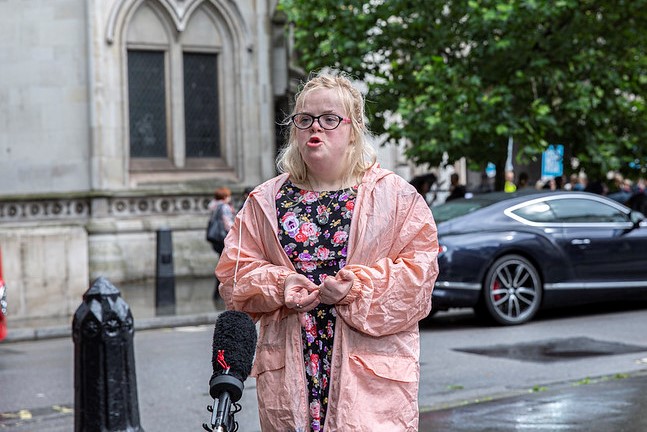
Twenty-six-year-old Heidi Crowter (pictured), an advocate for people with Down Syndrome like herself, and Máire Lea-Wilson, whose son Aidan has the same condition, claim that the 1968 Abortion Act promotes inequality and perpetuates outdated negative stereotypes as it puts no gestational limits to abortion when the baby has a disability.  A legal limit of 6 months applies only to babies with no disability.

The judges dismissed the claim and found that the legislation strikes a “balance between the interests of the foetus and the rights of women”.

One of the two judges in this case has a long record of legally representing abortions providers before becoming a judge. 

“This is a very sad day but I will keep fighting”, commented campaigner Heidi Crowter after the ruling. She said she will take the case to the Court of Appeal.

 With non-invasive prenatal tests it is now increasingly easy to detect chromosomal abnormalities and the number of abortions on disability grounds is increasing. A study covering the period 2013-2017 showed that the number of babies born with Down Syndrome has fallen by 30pc in NHS hospitals that have introduced this new form of screening.

In Ireland, it is possible to discover if a fetus has a chromosomal anomaly before the legal limit of 12 weeks, using such tests. Nonetheless, the window of time to request and obtain such terminations is quite restricted and many women go to the UK once the limit has passed. We don’t know how many babies with Down Syndrome have been aborted in Ireland under the new law but the number of Irish babies with Down Syndrome aborted in England went from 17 in 2018 to 27 in 2019, reaching 35 last year.

If the Court of Appeal will find the Abortion Act discriminatory against children with disabilities (a form of eugenics), this will have a positive impact on Irish children as well.

recent study across Europe showed that Ireland had the highest prevalence of live Down Syndrome births in Europe: 27.8 per 10,000 against the European average of 10 per 10,000.

This was one of the positive effects of the 8th amendment but with the new legislation, abortion is becoming more socially acceptable and there are already calls to allow terminations for non-fatal anomalies after the legal limit of 12 weeks.

When the new abortion law was introduced in Ireland, an amendment put down by pro-life politicians that attempted to ban abortion on disability ground was defeated.

A review of the existing legislation is due before the end of the year. The pressure is on to make it even more permissive.

In Northern Ireland, like in the rest of the UK, there is now no time limit to abortion on the disability ground. In March this year, a bill outlawing abortions in case of non-fatal disabilities was introduced by MLA Paul Givan. The Bill passed its second stage and it is still under consideration by the Stormont Assembly. Paul Givan has become Northern Ireland First Minister in the meanwhile but his Private Member’s Bill was transferred to another member and has been allowed to proceed.

lunedì, giugno 14, 2021

More Irish opting for eugenic abortion


The number of abortions in England and Wales hit a record high last year, and the number of Irish women travelling there to abort unborn children with Down Syndrome and other abnormalities has also increased, in line with growing acceptance of eugenics across the Western world.

In 2020, 209,917 women had an abortion in England and Wales. This was despite the extended lockdown. This is the highest number since the Abortion Act was introduced and it also represents the highest rate ever (18.2 per 1,000 women of fertile age).  Scotland also registered the highest historical rate last year.

The number of aborted babies is even higher than those figures as some women were expecting more than one baby.

194 women listed as resident in Ireland had an abortion in England in 2020, a 48pc drop from 2019, when Ireland’s liberal abortion law went into operation. Many went to England because the foetus had non-fatal disabilities and, after 12 weeks of gestation, it cannot be legally killed in Ireland for this reason. Many diagnoses of disabilities are made after 12 weeks.

In spite of the decline in numbers travelling to England, the number of Irish babies with Down Syndrome aborted there went from 17 in 2018, to 27 in 2019 reaching 35 last year.  Other conditions included three babies with spina bifida, one with cleft lip and palate.

The IFPA, together with other campaigners, want abortion for non-fatal abnormalities to happen in Ireland too.

The increasing number of Irish women opting to abort children with Down Syndrome could be due to more women availing of screening programmes and also greater social acceptability for what amounts to eugenics.

The number of English women opting to abort babies with Down Syndrome also increased to 693, a rise of 6pc from 2019, although this may be an underestimate.

The abortion rate in England and Wales continues to decline for girls age under 18, going from 16.5 to 6.9 per 1,000 between 2010 and 2020. This is a general trend in Western countries. But the rate for all other age groups has increased in the last 10 years.

In 2020, more than half of women over 30 undergoing abortion had one or more terminations before. Repeat abortions are now more and more common in the UK.

81pc of women who had terminations in England and Wales in 2020 were single. 51pc were single with a partner. This proportion has remained fairly constant in the last decade.

The report gives an idea of how the Covid pandemic impacted on the phenomenon of abortion.

In the first three months of 2020, before lockdown, the number of women undergoing abortion in England and Wales rose by 4.1pc compared to the first quarter of the previous year. After a spike in April (+28.7pc), just after lockdown was imposed, the rest of the year saw no substantial difference when compared to the previous one.

With regard to the 194 Irish women who travelled to England for abortions in 2020, 101 did so in the first half of the year and 93 in the second half when it was much more difficult to travel.

Another result of Covid restrictions can be seen in selective terminations, which is when only one child in a multiple pregnancy is killed. In England they decreased from 126 in 2019 to 65 in 2020. They generally happen after an IVF treatment, when multiple embryos are produced artificially, then moved into the womb and eventually selected if the couple do not want as many as have survived. This decline in 2020 is due to fewer IVF treatments happening during the pandemic.

lunedì, gennaio 25, 2021

How the 8th amendment saved hundreds of babies with Down Syndrome

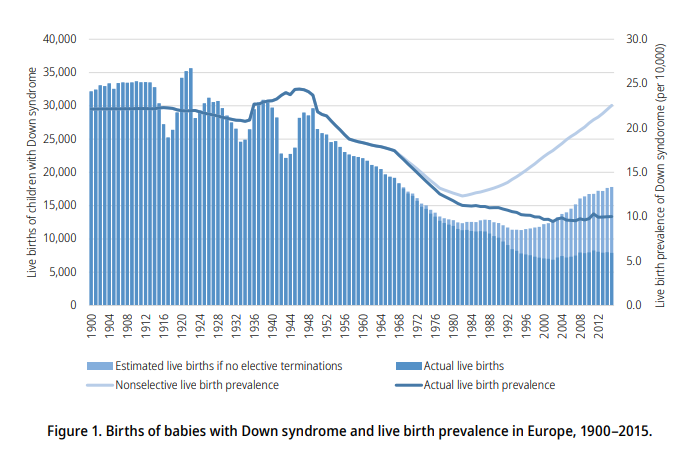
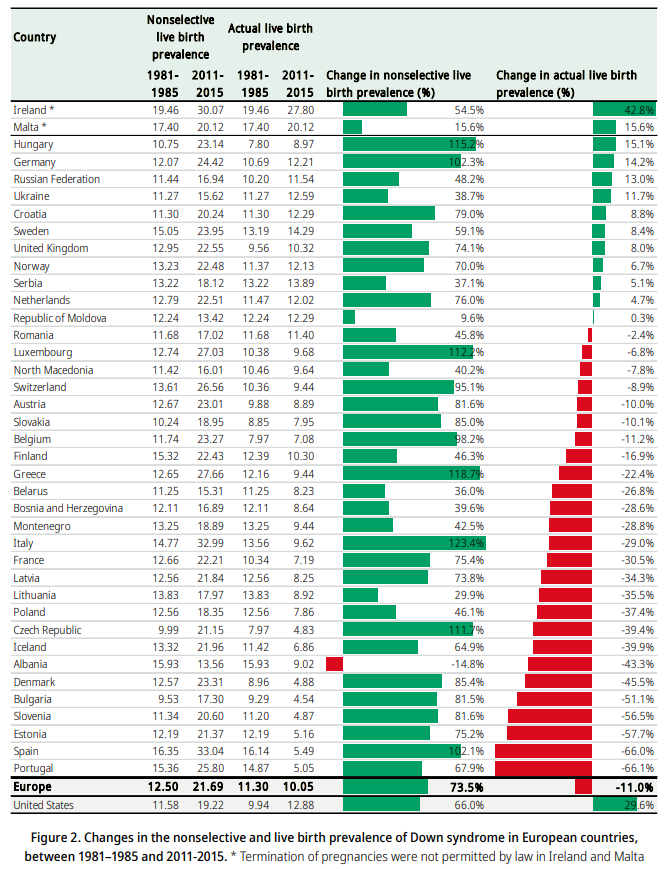
 Thanks to prenatal screening, far fewer babies with Down Syndrome are being born than was once the case. A recent study shows that across Europe as a whole, the reduction is in the order of half, but in Ireland prior to the introduction of abortion two years ago, it was ‘only’ 8pc, whereas in Spain it is above 80pc. This may become even worse with non-invasive prenatal testing becoming more widely available.

The study was published in the European Journal of Human Genetics.

The researchers, led by Dr Brian G Skotko from the Department of Pediatrics of Harvard Medical School, studied the period 2011-15 and discovered that 10.1 out of 10,000 live births in Europe involved children with Down Syndrome. They estimated that, in the same period, on average 54pc of babies found to have DS were aborted. Without these abortions, the prevalence would have been 21.7 per 10,000 live births.


As mentioned, this varies greatly country by country. It is very low here so far, but very high in countries like Spain, Portugal, Italy and Denmark. The fact that it is so high in the first three, shows how a eugenic mentality has overridden the Catholic culture of those societies.

Ireland had the highest prevalence of live Down Syndrome births in Europe: 27.8 per 10,000 against the European average of 10 per 10,000.

The population of Down Syndrome in Europe is estimated by this study at 5.6 per 10,000 inhabitants. In Ireland it is 13.9 per 10,000 inhabitants, the highest rate in Europe. What made Ireland different? Its pro-life culture and the 8th amendment.

The study estimated that without selective abortions, which are a form of eugenics, the number of people of all ages with DS would be 27pc higher in Europe that it is. This would be much worse than it is were it not for the fact that many people with Down Syndrome were born before prenatal testing become widespread.

It would also be worse were it not for the fact that people with Down Syndrome, once born, live much longer than they used to because of medical improvements.

It is a paradox that when people with DS can live longer more fulfilling lives, they are also killed before birth as never before.

Things are likely to become even worse as noninvasive pre-natal screening is made available to more and more couples. These tests can detect conditions like Down Syndrome at earlier and earlier stages of pregnancy.

Under Irish law you cannot have an abortion specifically because a baby has a serious (but non-lethal) chromosomal or genetic abnormality. If you want an abortion for that reason, you must still travel to Britain, and in 2019 27 Irish women did soNonetheless, you can have an abortion here for any reason up to 12 weeks. If DS can be detected before 12 weeks, it will almost certainly lead to a big reduction in the number of children being born here with DS.

The study itself acknowledges that “reduction [abortion] rates are very low in Malta and Ireland where terminations are highly restricted”. (It refers to the years 2011-2015, before we changed our abortion law). The 8th amendment has without doubt saved thousands of lives, including the lives of hundreds of babies with chromosomal or genetic abnormalities.

Before the 2018 abortion referendum, the pro-life side warned that with the repeal of the 8th amendment more Irish babies with Down Syndrome would be aborted.

The experience of other countries shows this is absolutely true.