Visualizzazione post con etichetta surrogacy. Mostra tutti i post

lunedì, agosto 25, 2025

A very strong critique of all forms of surrogacy from the UN


A new United Nations report is calling for the eradication of surrogacy in all its forms, arguing that the practice inherently harms both women and children. It also recommends punishing buyers, clinics and agencies. Ireland should pay attention. We have one of the most permissive surrogacy laws in Europe although it is awaiting commencement for reasons discussed below.

The report, authored by Reem Alsalem, UN Special Rapporteur on Violence against Women and Girls, will be formally presented at the General Assembly in October. Titled “The different manifestations of violence against women and girls in the context of surrogacy”, it constitutes the strongest condemnation of surrogacy ever made at the international institutional level and comes from a feminist perspective.

“The practice of surrogacy is characterised by exploitation and violence against women and children, including girls. It reinforces patriarchal norms by commodifying and objectifying women’s bodies and exposing surrogate mothers and children to serious human rights violations,” says the report.

The report recommends that commissioning parents, clinics, and agencies should be penalised, shifting responsibility away from the poor women who become surrogates and towards those profiting from or purchasing children through the practice.

Alsalem dismantles the distinction between commercial and altruistic surrogacy, arguing that, in reality, the line is blurred and illusory: “Particularly in jurisdictions where commercial surrogacy is formally prohibited but where reimbursement is so high that it effectively constitutes commercial payment”.

The report documents multiple forms of violence linked to surrogacy:

  • Economic violence, such as women being denied compensation or left in debt.
  • Psychological violence, including trauma from forced separation and so called “detachment therapies”, i.e. conditioning women to emotionally separate from the child during pregnancy so that handing the baby over will be “easier” afterwards.
  • Physical and reproductive violence, such as coerced abortions, unnecessary caesareans, and health risks from IVF drugs.
  • Trafficking and slavery-like conditions, where women are confined, transported across borders, or subjected to egg harvesting.

It also stresses the risks for children, who may be rendered stateless, abandoned, or even commissioned by sexual offenders, as background checks on intended parents are rarely carried out.

Compared with countries such as Italy, which in 2024 criminalised surrogacy even when carried out abroad, Ireland has placed itself at the opposite end of the spectrum, with what is possibly the most liberal surrogacy legislation in the world. The Assisted Human Reproduction Bill, passed in 2024, permits domestic “altruistic” surrogacy but also recognises foreign commercial surrogacy arrangements.

The law’s allowance for “reasonable expenses” effectively enables large payments to surrogate mother, which is commercial surrogacy in disguise. Ireland’s approach runs directly counter to the UN Special Rapporteur’s recommendations. By giving legal recognition to foreign commercial surrogacy, the Government risks entrenching exploitation abroad while normalising it at home.

Although the Assisted Human Reproduction Act 2024 has been signed into law, its surrogacy provisions have not yet been implemented, with the Government delaying commencement amid concerns about compliance with EU anti-trafficking rules.

This new UN report provides yet another reason to reconsider the law. If the international community is to take the protection of women and children seriously, countries such as Ireland must listen to Alsalem’s warning.

giovedì, agosto 15, 2024

Unlike Ireland, Britain can see the problem with international surrogacy


Ireland has recently passed one of the most permissive surrogacy law in Europe. To appreciate how extreme this law is, it can be compared with what is in the report issued last year by the Law Commission of England and Wales, in collaboration with the Scottish Law Commission.

This report reviews the current legislation and case law in the UK, which is already liberal by international standards, and proposes recommendations, including a draft bill for potential implementation. Unlike us, it recommends against international surrogacy.

Currently, in the UK, surrogacy is permitted, but the commissioning parents can apply for a parental order only after the child is born. The report recommends a new pathway so that the commissioning parents do not need to make an application to the court but, instead, their pre-conception agreement with the surrogate mother is registered by a newly proposed regulatory body, and they become legal parents as soon as the child is born.

The report repeatedly specifies that the pre-conception agreement is not a contract and is not enforceable by the parties against each other as a matter of contract law. The gestational mother can withdraw her consent before birth and up to six weeks after the baby is born.

In Ireland, the regulatory authority approves the surrogacy agreement before birth, and the application for a parental order is made after birth. This is the case for domestic and international arrangements.

The UK law reform, however, recommended against including international surrogacy arrangements in their proposed pathway, using the same arguments presented in Ireland—unfortunately without success—by the few members of the Oireachtas who opposed the new legislation.

“We have concluded that international surrogacy arrangements should be excluded from the new pathway, as we are concerned by the risks of exploitation since international surrogacy is beyond the jurisdiction of surrogacy regulation in the UK. … Such international surrogacy arrangements are almost invariably commercial in nature,” the report says.

The report highlights ethical, legal, and practical challenges. It acknowledges that international surrogacy often occurs in countries with weaker regulations, increasing the risk of exploitation of surrogate mothers. These women may face inadequate legal protections, poor healthcare, and financial arrangements that are not transparent or fair. The disparities in legal standards between countries can also create significant legal uncertainties for intended parents, particularly when bringing the child back to the UK.

“The risks of exploitation will depend on the effectiveness of regulation provided by national laws in different countries, and the impact that the payment available to women to be a surrogate can have on the lives of the surrogate and her family. Concerns may be greatest where regulation is inadequate, the sums of money payable to women who act as surrogates are life-changing, and where women do not have equal access to employment, education or other opportunities. While we do not consider that all international arrangements will necessarily be exploitative, we consider that the risk of exploitation is considerably higher than in domestic agreements and that those risks cannot be controlled by domestic laws”, says the report.

The UK Law reform document also notes the potential risks to the welfare of the child, including issues related to legal parentage, citizenship, and the child’s right to know their origins. The lack of international agreements on surrogacy standards exacerbates these risks, leading to inconsistent practices and outcomes.

Similar concerns were raised at the hearings of the Special Oireachtas Committee, even by some state officials, but they have been completely ignored by the Government. It is not an exaggeration to say that Ireland new surrogacy legislation is extreme, with no concern for the exploitation, commodification, and psychological harm caused, here and abroad.

lunedì, giugno 17, 2024

Government doubles down on what amounts to commercial surrogacy


A Bill that will allow surrogacy is currently being debated in the Seanad as it reaches the final stages of approval. The Government tells us it will not recognise commercial surrogacy, but in fact it will do so by allowing big payments to surrogate mothers under the heading “reasonable expenses”.

The Assisted Human Reproduction Bill 2022 addresses numerous issues related to artificial reproduction, such as IVF and embryo experimentation, which have deep ethical problems. However, another controversial aspect of the Bill relates to commercial surrogacy, which is banned in all EU countries.

In a previous blog, we raised serious concerns about an earlier draft of the Bill. With its progress in the Oireachtas, some approved amendments have exacerbated these issues, making the situation even worse.

An older version of the Bill would have banned payment of agencies or professionals who liaise with the surrogate mothers and organise the financial transactions with the commissioning parent(s).

The big change in the new version of the law is that while payment of intermediaries is still banned in Ireland, it allows for the payment of intermediaries overseas.

This double standard was criticised by a document of the Attorney General's office in 2022 but the Minister for Health, Stephen Donnelly, has ignored these warnings.

By permitting the payment of intermediaries abroad, the amended Bill is further endorsing a disguised form of commercial surrogacy, as these intermediaries often charge premium rates for their services.

The Bill purports to ban commercial surrogacy within the state, however, a closer examination reveals a loophole-laden framework that permits a multitude of “reasonable expenses” effectively transforming what is claimed to be altruistic surrogacy into a commercial endeavour under a different guise. 

The scope of what constitutes “reasonable expenses” has been expanded in the new version of the Bill and includes numerous categories that significantly blur the line between altruistic and commercial surrogacy.

First, the Bill permits compensation for any loss of income the surrogate mother might incur due to her pregnancy. This can include a period of up to six months around the time of birth. If you are in a demanding, but low-paid job on casual hours and you are offered what amounts to a steady wage for up to six months, how is this not commercial, in effect? The period can be extended to 12 months if the surrogate is not able to work because of medical complications. 

In practical terms, this provision means that a surrogate could receive a substantial sum if she has a well-paying job, thereby creating a financial incentive rather than merely covering a loss. 

In the amended version of the Bill, the definition of loss of income has been expanded to include any “net loss” and this applies not only the surrogate mother but also the woman who donates the eggs.

Moreover, the Bill allows for the reimbursement of pre-natal and post-natal medical expenses. The extent of these expenses can be substantial, encompassing everything from routine check-ups to more complex medical treatments and procedures. Given the high costs associated with reproductive medicine, these reimbursements alone could amount to significant sums.

Travel and accommodation expenses related to medical appointments and the birth process are covered by “reasonable expenses”. This provision opens the door to potential exploitation. For instance, surrogates living far from top-tier medical facilities could claim extensive travel expenses, including frequent trips and extended stays in comfortable accommodations, all funded by the intending parents.

The Bill includes allowances for various supportive services. Surrogates can be reimbursed for housekeeping or childcare services if they are unable to perform these tasks due to their pregnancy. Maternity clothing and pregnancy aids are similarly covered, further increasing the financial support provided to the surrogate.

Counselling services, both legal and psychological, are another category of “reasonable expenses”. The surrogate mother and intending parents must receive independent legal advice, the costs of which are to be borne by the intending parents. These legal fees can be quite high, especially if involving extensive consultations or complex legal procedures. In practice, not only the surrogate mother but many other professionals involved in the surrogacy arrangement will be compensated under the broad heading of “reasonable expenses”.

The cumulative effect of these allowances is that the surrogate mother could receive a considerable amount of money. This comprehensive financial coverage effectively transforms surrogacy arrangements that are presented as purely altruistic into something that provides significant financial benefits to the surrogate mother. (In Canada, a surrogate mother can receive between $18,000 and $35,000, which is €12,000 to €24,000.)

In conclusion, while the Bill claims to ban commercial surrogacy, it does nothing of the sort in practice as it endorses commercial surrogacywhen it happens abroad. Moreover, its broad definition of reasonable expenses, when it happens in Ireland, creates a framework that is equivalent to commercial surrogacy in practice.

The Government is taking us for fools and the latest version of the Bill is even worse than the older version in this regard.

giovedì, aprile 11, 2024

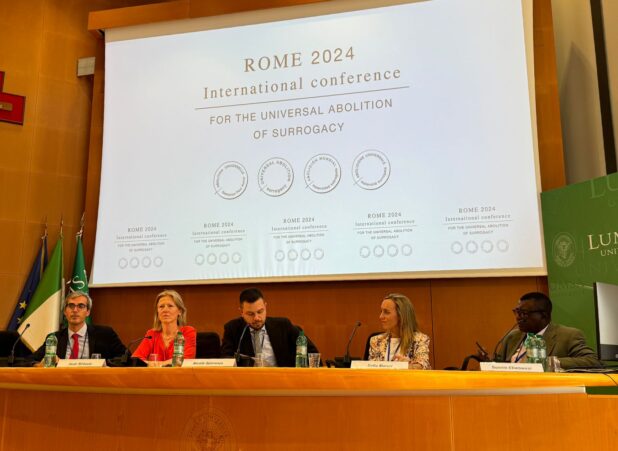
Major surrogacy conference seeks international action to ban the practice


The Vatican has just released a new document on the topic of human dignity. Among other issues, it addresses the ethical problems of surrogacy—including the commodification of babies and the financial exploitation of low-income women who are contracted to be surrogates.

Ireland is in the process of adopting one of the most permissive laws in Europe on the issue, but elsewhere, opposition to the practice is mounting.

major conference advocating for a worldwide ban on surrogacy was held in Rome last weekend. Experts at the conference argued that an international treaty is necessary to halt the practice. Although national bans have some impact, couples and single men may still travel to countries where surrogacy is legal or unregulated. This is why it is crucial for states to unite and establish a system to penalise corporations that serve as intermediaries between surrogate mothers and commissioning parents.

Some countries, such as Italy, are in the process of criminalising international surrogacy, punishing Italian citizens who engage in this practice abroad. Such an approach should be adopted by every country, the conference heard.

Banks and financial institutions play a pivotal role in the international surrogacy market, positioning them as critical targets in efforts to achieve worldwide abolition of this practice. At the conference, it was proposed that the responsibilities banks currently have in combating terrorism and money laundering should be expanded to include scrutiny of transactions related to surrogacy.

The meeting in Rome saw the participation of international experts and activists, including the Italian Minister for Family, a representative from the Holy See, various politicians, and notably, two United Nations officials. The UN Special Rapporteur on violence against women and girls, Reem Alsalem, and a member of the UN Committee on the Rights of the Child, Velina Todorova, attended as observers.

The politicians represented a broad spectrum of political affiliations, spanning right, centre, and left-wing parties. Similarly, the experts and activists brought a diverse range of ideological viewpoints to the discussion, including feminism, conservatism, and Christian Democracy, among others. This diversity underscored a rare consensus across political and ideological divides on the perils of surrogacy, a consensus that appears to be absent in Ireland.

This conference followed the launch of a declaration in Casablanca (Morocco) in March 2023, signed by 100 experts from 75 countries, calling for the universal abolition of surrogacy. The Casablanca Declaration initiative is led by Olivia Maurel, a French/US feminist activist conceived through surrogacy. The 32-year-old mother of three has faced mental health challenges from a young age, only later discovering the truth about her origins. She has since become one of the most vocal opponents of the “womb market.” At the conference, she gave a moving and powerful testimony about how surrogacy has affected her life, describing the commodification of children and women as a new form of slavery.

Before the conference, Olivia Maurel had a private audience with Pope Francis, who endorsed the conference’s goals. In January, the Pope had already called for “an effort by the international community to universally prohibit this practice,” a call reiterated in the new document on human dignity. Maurel is keen to stress that that she does not come at the issue from a religious perspective because she is an atheist.

The Rome conference continues the commitment of the Casablanca Declaration and aims to promote national and international initiatives, leading to the adoption of an international treaty among states.

At present, Ireland is far behind the curve on the matter, lost in the pretence that any ethical problems arising from the practice can easily be dealt with.

sabato, marzo 11, 2023

Declaration of Casablanca

   We, signatories of this Declaration,

Aware of

  • the suffering of the people who may not conceive
  • the attractiveness of the reproductive technologies 
  • and of the international issue of an efficient protection for human dignity

Convinced that the contract through which one or several orderers agree with a woman that she will carry one or several children for the purpose of their delivery upon birth, regardless to the name and terms and conditions of such contract, here below called surrogacy,

  • violates human dignity
  • and contributes to the commodification of women and children

Require from the States the prohibition of surrogacy in every modalities and kinds, whether remunerated or not, and the implementation of measures to fight such practice.

For this purpose, we make the following recommendations to the States:

  • prohibit surrogacy on their territory
  • deny any legal validity to contracts bearing the undertaking from a woman to carry and deliver a child
  • punish individuals and corporations acting as intermediaries**** between the surrogacy mothers** and the orderers***
  • prosecute individuals who have recourse to a surrogate mother on their territory 
  • prosecute their nationals who have recourse to a surrogate mother outside their territory 
  • act in favor of the implementation of a legal instrument bearing global prohibition of the surrogacy.

Attached to this Declaration, is a draft international Convention, freely available to the States wishing to commit themselves in such process.

________________

* Surrogacy, gestational surrogacy, surrogate motherhood, reproductive exploitation, use of a surrogate, is the arrangement by wich one or several orderers agree with a woman that she will carry one or several children for the purpose of their delivery upon birth, regardless the arrangement has been entered into directly by them or though one or several third parties.
** Gestational carrier, surrogate, or substitute mother: woman undertaking, to the benefit of one or several orderers, that she will carry for their account one or several children to be delivered to them at birth.

*** Orderer(s) : individual or individuals, also called clients or intended parents, who enter into an agreement with a woman, for her to carry for their account one or several children to be delivered to them at birth.

**** Intermediaries for the purpose of the surrogacy : individual(s) or corporate body(ies) putting in contact a woman and one or several orderers so that she will carry one or several children and delivered them upon birth and/or mediate between the woman and the orderer(s) for such purpose

______________

Schedule – International Convention for the global prohibition of surrogacy

The signatory States to this Convention,

Aware of

  • the suffering of the people who may not conceive
  • the attractiveness of the reproductive technologies 
  • and of the international issue of an efficient protection for human dignity

Convinced that the contract through which on or several orderers agree with a woman that she will carry one or several children for their delivery upon birth, whatever name and terms and conditions of such contract, here below called surrogacy,

  • violates human dignity
  • and contributes to the commodification of women and children

Denounce surrogacy in any modalities and kinds, whether remunerated or not.

Undertake to fight against such practice to protect and preserve human dignity and women’s and children’s rights, through the implementation of effective measures, including by :

  • prohibiting surrogacy on their territory
  • denying any legal validity to contracts bearing the undertaking from a woman to carry and deliver a child
  • punishing individuals and corporations acting as intermediaries between the surrogacy mothers and the orderers 
  • prosecuting individuals who have recourse to a surrogate mother on their territory 
  • prosecuting their nationals who have recourse to a surrogate mother outside their territory

venerdì, dicembre 16, 2022

Government recognising commercial surrogacy in all but name


The Government has approved a legislative proposal to recognise and facilitate what amounts to commercial surrogacy abroad, a practice banned almost everywhere in Europe because it commodifies babies and exploits low-income women. The Government denies it will recognise overseas commercial surrogacy, but this simply isn’t true.

Once drafted, the new provisions will be part of the Assisted Human Reproduction (AHR) Bill, presented in March and currently still at Committee Stage in the Dáil. Crucially, the law will allow a surrogate mother to be paid “reasonable expenses”. This includes a payment for earnings foregone, which is a fee in all but name. If a woman makes a living by being a surrogate, that makes it a commercial enterprise, especially when you add in other fees including those paid to the facilitating agency.

Notably, the law will not allow agencies in Ireland to be paid a fee, but will allow it overseas. This sort of payment falls under the definition of “commercial surrogacy”, according to the AHR Bill. (section 54) How is that not a huge double standard?

The new legislation will also recognise past surrogacy arrangements, applying criteria that are less demanding compared to those required for future contracts.

Commercial surrogacy is not recognised, or else is expressly banned, in all EU countries because it commodifies children and women. It can also created identity problems for the child also it divides the role of mother into several women (the egg donor, if there is one, the woman who gives birth and the woman who raises the child).
Before the war, Ukraine was the main destination for many Europeans, including Irish, looking to hire surrogates. Others went to Russia. Some of the business has now moved to Georgia and Belorussia.

The Canadian bioethicist, Winifred Badaiki, writes: “Surrogates in Georgia are typically low-income earners, and the intending parents are often middle-class foreigners. The Georgian surrogacy industry has taken advantage of this dynamic to build a thriving industry rife with exploitation. The victims, unfortunately, are the gestational carriers. For some women, in the absence of other options to break free from precarious situations, becoming gestational carriers appears to be their best option at escaping poverty, even if only for a short period”. It is the same in Ukraine and elsewhere.

The AHR Bill‘s list of “reasonable expenses” (section 55) includes any loss of income for a period of up to twelve months due to being unable to work; expenses for accommodation and travelling, for payment of childcare and housework undertaken by other persons; payments for legal advice, counselling, and more.

Such “reasonable expenses” would be a substantial source of income for less wealthy women. What the Bill calls “altruistic surrogacy” can easily be a commercial arrangement in disguise. This is even truer for women living in poor countries, where the Irish state has no means to set and attest standards.

Ireland will become the only country in the world with specific legislation for citizens engaging in surrogacy in other jurisdictions. Currently, there is no international framework to rely on, as for international adoptions for instance, and it is extremely complicated to control standards and regulations abroad. When legal difficulties for the parental recognition of babies born from surrogacy arrangements abroad arise, they are addressed according to the domestic family law, generally through some form of adoption. Ireland will be unique in facilitating with specific legislation such arrangements abroad.

This year, the Norwegian Minister for Children and Families compared this practice to human trafficking and proposed to make foreign surrogacy a criminal offence, as it is the case for the domestic one.

The Italian Prime Minister has also promised to legislate in the same direction.

venerdì, luglio 29, 2022

Ireland to legalize uterus for rent


An Irish parliament committee has proposed recognition of commercial surrogacy, a practice banned throughout Europe with the exception of Russia, Ukraine and Belarus.

In some countries, including Italy, there are discussions about how to punish those who resort to so-called “womb renting” by traveling abroad to procure children that way. Instead, Ireland, now lost in a hyper-permissive drift, is moving in the opposite direction, one that could even make it the new destination for procreative tourism, now that the war has overwhelmed the very traditional destinations.

In February, the Irish Department of Health introduced a bill to regulate various forms of assisted fertilization, including surrogacy. However, it was not part of the government’s intent to address the issue of recognizing births to surrogate mothers outside the country. And yet, after a media campaign that also featured entertainment personalities who had themselves resorted to surrogate mothers abroad, the parliament decided to set up an ad hoc committee that, just in the past few days, presented its puzzling conclusions.

The government bill only allows for the so-called altruistic surrogacy, but at the same time it also envisages reimbursement of “reasonable expenses” incurred by the “surrogate mother.” That is, not only medical expenses in the strict sense, but also any loss of income over a 12-month period, which for many women would represent a substantial amount of money.

In fact, one of the experts called to testify told the commission that, “under the bill, it is possible to pay an Irish surrogate mother for reasonable expenses. Once you calculate the loss of income and other expenses, the figure can easily be as high as 10,000 euros, which is probably not very different from what surrogate mothers are paid in other countries, with the exception of the United States.” In Ukraine, where couples seeking a surrogate usually go, the average per capita income is 2,500 euros a year.

In short, while theoretically banning commercial surrogacy, in practice the government’s proposal allows for some leeway, through expense reimbursements, which for many poorer women would represent real work.

The commission’s report also underscores the hypocrisy of calling a practice involving substantial payments “altruistic” and therefore calls for the bill to be amended. But the same report goes further and recommends payment for certain services performed abroad that the government’s proposal would prohibit, as they are explicitly commercial in nature. For example, payment of agencies or clinics that arrange or give effect to a contract between principals and the surrogate mother is prohibited.

During the Commission’s work, only one of the participants denounced the risks of commercial surrogacy, which turns the baby into a commodity and the woman into an incubator. All others, prompted by a very effective press campaign, have been willing to meet any request from couples or singles resorting to surrogacy.

Some state officials who had helped prepare the bill during Commission hearings on international surrogacy recalled the impossibility of using a double standard, allowing the recognition of a practice banned at home only because it is possible abroad. If it is wrong to rent a womb in Ireland, why should it be acceptable to do so abroad?

But the Commission says that while it would be desirable for the conditions covered in contracts signed abroad to match the conditions required within the Irish state, this principle is almost impossible to enforce, and therefore the Commission believes that “it is sufficient that the medical and health conditions set by the surrogate’s state are met.”

That is, precisely the double standard and the double moral is applied: a little stricter at home, but turning a blind eye to what is happening abroad. And this will obviously give boost to procreative tourism.

If the Commission’s proposal passes, Ireland would become the only state in the world to give legal recognition to foreign surrogacy contracts. However, there would be a safeguard: for example, the child must have a genetic link to at least one of the commissioning parents. But another puzzling passage in the report is the Commission’s finding that such a requirement in the government’s bill is unnecessary if and when surrogacy takes place in Ireland.”

It means that an unmarried man could pay a woman to bring into the world a child conceived using the reproductive cells of two donors, who will also be reimbursed. What would be the difference between this practice and buying children?

The baby would grow up without having any relationship with the genetic mother, with the genetic father, with the other mother who cared it for nine months and then gave birth, and with genetic brothers and sisters, if any. Legally, in short, it would only be linked to the outsider who commissioned it, paying the various actors in this tragedy. It seems incredible how a once-Catholic country like Ireland has completely lost its sense of the maternal bond and is about to approve an aberrant practice that the rest of Europe rejects and condemns.

lunedì, luglio 11, 2022

The appalling recommendations of the surrogacy committee

The very one-sided Oireachtas Committee on International Surrogacy has recommended the recognition of ‘compensated surrogacy,’ which is commercial surrogacy by another name, in Ireland and abroad. Under the broad notion of “reasonable expenses”, women will be paid large sums of money to carry a child for someone else under the terms of a contract. Almost no country in Europe recognises commercial surrogacy for this reason.

The Assisted Human Reproduction (AHR) Bill 2022, which is still under the consideration of the Dáil, does not include provisions for international arrangements. A special Committee was established last February to address this specific issue and some of their recommendations in the Report presented this week are quite shocking.

The AHR Bill allows non-commercial surrogacy, but also the payment of ‘reasonable expenses’. This would include not just medical expenses but also any loss of income for a period of 12 months, which could be quite substantial.

One of the experts told the Committee that, “Under the Bill, an Irish surrogate can be paid reasonable expenses. When loss of income and other expenses are calculated, this could easily reach €10,000, which is probably not very different from the amount that surrogates are paid in some other countries, excluding the United States, although, of course, this does acknowledge the socioeconomic situation may be different in other countries.”

In Ukraine, where many Irish couples go, the average per capita income is about $2,500.

The Committee Report highlighted the hypocrisy of calling ‘altruistic’ a practice that involves large payments and asked the Bill to be changed.

“The Committee notes that compensation to the surrogate in respect of costs arising in connection with the surrogacy is provided for in the AHR Bill, where it is defined as altruistic surrogacy. This terminology should be amended to be re-termed as compensated surrogacy, to better recognise the compensatory nature of the arrangement, and provisions made for international surrogacy arrangements of a similar nature to be permitted.”, the Report says.

But then the Report went even further and recommended the payment for services abroad that the AHR Bill would explicitly ban because of their commercial nature, such as paying agencies and clinics for “facilitating the entering into or giving effect to the agreement” (54.1a).

State representatives warned the Committee that double standards should not apply to domestic and foreign arrangements. If the potential exploitation of poor women is wrong in Ireland, why should it be accepted abroad? The Committee acknowledged that, while it would be desirable for all international surrogacy agreements to match the list of conditions which apply for domestic arrangements, “it would also be almost impossible to enforce. The Committee believes that as long as the medical and safety conditions of the country of the surrogacy are met, this should be considered sufficient.”

So, double standards will apply.

With the exception of Ukraine, Russia and Belarus, all European countries ban commercial surrogacy and many of them won’t allow any surrogacy at all, not even the “altruistic” one.

Commercial surrogacy in particular is considered exploitative for the women involved and treats children as commodities regulated by contract. There are proposals by politicians in Norway and Italy to make it a criminal offense using a surrogate mother abroad.

Ireland is one of the very few countries going in the opposite direction and will give legal recognition to foreign surrogacy arrangements.

Another shocking passage of the Report is that the Committee does not believe that a genetic link between the child and at least one of the commissioning adults (the ‘intended parents’) should be required in domestic surrogacy, something stipulated by the AHR Bill (53.3a). This means that a single man, for instance, should be allowed to pay a surrogate mother to carry a child conceived for him with the gametes of two “donors”, who will also be reimbursed for “reasonable expense”. How is this different from buying a child?

The child will grow up having no relations with the genetic mother, the genetic father, possible existing siblings, and with the birth mother. It will legally related only to the person who has commissioned him or her.

Senator Sharon Keogan was the only critical voice in a Committee that didn’t hear from exploited surrogate women from poor countries. She was constantly attacked but now that commercial surrogacy has been recommended, under the name of compensated surrogacy, her concerns have been proved to be well-founded. 

martedì, aprile 12, 2022

Oireachtas Committee told harsh facts of life about commercial surrogacy


Officials from three Government Departments have expressed great doubt about the possibility of legislating for the recognition of international commercial surrogacy contracts in Ireland. Besides practical difficulties, it would create a double standard if commercial surrogacy, which is banned here in Ireland, is tolerated when it happens abroad.

The Joint Oireachtas Committee on international commercial surrogacy, which had its first hearing last week, is addressing two main issues: the retrospective recognition of parentage for children who have already been born abroad from a surrogate mother, and the legal status of future arrangements.

The Committee wondered whether something should be added to the Assisted Human Reproduction (AHR) Bill that is currently under scrutiny in the Oireachtas, or if a separate piece of legislation is needed instead. Bar Senator Sharon Keogan, no-one on the Committee appears to be against commercial surrogacy in principle despite that the fact in Europe only Ukraine, Belarus and Russia permit it. Other countries regard it as womb-renting.

Officials from the three Departments (Justice, Health and Children) which appeared before the Committee reminded members of these facts. They said that no other country regulates surrogacy abroad as the State has no control and cannot legislate on what happens outside its jurisdiction. 

A representative from the Department of Children also told the politicians that he was “not aware of any EU Member State which has legislated specifically for their own citizens engaging in surrogacy in another jurisdiction. Rather, the norm appears to be that existing family law is utilised and adapted to deal with specific cases.”

This is also what currently happens in Ireland, but the Committee wants to create an easy pathway for surrogacy abroad.

The same representative warned that “international commercial surrogacy does raise concerns about the commodification of children, exploitation of women in poorer countries, the risk of child trafficking and the child’s right to know their identity.”

The Department of Health representatives said that they are “primarily concerned to ensure that any proposals that may emerge do not undermine the principles of the policy in respect of domestic surrogacy as reflected in the Assisted Human Reproduction Bill, or create a conflicting policy landscape”, whereby we ban commercial surrogacy here, but recognise it overseas.

The same safeguards to prevent the exploitation of women and children, and even of the commissioning couples, should be in place abroad as domestically but this is almost impossible to achieve. "How do you get assurance that standards are being applied?", asked Andrew Munro from the Department of Justice.

Some members of the Committee suggested a solution along the lines of international adoptions, where Irish couples can adopt children only from countries that guarantee good practice. But, unlike with adoption, there is no international convention on surrogacy, there is no international framework to rely on.

Speaking about surrogacy, Andrew Munro from the Department of Justice told the Committee: “We have seen some very difficult examples in the past where … a lot of people got exploited by bad actors, where the egg that was purportedly supplied by a purported donor was not the egg. The child given to the intending parents had no genetic link”.

He added there had been cases where the surrogate mother was “spirited away over a border immediately after birth,” or a birth certificate provided by local authorities falsely "named the intending father as father despite the child having none of his genetic material”.

Conor O’Mahony, Special Rapporteur on Child Protection, also spoke to the Committee, but he came down more on the side of facilitating commercial surrogacy.  He criticised the Government for ignoring his report on children’s rights in the context of surrogacy. If enacted without considerable amendments, he claimed, the Bill will be against the best interest of children in many ways.

Unlike the officials from the various Government Departments, Professor O’Mahony believes that international surrogacy can be regulated in the AHR Bill. He proposes that intending parents should “apply to the High Court for parentage and parental responsibility, as well as a grant of nationality and citizenship to the child, subject to satisfying a range of prescribed criteria.” He didn't clarified if the prescribed criteria should be the same as for domestic surrogacy.

This is probably what the Committee will recommend but it will create tension with the Government as it will delay the Assisted Human Reproduction Bill and its implementation, aside from the many inherent and unavoidable ethical problems created by commercial surrogacy.

martedì, febbraio 01, 2022

Officials warn against commercial overseas surrogacy


There is a mounting pressure in Ireland to have foreign commercial surrogacy arrangements recognised here. Today the matter is being considered by a Special Oireachtas Committee, but ahead of that meeting, the Attorney General’s office produced a document highlighting the ethical pitfalls with commercial surrogacy. It also challenges the recommendations on the matter of the Rapporteur on Child Protection.

To summarise, the document warns that commercial surrogacy commodifies babies, exploits women, and if we ban it here and recognise it overseas, that creates a double standard. These arguments echo the concerns of The Iona Institute, among others.

International commercial surrogacy by its nature involves paying poor women, usually in low-income countries to conceive and give birth for a commissioning couple or a single person. Usually, the gametes (eggs and sperm) are provided by the intending parents, but sometimes it comes from “donors”, who are also paid or compensated. In Europe, commercial surrogacy is legal only in Ukraine, Belarus and Russia.

Many European countries ban ‘altruistic’ as well as commercial surrogacy because it splits motherhood into several women potentially creating identity problems for the child.

The planned Irish law covering this area will allow non-commercial surrogacy while prohibiting commercial surrogacy agreements in Ireland. In practice, some Irish couples are going to places like Ukraine to avail of commercial surrogacy there.

Those couples are now campaigning for Ireland to recognise these arrangements, but the document from the AG’s office raises several objections.

It expresses concerns about “commodification of children and exploitation of surrogate mothers”, and says, “These issues are heightened in international surrogacy, especially where intending parents from a wealthy country such as Ireland undertake a commercial arrangement with a surrogate mother in a poorer country, or one where the rights of women are less protected.”

The paper also warns that prohibiting commercial surrogacy here, but recognising it when Irish couples go abroad would create a double standard.

It states: “If commercial surrogacy arrangements are to be prohibited in Ireland due to concerns relating to welfare of children and surrogate mothers, those concerns arise to an even greater extent in relation to commercial surrogacy arrangements undertaken outside the State. Providing for recognition of foreign commercial surrogacy arrangements while limiting domestic surrogacy to altruistic arrangements, thereby providing a greater standard of protection for women in Ireland than abroad, would create a double standard in Irish law which may be difficult to justify.”

In December 2020 Dr Conor O’Mahony, the Special Rapporteur on Child Protection, produced a report that addressed the ‘best interests’ of a child born through different forms of assisted reproduction, including surrogacy arrangement.

The report by Dr O’Mahony recommended that Irish law should make provision for international commercial surrogacy, when certain criteria are satisfied.

It is a plain contradiction to make a certain practice illegal here and at the same time to give it legal recognition it if it happens abroad.

The Attorney General’s office suggests the Joint Oireachtas Committee some possible options in dealing with international commercial surrogacy.

The current legislative provision could be maintained, that is, those who intend to become parents of children born via international surrogacy arrangements will apply to court, and each case will be considered individually.

A second option is that the same requirements for surrogacy in Ireland would apply for arrangements abroad and so only parents commissioning non-commercial arrangements abroad would receive parental status here.

The third option would be to allow commercial surrogacy in Ireland, but that would make Ireland an outlier in Europe and internationally.

But there is one option that neither this document nor the drafted Bill consider, even if it is the solution adopted by Germany, Italy, France, Spain, Austria, Norway, Finland, and many other European countries: i.e. a total ban of surrogacy in all its forms. This avoids the problems inherent in all surrogacy procedures.