Visualizzazione post con etichetta Divorce. Mostra tutti i post

mercoledì, luglio 09, 2025

Ireland today: fewer marriages and more divorce


New figures show that the number of people applying to divorce has fallen somewhat, seeming to reverse a previous upward trend, but look closer and you will see that divorce is becoming more common in Ireland, relatively speaking, that is, when compared with the numbers marrying each year, which is in steep decline.

In fact, relative to the number of couples getting married each year, the percentage of couples filing for divorce has gone up by nearly 30pc since 2010, a short time period.

The newly published Courts Service Annual Report shows that last year there were 5,004 applications for divorce, down on the previous two years. But those two years are not representative of present trends, for two main reasons.

One is that the Family Law Act 2019 halved the required separation period before filing for divorce from four years to two, meaning there was a rush of applications. This legislative change was introduced following a referendum.

The COVID-19 pandemic also played a role, disrupting both marriage and divorce patterns: marriages were postponed or cancelled, while household tensions during lockdowns may have led to a spike in divorce applications, post-lockdowns.

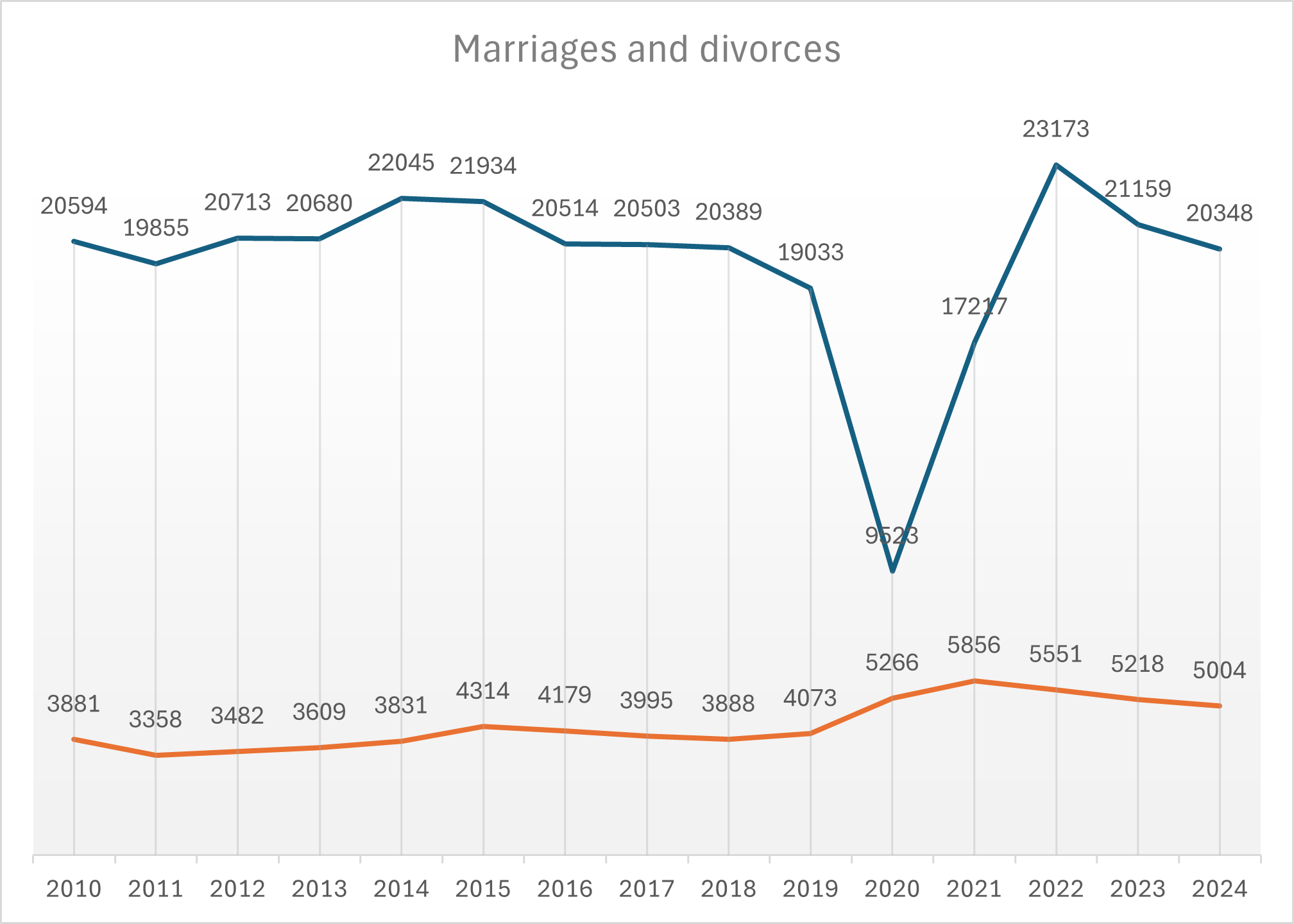
But if we look at the past 15 years, when the population grew approximately 20pc, the trend is quite clear: marriage rates have declined, while divorce applications have remained consistently high, if not rising overall. This is a pattern that predates the pandemic. In 2010, there were 20,594 marriages in a population of approximately 4,470,700. By 2024, that number had dropped to 19,680 (opposite-sex only) or 20,348 including same-sex couples, in an estimated population of 5,380,300. In contrast, divorce applications have increased by about 29pc, moving in the opposite direction.
 

There are many ways to measure divorce rates. For instance, we often hear that the divorce rate in Ireland is quite low and stable, compared to other countries. The crude divorce rate, a commonly cited figure, is expressed as a percentage of every 1,000 people and it is about 0.7 in Ireland. In other words, last year there were 7 divorces every 10,000 people.

But the crude divorce rate can be misleading, especially in societies where fewer people are marrying. It includes the entire population, married or not, making it a blunt tool for understanding real marital dynamics.

A more revealing statistic is the divorce-to-marriage ratio, which more accurately reflects the dramatic changes of the past 15 years in Ireland.

In 2010, there were 3,881 divorce applications and 20,594 marriages, giving a ratio of 18.8pc. By 2024, that ratio had increased to 24.6pc, with 5,004 divorce applications and 20,348 marriages recorded. In other words, in 2010 there was roughly one divorce application for every five new marriages; today, it is one for every four.
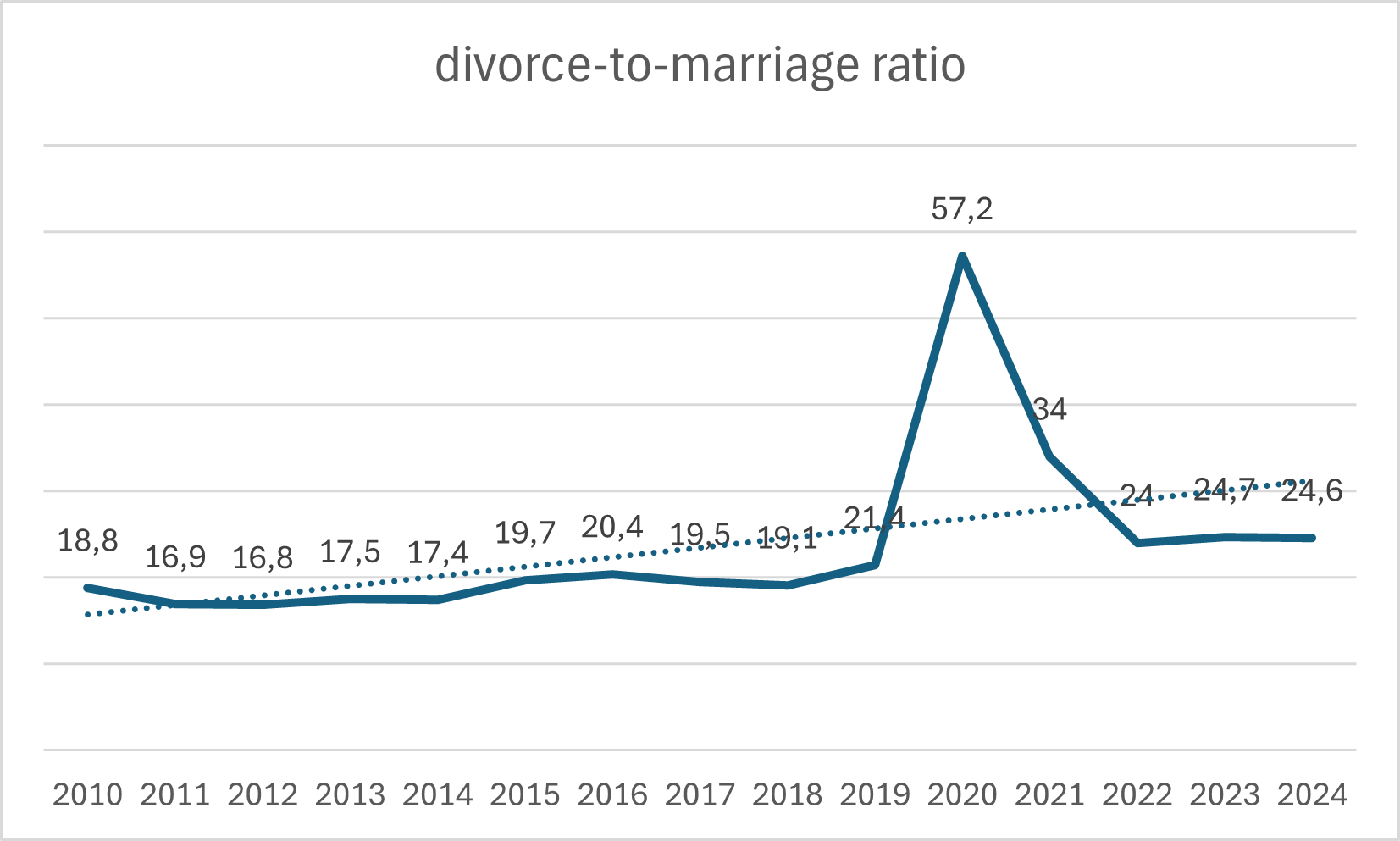
Interpreting this ratio also requires caution. The figure does not measure how many marriages eventually end in divorce; rather, it compares two parallel social trends: fewer newlyweds and more marital breakdowns, relatively speaking. (The blip in 2020 is due to Covid and few people marrying that year which artificially increased the divorce to marriage ratio).

Those two trends going in opposite directions is an unequivocal indication of malaise that the Irish couples are suffering.

The long-term negative effects of those trends not only the individuals involved but on society in general, deserve serious attention, public discussion, and thoughtful policy response.


mercoledì, maggio 28, 2025

Another study highlights how divorce can harm children


The harmful effects of divorce on children is something we are extremely reluctant to discuss probably because it is too close to the bone for many people, especially the adults involved. But if it affects children, then we should discuss it or we are only burying away the problem. A major new study from the US tracking the lives over time of five million young American confirms that the divorce of your parents can indeed causes problems in later life, and immediately.

The paper is from the National Bureau of Economic Research (NBER) and is titled Divorce, Family Arrangements, and Children’s Adult Outcomes. It offers a compelling and methodologically robust examination of how parental divorce impacts children’s long-term outcomes.

Using detailed records from over five million children born in the U.S. between 1988 and 1993, the researchers compared siblings within the same families who were different ages when their parents divorced.

Why is that so important? Because by looking at brothers and sisters, the researchers are controlling for all the factors that make families different from one another: social background, values, income, even parenting style. They are isolating the one variable that matters here: how old the child was when the parents split up.

And the results are striking. Children whose parents divorced before they turned five earned, on average, 13pc less by their late twenties than their older siblings. This means the younger you were when your parents divorced, the more of an impact it had on you. This drop in earnings is roughly equivalent to the economic impact of losing an entire year of education.

But income is only part of the story. These children were also 73pc more likely to become pregnant as teenagers, 43pc more likely to be incarcerated, and 35pc more likely to die by the age of 25. These are not small effects. They are deep and lasting.

So, what drives this damage? The study points to three main factors: a significant fall in household income (typically due to the loss or reduction of a parent’s financial support), relocation to lower-income neighbourhoods, which often means changing schools and social environments, and reduced parental involvement, especially as the custodial parent juggles more responsibilities alone. These factors explain between 25pc and 60pc of the negative effects seen in the data, according to the study.

The researchers warn that the consequences of divorce may be even more severe for families already under financial strain. As they put it, “because divorce has negative effects on children’s outcomes and is more common among low-income families, marital instability likely perpetuates disadvantage across generations.” (p. 6)

Of course, many parents do their best to protect their children through divorce but what this study shows is that divorce, especially early in a child’s life, can inflict real and lasting harm. It doesn’t just change the structure of a family, it reshapes the trajectory of a life, sometimes in lasting ways.

We may not have large-scale longitudinal studies in Ireland to match this level of evidence, but the warning signs are clear. Divorce is not merely a private decision, but it carries serious public consequences, for the next generation and beyond.

People may object that is it better for children if the parents are fighting a lot and they go their separate ways, but most marriages that end in divorce and separation are what they call ‘low conflict’, that is, there is little fighting that is obvious to the children, never mind violence and therefore the break-up can come as a complete surprise.

Also, there is no getting away from the fact that divorce or separation will almost certainly mean less available income, the children possibly having to move into a poorer area, moving schools, having to go back and forth between the two parents, plus the emotional pain of witnessing your family breakup. None of this is good and any sensible person will want the amount of divorce and separation reasonably minimised. Certainly, we should care about rising marital breakdown. As at Census 2022, about 320,000 adults living in Ireland had been through a divorce or separation, plus all the children involved. In 1986 (when we had legal separation, but not divorce), the figure was 40,000.

This new research forces us to address the consequences of divorce for children honestly. We can’t keep avoiding the conversation.

venerdì, dicembre 13, 2024

Will we ever have an honest discussion about divorce in Ireland?


Divorce will affect children for the rest of their lives, well into adulthood, but people don’t want to hear this because it makes them feel bad about their decisions, says Spectator columnist, writer and broadcaster, Bridget Phetasy.

piece she wrote a few months ago titled “How divorce never ends”, is based on her personal experience and presents the lifelong impact of parental break-up on children. It caused a huge reaction, for and against. Those who supported the article were themselves usually children of divorce. Those who reacted angrily were often the parents who exhibited great defensiveness about what they had done, even though Phetasy was at pains to say parental separation, for example when the relationship is abusive, is justified.

Phetasy (née Walsh), whose parents divorced when she was 12, recounts how her life and that of her future husband – also a child of divorce – were upended. Their school achievements declined, and they fell into rebellious behaviours. The logistical challenges of splitting time between parents, with cross-country travel and fractured holiday traditions, contributed to instability and neglect. Lacking proper supervision, the children often resorted to reckless behaviour.

“So often it feels like two people are just ‘over it’ [meaning the parents] and want to move on with their lives and be single again instead of doing whatever it takes to make it work for the kids. People don’t want to hear this because it makes them feel bad about their decisions. Divorce sucks. It never ends and it should be a last resort”, she wrote.

Phetasy – a former columnist for Playboy magazine, of all things, – is now a mother and uses her parents’ shortcomings as a guide for what not to do.

“Before I had a kid, I asked people who came from similar backgrounds how they managed to raise great, well-adjusted kids. They always said the same thing: “I just did the opposite of what my parents did.’”, she writes in her piece.

She argues that divorce is too often treated casually, with little regard for its profound and enduring impact on children.

She admits harbouring lasting anger and grief over her parents’ prioritisation of new relationships over their children’s well-being. These feelings persist into adulthood, particularly as the complexities of managing relationships with multiple sets of grandparents now affect her own family.

Talking to the feminist podcaster Louise Perry, she recalls the reactions from readers of the piece and also from followers of her YouTube channel.

“People lie to themselves about how hard it is on the kids. There’s this lie: kids are resilient, they’ll be fine. It was heartbreaking reading the initial flow of comments that came in.  First you get the flood of people who feel seen and heard and validated. “Thank you so much this was my experience. I felt I this brought up so many emotions of my own”, and then you get the backlash and the people misinterpreting you and taking it out of context”, she told in the interview.

Commenting on Bridget Phetasy’s article, Louise Perry noticed that the consideration of what is a truly valid reason for divorce often leads to exaggeration of issues, while many overlook the long-term impact on their children, whose lives will be shaped by the decision for decades to come.

The majority of break-ups occur in low-conflict marriages, where the impact on children is often more profound due to the unexpected and therefore more traumatic nature of the separation. In such cases, it is usually in the best interest of the children for the parents to remain together.

2025 will mark 30 years from the divorce referendum in Ireland, where now over 320,000 adults are today divorced or separated and hundreds of thousands of children affected. This anniversary will surely be celebrated with enthusiasm, but a mature assessment will consider the voices of people like Bridget Phetasy who have suffered because of their parents’ decisions.

venerdì, maggio 03, 2024

The huge rise of ‘New Age’ weddings in Ireland


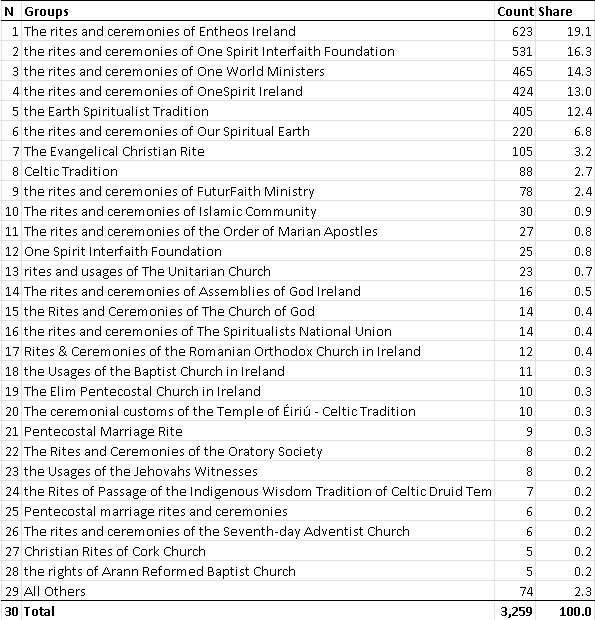
While the number of Catholic marriages in Ireland is steeply declining, new data released by the Central Statistics Office (CSO) highlights the rise of ceremonies belonging to “other religious denominations”, to use the CSO’s term. Now, you might think this means Muslim ceremonies, or perhaps those that take place in African Pentecostal churches, but these account for only a tiny fraction of the total (see table below). The vast majority of the ceremonies, in fact, really belong under the very broad heading ‘New Age’. They increased from 5.3pc of the total in 2018 to 15.8pc last year, growing from 1,009 to 3,259 in absolute numbers — a three-fold increase in just five years. 

The ceremonies incorporate elements from many different religions, as a couple choose. They can be extremely eclectic. There is no particular coherence to them in that they don’t come from a systematic religious worldview that can be called ‘Christian’, or Buddhist’, or ‘Muslim’ or ‘Hindu’. This is why the term ‘New Age’ might be most appropriate, even if some who act as the celebrants themselves, or even the couples involved, might resist the label. We use it here for short-hand.

To the category “other religious ceremonies” must be added ‘Spiritualist’ ones, which were nonexistent ten years ago and are not included in the “other religious” cohort by the CSO. These now account for 7.9pc of all marriages and also borrow from any and all religions depending on the taste of the couple.

This means what can very broadly be termed ‘New Age’ or ‘spiritual’ wedding ceremonies now account for almost a quarter of all weddings in Ireland.

The majority of these ceremonies are conducted by brand new organisations, the Spiritualist Union of Ireland being one. 

Another is ‘Entheos Ireland’, which only registered with the HSE three years ago. According to data provided to the Iona Institute by the CSO, Entheos ministries officiated at 623 marriages in 2023. They currently have 81 solemnisers approved by the State, compared with only five Muslim solemnisers and about 20 from various Orthodox churches.

Spiritual groups such as Entheos and One Spirit tailor their religious ceremonies to the preferences of the spouses, presenting themselves as 'inclusive, embracing people of every faith and none,' without referencing any specific deity or belief system unless requested.

Entheos says it was founded “to serve people who have been ostracised, marginalised or otherwise left behind by traditional faith paths on the basis of gender, race, sexual orientation, ability, nationality, parental / family status or any other reason.”

Another group is ‘One Spirit Interfaith Ministers’. They describe themselves as “ordained interfaith ministers embodying a vibrant and meaningful response to the changing spiritual needs of our times.” They say they are “of service to people of all faiths and none.”

There are many other similar groups offering their services to engaged couples including ‘The Earth Spiritualist Tradition’, ‘One Spirit Ireland’, and ‘One World Ministers’.

Many of the ‘New Age’ wedding ceremonies involved couples or individuals entering a second or third marriage. Data provided to the Iona Institute by the CSO reveal that the number of first marriages among “other religious” ceremonies is significantly lower than among traditional Christian denominations, likely because these groups also offer ceremonies for divorced individuals, which may partly explain their growing popularity. They are also very popular among same-sex couples. Of the 646 same-sex marriages celebrated in 2023, 145 (22pc) were with “other religion” ceremonies and 70 (11pc) with Spiritualist ones.

The rise of non-denominational religious ceremonies is a new trend that reveals the need to mark important events in life with some form of non-institutional religious rituals. Those who feel they do not belong to a religion, often still have religious beliefs of some sort and these new organisations (which charge €600 on average for a wedding) are emerging to satisfy their needs.

As for the broader picture, last year there were 20,513 opposite-sex marriages in Ireland, and 646 involving same-sex couples. Of the opposite-sex ones, 86pc were first marriages, a slight decline from 88pc in 2013. Our marriage rate last year was 4.0 per 1,000 adults—one of the lowest rates in Europe and a decrease from 4.5 ten years ago.  In other words, fewer people are getting married but the percentage of those who remarried after a divorce has increased.

The proportion of marriages conducted through religious ceremonies has obviously decreased, representing 60pc of all marriages last year, down from 70.5pc in 2013. Notably, Catholic marriages have dramatically declined from 62.5pc a decade ago to just 35.3pc in 2023.

Among first marriages, 40pc were celebrated in a Catholic church.

The face of marriage in Ireland is indeed changing very rapidly and the rise in ‘New Age’ ceremonies reflects the drift away from institutional religion of all types. At the same time, there is still clearly a taste for wedding ceremonies to have religious or ‘spiritual’ trappings of some sort and therefore we are not becoming as secular as some people think.

– – –

“Other religious” solemnisers

venerdì, agosto 06, 2021

Ireland’s rising number of divorces will harm children


There was a huge increase of applications for divorce last year. It was the highest number since divorce was introduced in 1997. There are many reasons why we should be worried about it, not least because children affected by parental divorce have a higher risk of developing a variety of difficulties.

The 29pc increase in divorce applications in 2020 is probably mainly due to the effects of the 2019 referendum that significantly halved the waiting time for divorce. Nonetheless, the number of broken marriages in the country keeps increasing. By the time of the last census in 2016, almost 150,000 couples had gone their separate ways.

It is true that Ireland still has one of the lowest divorce rates in Europe, but the marriage rate is also declining and for every four couples who marry in Ireland each year, roughly one couple breaks up.

All those trends should raise public concern about the negative long-term effects of breakdowns, particularly on children.

recent article published in the Journal of Psychiatric Research found that children of divorcees have a higher risk of mental health problems.

The article is a meta-analysis aggregating the results of other studies and it takes into consideration a total sample of more than half a million people.  It is the first for many years to consider a great variety of mental health aspects.

The authors observed “a consistent negative association between parental divorce on all observed dimensions [among children]: depression, anxiety, distress, suicide (attempts and ideation), alcohol and drug consumption, as well as smoking”. (p. 112)

Different affective and behavioural dimensions are negatively affected by divorce.

“Parental divorce may be consistently connected to detrimental long-term effects, whereby their sizes vary across samples and measures, but with a clear and marked but unspecific disadvantage for those who had experienced it”, the article claims. (p. 112)

These results are consistent with similar studies carried in the past which outlined the long-term negative effects of breakdown on the mental health of children of divorcees.

Paul Amato, possibly the leading sociologist of marriage, found that over half of couples who divorce are in low conflict as distinct from high conflict marriages.

He claims that, at least in low-conflict relationships, parents should try and stay together as in those cases, children have experienced a generally positive family life and are not prepared for the break-up of their family.

On the other hand, he believes that when a marriage is high-distress, then it probably is better for the children if their parents separate.

In Ireland, we don’t know how many marriages that end in separation or divorce are low-conflict or high-conflict. If we have the welfare of children in mind, we should find out.

mercoledì, giugno 24, 2020

Marriage in Ireland continues its decline

Marriage continues to change and decline in Ireland as the latest figures from the Central Statistics Office show. Fewer marriages are taking place, fewer are taking place in churches, more are taking place between people who were married before and are now divorced, and couples are older when they marry. Same-sex "marriage" is now permitted.

In 2019, there were 19,673 opposite-sex marriages in Ireland. This was down from 20,389 the previous year.

Just over 60% of the all opposite-sex marriages took place in religious ceremonies, while this is the case only for 22.2% in same-sex marriages.

Half of first marriages were celebrated in a Catholic Church. If we include also marriages involving someone who has been married before, this figure drops to 45.1%. The second most popular religious ceremonies are performed by the Spiritualist Union of Ireland (7.7%), followed by the Church of Ireland (1.5%), and then Presbyterian (0.3%).

Civil marriages were the most popular form for non-religious ceremonies accounting for 30.6% of the total.  In recent years, Humanist Association marriages have also risen in popularity accounting for 9.2% of such marriages in 2019, compared to 8.7% in 2018.

The average age of grooms was at its highest to date at 36.8 years, while the average age of brides was 34.8 years.

The crude marriage rate (number of marriages per 1,000 persons per annum) for Ireland was 4.1 in 2019. This is the lowest level on record and is below the EU average of 4.4. In the 1970s our figure was above 6 or 7 per thousand. This means that less and less people get married proportionate to the population, and at a later stage.

Just over 12% of opposite-sex marriages involved at least one divorced person.

According to the latest available data, in 2018 there were 5,157 divorces or separations.

This means that today there are about 20,000 marriages per annum and about 5,000 marital breakdowns, which is equivalent to one breakdown every four new marriages. This is not good news, although it is still a lot lower than in countries like Britain, or France, or Sweden.  (See here for a more detailed analysis https://ionainstitute.ie/marriage-breakdown-in-ireland-higher-than-we-think/)

Last year, the Irish Times wrote that “the institution of marriage in Ireland is in pretty good health.”

Quite the opposite, all those figures show that the institution of marriage is in constant decline and deep crisis. As previous Iona Institute reports have shown, the situation is far worse the lower down the socio-economic ladder you go.

The social consequences of this phenomenon need to be considered in depth. For instance, fewer children are born and raised in committed relationships between a man and a woman. Will we ever take stock and attempt to arrest the decline of marriage in Ireland?

martedì, maggio 28, 2019

Irci na referendumu ogromnom većinom izglasali liberalizaciju razvoda

Sa stavom irskog ministra ne slažu se u Iona institutu, posvećenom religiji i društvu. Predstavnik instituta dr. Angelo Bottone u svom je tekstu napisanom uoči referenduma istaknuo da većina irskih parova koji se rastavljaju žive u braku „niskog sukoba“, te da će liberalizacija zakona o rastavi ugroziti upravo takve brakove.
“Kada je brak visokog sukoba, tada se čini da je bolje za djecu ako svaki roditelj ode svojim putem. Ali ako je riječ o braku niskog sukoba i roditelji stavljaju dobrobit svoje djece na prvo mjesto, tada bi trebali ostati skupa”, stoji u Bottoneovu tekstu.

Qualcuno capisce il croato?  

martedì, maggio 21, 2019

The risk factors leading to marital breakdown


Do marriages that end in separation or divorce share certain traits, risk factors that allow us to predict which couples will stay together and which ones will not? The answer is, yes.
In my previous blog I referred to the studies of Paul Amato, a sociologist of marriage from Pennsylvania State University. He pointed out that somewhat more than half of marriages that break up were low-conflict, not high-conflict, which means the relationships were not abusive and had low levels of discord.  They may even have been outwardly happy, especially to the children.
Using data from the US National Survey of Families and Households, Amato and his collaborators tried to identify possible predictors of marriage breakdown. He looks at both types of marriages that end in break up, high-conflict ones and low-conflict ones, and finds certain common predictors of divorce or separation.
These are:
  • marrying at an early age
  • cohabiting with other partners prior to the current marriage
  • having divorced parents
  • having stepchildren in the household
  • holding liberal family values
  • believing in the acceptability of divorce
As most of those factors are more present in our society nowadays compared to the past, it follows that couples have never been at higher risk of breaking up.
Believing that a better alternative to a present spouse is available is also an important factor. A substantial percentage of spouses in both groups began dating within one month after the separation. In other words, they had someone else in mind when they left their marriage.
Speaking of people in low conflict marriage who nonetheless break up, Paul Amato notes: “The absence of barriers [to breaking up] and the availability of alternatives [another person] may entice some moderately happy individuals to leave their marriages and to seek greater happiness with different partners”.
How do they fare afterwards? Do they find the happiness they seek? Not necessarily. Divorced individuals generally experience a lower level of well-being than do married ones. Also, subjective well-being tends to decline following divorce and so does the general standard of living. Those who raise their children, now have to do it without the daily help of the other parent, and those who don’t, often see the ties with their children become weaker. There is always much emotional cost involved.
We are nearing the end of another divorce referendum, this one aimed at removing the waiting time for divorce from the Constitution, but we have not seriously discussed what causes a marriage to break up in the first place. There has been discussion of abusive relationships, but none at all of the fact that most marriages that end are not high conflict and could possibly have been saved.
We have not looked at the risk factors that lead to divorce or separation and how to reduce these, or how a marital breakup can affect children. In other words, there has been no proper discussion at all. As usual.

mercoledì, maggio 15, 2019

Children suffer when parents in low-conflict marriages divorce


We are in the middle of a referendum right now on whether the waiting time required before a couple can divorce should be removed from the Constitution. It therefore seems a good time to look at the general issue of divorce, and in particular on what makes a person file for divorce. You might think most people who do this are in high conflict marriages, but actually they are more likely to be in a low-conflict one, and when a low-conflict marriage ends in separation or divorce, that is bad for any children caught in the middle of it.
High conflict marriages sometimes involve violence but are more likely to comprise frequent rows and obvious unhappiness. Low-conflict marriages are ones in which couples rarely fight and marital discord is not evident. Certainly, the children are often oblivious to any unhappiness one or other spouses might be experiencing and the announcement of a split comes as a real shock to them.
Paul Amato is one of the leading sociologists of marriage today. He has been studying marriage for decades.
In one of his many studies, he and his collaborators tracked the marriages of almost 4,500 couples. Of these, 509 separated or divorced during the period during the period under examination.
Crucially, the study found that just over half of couples who divorced were in low conflict as distinct from high conflict marriages.
These couples do not experience high levels of discord and marital unhappiness prior to breaking up, they often get on well after they split.
What is the impact of divorce or separation on children? When the marriage is high-conflict, it seems to be better for the children if the parents go their separate ways. But if it is low-conflict, and the parents are putting the welfare of their children first, then they should stay together.
This article sums up Amato’s conclusions well: “Dr. Amato found two categories of children who are most at risk for future psychological problems: those who grow up with parents who stay married but remain conflicted and hostile, and those whose parents are in low-conflict marriages and divorce anyway. ‘Two different kinds of marriages that end in divorce have very different impacts on children as adults,’ says Dr. Amato, whose research was published in the Journal of Marriage and the Family.”
Children whose parents had a low-conflict marriage but split anyway suffer because the split is usually unexpected, and the children’s experience of family life had been positive. Divorce or separation is more disruptive in their lives as they were not prepared or alerted by an ongoing fight between their parents.
How many Irish people know any of this? How many Irish marriages that end in separation or divorce were low-conflict, and do we know what effect the end of these kinds of marriages have on Irish children?
The Government wants us to reduce the waiting time for divorce. But how about it invests some time and money investigating what makes marriages work and informing parents whose marriages are “good enough” that they should stay together for the sake of their children?
PS. Here is a very interesting article from a woman who regret a marriage that was only low-conflict and regrets it.
PPS. Here are two more articles about low conflict marriages that end in separation or divorce and the effects on children. https://www.divorcesource.com/ds/considering/most-marriages-and-divorces-are-low-conflict-483.shtml
https://www.3stepdivorce.com/blog/2015/08/25/low-conflict-marriage-low-conflict-divorce/