Visualizzazione post con etichetta Ireland. Mostra tutti i post

sabato, maggio 02, 2026

The Strange Rise of ‘Spiritual’ Weddings in Ireland


Two years ago, while examining data on marriage in Ireland, I noticed a rise in what the Central Statistics Office (CSO) classifies as ‘Other religious’ wedding ceremonies.

At first, I assumed these ceremonies were being conducted mainly by Muslim, Hindu or other minority-faith clergy, reflecting Ireland’s changing population. But when I asked the CSO for a more detailed breakdown, the picture turned out to be very different.

Many of these ceremonies were not being conducted by recognisable religious communities at all. They were being performed by groups that, in many cases, have no congregations in the ordinary sense, no parish life, and little resemblance to what most people would understand by a religion. They are, rather, ceremony providers, often offering highly personalised weddings as part of a wider commercial ecosystem around hotels and reception venues.

At the time, I wrote a number of blog posts on the subject, and Breda O’Brien later produced a paper for The Iona Institute based on my research. Since then, I have continued to look into the issue, and in this piece I want to bring that work together.

This week, the CSO released publicly, for the first time, some of the more detailed figures it had previously supplied to me on request. I welcome the fact that this topic is receiving official attention, but I also find the new CSO release perplexing in two respects.

First, it compares 2024 with 2014, even though the CSO is due to publish the overall 2025 marriage figures on 5 May. It would surely have made sense to wait and include the most recent data. Second, the comparison is not always like with like. The CSO’s headline 2024 figures combine opposite-sex and same-sex marriages, while 2014 necessarily refers only to opposite-sex marriages. The CSO’s own data page links separately to datasets for opposite-sex and same-sex marriages, and that distinction matters. 

In the analysis that follows, unless otherwise stated, I compare like with like and refer to opposite-sex marriages.

One of the most surprising discoveries was the scale of the Spiritualist Union of Ireland. In 2024, it performed 1,374 opposite-sex marriage ceremonies. For comparison, that is more than seven times the number of Church of Ireland ceremonies, which stood at 193.

But what is the Spiritualist Union of Ireland?

The organisation was set up by Tom Colton, a self-described spiritual medium. Colton has a serious criminal history. The Irish Times reported that he was disqualified from acting as a company director following a 2014 conviction for the theft of €322,000 from an elderly couple while acting as their accountant, with the trial judge describing his conduct as “extraordinarily dishonest and fraudulent”. That conviction triggered an automatic disqualification from acting as a company director.

However, according to the Irish Times, Tom Colton later pleaded guilty to breaching that disqualification by acting as a director and legal secretary of Grá Agus Solas ULC, a company providing celebrant services for weddings, funerals and baby naming ceremonies, while disqualified. He received a nine-month suspended sentence and consented to a ten-year directorship disqualification. 

Grá Agus Solas, trading as Spiritual Ceremonies, is not the same legal entity as the Spiritualist Union of Ireland. The Spiritualist Union is a separate company and solemnising body. However, the two are closely linked in practice: Grá Agus Solas/Spiritual Ceremonies operates as a ceremony-services platform, its celebrants include officiants of the Spiritualist Union of Ireland, and company records place Grá Agus Solas at the Spiritualist Union’s address.

Despite Colton’s convictions, Spiritualist ceremonies continue to form a major part of Ireland’s marriage landscape, but they are only one part of a much broader and rapidly expanding ecosystem of pseudo-religious ceremony providers.

Over the past few years, my research has documented the emergence of a wide range of organisations offering what might loosely be called ‘alternative spiritual’ ceremonies. These groups present themselves as religious or spiritual bodies, but in most cases they do not resemble traditional religions in any meaningful sense.

Among the most prominent are organisations such as Entheos and OneSpirit Ireland, which together officiate at a large and growing number of weddings each year. OneSpirit Ireland says its interfaith ministers have been active in Ireland since 2008 and that they offer ‘unique and bespoke legal weddings’, funerals, naming ceremonies and spiritual counselling. It also states plainly: ‘We Have No Church.’

What is typically being offered is not membership in a religious community, but a service: a personalised ceremony, tailored to the couple’s preferences, and frequently designed to fit smoothly into the wedding venue and reception.

Some organisations go further still. In earlier work, I highlighted a group that offers not only weddings and funerals, but also ceremonies linked to abortion. This illustrates how far the category of ‘religious’ or ‘spiritual’ ceremony has expanded in practice.

Individuals associated with this broader sector are also involved in wider political causes. Karen Dempsey, the founder of Entheos Ireland, was involved in the Repeal the 8th campaign. In 2017, she was one of about 25 women dressed as red handmaids, inspired by ‘The Handmaid’s Tale’, who marched to the Dáil in an event hosted by Socialist feminist group ROSA.

Another celebrant of Entheos is Janie Lazar, the founder and chair of End of Life Ireland, a group campaigning for euthanasia and assisted suicide.

The Temple of Plants is an especially bizarre example. Its rites now appear in the CSO marriage data. The organisation describes itself as ‘non-religious, multi-racial, multi-cultural and multi-dimensional’, while also speaking of honouring ‘the Goddess, our Divine Cosmic Mother’. It says: ‘We are united in our love for the Earth and all Her realms. Plants are central to our work and seen as an expression of the Divine Feminine.’

Such language gives a sense of the highly eclectic and loosely defined belief systems that now fall within the scope of legally recognised solemnising bodies. If they define themselves as ‘non-religious’, why are they functioning as a recognised provider of religious marriage ceremonies under Irish law?

The fact that such rites can appear in the State’s marriage statistics as part of the ‘Other religious’ category shows how elastic that category has become.

Now let us look at the data. They confirm that something significant has changed in a relatively short period of time. Ireland is not simply moving from religious weddings to secular ones. Instead, a large and growing number of couples are choosing ceremonies that are religious or spiritual, but outside the mainstream Churches.

Between 2014 and 2024, the total number of marriages fell by 7.7pc, from 22,045 to 20,348, even though Ireland’s population grew substantially over the same decade. Catholic ceremonies fell far more sharply, from 13,071 in 2014 to 6,425 in 2024, a drop of almost 51pc. Civil ceremonies are now the most common form of marriage when opposite-sex and same-sex marriages are counted together. 

Among opposite-sex couples, however, Catholic ceremonies still remain the largest category, but only just. In 2024, Catholic ceremonies accounted for 6,425 out of 19,680 opposite-sex marriages, or 32.6pc. Civil ceremonies came to 6,392, and Humanist ceremonies to 1,439.

A caveat is needed. Some civil weddings are not necessarily secular in substance. A couple may, for example, have a religious ceremony abroad and then complete a civil registration for legal purposes in Ireland. Likewise, some minority religions do not have State-registered solemnisers, or couples may simply choose a civil registration for convenience.

The decline in church weddings is not confined to Catholics. Smaller Christian denominations have declined even more steeply in percentage terms. Church of Ireland weddings fell from 443 in 2014 to 193 in 2024, a decline of 56pc. Unitarian ceremonies fell by 55pc.

But the most striking development is the continued growth of ‘Other religious’ ceremonies. Among opposite-sex couples, these reached 3,806 in 2024. Adding the Spiritualist Union of Ireland, broadly alternative religious or spiritual ceremonies accounted for over a quarter of all opposite-sex weddings.

Some are difficult to classify. They are not denominations in the ordinary sense. Some are spiritualist, some interfaith, some pagan or nature-based. What unites many of them is not doctrine, worship or community, but personalisation. They allow the couple to design a ceremony around themselves.

That is precisely the point. The broad trend is unmistakable. Traditional church weddings are declining, while hotel-based, personalised, spiritual ceremonies are growing. Ireland is not simply becoming more secular. In some respects, it is becoming more pagan, more eclectic, and more willing to treat spirituality as a consumer preference.

One big reason is convenience. Weddings can now be celebrated in hotels and other approved venues, and alternative spiritual ceremonies are often offered as part of the overall wedding package. Couples can have the ceremony and reception in the same place, without going near a church.

The law, in effect, has reshaped the market. By allowing a wide range of bodies to register solemnisers, and by permitting ceremonies in approved venues, it has created the conditions for a new type of provider to emerge, one that combines spirituality, personalisation and commercial service.

The State should be more honest about what is happening. It is misleading to treat every eclectic, bespoke, self-invented ceremony provider as if it were a denomination in the ordinary meaning of the word. Some of these bodies may be perfectly sincere, but sincerity alone does not make a religion.

venerdì, gennaio 16, 2026

Facing death and bereavement in Ireland: why we must plan, talk and care better


A new report by the Irish Hospice Foundation on dying, death and bereavement in Ireland offers a sobering picture of how deeply these experiences already shape Irish society — and how much more central they will become in the years ahead. Death and bereavement are not marginal events affecting only a few; they touch a very large part of the population every year, and their impact is set to grow.

Over 350,000 people are newly bereaved each year, around 6% of the population. At the same time, Ireland’s population is ageing rapidly. Over the next 20 years, the number of people dying each year is projected to increase by about 40%, creating an urgent need for better planning, services and public awareness.

These changes demand proactive policies and sustained investment to ensure that people at the end of life — and their families — receive the care, support and dignity they deserve. This is not only a healthcare issue; it is a social, emotional and moral one.

When people are asked what matters most at the end of life, their answers are strikingly consistent. They want honest communication, to be listened to, to have their wishes respected, and to feel connected to those they love. Yet the reality often falls short of this ideal. Two thirds of people who lost a loved one said that the person had not been told by a medical professional that they were dying. This lack of clear communication can prevent people from preparing emotionally, practically and spiritually, and can leave families shocked, distressed and burdened with unanswered questions.

Where people die also matters deeply. A key aim of good end-of-life care is that a person is supported to die where they wish to be cared for. The National End of Life Survey found that 81% of those whose loved one died in a single hospital room felt they died in the right place, compared with only 51% when this was not the case. Privacy, calm and dignity make a real difference in how death is experienced and remembered.

The demand for palliative care is also rising sharply. In 2026, an estimated 25,669 people will die from an illness requiring palliative care; by 2046 this is projected to increase by more than 50% to over 40,000 people each year. Although palliative services have expanded, significant gaps remain. Some regions, including the Midlands and North East, still do not have an adult hospice. These services must be delivered without further delay, and general palliative care needs to be strengthened across all settings, especially in primary care.

Bereavement does not end at the graveside. It affects people’s mental health, family life and working lives. Yet there is no statutory entitlement to bereavement leave in Ireland. This means that many people must return to work almost immediately after a profound loss. Bereavement should be formally recognised as a significant life event, and statutory bereavement leave should be introduced to ensure that all workers are treated with fairness, compassion and dignity.

As Ireland faces a future with more death, more bereavement and greater need, the response must be honest, humane and collective: better communication, better care, better data, and better support — for the dying, the bereaved, and all of us who will one day stand in their place. 

lunedì, ottobre 06, 2025

Shocking revelation about babies born alive after abortion


It has been revealed that more than one hundred babies have been born alive in Ireland following abortions since the procedure was legalised in 2019. A large majority of these babies suffered from a major congenital abnormality and were generally delivered between the 22nd and 27th week of pregnancy. The grim news came in reply to a Parliamentary Question from Deputy Ken O’Flynn (Independent Ireland). The HSE confirmed that in 2022 alone, 12 neonatal deaths followed a termination of pregnancy.

These were babies born alive after an abortion who died within the first week of being delivered, generally on the first day. As mentioned, in nearly all of these cases, they suffered from a life-limiting condition. The HSE response did not include a further 11 cases from the same year where babies were delivered alive before 24 weeks of pregnancy or with a birth weight under 500 grams.

Reports from the National Perinatal Epidemiology Centre (NPEC) provide a fuller picture.

Between 2019 and 2022, the NPEC recorded 84 live births following termination of pregnancy. Every one of these babies died soon after birth, either as a neonatal death or at an earlier “pre-viable” stage, before 24 weeks’ gestation and weighing under 500 grams.

The numbers varied by year. In 2019 there were 17 such cases, in 2020 there were 30, in 2021 there were 14, and in 2022 there were 23. Most of these cases occurred between 22 and 27 weeks of pregnancy, and in nearly every instance the babies had a major congenital anomaly — a serious medical condition that meant survival beyond 28 days after birth was not expected.

This would be a ground for legal abortion in Ireland after 12 weeks of pregnancy.

Alongside the live births, the NPEC reports also record cases where babies are delivered without signs of life following a termination. Between 2019 and 2022, there were 106 stillbirths after abortion in Ireland. As with the live births, the overwhelming majority occurred between 22 and 27 weeks of pregnancy.

What about the most recent years? Unlike the earlier reports, the 2023 NPEC audit excluded abortions from its main figures, but if the same pattern continued, there were probably around 18 live births after abortion in 2023, with a similar number expected in 2024.  That would bring the total for the six years 2019–2024 to about 120 live births following terminations of pregnancy in Ireland.

Deputy O’Flynn has raised further questions with the Minister for Health about the kind of care these babies receive in the moments after birth.

In 2020, a study based on interviews with 10 doctors who perform abortions in Irish hospitals revealed that it was unclear to them who should look after babies born alive, and that they were “begging people to help” provide palliative care.

In 2023, even the strongly pro-choice review of abortion legislation by Marie O’Shea noted that some doctors were not “prepared to offer comfort care where the birth is a result of a termination of pregnancy,” and called for proper guidelines to be developed.

Pro Life Campaign spokesperson Eilís Mulroy commented on the recent revelations from the HSE: “Back in 2018, soon after the abortion referendum, the then Minister for Health, Simon Harris, accused TDs in the Dáil of resorting to ‘shock tactics’ for raising concerns about babies being born alive after abortion and the care they might receive. We now know that the concerns raised are grounded in harsh reality and should not have been dismissed.”

mercoledì, settembre 24, 2025

The problems with the new primary school curriculum


The Department of Education has published the redeveloped Primary School Curriculum. It contains five broad subject areas and they will be all rolled out in schools over the next few months. Last year, during the consultation process, the Iona Institute presented concerns about the draft proposals, concerns that have now been confirmed by what has been presented.
For example, compared with the previous version from 1999, the new curriculum has downgraded the place of religion and spirituality. It remains the case that patron bodies such as the Catholic Church can still emphasise religion, but nonetheless it is depressing to see the Irish State demote it compared with 26 years ago. The new Wellbeing Specification goes even further in this regard.

Being spiritual” is one of the key components of “being well” in the Primary Curriculum Framework, yet the Social, Personal and Health Education (SPHE) specification omits it. Although the “spiritual” dimension is acknowledged in principle, no specified curriculum outcomes or learning content give shape to this. There is a clear mismatch between the framework’s ambition and the specification’s content. It offers no concrete outcomes or content linked to religious practice, even though extensive evidence shows that religious faith, communal worship, and spiritual identity contribute significantly to psychological wellbeing, mental health, life purpose, and social cohesion.

Marriage, another foundational social institution, is similarly neglected. The relationships programme does not explicitly mention marriage. Given the strong empirical evidence on how stable marriage benefits individuals, especially children, and society at large, its absence is conspicuous. For children learning about family, relationships, responsibility and social structures, not to include marriage as a topic undermines completeness, leaving out a significant part of many children’s lives.

A further item to note is the treatment of sexual orientation in the curriculum. One of the learning outcomes for 5th and 6th classes is that students will “begin to understand sexual orientation as describing attraction to someone of a different gender, the same gender or more than one gender.” This marks a shift: sexual orientation is now defined in terms of gender, not sex. Why then is it called “sexual”? Gender as a category is not tied to objective biology but to social or psychological identity, which is subjective and fluid. Also, what does “more than one gender” mean?

We also see a strange choice in the supporting materials for the Social and Environmental Education curriculum. Three topics are mentioned: the history of the GAA, the 1916 Rising — both of which play an important role in Irish identity — and then “The History of Buddhism and its continuing influence on modern life.” Buddhism has little historical significance in Ireland, or in Western society, compared with Christianity (especially Catholicism). According to the most recent Census, there are fewer than 10,000 Buddhists in Ireland, in a population of more than 5 million. Why such an emphasis on an essentially marginal tradition, at the expense of more deeply rooted ones?

These omissions and inconsistencies point to a curriculum that is less reflective of Ireland’s cultural heritage.

In our submission, we also raised concerns about how appropriate it is for primary school children to engage in political discussion. The Social and Environmental Education (SEE) curriculum specification states that “learning in SEE provides opportunities for children to explore and think critically about social and environmental justice issues from different perspectives.” But can such discussions genuinely take place without being shaped, even inadvertently, by the views of the adult in the room, particularly if that teacher holds strong political opinions?

lunedì, settembre 08, 2025

Deaths outnumbered births among Irish people in Q1 2025


In Ireland, the number of births continues to exceed deaths, but only thanks to the contribution of immigrant communities. In the first quarter of 2025, for the first time on record, more Irish nationals died than were born, a watershed moment. The overall fertility rate for the country is now 1.5, well below the replacement level of 2.1 children per couple.

According to the latest Vital Statistics from the Central Statistics Office (CSO), 13,665 births were registered in the first three months of 2025. This continues the downward trend of recent years: ten years earlier, in Q1 2015, there had been 17,183 births, even though the overall population was smaller.

In the first three months of 2025, there were 10,230 deaths, leaving a modest natural increase overall.  In other words, there were more births than deaths. There are always more deaths in the winter months, for obvious reasons.

However, when broken down by ethnicity and nationality, the picture becomes more complex.

The CSO publishes data on the nationality of the mother, rather than her country of birth. Some Irish-national mothers would been born abroad but later gained citizenship. Even so, the number of births to Irish mothers (whether born here or overseas) has been falling sharply. Compared with Q1 2022, births to Irish citizens were down by 2,858, a drop of 23pc. In proportional terms, Irish citizens accounted for 77.5pc of births in Q1 2021, but only 70.6pc in Q1 2025.

By contrast, births to non-Irish mothers have risen. The sharpest increase is among those from outside Europe, where births have more than doubled (+115pc) since 2021. In Q1 2025, non-Irish mothers accounted for about 4,000 births, or nearly 30pc of the total.

The new figures from the CSO also show that 39.9pc of births in Q1 2025 were outside marriage, with the figure higher among Irish mothers (45.5pc).

More than 80pc of births to mothers born outside of Europe were within marriage. This is because Indians, Nigerians, Filipinos and so are still far more attached to traditional values than are Irish-born people.

The average age of mothers has also been rising. In Q1 2025 it was 33.2 years, compared with 32.5 years ten years earlier. Irish mothers were slightly older, at 33.4 years.

There were 10,230 registered deaths in Ireland in Q1 2025, 7pc more when compared with the same period in 2024. The overall births (13,665) exceeded deaths by 3,435. This means that the population is growing, without considering immigration and emigration. But it is a small natural increase, about 60pc smaller than ten years ago.

With regard to deaths, while the CSO did not publish an ethnic breakdown for Q1 2025, we can rely on provided data for 2017–2022.

Using those proportions as a guide, it can be estimated that around 95pc of deaths were among ‘White Irish’ (the CSO’s term), equivalent to roughly 9,719 deaths. This figure is slightly higher than the number of births to Irish mothers in the same quarter (about 9,647).

One quarter’s data is not enough to draw firm conclusions, and it is better to wait for the full-year figures. Nevertheless, the trend can be expected to go further in this direction over time.

Overall, while the Irish-national population is edging towards decline, non-Irish births are sustaining population growth. The demographic balance is shifting, and children of migrant backgrounds now make up a rising share of Ireland’s future generations, a change that will become increasingly visible in schools and communities in the decade ahead.

mercoledì, agosto 13, 2025

Ireland’s terrible combination: more abortions and fewer births

Since the 2018 referendum repealing the Eighth Amendment, the number of abortions in Ireland has continued to rise.  According to the annual report produced by the Department of Health recently the number rose to 10,852 in 2024 compared with 6,666 in 2019. This represents a 63pc increase.

Additionally, 201 Irish residents had abortions in England, based on the most recent UK statistics (referring to 2022), and 10 Irish residents had abortions in the Netherlands (in 2023).

The upward trend is clear. Abortion has become more socially accepted, and the legal framework introduced after the referendum has significantly increased requests.

One measurable outcome of this shift is the abortion ratio, i.e. the number of abortions compared to births. In 2024, there were 201 abortions for every 1,000 live births, meaning approximately 16.8pc of known pregnancies (excluding miscarriages and stillbirths) ended in abortion. To put this in context, let’s consider the figures from when abortion was legal in Ireland only to save the life of the mother.

In 2018, 2,879 Irish women had abortions in England, equivalent to 47 abortions per 1,000 live births, or 4.5pc of know pregnancies.

Pro-choice campaigners told the Oireachtas Committee on abortion in 2017 that around 5,000 Irish women were having abortions annually at that time, between women travelling to England, and women buying the abortion pill illegally. This would be an upper estimate of the total number.

This upper estimate means that at most there were about 82 abortions per 1,000 live births in 2018.

This means that since the repeal of the Eighth Amendment, the proportion of pregnancies ending in abortion increased hugely from 7.6pc (taking the pro-choice claim at face value) to 16.8pc. This sharp increase is one of the most striking consequences of the 2018 referendum.

Setting aside for a moment all moral considerations, let’s see how the growing number of abortions has an impact on the future population.

The current fertility rate in Ireland is just 1.5 children per woman, well below the replacement level of 2.1. At this rate, assuming no emigration or immigration, Ireland’s population would decline to around 3.05 million in 50 years-time from 5.3 today. Of course, there will surely be lots of net immigration, but we can still see what a low birth rate can do.

Fertility rates reflect only live births because they are calculated as the average number of children a woman would have in a lifetime, but if abortions are included in the calculation, the adjusted fertility rate for Ireland in 2024 would raise to approximately 1.78.

This is still below the replacement level, but significantly higher than the current rate.

A 1.78 rate means that, assuming no emigration or immigration, Ireland’s population would decline to around 4.04 million in 2075, a much smaller drop.

What is more concerning is that as the abortion rate is increasing, the impact on the future population is likely to be even more dramatic.

The figures outlined above make it clear that the abortion referendum in 2018 has brought about not only a legal and cultural shift, but also a significant demographic one. The significant rise of the abortion ratio within less than a decade is a measurable and consequential outcome. The broader societal implications, particularly in terms of declining fertility and long-term population reduction, should not be overlooked.

mercoledì, luglio 09, 2025

Ireland today: fewer marriages and more divorce


New figures show that the number of people applying to divorce has fallen somewhat, seeming to reverse a previous upward trend, but look closer and you will see that divorce is becoming more common in Ireland, relatively speaking, that is, when compared with the numbers marrying each year, which is in steep decline.

In fact, relative to the number of couples getting married each year, the percentage of couples filing for divorce has gone up by nearly 30pc since 2010, a short time period.

The newly published Courts Service Annual Report shows that last year there were 5,004 applications for divorce, down on the previous two years. But those two years are not representative of present trends, for two main reasons.

One is that the Family Law Act 2019 halved the required separation period before filing for divorce from four years to two, meaning there was a rush of applications. This legislative change was introduced following a referendum.

The COVID-19 pandemic also played a role, disrupting both marriage and divorce patterns: marriages were postponed or cancelled, while household tensions during lockdowns may have led to a spike in divorce applications, post-lockdowns.

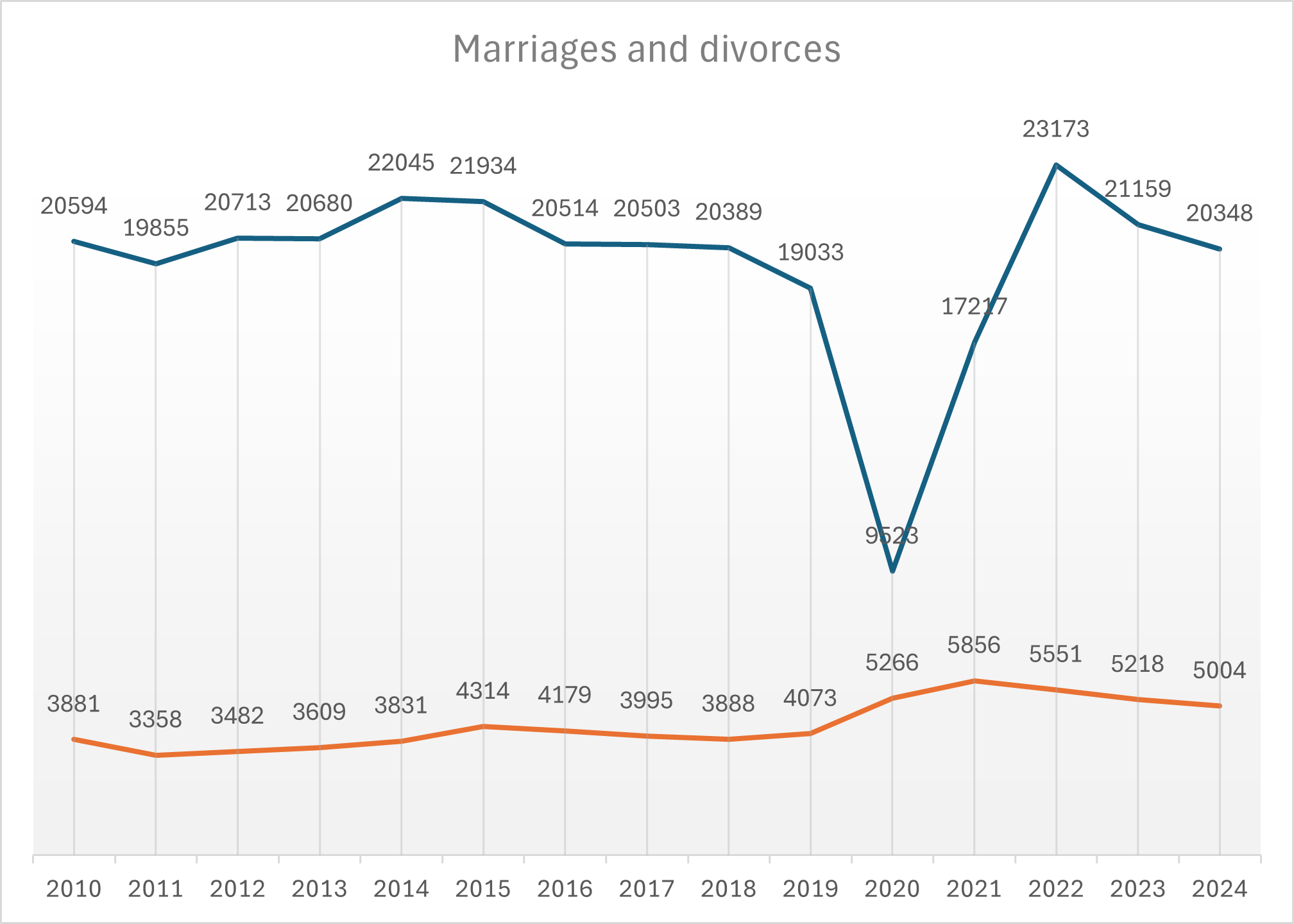
But if we look at the past 15 years, when the population grew approximately 20pc, the trend is quite clear: marriage rates have declined, while divorce applications have remained consistently high, if not rising overall. This is a pattern that predates the pandemic. In 2010, there were 20,594 marriages in a population of approximately 4,470,700. By 2024, that number had dropped to 19,680 (opposite-sex only) or 20,348 including same-sex couples, in an estimated population of 5,380,300. In contrast, divorce applications have increased by about 29pc, moving in the opposite direction.


There are many ways to measure divorce rates. For instance, we often hear that the divorce rate in Ireland is quite low and stable, compared to other countries. The crude divorce rate, a commonly cited figure, is expressed as a percentage of every 1,000 people and it is about 0.7 in Ireland. In other words, last year there were 7 divorces every 10,000 people.

But the crude divorce rate can be misleading, especially in societies where fewer people are marrying. It includes the entire population, married or not, making it a blunt tool for understanding real marital dynamics.

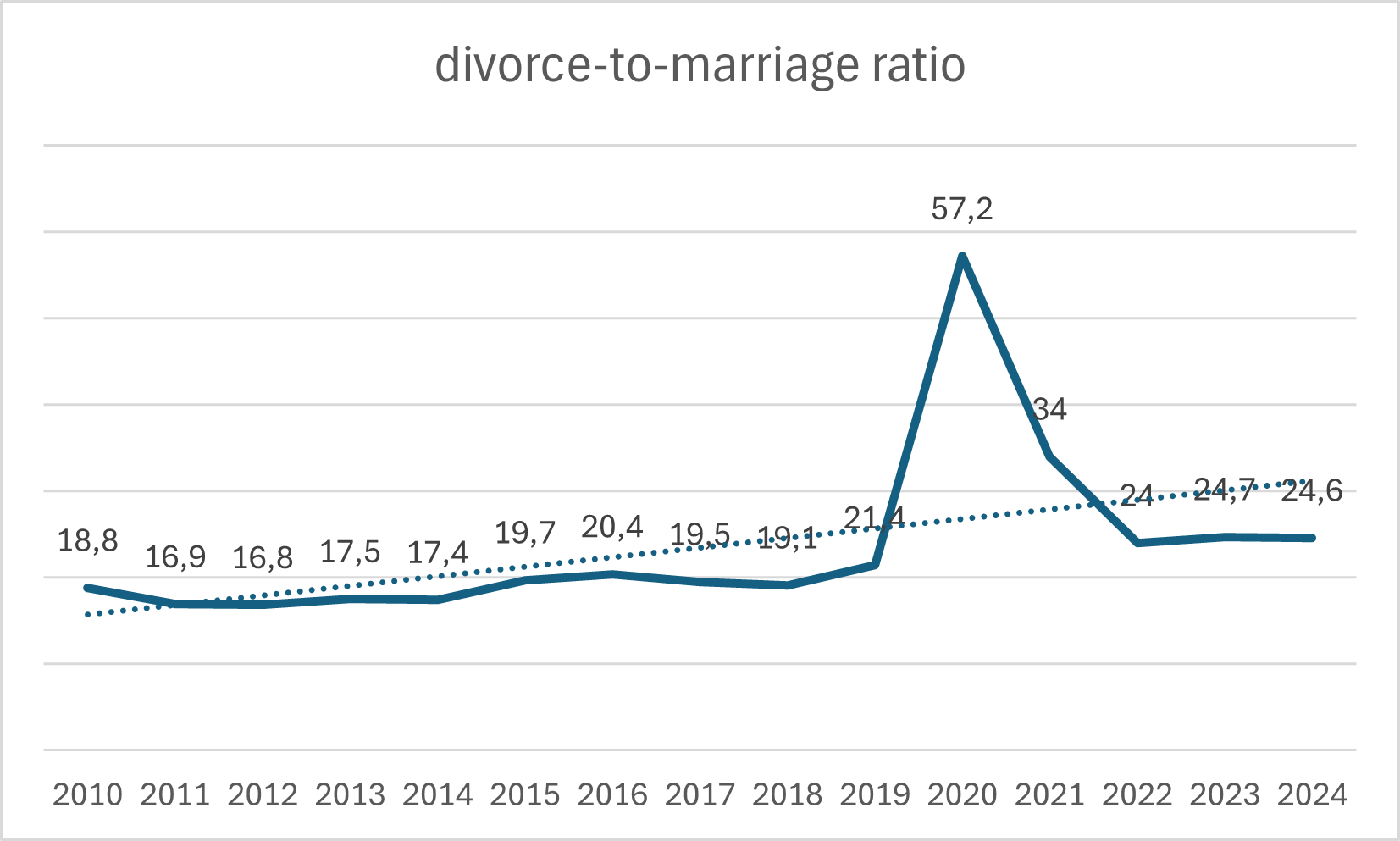
A more revealing statistic is the divorce-to-marriage ratio, which more accurately reflects the dramatic changes of the past 15 years in Ireland.

In 2010, there were 3,881 divorce applications and 20,594 marriages, giving a ratio of 18.8pc. By 2024, that ratio had increased to 24.6pc, with 5,004 divorce applications and 20,348 marriages recorded. In other words, in 2010 there was roughly one divorce application for every five new marriages; today, it is one for every four.

Interpreting this ratio also requires caution. The figure does not measure how many marriages eventually end in divorce; rather, it compares two parallel social trends: fewer newlyweds and more marital breakdowns, relatively speaking. (The blip in 2020 is due to Covid and few people marrying that year which artificially increased the divorce to marriage ratio).

Those two trends going in opposite directions is an unequivocal indication of malaise that the Irish couples are suffering.

The long-term negative effects of those trends not only the individuals involved but on society in general, deserve serious attention, public discussion, and thoughtful policy response.

mercoledì, giugno 04, 2025

Introducing organ donation euthanasia


A new “soft opt-out” organ donation law will take effect from June 17th. Under this legislation, the State will be allowed to remove your organs upon death without your explicit consent, unless you registered a request to opt out.

When the law was still being debated, I argued that donation should arise only from an informed and deliberate decision on a person’s part. If consent is only presumed, organs will be taken from individuals who never agreed to it, simply because they failed to opt out.

However, there is a more disturbing trend emerging in countries where euthanasia is legal: the practice of harvesting organs from patients who have chosen “medical assistance in dying”. The convergence of opt-out organ donation systems with legalised euthanasia, as seen in the Netherlands, Belgium, and some provinces of Canada, sets a dangerous precedent. The line between patient care and organ procurement becomes perilously blurred.

While donation after euthanasia is already happening in those countries, doctors are now discussing harvesting organs before euthanasia patients are declared dead, in order to preserve organ viability.

They propose that organs be removed under general anaesthesia before the patient is declared dead, thereby maintaining continuous blood circulation and oxygenation to the organs until the moment of retrieval. This method could significantly improve the quality and quantity of organs available for transplantation.

The practice, known as “organ donation euthanasia,” represents a profound ethical breach. It violates the “dead donor rule”, the fundamental medical and moral principle stipulating that organs may only be taken from those who are already dead.

Proponents of this practice argue it is a triumph of autonomy: if a patient chooses euthanasia and also chooses to donate their organs, why should we deny them that choice?

But this logic is dangerously superficial and overlooks the subtle pressures that may influence such decisions. If and when euthanasia becomes normalised, an organ donation system can exert subtle but powerful pressure on the dying. They may feel an obligation to “give back” to society by allowing their organs to be removed from their bodies before they are finally euthanised. And the pressure to opt for euthanasia that bit sooner because your organs will benefit someone will that bit greater.

Even more disturbingly, doctors, many of whom are involved in both euthanasia and organ transplant programs, may, consciously or not, begin to view their patients through a utilitarian lens. The desire to save multiple lives through organ donation can bias physicians toward steering patients toward euthanasia, especially in emotionally charged or economically constrained health systems. What starts as compassionate care can mutate into a system where ending life is seen as medically efficient and socially beneficial.

Ireland must not embark on this perilous path. The combination of a soft opt-out organ donation regime with the potential legalisation of euthanasia is a recipe for abuse and moral pressure. Such a system opens the door to exploitation, particularly of vulnerable patients.

We must defend the foundational principles of medical ethics: that life has inherent dignity and that doctors must never become agents of death. Failing to do so risks transforming medicine into a cold calculation of utility, where the very sick are increasingly valued for the usefulness of their body parts.

martedì, maggio 27, 2025

As marriages rates collapse who is getting married?

Ireland’s marriage rate has now reached its lowest ever level, not including the years of the pandemic, according to new data from the Central Statistics Office.  At 3.8 marriages per thousand adults last year, the rate has fallen below the EU average and is very likely to fall even lower.

In 2024, there were 19,680 opposite-sex marriages registered in Ireland, marking a 4.1pc decrease from 2023’s total of 20,513. The marriage rate for opposite-sex couples now stands at 3.7 per 1,000 adults. The current EU average is approximately 4.0 per 1,000.

What going on? For a start, the population is ageing, meaning the number of people of typically marriageable age is declining as a share of all adults. This alone will reduce the marriage rate.

But when we zero in on those who are of typically marriageable age (20-40 years old), what is happening?

Well, the marriage rate among those in their early to mid-20s has dropped hugely in the last ten years alone. For males aged 20–24, the rate dropped from 4.1 to just 1.8 per 1,000, and for females in the same age group, from 8.1 to 2.6 per 1,000.

You might consider this a good thing, if you think getting married in your early to mid-20s is too soon.

But we have also seen a big decline in marriage rates among those in their mid to late-20s. Among males aged 25–29 it has dropped from 29.7 per 1,000 to 13.9 since 2014, and among females in this age cohort from 39.8 to 21.8 per 1,000.

If marriage rates among those in their 20s are declining, then maybe there is a pickup by the time people reach their thirties? Yes, far more people marry in their 30s than in their 20s, but not by enough to increase marriage rates overall.

Among the 30–34 age cohort marriage rates have barely budged in the last ten years. Males experienced a slight decrease from 49.3 to 43.5 per 1,000, while females saw a marginal increase from 44.3 to 44.9 per 1,000.

For the 35–39 cohort, male marriage rates slightly decreased from 24.1 to 23.7 per 1,000, whereas female rates increased from 17.5 to 17.8 per 1,000.

Therefore, two things seem to be happening. First, people are waiting much longer to marry, but secondly, fewer people are marrying, full stop. We can expect this trend to continue. Fertility rates almost always follow marriage rates on a downward course and Ireland’s fertility rate is now just 1.5, well below the replacement level of 2.1.

These are awful trends if you care about the future of Irish society.

The new marriage data from the CSO confirm a trend that has emerged over the past few years: the rise of “New Age” weddings and the decline of traditional religious ceremonies.

Catholic ceremonies remained the most popular form of marriage, but only just, accounting for 32.6pc of opposite-sex marriages in 2024, though this represents a notable 11.5pc decline compared to 2023. The decline in Church of Ireland ceremonies was even more dramatic with a fall of 20.2pc last year. Conversely, “Other Religious” ceremonies increased significantly (+16.2pc) and now represent almost 20pc of all ceremonies.

To this must be added ceremonies conducted by the ‘Spiritualist Union of Ireland’ which accounted for 7.1pc of the total. This means that cohort of weddings accounted for around 26pc of all wedding ceremonies last year.

Among non-religious ceremonies, humanist weddings declined by 10.8pc year-on-year, while civil ceremonies also saw a slight decrease in numbers (-1.3pc).

Civil ceremonies include Christians who marry abroad, and also Muslim or Hindu couples, for example, who do not have a religious solemniser recognised by the State here.

Wedding ceremonies in Ireland have undergone substantial changes since 2007, the year when civil ceremonies were first permitted outside registry offices. Today, many hotels offer religious ceremonies performed by solemnisers belonging to new ‘religious organisations’, explaining the explosion of “other religious” ceremonies.

Alternative religious ceremonies are also growing in popularity among same-sex couples. In 2024, almost 40pc of same-sex marriages were religious ceremonies. Both Spiritualist and “Other Religious” ceremonies are now more popular than Humanist ceremonies, which dropped by 30pc in 2024 among same-sex couples.

This trend suggests that Ireland is not becoming more secular, but arguably more pagan.

lunedì, gennaio 13, 2025

Demands of employers can’t dictate childcare policy


new survey from the Dublin Chamber of Commerce (DCC) finds that a lack of affordable childcare affects employers’ ability to attract new employees. Aebhric Mc Gibney of DCC was interviewed on Morning Ireland about the survey, and as usual no consideration was given to all the parents of young children, especially mothers, who would prefer to mind their children at home rather than put them in daycare. It is like the referendums of last March never happened.

The latest ‘Business Outlook Survey’ by the DCC found that childcare challenges impact almost nine-in-ten (88pc) businesses to some degree.

Childcare availability and costs affect workforce participation and productivity, as employees struggle to balance work commitments with parental responsibilities, says the DCC.

The DCC has asked the next Government to prioritise a public model of childcare. “Moving to a public model will be critical for ensuring a steady supply of affordable, quality childcare and building a more sustainable and diverse labour market,” said Mia Finnegan, Public Affairs Executive at Dublin Chamber.

Nonetheless, while employers’ concerns about childcare availability and costs are valid in their own narrow way, they should not be the sole determinant in shaping childcare policies.

survey commissioned by The Iona Institute last year, and conducted by Amarach Research, revealed that more than two-thirds (69pc) of mothers with children under 18 would prefer to stay at home with their children if financial circumstances allowed. Furthermore, 76pc of these mothers feel that women who work in the home are undervalued by society. These findings suggest a strong inclination among mothers towards full-time caregiving, provided economic conditions are favourable.

We can’t expect employers to care too much about this very large group. They want everyone out working, after all, because that helps their businesses. But it can’t be the only consideration for Government policy in this area.

According to the DCC survey, companies are trying to accommodate the needs of employees who are also parents in various ways. For example, 74pc offer remote work options and/or providing flexible working hours (70pc) arrangements.

Over a third (36pc) allow part-time work or reduced hours for parents with childcare needs, while 31pc offer paid parental leave or additional leave options.

While businesses may advocate for enhanced public daycare services to support working parents, it is also crucial to acknowledge and respect the desires of many mothers and fathers to prioritise home-based caregiving. Part-time work, reduced hours and additional leaves would allow those who want to continue to be employed to balance their work and parental responsibilities.

A public model of childcare would not suit every family. Childcare policies should strive to accommodate the diverse needs and preferences of parents, and to repeat, the demands of employers cannot be the decisive factor in the debate about childcare. A comprehensive strategy that considers the preferences and needs of parents, particularly mothers, is essential for creating a supportive environment for all families.

mercoledì, dicembre 18, 2024

In Europe last year, deaths outnumbered births by 1.2 million


New figures from Eurostat, the statistical office of the European Union, confirm the growing demographic crisis facing Europe. Last year, deaths across the EU outnumbered births by almost 1.2m, and this is only going to get worse. Births have not outnumbered deaths since 2012.

This is a consequence of fertility rates being well below replacement level across the continent and in some cases for decades.

At the beginning of 2023, according to Eurostat, there were 448.8 million people living in the European Union. The only reason this is little different from 20 years ago is because of immigration.

The average number of births per 1,000 persons living in the EU has dropped from 10.6 in 2008 to 8.7 in 2022.

One way of analysing fertility trends is to look at how many babies are born to mothers aged 40 and older compared to all babies born in a year. It shows the degree to which people are delaying having children.

In Ireland in 2022, 11.2pc of all births in 2022 were to mothers aged 40 and over, the highest in Europe. This has soared from 3.4pc in 2002.

Across the EU, the figure was 6pc in 2022, meaning many women in Ireland are waiting a particularly long time to have children, for whatever reason.

The proportion of births to mothers aged at least 40 in the EU as a whole was 2.2pc in 2002.

In Ireland, the mean age of first-time mothers is the third highest in Europe, at 31.5 years. The EU average is 29.7 years.

Ireland used to have the highest fertility rate in the EU – 1.97 births per woman in 2002 – but now it has decreased significantly. The current value (1.56) is slightly higher than the European average (1.46) but way below what is needed to ensure a natural balance between births and deaths, which is 2.1 births per woman.

Among EU countries, France has currently the highest total fertility rate (1.79), followed by Romania (1.71) and Bulgaria (1.65). The lowest rates were found in Malta (1.08), Spain (1.16) and Italy (1.24).

While the population is growing, due to immigration and people are living longer, there are ever fewer young people.

In the last 20 years, the percentage of people aged 0 to 19 years of age across the EU declined from 22.6pc to 20.1pc. Over the same period, the share of persons aged 65 and over increased in all EU countries 16.2 to 21.3.

Over the past twenty years, the Irish population grew by a massive 32.9pc, from 3.7 million in 2003 to 5.27 million last year. Much of this is immigration-driven. To put this into perspective, the total population of the EU increased by only 4pc during the same period.

In Ireland, births still outnumber deaths, although the gap between the two has halved in the last ten years. In due course, given our low fertility rate, deaths will outnumber births as elsewhere.

The European demographic crisis, which is already here, will affect Ireland as well, even before ours hits us directly, simply because our fate is so tied to Europe’s in multiple ways. It is time we began to have a serious discussion in Ireland about this topic.

venerdì, dicembre 13, 2024

Will we ever have an honest discussion about divorce in Ireland?


Divorce will affect children for the rest of their lives, well into adulthood, but people don’t want to hear this because it makes them feel bad about their decisions, says Spectator columnist, writer and broadcaster, Bridget Phetasy.

piece she wrote a few months ago titled “How divorce never ends”, is based on her personal experience and presents the lifelong impact of parental break-up on children. It caused a huge reaction, for and against. Those who supported the article were themselves usually children of divorce. Those who reacted angrily were often the parents who exhibited great defensiveness about what they had done, even though Phetasy was at pains to say parental separation, for example when the relationship is abusive, is justified.

Phetasy (née Walsh), whose parents divorced when she was 12, recounts how her life and that of her future husband – also a child of divorce – were upended. Their school achievements declined, and they fell into rebellious behaviours. The logistical challenges of splitting time between parents, with cross-country travel and fractured holiday traditions, contributed to instability and neglect. Lacking proper supervision, the children often resorted to reckless behaviour.

“So often it feels like two people are just ‘over it’ [meaning the parents] and want to move on with their lives and be single again instead of doing whatever it takes to make it work for the kids. People don’t want to hear this because it makes them feel bad about their decisions. Divorce sucks. It never ends and it should be a last resort”, she wrote.

Phetasy – a former columnist for Playboy magazine, of all things, – is now a mother and uses her parents’ shortcomings as a guide for what not to do.

“Before I had a kid, I asked people who came from similar backgrounds how they managed to raise great, well-adjusted kids. They always said the same thing: “I just did the opposite of what my parents did.’”, she writes in her piece.

She argues that divorce is too often treated casually, with little regard for its profound and enduring impact on children.

She admits harbouring lasting anger and grief over her parents’ prioritisation of new relationships over their children’s well-being. These feelings persist into adulthood, particularly as the complexities of managing relationships with multiple sets of grandparents now affect her own family.

Talking to the feminist podcaster Louise Perry, she recalls the reactions from readers of the piece and also from followers of her YouTube channel.

“People lie to themselves about how hard it is on the kids. There’s this lie: kids are resilient, they’ll be fine. It was heartbreaking reading the initial flow of comments that came in.  First you get the flood of people who feel seen and heard and validated. “Thank you so much this was my experience. I felt I this brought up so many emotions of my own”, and then you get the backlash and the people misinterpreting you and taking it out of context”, she told in the interview.

Commenting on Bridget Phetasy’s article, Louise Perry noticed that the consideration of what is a truly valid reason for divorce often leads to exaggeration of issues, while many overlook the long-term impact on their children, whose lives will be shaped by the decision for decades to come.

The majority of break-ups occur in low-conflict marriages, where the impact on children is often more profound due to the unexpected and therefore more traumatic nature of the separation. In such cases, it is usually in the best interest of the children for the parents to remain together.

2025 will mark 30 years from the divorce referendum in Ireland, where now over 320,000 adults are today divorced or separated and hundreds of thousands of children affected. This anniversary will surely be celebrated with enthusiasm, but a mature assessment will consider the voices of people like Bridget Phetasy who have suffered because of their parents’ decisions.

venerdì, novembre 15, 2024

How marriage protects against depression


A major new study shows that unmarried individuals are much more likely to experience depression than those who are married. The study looks at seven different countries, including Ireland.

The research revealed that unmarried individuals - including those who are single, divorced, separated, or widowed - exhibit significantly higher risks of depressive symptoms compared to those who are married. Specifically, the analysis found that unmarried status is associated with an overall 86pc higher risk of depressive symptoms. This increased risk appears particularly pronounced among divorced or separated individuals (99pc). It is instead 79pc higher in single and 64pc in widowed individuals, when compared to married people. 

The study involved over 100,000 participants. The other countries examined along with Ireland were the United States, the United Kingdom, Mexico, South Korea, China and Indonesia.

In Ireland, the risk of depression was notably higher for divorced or separated individuals, who faced a 160pc increased risk, and for widowed individuals, who had a 115pc increased risk, compared to their married counterparts. In other word, for every 100 married individuals experiencing depressive symptoms, in Ireland there would be approximately 260 divorced or separated individuals and 215 widowed individuals experiencing similar symptoms.

The research suggests that marriage provides protective mental health benefits, possibly through mechanisms such as emotional and social support, economic stability, and the positive influence spouses can have on each other’s well-being.

Importantly, the study also highlights that the association between marital status and depression is influenced by demographic and cultural variables. The authors suggest that the more pronounced link in Western countries, including Ireland, reflect cultural differences in social expectations and support systems surrounding marriage. “Eastern cultures tend to tolerate higher levels of emotional distress before it becomes problematic, which may partially explain the lower risk of depressive symptoms in unmarried participants from these countries”, they say. The authors admit that further research is needed to understand the observed cultural differences.

Gender and education level influence in the relationship between marital status and depression. The study found that unmarried men are 25pc more likely to experience depressive symptoms than unmarried women. This risk was even higher among single men (48pc) while the research did not observe a significant difference between men and women among divorced/separated or widowed.

“Females tend to have larger and stronger social support networks than males, particularly among never-married individuals”, the authors note.

Additionally, those with higher educational attainment showed a greater likelihood of depression when unmarried compared to those with lower educational levels. This could reflect variations in social expectations and pressures, where individuals with higher education may feel a stronger sense of isolation or failure if they remain unmarried.

In conclusion, this study reinforces the link between marital status and depression, expanding previous understandings by including a more diverse global sample. Marriage, as highlighted by this research, provides significant mental health benefits, reducing the risk of depressive symptoms. It offers emotional support, economic stability, and shared responsibilities, fostering resilience against stress. These are all good reasons why marriage should be promoted and strengthen in public policy and legislation.

venerdì, ottobre 25, 2024

“They can have an abortion every month if they want”


recent study by two pro-choice academics provides interesting insights into the GPs who offer abortion services in Ireland. Those GPs, while fully in favour of abortion, nonetheless have reservations about some of what they are seeing, and in particular about women who have had multiple abortions in a relatively short time.

Very revealingly, when one doctor raised concerns about women having multiple abortions, someone from the British Pregnancy Advisory Service (BPAS), which is a big abortion provider, accused the doctor of being ‘judgemental’, and said women should be able to have an abortion every month if they want.

The research, published by two members of the Law School at University College Cork (UCC), is based on interviews with 15 doctors, most of whom are part of START (Southern Task-force on Abortion and Reproductive Topics), a network of pro-choice healthcare professionals.

According to the study, a key motivation for participating in providing abortions is “respect for human rights, women’s rights, and equality.” ‘Dr H’ (all names are anonymised) stated: “I’m a very great believer in bodily autonomy and the rights of the individual.”

Some of these doctors were politically active in campaigns to repeal the Eighth Amendment. However, the anonymous interviews reveal that even among strong pro-choice advocates, there are reservations about aspects of the work they are doing.

‘Dr P’ told the researchers: “I think it’s important to acknowledge that we’ve made a decision that a woman should be able to have an abortion if she wants one and, big deal, you shouldn’t have to justify it or beg for one. But at the same time, like I remember, I had one girl, a student, and she had three abortions in 18 months. And I remember thinking, you know, that’s not what I voted yes for.”

It should be noted that the study is written from a distinctly pro-choice perspective. It was partially funded by the Irish Family Planning Association, and one of its authors is a member of the Abortion Working Group of the National Women’s Council of Ireland. Only selected responses from the interviews are published, and we do not have access to the complete data, yet these selected quotes reveal some hesitations.

Another doctor, referred to as ‘Dr O’R’, remarked: “You know, I have had five who’ve had three [abortions]. Four or five women for three. And when we’re talking in our group, we get quite paternalistic saying, ‘Jesus, throw the Implanon [a long-term form of contraception] into her.’ And when we had BPAS over, they were saying, ‘How dare you be so judgemental? She can have a termination every month if she wants.’ Still, you know, the medic part of me goes, ‘God—surely that’s tough on her,’ you know, but yeah—how do you reconcile that?”

Unlike other countries, Ireland collects almost no data on women undergoing terminations, so it is unclear how many have had more than one abortion but this study confirms that this is not uncommon here.

The interviews also reveal tensions within GP practices between those who provide abortion services and those who do not. “Yeah, I’m probably known as the baby killer, but no, all nicely. Some of my very best friends and colleagues absolutely refuse to do this. They will remain my best friends. You know, I don’t do toenails. I send them up to my colleague. He sends me, you know… so we, you know, I think we’re all over it,” said ‘Dr O’R’.

Some participants in the study admitted they do not discuss their involvement in providing abortion services with family members or acquaintances. ‘Dr B’ stated: “I would say there’s very few people who would talk openly about the fact that they provide that service in a social setting because they just don’t know who’s there and what their view is going to be. And that’s actually a stigma, like, that is actually, you know, a stigma that you’re carrying.”

The report by Marie O’Shea on abortion services in Ireland estimates that around 90pc of Irish GPs do not participate in offering these services. This new study suggests that even those who are involved may struggle to reconcile their ideological commitment with the realities they face in practice.