Visualizzazione post con etichetta pornography. Mostra tutti i post

martedì, luglio 09, 2024

Senator Mullen bill aims to protect children from pornography


In an era where digital content is accessible at the click of a button, the exposure of children to inappropriate material, particularly pornography, has become a pressing issue. In response to these concerns, Senator Rónán Mullen, along with a bipartisan group of co-sponsors, has introduced the “Protection of Children (Online Age Verification) Bill” in Seanad Éireann. This Bill, which will be debated on Thursday, mandates strict age verification measures for accessing pornographic content online, aiming to safeguard children aged under-18 from exposure to such material.

Key elements of the Bill include:

  1. Age Verification Mandate: Website controllers and app store service providers must ensure that users undergo an age verification process before accessing pornographic content. This can be outsourced to approved third-party organisations, but the ultimate responsibility remains with the service providers.
  2. Liability and Legal Defences: Providers will be held liable for any failure to implement age verification measures. However, a legal defence is available if it can be proven that circumvention of the age verification was facilitated by another party.
  3. Data Security: The Bill mandates secure storage of age verification data for five years, accessible only for legal proceedings.
  4. Focus on Child Protection: Senator Mullen emphasised that the Bill solely focuses on protecting children and does not aim to restrict adult access to pornography.

The concern about children’s access to pornography is not confined to Ireland.

Various European countries have implemented or proposed similar measures, highlighting the need for a concerted effort to address this public health concern.

Spain has recently launched an innovative solution known as the “Porn Passport”. This mobile application aims to verify the age of users before granting access to online pornography. The application, developed to protect minors, requires users to verify their age through a secure and anonymous process. This initiative is part of Spain’s broader efforts to regulate access to adult content and ensure the safety of younger internet users.

Italy mandates age verification systems on websites distributing pornography and includes fines and potential site blockage for non-compliance.

In France age verification laws have been strengthened, and recently the Court of Cassation ruled that “a child protection can ask the courts to order internet service providers to block access to pornographic sites likely to be viewed by a minor without first having to take action against the host, publisher or author of the content.”

The French government is also testing a “double anonymity” verification solution to enhance protection.

In Germany, providers must implement age verification mechanisms, and regulatory authorities can block non-compliant sites.

Research underscores the detrimental effects of pornography on young people, including the development of addictive behaviours, distorted perceptions of sexuality, and emotional and relational issues. Statistics reveal alarming rates of pornography consumption among minors across Europe, necessitating urgent policy interventions. (More information can be found in the European Child Shield Platform advocacy paper: https://www.fafce.org/european-child-shield-platform-launches-awareness-campaign/ )

The “Protection of Children (Online Age Verification) Bill” represents a critical step towards defending children from the harmful effects of online pornography. By enforcing stringent age verification measures, Ireland aims to join other European nations in addressing this pervasive issue.

As Senator Mullen aptly stated, “Everything must give way to the protection of children”. The successful implementation of this Bill could serve as a model for other countries, fostering international cooperation in the fight against the exposure of minors to pornographic material.

 

lunedì, febbraio 13, 2023

Children are left unprotected against extreme pornography


There is an urgent need to protect children from online pornography, according to a new report by the UK Children’s Commissioner. To tackle this problem, obligatory age verification to watch porn will be introduced soon in France. Ireland should consider something similar.

The UK Children’s Commissioner, Dame Rachel de Souza, launched the new report which shows how pornography has become all-pervasive and reveals the destructive effects on young people’s lives.

Based on focus groups and a survey of 1,000 teenagers and young people, it found that 13 is the average age at which children first see online pornographic material. By age 9, 10pc have seen it. More than one out of four had seen it by age 11, and half of children have seen it by the age of 13.

The pictures or videos children have access to are not only obscene but also violent and degrading. “Depictions of degradation, sexual coercion, aggression and exploitation are commonplace, and disproportionately targeted against teenage girls”, says the report.

The age of first exposure is determined by when children first have their own device. Parents should be aware of such risks when letting their children use smartphones or tablets.

Those who were exposed to porn at younger age were significantly more likely to become frequent users and develop dependency, the report found.

The document by the UK Children’s Commissioner also found that frequent users of porn are more likely to engage in physically aggressive sex acts.

In terms of social media or websites, Twitter is where young people are more likely to have seen porn.

51pc of girls aged 16-21, and 33pc of boys, have seen or been sent pictures and videos of people they know in real life. Other research has shown that “girls are overwhelmingly the recipients of unwanted explicit images of male peers”.

In the UK there is no legal requirement for websites hosting porn to verify the age of users, but this will change soon with the Online Safety Bill that is making its way through the British Parliament.

France has just announced that it will become the first country to introduce a “digital certificate” to prove the age of those who want to access online pornography.

This decision follows a shocking report on the pornographic industry, presented by the French Senate. The document that the porn industry “contributed to an upsurge in increasingly violent content, without any control or consideration for the conditions in which this content is produced.”

One of the recommendations put forward by the French Senate report was precisely an age-verification mechanism to prevent children accessing obscene material.

Last year an RedC poll found that 71pc of Irish citizens believe pornography is causing serious harm to society and 81pc of young people believe porn leads to more demands for violent sex.

Ireland should follow France and adopt a similar procedure to keep children away from porn websites.


Photo by Daria Nepriakhina on Unsplash

domenica, dicembre 01, 2019

Teaching children that porn can be ethical and positive

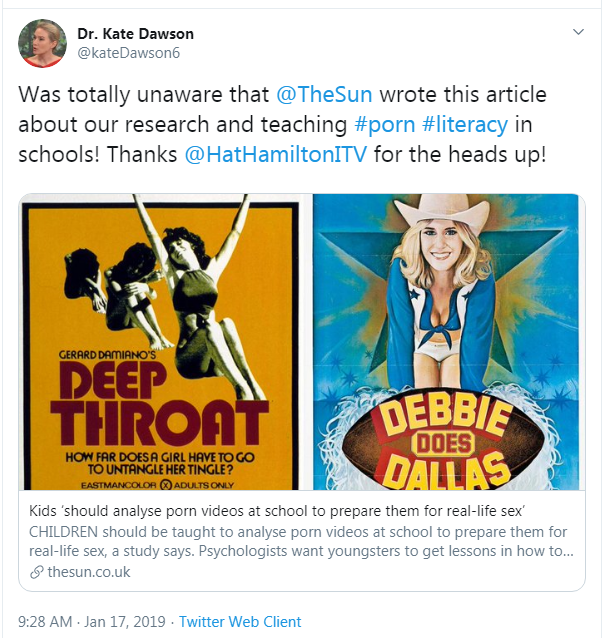
Is ‘porn literacy’ something we should be teaching in schools? If so, at what age? What is ‘porn literacy’? Is there such a thing as ‘ethical porn’? To what extent will these things be part of the planned new Relationships and Sexuality Education (RSE) course?

For clues, we might look to Kate Dawson who is a doctoral student at NUI Galway. She believes in ‘porn literacy’ and in ‘ethical porn’. Sometimes she goes into schools to give children her views on sex, porn and relationships as part of the HSE funded WISER (West of Ireland Sex Education Resource) programme.

‘Porn literacy’ is, of course, a highly ambiguous term. It could simply mean teaching students about the negative effects of consuming porn but in a recent article, written with two other academics from NUI Galway, Dawson clearly states that one of the learning outcomes of porn literacy is to “reduce shame and increase acceptability” (p. 7). Why should we increase the acceptability of watching porn among school children?

In the same article we read: “A variety of teaching methods could be employed within a porn literacy intervention, including … the use of activities or video content on digital and social media platform” (p. 11).


Recently, Dawson has appeared in various media defending “porn literacy” or criticising the attempts made in different countries to ban online porn that can be accessed by children.  She wants pupils shown porn videos so as to help them understand such films are “scripted and dramatised” and to “reduce the shame” of watching. Is this something their parents would feel comfortable about? It seems that she has no principled objection to porn per se. Moreover, as mentioned, she believes in “ethical porn”.

In October 2016, she was one of the authors of the “Porn as Pedagogy” (PAP) event at Tate Modern, in London, where participants were shown a 45 minute selection from “ethical porn” movies. A discussion followed.

One might wonder what “ethical porn” is. From a report she produced we can learn that the organisers at the Tate wanted to “expose the audience to the beauty and variety that exists within the porn industry that is often dominated by heteronormative, sexist and racist content. We knew that all performers involved in the footage were protected and cared for in their working environments and were paid the same rate, regardless of race, gender and sexuality. We knew that safer sex was pre-negotiated between performers for all of their scenes and that they choose what they want to do on screen.”

It is interesting to note that the only moral concern expressed about porn is about how it is made. It is “ethical” as long as it is produced according to certain moral standards. Aside from that, porn is seen as morally neutral, if not actually a good thing.

Dawson comments: “Personally, the experience [at Tate] was transformative. I feel privileged to have learned from these films, and to have had the opportunity to share the work in such a setting. It is safe to say that Pink & White Productions have changed my perspective on porn. This really is porn as it should be.”

What does she want taught in schools? Here you can find some examples of the very explicit language  on porn offered to teenagers by Dawson.

It is important to note that we are not talking about some fringe group with extreme views.  The WISER programme, in which Ms Dawson in involved, is funded by the HSE. We are therefore entitled to ask, is this what the State wants taught in our schools?

Last year, an NUI Galway report on porn was launched by Minister for Higher Education Mary Mitchell O’Connor. Kate Dawson, who contributed to the report, commented: “it is not good enough to just say that ‘porn is bad’ because it is not, people really enjoy watching it, there are a lot of positive uses, but people need to have the skills to make their own mind up about the content they see because porn is so varied.”

Does Minister O’Connor agree that porn in itself is not bad? To what extent should this kind of “porn literacy” be officially included in the RSE programme aimed at school-age children? Should pupils be taught about ‘ethical porn’? Parents deserve answers to these questions.