giovedì, novembre 30, 2017

Making contraception cheaper does not reduce a country’s abortion rate


You would think that there would be a correlation between the affordability of contraception and the abortion rate of a country. That is to say, the cheaper contraception is, the lower the rate of abortion should be. Not so, a new study from the Nordic countries suggests.
The aim of the study, which was published on the journal of the Nordic Federation of Societies of Obstetrics and Gynaecology, is to describe and compare contraceptive use, fertility, birth, and abortion rates in Denmark, Finland, Iceland, Norway, and Sweden.
In the European context, the Nordic countries are among those with the highest user rates of hormonal methods (like ‘the Pill’) and intrauterine devices and the overall use of contraception has remained relatively stable in recent years.  From roughly 1975 until the mid-1990s the abortion rate declined from a high in Denmark and in Finland, increased in Iceland and remained stable in Sweden and Norway.
“There was no clear correlation between the contraceptive user rates and abortion rates”, over this period, the study concludes.
For example, Sweden has a somewhat higher abortion rate than Denmark even though various Swedish counties subsidise contraception and Denmark does not. If making contraception more affordable reduces the abortion rate, then Sweden should have a lower abortion rate than Denmark. (In Sweden about one in four pregnancies ends in abortion. In Denmark the rate is about one in five).
This seems to be confirmed by the findings of another study, published in 2014 in the BioMed Central Public Health journal, on the reimbursement of hormonal contraceptive and the frequency of induced abortion among teenagers in Sweden.
The study found that no correlation can be found between the cost of hormonal contraceptives and the rates of abortion.
As mentioned, in Sweden the provision of family planning centres are decided by each county separately. So, there are differences in the amount of reimbursement of contraceptives between counties. The study tested the hypothesis that costs for contraceptives are a deciding factor and have an impact on the abortion rates.
Here is the result: “No clear connection is found in this paper between actual sales of hormonal contraceptives, induced abortion or the relation between different counties with different amount of reimbursement among young women 15-19 years. Our study suggests that in a modern welfare society there is neither a straight agreement between induced abortion and the amount of prescribed and dispensed hormonal contraceptives, nor reimbursement and rates of induced abortion, not only in Sweden, but also, in comparison with other Nordic countries.”
In the county of Stockholm, for instance, a fall in dispensed hormonal contraceptives was not paralleled to a rise in the numbers of abortion. (Something similar was recently noted in the UK, where the expenditure cuts in the programmes to reduce rates of teen pregnancies was found to be associated with reductions, rather than increases, of those rates).
The study also noted that Finland has no reimbursement at all for hormonal contraceptives and from 2004 has had a steady drop in the number of induced abortions.
It concluded that abortion rates among teenagers are multifactorial, they don’t depend much on the availability and cost of contraception but rather on “attitudes, education, religion, tradition or cultural differences”.


giovedì, novembre 23, 2017

Assisted suicide comes before the Oireachtas Justice Committee


It is worrying that the topic of assisted suicide is even before our politicians, because it means some of them want us to legalise it, but the matter was considered by the Oireachtas Committee on Justice and Equality on Wednesday. Fortunately, it heard from an excellent witness in the form of Dr Regina Mc Quillan of the Irish Association for Palliative Care. She said that the introduction of assisted suicide or euthanasia would put vulnerable people at risk.
Dr McQuillan said we should reject the idea that ‘dying with dignity’ is associated with the right to assisted suicide or euthanasia. Moreover, “the acceptance of assisted suicide and euthanasia could lead to an under investment in palliative care research and service delivery, as they might be promoted as cheaper options than appropriate health care provision.”
In the previous Dail, a Private Member’s Bill by John Halligan TD was introduced in favour of assisted suicide but it didn’t proceed beyond the first stage and it was then withdrawn. Currently, the Justice Committee is considering possible recommendations in this area.
Dr Mc Quillan maintained that while healthcare professionals have a duty to respect the values and the wishes of the patients, individual autonomy is not an absolute but it must be balanced with consideration of the needs of society as a whole. Legislating in favour of assisted suicide or euthanasia may put pressure on vulnerable people, including the unwanted, the rejected, the lonely, and the emotionally vulnerable who may elect to hasten death as to avoid a sense of being a burden on family and society. Changing the law will endanger the lives of many.
Two representatives of Right to Die, Tom Curran and Michael Nugent, also presented their arguments in favour of euthanasia and assisted suicide. In the past, Tom Curran had helped deputy Halligan in drafting his Private Members Bill and was also involved in a famous constitutional challenge to the law on suicide. In his submission he asked: “if it is legal for rational person to take their own life why is assisting a person to do something that is legal a crime?”
A good response to this question came from Dr Regina Mc Quillan: “the decriminalisation of suicide was a recognition that those who survive a suicide attempt need treatment, not prosecution. Suicide is rightly considered a blight on society and there are many efforts made to reduce it. That there are some people for whom suicide is considered appropriate may suggest that there are people whose lives are not deserving of the same level of protection.”
Dr Mc Quillan also said that it is not possible to put adequate safe-guards in place and, if the law will be changed, the drive to improve the care of people with life-limiting illnesses by education, service development and research may be compromised.
More experts will be heard next week and we will keep you updated.  If you want to read about euthanasia in other countries, see here.

mercoledì, novembre 15, 2017

Minister Harris should heed scandals engulfing abortion clinics overseas


Health Minister Simon Harris intends passing a law that will regulate ‘rogue’ pro-life agencies that give bad advice to women. We don’t have any abortion clinics here and hopefully never will, but Minister Harris might like to pay attention to the scandals engulfing abortion clinics overseas, for example in the Netherlands and Britain. There is not the slightest reason to think similar things could not happen here.
In the Netherlands, almost half of abortion clinics have been closed after two newspaper investigations exposed a massive financial fraud.    CASA clinics, which are responsible for nearly half of the 31,000 abortions per year in the Netherlands, have allegedly committed fraud worth a massive €15 million to date. The clinics have been accused of irregular billing practices for public subsidies, including claims for deep sedation and overall anesthesia that were never performed.
The “Follow the Money” investigative website reports: “Consultations to clients were charged separately while they were already included in the price of a treatment. Foreign clients were overcharged for a second trimester abortion.” Health insurers were reimbursing certain operations on the assumption the were carried out by medical specialists. They were instead the work of basic physicians, for which lower rates apply.
Last week, all the seven CASA clinics have been declared bankrupt and shot down. Eight other abortion clinics, from other companies, are still in operation but some of them are also under investigation. The whole Dutch abortion industry has been exposed and at risk of further closures.
Meanwhile in Britain, the employment of non-qualified personnel has been highlighted by the Care Quality Commission (CQC), following investigations on the Marie Stopes International clinics (MSI). Last year it was found that MSI put women at risk by failing to adequately train their staff and neglecting to obtain proper consent from patients.
According to the Guardian, “Doctors in one location, who were observed obtaining consent from a woman with a learning disability, failed to ensure she understood the procedure and handled the consultation “poorly and insensitively” … Some staff obtaining consent from patients also appeared to have insufficient knowledge of procedures.” Marie Stopes International had to suspend surgical abortions for girls under 18 and vulnerable women for a period after concerns were raised by the CQC about patient safety.
further investigation this year found that staff were offered bonuses to persuade women to have abortions. The report states that: “staff were concerned that ‘Did Not Proceed’, the term used when women decided not to proceed with treatment, was measured as a key performance indicator and linked to their performance bonus. They felt that this encouraged staff to ensure that patients underwent procedures.” They discovered that it is common practice in Marie Stopes clinics to contact women that changed their minds about having an abortion and offer them a new appointment.
Some representatives of the abortion business were invited as “experts” at the Citizens’ Assembly and at the Oireachtas Committee on the 8th Amendment. These scandals were not highlighted.
Marie Stopes International is already operating in Northern Ireland and if abortion is introduced in the Republic we can expect that those clinics will operate here as well. As mentioned, Minister Harris seems to be concerned about crisis pregnancy agencies with a prolife ethos. What some of them have been accused of is nothing compared to the scandals mentioned above, scandals our own media haven’t bothered to highlight either.

giovedì, novembre 09, 2017

Shielding students from uncomfortable opinions does them no favours


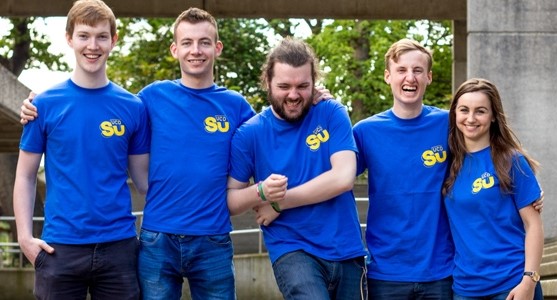
Identity politics is killing critical thinking in the university. I have been in UCD for fifteen years, first as a PhD student, then as a tutor and currently as a lecturer. I am also research officer for the Iona Institute. If you believe in rumors or conspiracies theories, I should qualify as the best candidate to be the mastermind of Katie Ascough’s election as president of the UCD Students’ Union (UCDSU). Unfortunately, I have never had the pleasure to meet Miss Ascough in my life.
In the current issue of the University Observer, the official paper of the UCDSU, the Iona Institute and its malefic influence is mentioned in three different articles. Rather than tackle their highly paranoid view of us, I will take this opportunity instead to highlight the alarming restrictions now being placed on contemporary university life and debate.
In my youth, I was a national leader of the national federation of university students and this is probably why I take student activism and participation, which are a good example of civic commitment, seriously. Not everybody does. In UCD, earlier this year, 90% of students did not vote for the election of their union officers. Even when they ousted Katie Ascough, attracting interest internationally, 80% of the students didn’t care to cast a vote.
Why are students disengaged from the Union that purports to represent them? Their apathy has many reasons. Some might be happy with how things are, others, more likely, might find a student union irrelevant. But there is another significant reason that needs to be addressed because it questions the nature of university education itself, today more than ever.
The Students’ Union is not only unable to embrace the plurality of views of its members but, in promoting divisive identity politics rather than fair representation, it alienates its own members. When, rarely, the frustration of some students takes the form of a challenge rather than mere indifference, the Union chastises them. This happened in 2013, for instance, when a student’s request to leave the Union was denied by the UCDSU. Fortunately, the Independent Appeals and Disciplinary Board ruled that they were wrong and couldn’t force someone to stay in the Union against his or her will.  More here: http://collegetribune.ie/ucdsu-suffers-first-disaffiliation-in-its-history/
And it happened again with the election of an ‘outsider’ such as Katie Ascough.  “There were reasons for impeachment that appeared before she got in the door”, writes the editor of the University Observer. The defenders of the official orthodoxy, who called for her removal from the very minute she was elected, didn’t had to wait long to find a ‘good’ pretext. These reasons are the views she shares with her father, a member of the Muslim Brotherhood. Oops, sorry, I meant to say of the Iona Institute. The Muslim Brotherhood would be more acceptable to the establishment in Ireland nowadays.
Last week prolife speakers from Ireland were shouted down by representatives of the Oxford Student Union. The same is likely to happen soon in our best universities too, given the current climate. In a predictable attempt to defend those bullies, the leader of the Oxford SU tweeted “Bodily autonomy is not up for debate; it is not a question of opinion.
Quite the opposite. The university, as an institution, was founded in the Middle Ages on the principle that everything should be up for debate and no opinion should remain unquestioned. Otherwise, it is not a place for critical inquiry but for propaganda. Unfortunately, a growing deficit in viewpoint diversity is evident not only among students but also among lecturers. However, shielding students from arguments that they might find uncomfortable is a disservice to them and the truth.
I appreciated the ingenuous sincerity of the editor of the University Observer who told her readers to “avoid reading the articles of columnists who are part of the IONA institute.” She interprets wonderfully the fashionable misunderstanding of the university as a safe place where certain opinions should be avoided because they are likely to offend, cause conflict, trigger warning. She believes that her role as editor of the Students’ Union paper is to invite students to limit their sources of knowledge, for their own good. I doubt anyone will listen but this attitude betrays an ideology that kills university life.
Cardinal Newman, so dear to UCD, in discussing and rejecting the exclusion of dangerous books from the curriculum so as to preserve students from the threats of reality, said: ‘It is not the way to learn to swim in troubled waters, never to have gone into them’. Students should face all kinds of opinions and make up their own minds.
If the Students’ Union wants to regain legitimacy it should aim at reaching all sorts of students, particularly those who are ideologically more distant from the stereotypical activist. The Ascough case was a lost opportunity.

—–
Post scriptum:  The University Observer has contacted me to clarify that the editorial was written not by the Editor but by the Deputy Editor.

giovedì, ottobre 26, 2017

Peter Boylan is wrong about abortion rates going down when law liberalised


Two doctors, one of them being Peter Boylan, told the Oireachtas Committee on the Eighth Amendment last week that when a country’s abortion law is liberalised, abortion rates decline. This is not true.
Abortion rates and trends vary considerably by geographic region. In discussing Ireland, we should look at countries that are socially and culturally closer to us and base our expectations on what happened there.
This might true in some developing countries but in Western countries there are plenty of examples that show the opposite.
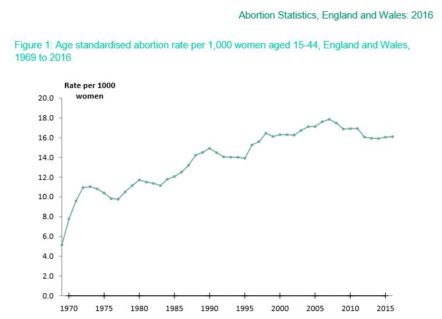
Let’s consider our neighbours. In England and Wales following liberalisation of the law in 1967, abortion rates grew enormously as the chart below shows.
Source: UK Department of Health, accessible here.
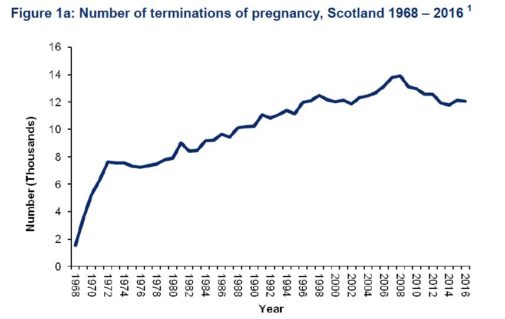
The same happened in Scotland. Rates jumped enormously at the time of liberalisation.
Source: NHS National Services Scotland, accessible here.
The Netherlands is a country that is often presented by pro-choice advocates as a good example in term of abortion rates, sexual education and access to contraception.
Dr. Meabh Ní Bhuinneáin, answering a questions after her presentation, claimed that the Netherlands is one of those countries “where abortion rates have fallen.”
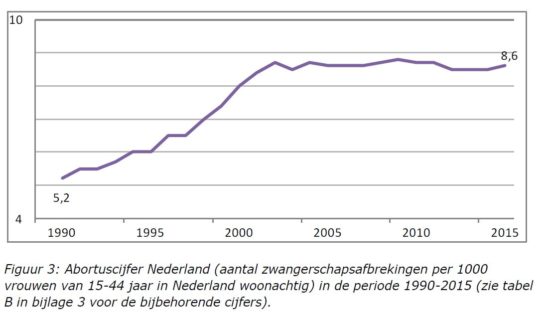
That is not correct. Quite the opposite, in the last 15 years the abortion rate has gone up, according to the official report.
Source: Minister of Health, accessible here.
Abortions rates are falling in some countries, for a variety of reasons, but not because of a more liberal regime. No country with liberal laws has an abortion rate lower than countries such Ireland, Poland and Malta, which have restrictive laws. (I have covered this topic here).
It is not the first time Dr Boylan makes incorrect claims about abortion statistics.
For instance, in a recent interview with Eamon Dunphy that you can listen here he said: “The interesting thing is that in countries that we regard perhaps as the most liberal legislation, places like Denmark and the Netherlands, they have extremely low rates of termination by comparison with the instances that you have mentioned.” He and Eamon Dunphy had been discussing Britain and the United States.
The percentage of pregnancies ending in abortion is actually higher in Denmark than in Britain or in the United States. Here you can find a comprehensive comparative table.
Denmark, as other Northern countries like Sweden or Norway, provides the kind of sexual education and access to contraception that pro-choice advocates favour and still has higher abortion rates than Italy, Portugal, Germany or Switzerland. The Scandinavian countries can be hardly taken as good examples.
These doctors need to revise their claim that liberalisation of the law leads to lower abortion rates when the facts show something very different.

mercoledì, ottobre 18, 2017

Masters of two main maternity hospitals want law to permit abortion of disabled babies


The Masters of the two biggest maternity hospitals in the country have both declared their support for abortion where a child suffers either from a fatal or a non-fatal foetal abnormality. If implemented, this would mean that unborn children suffering from conditions such as Down Syndrome could be aborted in Irish hospitals.
The two Masters were Professor Fergal Malone of the Rotunda Hospital Dublin, and Dr Rhona Mahony of the National Maternity Hospital. Last week they appeared before the Joint Committee on the Eighth Amendment.
Professor Malone doesn’t want any limits placed on the type of foetal abnormalities that can lead to abortion, or any limits placed on the point in the pregnancy when an abortion for such conditions can take place. He wants abortion in this context decriminalised.
He said it would not be appropriate to provide a list of spe­cific foetal diagnoses that should be considered “eligible” for an abortion but, instead, that “the individuals best placed to make such a decision are the patient and her doctor, without the direct involvement of external agencies”.
Moreover, he did not consider it appropriate to specify a precise gestational age limit in weeks beyond which a pregnancy termination would be illegal because, he said, the definition of foetal viabil­ity is not precise and is likely to change. According to him, the mother and her doctor only should make such a decision, without a legal cut-off.
This practically means abortion on request for any foetal abnormality, without gestational age limit. One couldn’t think of a more liberal regime.
Fine Gael Deputy Peter Fitzpatrick found it “disturbing that the witness refers to the abortion procedure as ‘care’ as it is certainly not care.”  He noted that: “what is meant by ‘care’ is a proce­dure that would lead to the ending of a baby’s life”. He asked at what point it is decided that the baby is no longer the patient. In answering this question Professor Malone continued to refer only to the mother as “the patient”, never mentioning the other patient, namely the unborn child.
Dr Mahony also supported decriminalisation. She didn’t specify on what grounds but quoted without any qualification the Royal College of Obstetricians and Gynaecologists in the UK which recently voted by a large margin in favour of removing criminal sanctions that still cover some abortions in Britain, for example, late term abortions except in cases of disability.
She claimed that an error in clinical judgement regarding the real and substantial risk to the life of a woman, which would qualify for a legal abortion in Ireland, is potentially punishable by a custodial sentence of 14 years for both the mother and her doctor if an identified risk is deemed not substantial enough.  “I believe that the definition of substantial risk to life can provide problems for doctors who are worried that if they make a wrong clinical decision, a custodial sentence of 14 years is hanging over both them and their patient.”
But when challenged by Senator Ronan Mullen, she admitted there has been no case law of doctors being prosecuted in Ireland and “one or two cases where doctors have been accused of inappropriate termi­nation of pregnancy” in Northern Ireland, were not on their assessment of risk but on a completely different ground.

venerdì, ottobre 06, 2017

Professor Binchy defends equal worth of every human being before Oireachtas Committee on abortion


Professor William Binchy appeared before the Oireachtas Committee on abortion yesterday.  Professor Binchy, an expert in constitutional law, is one of the main architects of the pro-life clause of our Constitution. In his testimony to the committee, he defended the right to life of the unborn and challenged the idea that under our international law commitments, we must liberalise our abortion regime.
Human rights, he explained, are based on the inherent and equal worth of every human being. “Human beings have human rights, not because they are given by legislators or courts, but by reason of their humanity.” Commenting on the recommendations of the Citizens’ Assembly, he claimed that, if accepted, they would make lawful to take the life of a child on request, with no restriction as to reasons, and also where the child has a significant foetal anomaly. If human rights are to have any meaning, one human being should not be entitled to choose to end the life of another, innocent and defenceless, human being. The idea that our law should authorise the taking of a child’s life with “no restriction as to reasons” is, frankly, abhorrent to any civilised society.”
Speaking of children with disabilities, professor Binchy remarked that “terminating the life of a disabled child because of the child’s disability is not consistent with respect for the child’s equal right to life.” Our society has been founded on the value that no one has the right to choose to hurt, let alone kill, another innocent human being – professor Binchy claimed -but the “right to choose” philosophy, fully embraced by the Citizens’ Assembly implies, the right to take the life of another human being, with “no restriction as to reasons”, on the basis of the supremacy of choice.
The international human rights treaties which Ireland has ratified do not provide for a right to abortion, according to the Trinity academic. If they were in conflict with the Irish Constitution they would not have been ratified. Any comment from the monitoring committees of the international treaties does not change the meaning of the treaties. Their members, Professor Binchy maintained, are earnest supporters of the “right to choose” philosophy and Ireland doesn’t have to change its Constitution to get it in line with their views.
Commenting on the submission of the Irish Human Rights and Equality Commission, of which he was a member for two terms, he noted that if the proposals were implemented, they would involve abortion with little or no restrictions in practice, i.e. a regime of abortion on demand. “Throughout its Policy Document, the Commission never addresses the entitlement of children before birth to be protected from having their lives ended. It offers no reasons why such a profound discrimination against them should be proposed. Alarmingly, it presents no objections from a human rights perspective to late term abortions.”

martedì, settembre 26, 2017

How ‘safeguards’ aimed at limiting assisted suicide are collapsing


“Is it time we talked about euthanasia?”, an Irish Time article asks. Yes, it is and it is also time to show what happens when a country legalises euthanasia or assisted suicide. We can see, for example, how the number of deaths by assisted suicide has been rapidly escalating in Belgium and the Netherlands.
We can, in addition, see that euthanasia or assisted suicide are usually introduced on seemingly very limited grounds and in a short matter of time these grounds are widened to non-terminal conditions such as “unbearable pain and suffering”. This is a common pattern.
These developments should be taken note of in months to come when they are presented with a Private Member’s Bill by John Halligan TD in favour of assisted suicide.
In the Netherlands, the number of cases of assisted suicide increased by 10% in just one year in 2016 with 6091 reported deaths by euthanasia/assisted suicide.  Since 2006 there has been a huge 317% rise in cases of assisted suicide. In recent years the rate of increase has accelerated. This is true not just for the overall number but also for non-terminal cases.
In 2016, 141 people were killed because of dementia (564% increase since 2010), 60 for psychiatric reasons (428% increase since 2012) and 244 for “advanced age”. Non-voluntary euthanasia, without an explicit request from the patient, is also permitted.
In Belgium euthanasia was legalised in 2002 and in 2014 it was extended to children!
The rate of euthanasia increased significantly between 2007 and 2013, from 1.9 to 4.6% of overall deaths, and it is now significantly higher than the Netherlands where it represents 4.1% of deaths. Both the number and the proportion of the requests granted has increased.
These trends have raised serious concerns regarding the changing role of health care professionals, who are now required to kill rather than cure and take care. Moreover, there is a suspicion that in some cases euthanasia is performed with the purpose of getting organs from the patient. For instance, in Belgium almost a quarter of transplanted lungs are from euthanised patients.
In Belgium and Switzerland mental illness can itself be a basis for euthanasia or assisted suicide. A study published in 2015 in the British Medical Journal shows that of 100 patients who requested euthanasia for psychiatric reasons not even one was terminally ill. They suffered of mood disorders, post-traumatic stress disorders, eating disorders, autism, etc. The most frequent diagnosis was depression.
The official report from Oregon shows that the most frequent end of life concerns cited by people requesting assisted suicide are psychological rather than medical. They relate to disability and increased dependence. Being a burden on others is more significant than fear of pain.
The problem with euthanasia is that once we accept the idea that we have a right to die, which in fact means a right to be killed, it becomes difficult to limit this right.  Moreover, what is the point of campaigning against suicide, in school for instance, if the state offers it as an opportunity?
These laws “normalise” suicide and they are in fact associated with an increase of suicide in the general population because they tell them that it is an appropriate response to the burdens of life. With time, those practises becomes acceptable, creating social pressure and also expectations on the most vulnerable patients and families.

More information about euthanasia can be found here.

venerdì, settembre 22, 2017

Irish Government happy to promote gay rights abroad but not religious freedom


A delegation from the Irish State’s foreign aid organisation, Irish Aid, is currently in Vietnam promoting gay rights. Interestingly, Irish Aid seems to have nothing to say about the suppression of religious freedom in the Communist dictatorship, never mind other crucial freedoms. Why?
The Socialist Republic of Vietnam controls all aspects of the lives of its citizens, including religion. Government oversight and repression of religious activity, and persecution is very common. Last year, for example, 108 protestant pastors were imprisoned.  Vietnam’s most famous religious leader, Cardinal Nguyên Van Thuán was arrested in 1975 and spent 13 years in prison – including nine years in solitary confinement.
Vietnam’s appalling record on human rights includes no right to life for the unborn.  Vietnam ranks first in Asia for abortions, and among the top five in the world. Every year one million abortions are carried out, corresponding to a rate of 59 cases to 100 live births.
According to its website the purpose of Irish Aid fight global poverty and hunger. It also promotes “equality and respect for human rights”. As an article on its website explaining its visit to Vietnam promoting gay rights says: “Equality and respect for human rights are key values of Ireland both at home and abroad, and remain at the heart of the work of Irish Aid and the Department of Foreign Affairs and Trade. Vietnam is one of Ireland’s key partner countries receiving support through the Irish Aid programme. As part of Irish Aid’s Civil Society support programme, Ireland has been supporting a number of initiatives to facilitate the realisation of rights of the LGBTI community in Vietnam.”
The question arises: if Irish Aid sees fit to promote LGBT rights in Vietnam, why not the rights of religious believers there? Why is Irish Aid being so selective? Are human rights divisible?
Another question arises: why is it that a single-party, authoritarian State like Vietnam finds it less threatening to promote gay rights than freedom of religion? It permitted gay marriage in 2015. The Vietnamese Government knows this will make it appear ‘modern’ and ‘tolerant’ to the Western world. It is part of the official propaganda and Irish Aid certainly seems to be taken in by this.
LGBT rights don’t challenge the hegemony of the State whereas religion does by pointing to a source of moral authority independent of the State. The Vietnamese Government will be well aware of the role religion played in helping to bring about the fall of European communism. Indeed, the Catholic Church also helped to bring down military dictatorships in South Korea and the Philippines.
Little happens in Vietnam that is not approved and controlled by its dictatorial State. It is very wrong of Irish Government agencies to go along with the agenda of the Vietnamese regime in promoting what suits it while continuing to suppress fundamental human rights.

mercoledì, settembre 06, 2017

Katherine Zappone’s madly contradictory views on Church and State


Following a meeting between Catholic bishops and Government representatives last week, Children’s Minister Katherine Zappone, who was not present, told the Catholic Church that it has no right to determine our laws, and that its own teachings ought to recognise a right to abortion. That is quite a double whammy.
According to The Times Ireland Edition, she said: “I absolutely do want to see a referendum on the Eighth Amendment, I think it is really integral to a social justice agenda in order to enable women to have greater choice in relation to the issue of their pregnancy. The Catholic Church has a very strong social justice tradition, and so I would think that in our negotiations discussion with them we need to draw on that social justice tradition to ensure it extends to women’s ethical choices in relation to their reproductive capacity. I respect the tradition, I think they need to voice their views, but I also believe and know that those views were to influence their own members. They cannot determine the laws of the land,” Ms Zappone said.
These comments raise a number of questions.
If Ms Zappone believes that the Bishops should influence only their own members, why were they invited by the Taoiseach to present and discuss their views with representatives of the Government, including the Taoiseach. Does she believe the meeting should never have happened?
Would Minister Zappone tell any other part of civil society that they cannot attempt to influence the laws of the land? Would she say it to Amnesty Ireland, for example, which is campaigning to have abortion made legal on wide-ranging grounds? If not, why single out the Churches? Are religious groups less entitled than others to contribute to democratic debate?
Additionally, if the Minister wants the separation of Church and State then it is not her role to tell the Catholic Church what to believe. (On the other hand, as citizens we all have a right to seek to determine our laws, whether we are religious or not). To demand that the Catholic social justice tradition should extend to women’s ‘ethical choices in relation to their reproductive capacity’, which is another name for abortion, is an unjustifiable interference in contradiction with the principle of separation.
Moreover, suggesting that the Catholic social justice tradition could somehow justify the legalisation of abortion negates the long established Catholic teachings on the profound injustice that abortions imply.
It is at the same time ironic but also tragic that the person calling on Catholic bishops not to stand up for unborn children is the Minister for Children.
In the USA, the country of origin of Ms Zappone, abortions can be performed until birth. As she is actively promoting a referendum to liberalise abortion, it would be interesting to know if this is the model that Minister Zappone is advocating.