Presented here is the English translation of an article I authored for L'Osservatore Romano, published on 14 April. Auro d’Alba was a third cousin of my grandfather.
Since 1948, and for more than twenty years, L’Osservatore della Domenica hosted the column "The Charity Appointment," dedicated to collecting aid for those in need.
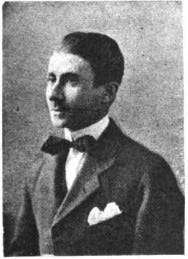
When announcing the sudden death of the column’s curator - exactly sixty years ago, on April 15, 1965 - the director Enrico Zuppi revealed to readers that behind the pseudonym “Benigno” was the poet Auro d’Alba. A name which, under the veil of anonymity, had made charity a silent yet tangible mission.
The column had begun almost by chance when Benigno, who was already contributing religious meditations to the newspaper, was asked to present a particularly urgent case. In just a few days, an unexpected wave of donations poured in from readers touched by the delicacy of his words. From that moment, the appointment became a permanent feature.
Those were difficult years, the immediate post-war period. Benigno devoted himself daily to sorting through bundles of letters, verifying their authenticity, assessing genuine need, and finally presenting the most urgent cases to readers. Assistance was not merely financial: through the mediation of the newspaper, food, medicines, clothing, orthopedic equipment, prosthetics, and even vehicles were distributed, both to individuals and institutions.
But who was Auro d’Alba? Born in Rome in 1888 to a family of Abruzzese origins, he published his first collection of poems, Lumi d’argento (Silver Lights), at just 17, under his real name, Umberto Bottone. His works were imbued with a crepuscular tone and were reviewed with interest by his friend Sergio Corazzini.
In the 1910s, he was drawn into the Futurist movement by Filippo Tommaso Marinetti, contributing to publications such as Lacerba by Papini and Soffici, before aligning with the avant-garde movement represented by the Neapolitan magazine La Diana.
A political activist, in 1916 he was arrested alongside the Futurists Marinetti, Balla, Depero, Cangiullo, and Jannelli during a pro-interventionist demonstration. Staying true to his convictions, he enlisted in World War I, fighting among the Bersaglieri. His time at the front earned him a silver medal and a war cross, as well as material for the short stories and poems he produced in the immediate post-war years.
During this period, he also wrote poetry for children, published in Giornalino della Domenica, the magazine founded by Vamba, creator of Gian Burrasca.
An early supporter of Fascism, he became head of the press office and official historian for the Milizia Volontaria per la Sicurezza Nazionale. His peak of literary fame coincided with a personal tragedy that reignited his deep Catholic faith.
In 1930, he published Nostra famiglia (Our Family), a partly autobiographical novel imagining the ideal family of the new regime. However, just months after its release, his eighteen-year-old daughter Ofelia took her own life in the family home. The tragedy profoundly changed his life and moved the entire Italian literary world.
A commemorative volume published the following year collected tributes to Ofelia d’Alba by major figures such as Salvatore Quasimodo, Grazia Deledda, Giuseppe Ungaretti, Clemente Rebora, Giovanni Papini, Aldo Palazzeschi, and many others.
Auro d’Alba’s poetry following this tragedy is almost entirely dedicated to his lost daughter.
In the ensuing years, he collaborated with Il Frontespizio, the prestigious Florentine magazine of Catholic inspiration and a touchstone for literary culture of the time. He rejoined Marinetti during the Ethiopian campaign, distinguishing himself in military operations that earned him another silver medal and two additional war crosses. During these years, he also wrote military songs, including Battaglioni M and Cantate di Legionari.
After World War II, in which he was involved in propaganda roles, and following the death of his wife, Auro d’Alba returned to writing. However, he often used various pseudonyms for his contributions to periodicals, perhaps to distance himself from a politically compromised past.
He collaborated with Il Popolo, the daily newspaper of the Christian Democrats, signing his contributions, portraits and literary profiles drawn from his memories, under the pseudonym Benigno. These writings were later collected in the memoir volume Formato Tessera (Passport Size, 1956).
In addition to literary criticism, he continued to publish poetry and meditations, particularly in the Florentine magazine Città di Vita and in L’Osservatore della Domenica.
In the latter, under the pseudonym Benigno, he curated the “Voli” column, which initially had a purely literary focus but soon evolved into “The Charity Appointment,” where cases of need were often introduced by brief, intense spiritual reflections.
Benigno gave voice to the needy with profound sensitivity, often allowing their own words to recount their plight. He presented the cases through the letters received, preserving their authenticity and human tone. It was as if those writing finally found a space for their stories to be heard, a hand extended through the page.
Every week, Benigno offered readers of L’Osservatore della Domenica a concrete opportunity to perform an act of charity. When generosity was not sufficient to meet the need, he intervened personally, discreetly filling the gaps. His pen gave voice to pain and offered a silent, often tangible, response to suffering.
One of the first letters presented by Benigno did not come from someone seeking help but from a benefactor. In January 1948, a former prisoner of the Mauthausen concentration camp wrote, requesting that his anonymous donation be given to a German in need, as a gesture of reconciliation. “More than forgiveness, this Christmas, I wish to help someone who perhaps wronged me but who, in the end, was himself a victim of deceit. The Pope’s words are always full of compassion; may they be heard more often, and may we thus gain, through love and not hatred, the peace the world so yearns for,” the reader wrote.
Benigno recognized in this gesture not merely generosity, but an expression of true sanctity.
In a heartfelt farewell article sixty years ago, director Enrico Zuppi recalled that Auro d’Alba, having endured painful storms in life, “found particular comfort in doing good for others, with an inexhaustible charity.”
In one of his introductory meditations for The Charity Appointment, Auro d’Alba wrote:
“Suffering makes us understanding and charitable; it becomes easier to extend a hand to a brother, to open our arms to him, to listen to his heart beating with our own; to share both bread and sorrow. How often have I noticed that joy, instead, can be selfish and cruel, like youth itself, which has all of life before it and wants nothing to do with suffering. And do you know why it is selfish? Because it wishes never to end; it is cruel because others’ sadness casts a shadow, disturbs it, recalls a duty it would rather neglect, ignore, perhaps even disdain... And so we forget the highest truth of our Faith: 'A cup of water given in love is worthy of eternal life.'”
In his commemorative article, Zuppi added: “We will no longer see him among us, with that seemingly skeptical smile, that worldly air with which he tried to shield his immense kindness, his altruism, his exquisite sensitivity.”
The Charity Appointment continued after Auro d’Alba’s death, thanks to the commitment of his second wife, Maria Antonietta Pozzi, his collaborator in both life and work.
Today, Auro d’Alba is a forgotten author. His books survive only among the yellowed pages of old editions, found in antique shops or libraries. His name, once familiar, was later obscured by his evident connection to the Fascist era, which marked his cultural destiny more than his inner voice ever did. Yet, the invisibility he embraced during the last twenty years of his life was far from a retreat imposed by history. It was, rather, a form of modesty, a deliberate discretion. A refusal of personal recognition, to leave space for the urgent needs of others, for suffering that demanded to be heard.
He did not hide out of fear, but to promote silent charity. Behind Benigno, there was not an author in retreat, but a man who had learned to write no longer for himself, but for others.

Nessun commento:
Posta un commento