Sono stato intervistato dagli amici di Radio Notting Hill.
mercoledì, maggio 22, 2024

martedì, maggio 21, 2024
Irish medical bodies almost uniformly against euthanasia
The Irish Medical Council recently dropped from its ethical guidelines the prohibition on doctors deliberately killing their patients. It is hard to believe they are not paving the way for euthanasia. However, they made this change without properly consulting their members. However, most of the bodies representing the medical profession in Ireland remain firmly opposed. This was confirmed after the recommendations of the Joint Oireachtas Committee on Assisted Dying in favour of the practice were published recently. They claim that legislating for assisted suicide is harmful and contravenes good medical practice.
The bodies that pushed back against the recommendations are the Irish Association of Palliative Care, the Irish Palliative Care Consultants’ Association, the Royal College of Physicians and the College of Psychiatrists of Ireland.
The Irish Association of Palliative Care stated: “We do not support any change in the law to legalize euthanasia or Physician-Assisted Suicide. Palliative care should exclude any action or treatment designed to cause a patient’s death.”
Instead of euthanasia and assisted suicide legislation, they advocate for “an emphasis on enabling dignified dying, delivered through the provision of palliative care, to help people live well until they die. The focus should be on ensuring that patients have access to resources and information about their end of life and dying.”
The Irish Palliative Care Consultants Association also expressed deep disappointment with the majority report of the Committee, claiming that ‘assisted dying’ will inevitably and disproportionately place vulnerable people at risk. “In a progressive and inclusive society, we believe the fears and challenges of life-limiting illnesses, particularly if they lead to a wish to die, should be responded to with better care rather than facilitating an early death. In view of this, we do not feel that legislating for assisted dying is the appropriate answer to address these concerns”.
The Royal College of Physicians of Ireland (RCPI) said they “oppose the introduction of any legislation supportive of assisted suicide because it is contrary to medical practice.” The RCPI, which has more than 11,000 members, is the largest postgraduate medical training and professional body in Ireland.
Dr. Feargal Twomey, Chair of the RCPI expert group and a Consultant in Palliative Medicine, added: “The introduction of legislation on assisted suicide has the potential for immense harm and unintended consequences, and our view is that the potential harms outweigh the arguments in favor of legislation for assisted suicide.” Dr. Twomey, who presented to the Oireachtas Committee on Assisted Dying last October, stated: “My concern about the inability for safeguards to be maintained leads me to say the only true safeguard is that the law does not change.”
Another critical response came from the College of Psychiatrists of Ireland. They said that the recommendations of the Committee “undermine Irish society’s strong focus on suicide prevention policy” and believe that Ireland “can do better in providing compassionate care to those who are dying than to introduce assisted suicide and euthanasia.”
The consistent opposition from these medical professional bodies, who confront end-of-life situations daily, underscores a profound understanding of the complexities and the ill effects involved in legislating for euthanasia or assisted suicide.
Given their expertise and the concerns they raise, it is essential for lawmakers and the public to reflect deeply on these perspectives before taking any decision on these matters.
lunedì, maggio 20, 2024
A Draft Manifesto of the Suburban Romantics
From my friend Maolscheachlann.
A Draft Manifesto of the Suburban Romantics
1) The Suburban Romantics are on the side of life.
2) The Suburban Romantics favour all the poetic conventions that were the poet's stock-in-trade up to the day before yesterday, especially rhyme and metre.
3) The Suburban Romantics believe that traditional poetic forms (such as blank verse, the sonnet, the ode, the villanelle etc.) are just as valid in the twenty-first century as they were in the seventeenth, eighteenth or nineteenth centuries.
4) The Suburban Romantics do not agree with Thoreau that “the mass of men live lives of quiet desperation”, or with Wilde that “most people exist, that is all”. We celebrate the routine, the ordinary, the workaday, the familiar.
5) The Suburban Romantics are not afraid of sentimentality or nostalgia, nor are we afraid of challenging or subverting sentimentality or nostalgia.
6) The Suburban Romantics do not genuflect before any transitory socio-political orthodoxies.
7) The Suburban Romantics want to evoke mystery, not practice mystification.
8) The Suburban Romantics are nourished at the wells of myth, legend, archetype, the sacred, the proverbial, the folkloric, the sacramental, and so on.
9) The Suburban Romantics do not disdain the topical, the ephemeral, the colloquial, the commercial, and so on.
10) The Suburban Romantics accept that the great majority of people (and perhaps an ever-increasing majority) are destined to live in suburbs, conurbations, commuter towns, housing estates, and so on. We insist that these can be the subject and setting of poetry; not just the poetry of satire and protest, but the poetry of affirmation and celebration as well. We seek the re-enchantment of the world, the transfiguration of the commonplace.
11) The Suburban Romantics have a special respect for Philip Larkin and John Betjeman, who demonstrated beyond all doubt that traditional forms can be used to explore contemporary life.
12) The Suburban Romantics are quite willing to use irony, but not to live in it as our natural element.
13) Suburban Romanticism is not a straitjacket. We do not preclude forays into free verse, rural themes, bleakness, misanthropy, obscurity, or any of the things against which this manifesto is a riposte. But they should be the exception, not the rule.
lunedì, maggio 13, 2024
The organisation that offers abortion ceremonies
Recently, I revealed the rapid increase in what might broadly be called ‘New Age’ wedding ceremonies in Ireland presided over by various non-denominational organisations. But wedding services are not all they provide. At least one group offers ceremonies to mark abortion, divorce, and “preparation for dying”. It would have been also unimaginable until very recently that a ceremony would be offered to mark, or even celebrate, an abortion, but this is the point we have reached.
The organisation is called ‘Entheos Ireland’. It presides over hundreds of marriages per year, having been founded just three years ago.
In the “ceremonies of threshold and transition” section of their website, they also outline ceremonies that “have their roots in beginnings, such as Renaming, Gender Affirmation, Coming-of-age, New Career”, in addition to ones that “stem from endings, such as Abortion, Divorce, Retirement”.
To this list must be added “preparation for dying” services, which are distinct from funerals.
Abortion or “preparation for dying” celebrations sound quite shocking, but not surprising when we explore who is behind these new ceremonies.
Entheos Ireland was launched in 2021 by Karen Dempsey. Dempsey is a pro-choice activist who was involved in the Repeal the 8th referendum campaign. At the time, she was one of the 25 women who dressed as red handmaidens (inspired by the book, ‘The Handmaid’s Tale’), and marched to the Dail in an event organised by the Socialist feminist group ROSA, one of the most radical pro-choice groups.
(She also protested against the removal of a pro-abortion mural from the Project’s Art Centre a few years ago. See here)
Entheos describes “preparation for dying” ceremonies as follows: “Our End of Life sessions create a space for the psychological and spiritual exploration needed for individuals and families facing death. … Actively engaging with the process of dying can be both liberating and comforting, and can help to relieve the anxiety of dying with important things left unsaid and undone.”
Interestingly, one of their solemnisers is Janie Lazar, the chair of the pro-euthanasia organisation End of Life Ireland.
We can envisage that if assisted suicide or euthanasia are legalised in Ireland, groups such as Entheos will offer ceremonies to go along with them. Some might be shocked, but in Canada there is at least one church that hosts assisted suicide ceremonies on its premises.
Entheos does not promote a specific faith, but their solemnisers are registered with the HSE as “religious”. They are akin to religious ministers without a regular congregation, performing ceremonies upon request. This is a new form of “liquid spirituality”, which requires no strong commitment or beliefs. Anything goes.
“I would rather not have the word religious involved with us,” said its founder Karen Dempsey in a recent interview. The interviewer says that “the designation as ‘religious’ is a useful loophole [in the relevant regulations]. It allows Entheos’ celebrants to incorporate elements of faith into people’s ceremonies … in a way that a totally secular officiating body could not.”
The organisation already has 65 celebrants registered with the HSE and over 80 people on the waiting list for their training sessions, which costs €2,500. This emergent market can be quite profitable, with an average fee of €600 for a wedding and €280 for funerals and other ceremonies.
The rise of these ‘New Age’ ceremonies indicates that people still want a spiritual element in the key moments of their lives. But apart from funerals, traditional religions have always offered these ‘rites of passage’ at positive moments like when a baby is born, or a couple get married. The emerging spirituality adds much less positive events like abortion and divorce to the list of possible rites of passage, and probably in time, euthanasia as well.
venerdì, maggio 03, 2024
The huge rise of ‘New Age’ weddings in Ireland

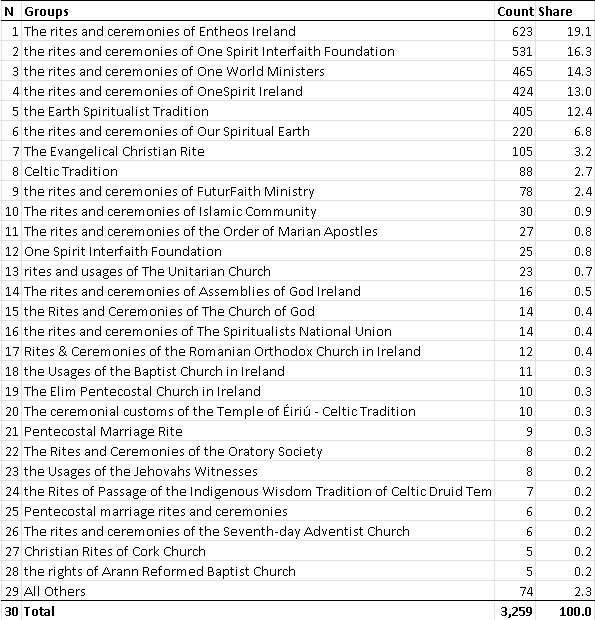
While the number of Catholic marriages in Ireland is steeply declining, new data released by the Central Statistics Office (CSO) highlights the rise of ceremonies belonging to “other religious denominations”, to use the CSO’s term. Now, you might think this means Muslim ceremonies, or perhaps those that take place in African Pentecostal churches, but these account for only a tiny fraction of the total (see table below). The vast majority of the ceremonies, in fact, really belong under the very broad heading ‘New Age’. They increased from 5.3pc of the total in 2018 to 15.8pc last year, growing from 1,009 to 3,259 in absolute numbers — a three-fold increase in just five years.
The ceremonies incorporate elements from many different religions, as a couple choose. They can be extremely eclectic. There is no particular coherence to them in that they don’t come from a systematic religious worldview that can be called ‘Christian’, or Buddhist’, or ‘Muslim’ or ‘Hindu’. This is why the term ‘New Age’ might be most appropriate, even if some who act as the celebrants themselves, or even the couples involved, might resist the label. We use it here for short-hand.
To the category “other religious ceremonies” must be added ‘Spiritualist’ ones, which were nonexistent ten years ago and are not included in the “other religious” cohort by the CSO. These now account for 7.9pc of all marriages and also borrow from any and all religions depending on the taste of the couple.
This means what can very broadly be termed ‘New Age’ or ‘spiritual’ wedding ceremonies now account for almost a quarter of all weddings in Ireland.
The majority of these ceremonies are conducted by brand new organisations, the Spiritualist Union of Ireland being one.
Another is ‘Entheos Ireland’, which only registered with the HSE three years ago. According to data provided to the Iona Institute by the CSO, Entheos ministries officiated at 623 marriages in 2023. They currently have 81 solemnisers approved by the State, compared with only five Muslim solemnisers and about 20 from various Orthodox churches.
Spiritual groups such as Entheos and One Spirit tailor their religious ceremonies to the preferences of the spouses, presenting themselves as 'inclusive, embracing people of every faith and none,' without referencing any specific deity or belief system unless requested.
Entheos says it was founded “to serve people who have been ostracised, marginalised or otherwise left behind by traditional faith paths on the basis of gender, race, sexual orientation, ability, nationality, parental / family status or any other reason.”
Another group is ‘One Spirit Interfaith Ministers’. They describe themselves as “ordained interfaith ministers embodying a vibrant and meaningful response to the changing spiritual needs of our times.” They say they are “of service to people of all faiths and none.”
There are many other similar groups offering their services to engaged couples including ‘The Earth Spiritualist Tradition’, ‘One Spirit Ireland’, and ‘One World Ministers’.
Many of the ‘New Age’ wedding ceremonies involved couples or individuals entering a second or third marriage. Data provided to the Iona Institute by the CSO reveal that the number of first marriages among “other religious” ceremonies is significantly lower than among traditional Christian denominations, likely because these groups also offer ceremonies for divorced individuals, which may partly explain their growing popularity. They are also very popular among same-sex couples. Of the 646 same-sex marriages celebrated in 2023, 145 (22pc) were with “other religion” ceremonies and 70 (11pc) with Spiritualist ones.
The rise of non-denominational religious ceremonies is a new trend that reveals the need to mark important events in life with some form of non-institutional religious rituals. Those who feel they do not belong to a religion, often still have religious beliefs of some sort and these new organisations (which charge €600 on average for a wedding) are emerging to satisfy their needs.
As for the broader picture, last year there were 20,513 opposite-sex marriages in Ireland, and 646 involving same-sex couples. Of the opposite-sex ones, 86pc were first marriages, a slight decline from 88pc in 2013. Our marriage rate last year was 4.0 per 1,000 adults—one of the lowest rates in Europe and a decrease from 4.5 ten years ago. In other words, fewer people are getting married but the percentage of those who remarried after a divorce has increased.
The proportion of marriages conducted through religious ceremonies has obviously decreased, representing 60pc of all marriages last year, down from 70.5pc in 2013. Notably, Catholic marriages have dramatically declined from 62.5pc a decade ago to just 35.3pc in 2023.
Among first marriages, 40pc were celebrated in a Catholic church.
The face of marriage in Ireland is indeed changing very rapidly and the rise in ‘New Age’ ceremonies reflects the drift away from institutional religion of all types. At the same time, there is still clearly a taste for wedding ceremonies to have religious or ‘spiritual’ trappings of some sort and therefore we are not becoming as secular as some people think.
– – –
“Other religious” solemnisers
sabato, aprile 27, 2024
mercoledì, aprile 24, 2024
The minority report of the Oireachtas euthanasia Committee
The introduction of euthanasia in Ireland could lead to the closure of care homes and have an ill effect on the healthcare system, according to the minority report from the members of the Oireachtas Committee on Assisted Dying. A government seeking savings in the healthcare system could favour assisted suicide over comprehensive end-of-life medical treatments, they said.
Last month, the Joint Oireachtas Committee on Assisted Dying presented its final report, which received approval by nine of the Committee’s fourteen members. A minority report was also produced on that occasion, but its release coincided with the resignation of Leo Varadkar, which overshadowed its public reception. Given the circumstances, it is worth now considering the contents of this minority report and the significant issues it raises.
According to the minority report, several critical issues have been overlooked or insufficiently addressed by the Committee.
Firstly, there are worries that the introduction of euthanasia or assisted suicide could detract from the quality and availability of palliative care services. The minority members are concerned about the economic implications of introducing assisted dying, including the potential for healthcare cost-cutting measures that could favour assisted dying over more extensive and expensive care options.
“Why should the service be provided by the State? How can one ensure that a Government seeking savings in the health-care system will not prefer assisted dying over end-of-life medical treatments? How can one ensure that health insurers do not promote assisted dying as a cheaper option for elderly or chronically ill patients? Given the potential, and possibly hidden, impact of potential budgetary savings on policy, the Committee should have undertaken to investigate these matters in depth.” (p. 33)
A second major critical issue regards the ethical implications for healthcare providers involved in “assisted dying”. Requiring professionals to participate in or refer for euthanasia and assisted suicide can compromise their ethical standards and the trust placed in them by patients, says the minority document.
More specifically, because the Committee recommends that only individuals should be allowed to avail of conscientious objection to euthanasia or assisted suicide, institutions with a pro-life ethos such as Catholic hospitals or nursing and care homes may be forced to close, as it has happened in other countries.
“The [Committee] majority believes that, once the State legislates for assisted dying, it must somehow become an obligation for a State-funded institution, or indeed any caring institution, to provide it. Yet any legislation reflecting such thinking may lead to the closure of many care homes and the withdrawal of staff from an already understaffed Irish healthcare sector.” (p. 32)
Another criticism from the minority is that the safeguards proposed by the Committee’s final report are inadequate for protecting vulnerable groups, including the elderly, disabled, and those suffering from mental illnesses. These safeguards would fail to prevent coercion and abuse effectively.
“The Committee majority voted down a recommendation to make it a criminal offence for any health professional to advertise assisted dying or to initiate the question of assisted dying with any patient.” (p. 19)
The minority report highlights potential societal impacts, such as the normalisation of euthanasia and suicide, and their effect on societal attitudes towards the elderly and disabled. The Committee minority members are concerned about the message the report sends regarding the value of life, especially for those considered vulnerable. The official final report fails to adequately address the complex psychological impacts of assisted dying on patients and their families. This includes the risk of increased suicide rates and the need for comprehensive mental health supports.
The minority report also expresses concerns about the legal implications of assisted dying, including potential challenges to the constitutionality of such legislation. They worry about the legal precedents it might set and the implications for the right to life enshrined in the Constitution.
The minority report was endorsed by the three members of the Joint Oireachtas Committee. Notably, the Chair of the Committee, independent Michael Healy Rae, together with Fianna Fail TD Robert Troy and independent Senator Ronan Mullen. One member of the Committee was absent from the final vote, one member, namely Pa Daly from Sinn Fein, abstained, and the rest voted in favour.
venerdì, aprile 19, 2024
RTE’s hopelessly unbalanced review of Ireland’s abortion law
At a time when the government is considering a further liberalisation of our already permissive abortion legislation, RTE Investigates this week aired a documentary on “the realities of Ireland’s current abortion services” which was far from being fair and impartial. In fact, we didn’t get to hear from a single pro-life advocate, and it did not tell us that some of the experts we did get to hear from are, in fact, long-time pro-choice advocates. All in all, a very bad day’s work.
The documentary, which was aired on Monday night, included several ‘sting operations’, in an attempt to “expose” pro-life agencies that offer support to pregnant women. Three health professionals were introduced in neutral terms and were asked to comment on the advice those agencies were giving.
One of them, Mark Murphy, portrayed in the documentary as merely a GP, actually served as the national spokesperson for Together for Yes, the organisation leading the campaign to repeal the 8th amendment during the 2018 referendum. We were not told this.
Similarly, psychiatrist Veronica O’Keane featured in the documentary. She responded in shock to some of the advice being offered to pregnant women by the pro-life agencies, but she was a long-time critic of the 8th Amendment. Again, the innocent viewers at home were not informed of this, potentially leading them to perceive those doctors as impartial experts.
Yet, the most egregious example involved Dr. Jonathan Lord, who was portrayed in the documentary solely as a “consultant gynaecologist.”
In fact, Dr Lord is the Medical Director of MSI Reproductive Choices UK, one of the leading providers of abortion in the UK.
This chain of abortion clinics has a history of failings that put women at risk, but we are not told about this either, which is interesting given that the programme was supposed to be partly an exposé of manipulatively emotional practices.
In 2016, inspectors from the UK Care Quality Commission found numerous failings at MSI clinics, including staff “bulk signing” consent forms, limited clinical oversight, poorly trained staff, and at least one case in which a vulnerable woman was given a termination despite not understanding what was going on.
A further inspection in 2017 found more failings. (You can read the official reports here: https://www.cqc.org.uk/provider/1-102643434/reports )
MSI were also accused of paying their staff performances bonuses for persuading women to have abortions.
MSI Reproductive Choices UK used to be called "Marie Stopes UK" but in 2020 they removed the reference to Marie Stopes as she was a racist eugenicist who wanted the "hopelessly rotten and racial diseased" to be sterilised.
Inviting a representative from the most fervently pro-abortion sector to offer insight on purported "rogue pro-life agencies" is akin to soliciting commentary on animal cruelty from the CEO of a slaughterhouse corporation.
The programme also presented the stories of three women who went to England to have a termination. Their unborn children were diagnosed with some anomaly that would not qualify for abortion here in Ireland as they were expected to live more than 28 days after birth.
We were not told what the anomalies were. What life expectancy did the children have? Was it weeks, months or years?
Is RTE now effectively campaigning for abortion to take place in Ireland when a foetus is found to have an anomaly that might not result in death for years? Would that include Down Syndrome? We know from British figures that many of the Irish women who still travel to England for abortions (206 according to the last report), do so because their babies have conditions like Down Syndrome.
Even though the documentary was about the operation of our abortion law, it signally failed to tell us how the number opting for abortion keeps on increasing, probably far past the point that the average person who voted Yes in 2018 expected. It looks like 10,000 abortions took place here last year.
The undercover investigation of the counselling agencies didn’t even reveal very much. For example, one of the Gianna Care counsellors advised the RTE undercover reporter to read online about the possible bad emotional effects of abortion. But shouldn’t pro-choice agencies also do this?
Two RTE journalists attended, on false pretenses, a spiritual retreat for women who regret their abortion. It would have been insightful to hear from those women. RTE failed to interview them, or to interview Bernadette Goulding, the organiser of those retreats, who herself regrets her past abortion and dedicates her life to supporting women who have undergone similar experiences.
Furthermore, why would a documentary purportedly focused on “the realities of Ireland’s current abortion services” fail to even acknowledge, let alone interview, women who have undergone abortions after being incorrectly told that their baby had a fatal anomaly?
The programme set out to review Ireland’s abortion law and services, but the lack of balance in it was so bad, it deserves a review of its own.
giovedì, aprile 11, 2024
Major surrogacy conference seeks international action to ban the practice
The Vatican has just released a new document on the topic of human dignity. Among other issues, it addresses the ethical problems of surrogacy—including the commodification of babies and the financial exploitation of low-income women who are contracted to be surrogates.
Ireland is in the process of adopting one of the most permissive laws in Europe on the issue, but elsewhere, opposition to the practice is mounting.
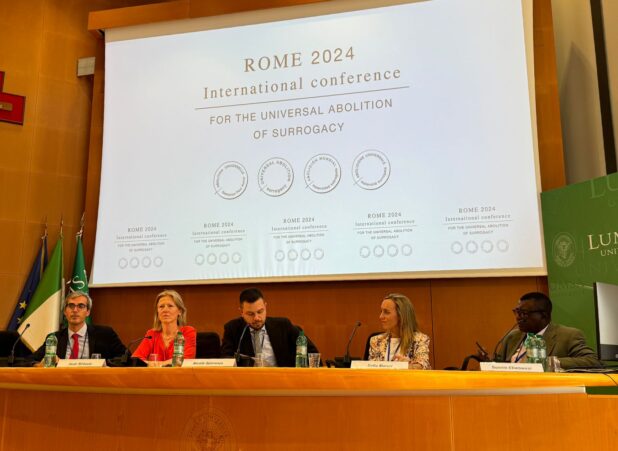
A major conference advocating for a worldwide ban on surrogacy was held in Rome last weekend. Experts at the conference argued that an international treaty is necessary to halt the practice. Although national bans have some impact, couples and single men may still travel to countries where surrogacy is legal or unregulated. This is why it is crucial for states to unite and establish a system to penalise corporations that serve as intermediaries between surrogate mothers and commissioning parents.
Some countries, such as Italy, are in the process of criminalising international surrogacy, punishing Italian citizens who engage in this practice abroad. Such an approach should be adopted by every country, the conference heard.
Banks and financial institutions play a pivotal role in the international surrogacy market, positioning them as critical targets in efforts to achieve worldwide abolition of this practice. At the conference, it was proposed that the responsibilities banks currently have in combating terrorism and money laundering should be expanded to include scrutiny of transactions related to surrogacy.
The meeting in Rome saw the participation of international experts and activists, including the Italian Minister for Family, a representative from the Holy See, various politicians, and notably, two United Nations officials. The UN Special Rapporteur on violence against women and girls, Reem Alsalem, and a member of the UN Committee on the Rights of the Child, Velina Todorova, attended as observers.
The politicians represented a broad spectrum of political affiliations, spanning right, centre, and left-wing parties. Similarly, the experts and activists brought a diverse range of ideological viewpoints to the discussion, including feminism, conservatism, and Christian Democracy, among others. This diversity underscored a rare consensus across political and ideological divides on the perils of surrogacy, a consensus that appears to be absent in Ireland.
This conference followed the launch of a declaration in Casablanca (Morocco) in March 2023, signed by 100 experts from 75 countries, calling for the universal abolition of surrogacy. The Casablanca Declaration initiative is led by Olivia Maurel, a French/US feminist activist conceived through surrogacy. The 32-year-old mother of three has faced mental health challenges from a young age, only later discovering the truth about her origins. She has since become one of the most vocal opponents of the “womb market.” At the conference, she gave a moving and powerful testimony about how surrogacy has affected her life, describing the commodification of children and women as a new form of slavery.
Before the conference, Olivia Maurel had a private audience with Pope Francis, who endorsed the conference’s goals. In January, the Pope had already called for “an effort by the international community to universally prohibit this practice,” a call reiterated in the new document on human dignity. Maurel is keen to stress that that she does not come at the issue from a religious perspective because she is an atheist.
The Rome conference continues the commitment of the Casablanca Declaration and aims to promote national and international initiatives, leading to the adoption of an international treaty among states.
At present, Ireland is far behind the curve on the matter, lost in the pretence that any ethical problems arising from the practice can easily be dealt with.
martedì, aprile 02, 2024
Recommendations for 'assisted dying' are wrong and dangerous, even by their own standards

As predicted, the Joint Oireachtas Committee on Assisted Dying has recommended the legalisation of assisted suicide and euthanasia in Ireland. It claims they will be allowed under only strict conditions and with proper safeguards, but when you read the actual report, some of the conditions and safeguards seem neither strict nor proper.
The final report from the
Committee, presented last month, includes some criteria to qualify for assisted
suicide and euthanasia, but it also recommends a formal review of the
legislation after three years of operation, when these criteria could be
changed. We all know that they will be changed, as it has happened in other
countries.
Specifically, the report
recommends that so-called “assisted dying” should be offered to adults who are
Irish citizens or have been residents here for at least one year.
In order to qualify, the
person should be “diagnosed with a disease, illness or medical condition that
is: a) both incurable and irreversible; b) advanced, progressive and will cause
death; c) expected to cause death within six months (or, in the case of a
person with a neurodegenerative disease, illness or condition, within 12
months); and d) causing suffering to the person that cannot be relieved in a
manner that the person finds tolerable.”
This is objectionable enough,
but even on its own terms, the report’s recommendations would not create proper
safeguards.
For example, take
Recommendation 28 of the report. It says: “The Committee recommends that two
formal requests for assisted dying must be made, with a set specified interval
between. At least one of these requests must be recorded in writing, and before
two independent witnesses.”
So, two requests have to
be made, only one of which in writing and before two witnesses.
This is extremely loose wording. It does not tell us
whether the two requests must be made to two separate individuals. Could the
two requests be made to the same person?
We are not told that the
person or persons to whom the requests are made should be a doctor. Presumably
they ought to be, but we should be told. Then again, should doctors be involved
in this at all except to confirm that the person is dying and is within a
certain number of months of death?
Who would the
“independent witnesses” be? Two friends? Two strangers? Two lawyers? Who knows?
The report does not
clarify who will assess the requests and, specifically, no mental health
assessment is recommended. It only says that “the doctors have an obligation to
acknowledge receipt of the request and should deliver a response within a
specified timeframe.” According to the recommendations, a qualified
psychiatrist is required only when there are concerns that the person might not
be competent to make an informed decision.
The report recommends an
interval between the two requests, but it does not specify its length. It could
be two weeks or a day. Such intervals are required, in some jurisdictions that
permit assisted suicide or euthanasia, as “cooling off” periods that allow the
patients to reflect about their decision.
There is no requirement
in the report that the family of the patients be informed before the procedure.
In some jurisdictions,
health professionals cannot actively suggest assisted suicide or euthanasia to
their patients as an option, but they can only accept requests coming
spontaneously from patients. This is a protection against patients being
coerced or led towards the procedure.
In the Oireachtas report
there is no recommendation that would stop doctors mentioning ‘assisted dying’
as an option, which is an appalling oversight, or was it deliberate?
The recommended
protections for conscientious protection do not go far enough. Medical
personnel will not be obliged to take part in ‘assisted dying’ but will have to
refer a patient who requests to die in this way to another doctor. This is seen
by many doctors as a form of coerced participation. Institutions are offered no
protection. This means a hospice, for example, could potentially be forced to
allow its patients to die in this way if that is what a patient wants,
regardless of its ethos.
The final report received
approval by nine of the Committee’s fourteen members. Three members voted
against it. Notably, the Chair of the Committee, independent Michael Healy Rae,
voted against, together with Fianna Fail TD Robert Troy and independent Senator
Ronan Mullen. One member of the Committee was absent from the final vote and
one, namely Pa Daly from Sinn Fein, abstained.
The three members who
voted against also presented a minority report, which I will analyse in the
future.
The 38 recommendations in the
report, while extensive, demonstrate a problematic prioritisation of ‘choice’
over the intrinsic value of life and the potential for unintended consequences,
especially for the most vulnerable in society.
The report
ignores the opposition of the main medical organisations in Ireland,
particularly of those medical professionals who work in palliative care.
The report glosses over
the evidence presented by many experts regarding the deeply divisive and
contentious outcomes observed in jurisdictions like the Netherlands, and
Canada, where the slippery slope of criteria expansion and the blurring lines
between voluntary and non-voluntary euthanasia have been well-documented.
Even on their own terms, some
of the recommendations of the report are appallingly lax. The final document has
been barely analysed by a media distracted by the resignation of Leo Varadkar
as Taoiseach, and which tend not to subject euthanasia advocates to proper
critical scrutiny anyway.
In the greater
scheme of things this report, which represents a big step
towards euthanasia and assisted suicide, is far more important than the
resignation of any given Taoiseach. It beckons us to cross a moral rubicon.
Iscriviti a:
Post (Atom)