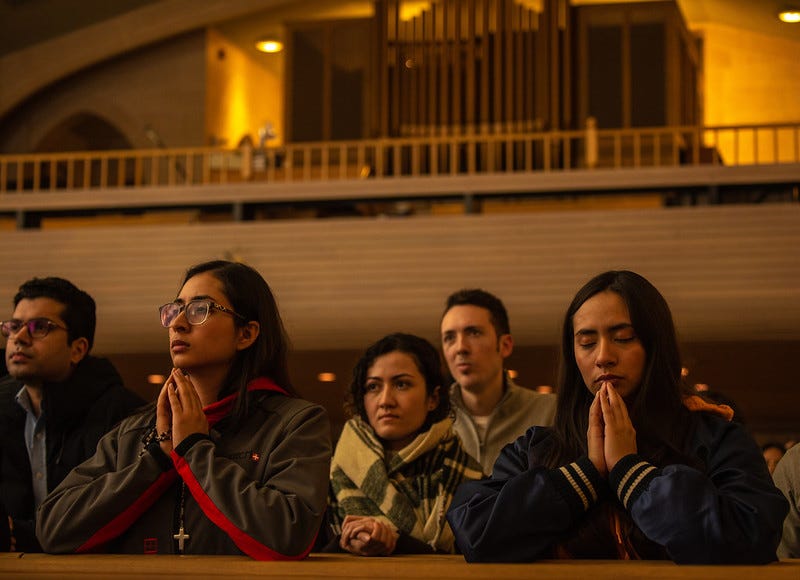
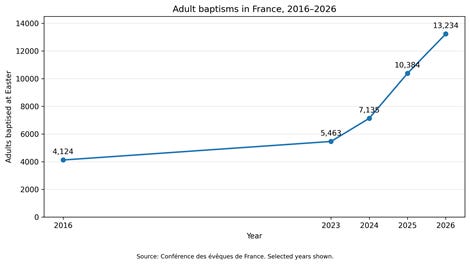
At Easter this year, 13,234 adults were baptised into the Catholic Church in France. Ten years ago, the figure was 4,124. When more than 8,000 adolescent baptisms were added, over 21,000 French teenagers and adults received baptism. In Toronto, 2,050 adult catechumens were baptised and another 1,620 already-baptised Christians entered full communion with the Catholic Church at Easter. Melbourne reported about 550 people entering the Church, 57 pc more than in 2025, after a 40 pc rise the year before. Brisbane’s cohort almost doubled, while Westminster gathered nearly 800 adults for its largest Rite of Election in fifteen years.[1]
Smaller but similar stories have appeared elsewhere. Belgium recorded 536 adult baptisms in 2025, compared with 362 in 2024 and 180 a decade earlier. The Netherlands reported more than 500 adult baptisms and over 100 receptions into the Church in 2024. Hong Kong had 2,500 Easter baptisms in 2026, including 1,600 adults, while Singapore prepared to welcome about 1,250 catechumens and candidates, its largest group in a decade.[2]
Any one of these reports might be explained as a local success. Together, they are harder to dismiss. They suggest that in a range of societie
s and cultures (European and Asian, Anglophone and Francophone, historically Catholic and religiously mixed) more adults, often younger adults, are approaching the Catholic Church for baptism or reception. The evidence does not yet establish a worldwide religious revival, but it does reveal an international phenomenon that deserves closer attention.
The rise in baptism is not confined to Catholicism. In the Church of England, adult baptisms increased from 7,800 in 2023 to 8,700 in 2024, while teenage baptisms and confirmations also rose.[3] In the United States, Southern Baptist congregations reported 263,075 baptisms in 2025, almost 5 pc more than the previous year and the fifth consecutive annual increase.[4]
What exactly is being counted?
The first caution is that these figures do not all measure the same thing. France counts adults actually baptised at Easter. Many English-speaking dioceses report everyone in an initiation programme together: unbaptised catechumens, already-baptised Christians preparing for full communion, and Catholics completing sacraments they did not receive earlier. Some countries use “adult baptism” for anyone over seven; others combine adolescents and adults. “Catechumens”, “candidates”, “converts”, “receptions” and “people entering the Church” are related but not interchangeable categories.[5]
There is therefore no single global statistic showing a uniform Catholic conversion boom. The evidence is better understood as a family of connected trends: clear rises in adult baptism in some countries, larger mixed initiation cohorts in others, and growing interest where exact sacramental figures are unavailable. That is still enough to justify serious attention, provided the differences are not concealed.
France: the strongest national evidence
France offers the clearest picture because its bishops publish a consistent national series. Adult baptisms rose from 4,124 in 2016 to 5,463 in 2023, 7,135 in 2024, 10,384 in 2025 and 13,234 in 2026. The number has therefore more than tripled in ten years, with the sharpest acceleration coming since 2023.[6]
The French reports also show who is coming. The most striking change is age. In 2020, catechumens aged 26-40 were roughly twice as numerous as those aged 18-25. By 2026, the younger group had overtaken them. Students form a growing share, but this is not simply a university or middle-class phenomenon. Workers, technicians and employees remain the largest socio-professional bloc, and candidates come from major cities, smaller towns and rural areas.[7]
Women remain more numerous than men in almost every age group. This matters because much public discussion of renewed religious interest has centred on young men. There may indeed be a change among some young males, but the best direct evidence on Catholic entrants does not show a male-dominated movement. Women were a clear majority in recent French cohorts, 57 pc of Southwark’s 2026 entrants and 54 pc of participants in the large American study discussed below.[8]
Religious background is varied. Many French catechumens still come from families retaining some Christian memory, even if faith was not practised. An increasingly important group, however, reports no religious tradition or little knowledge of Christianity. Others come from different religions. Converts from Islam are real but remain a small minority, about 3 pc in the 2026 French report.[9]
Motivation is where the statistics begin to turn into human stories. A 2026 French survey of 1,450 catechumens in 60 dioceses found that 40 pc linked their journey to an ordeal: illness, bereavement, suffering or a wider crisis of meaning. About one third reported a powerful spiritual experience. Others described prayer, reading Scripture, intellectual questioning, Christian beauty or the influence of a credible believer. One former atheist explained that he had wanted to understand why he did not believe. Only 11 pc identified social-media influencers as the principal trigger. The internet is part of the story, but rarely the whole story.[10]
What the Chicago study adds
The richest recent study of people in Catholic initiation programmes in the US comes from the Archdiocese of Chicago. In 2026 it surveyed 2,127 participants, in English and Spanish, across 20 American dioceses. The sample included 717 unbaptised catechumens, 715 already-baptised Christians seeking full communion and 695 Catholics completing initiation. Unlike the French figures, it is not a national baptism count. Its strength lies in showing why people come and what paths they follow.[11]
The leading motives were spiritual and existential, not political. Eighty-four per cent wanted a deeper spirituality or relationship with God; 77 pc wanted to grow in goodness and virtue; 76 pc sought a deeper understanding of truth; and 72 pc wanted inner peace. Liturgy, sacraments, tradition and the long intellectual inheritance of Catholicism also attracted many participants. Catholic positions on political or social controversies were much less important.
Here Chicago and France converge. In both, people describe a search for God, truth, coherence and a more substantial way of living. Crisis may open the door, but positive attractions matter too: beauty in worship, a serious conversation, a friendship, an admired Catholic, the discipline of prayer, or the discovery that Christianity has answers to questions the person had never previously explored.
Digital media were more prominent in Chicago than in France. About two thirds named at least one meaningful digital resource, and 40 pc said online material had helped them move forward in faith. Podcasts, videos, prayer apps and online Bible or theology programmes allow someone to investigate Catholicism privately before approaching a parish. Yet online interest normally has to become personal contact, catechesis, worship and membership of a real community.[12]
A global phenomenon, but not a global reversal
Religious-switching surveys provide another kind of evidence. Church reports measure a yearly flow, i.e. people baptised or received in a particular year. Surveys measure a stock, i.e. the proportion of adults who were not raised Catholic but now identify as Catholic. The two measures cannot be added together, but surveys reveal conversion in countries that publish few catechumenate statistics.
Recent Pew Research Center data found that adults not raised Catholic but now identifying as Catholic made up 6 pc of all adults in Kenya; 5 pc in South Korea and Hungary; 4 pc in Peru and Argentina; 3 pc in Colombia; and 2 pc in Spain, France, Brazil, Mexico, Australia, the United States and the Philippines. These are accumulated changes over many years, not one Easter’s baptisms, but they show that entry into Catholicism is not confined to France or to the West.[13]
The same surveys prevent easy triumphalism. Catholicism continues to suffer net losses through religious switching in most countries studied: the number of adults who leave is generally much larger than the number who enter. Rising annual baptisms and long-term institutional decline can therefore occur simultaneously. The new entrants are real and may be transforming particular communities, but they are not yet numerous enough to reverse decades of accumulated departures.
The United States offers a particularly detailed profile. Pew estimates that converts constitute about 8 pc of American Catholics. Of these, 59 pc were raised Protestant and 22 pc with no religion. Nearly half identified a spouse or marriage as the main reason they became Catholic; others cited Catholic teaching and history, a spiritual calling, or the influence of relatives and friends. Converts also reported somewhat higher weekly Mass attendance than cradle Catholics.[14]
The common profile
No single portrait fits everyone, but several findings recur. The newer cohorts are often younger than those of the recent past. Women still usually outnumber men. Converts come from varied social classes and educational levels. Some recover a half-forgotten Christian inheritance; others begin with no religion or move from another faith. Spouses, friends, grandparents, teachers, fellow students and welcoming parishioners are often decisive. Crisis, grief and inner emptiness initiate many journeys, while beauty, truth, moral seriousness, community and the desire for spiritual stability draw them further.
The pattern also corrects two common stereotypes. It is not mainly a movement of young men radicalised by the internet, although young men and digital media are both present. Nor is it simply a return of conventional family religion. Many entrants have had little contact with Christianity, and even those who approach the Church through a spouse, wedding or child’s sacrament may gradually make a personal decision that goes beyond the original practical reason.
The Covid hypothesis
The timing naturally raises the question of Covid. Many of the sharpest increases became visible after the pandemic. Lockdowns brought isolation, interrupted relationships and confronted millions with illness, mortality and uncertainty. They also forced churches to broadcast online, making religious services accessible to people who might never have entered a church. A simpler backlog effect is possible too: initiation programmes and baptisms delayed in 2020-21 may have enlarged later cohorts.
Research makes an existential effect plausible, although it does not prove that Covid caused the present baptismal increase. A German study based on about 7,500 respondents across thirteen survey waves in 2020 found that religiosity rose when people experienced the pandemic as a direct threat to their personal existential or economic security, but not merely when infection levels rose around them. A later study using Gallup World Poll data from 2.6 million respondents in 165 countries found that global religiosity, which had previously been declining slightly, generally increased during the pandemic years, although the scale and pattern varied among countries.[15]
These results fit the testimonies of catechumens who speak of suffering and a search for meaning. Yet neither the Chicago survey nor the French series establishes a causal link, and the growth has continued too long to be explained simply as postponed ceremonies. Covid may have been an accelerator, a catalyst or a moment of awakening for some; it is not a complete explanation.
A quiet religious revival?
Some have spoken of a “quiet revival” in religion, happening particularly in the West. An Iona Institute polls found that in Ireland, respondents aged 18-24 were more likely than those aged 25-34 to describe themselves as religious or spiritual and to consume religious or spiritual material. In Northern Ireland, we found that 18-24-year-olds were more likely than any other age group to have a “very positive” view of Christianity and were more engaged than the 25-34 group on several measures; yet about half said they were neither religious nor spiritual.[16]
The rise in adult baptisms does not mean that whole societies are returning to weekly worship or that decades of religious decline have suddenly been reversed. More cautiously, those figures suggest that there is a new trend and, within increasingly secular populations, a visible minority, often young, is becoming more curious, more open and sometimes more committed.
The secularisation paradox
The secularisation paradox is that adult baptisms can rise partly because a country has become less culturally Christian. When infant baptism declines, more children grow up unbaptised and some later choose baptism for themselves. As inherited Catholicism weakens, the smaller number who enter the Church do so more deliberately. Rising adult baptism and declining nominal affiliation are not opposites; they can be two results of the same transition from inherited religion to chosen religion.
The clearest national surges have been documented in highly secularised France, Belgium and the Netherlands. Comparable national trends have not yet been demonstrated in less secularised Catholic countries such as Spain, Italy or Poland, but this must be stated cautiously. Spain reports more than 1,000 adults requesting baptism each year without publishing a recent, comparable year-by-year series. Italy’s 2023 survey was incomplete, covering 128 of 226 dioceses, but found 742 catechumens, 47 pc of them aged 19-30; Milan’s adult catechumens have risen locally, reaching 101 in 2026. In the sources reviewed, no recent Polish national series comparable to France’s was found. The contrast may be real, or it may partly reflect differences in data collection and publication.[17]
There is nevertheless a plausible social mechanism. Where almost everyone was baptised as a child, there are fewer unbaptised adults available to become catechumens. Where cultural Catholicism has receded for a generation, a larger population reaches adulthood without baptism but may encounter Christianity later as something new. Secularisation can reduce the Church’s inherited numbers while creating the conditions for a smaller but more intentional form of belonging.
The unanswered question
The figures discussed in this paper should be neither dismissed nor inflated. In most Western countries, departures from Catholicism still greatly exceed entries. Yet adult initiation is real, increasingly visible and global enough to challenge predictions that religion will simply disappear. Even small numbers can alter a parish or diocese long before they alter a national census.
The central unanswered question is what happens after Easter. Churches count catechumens at the Rite of Election and baptisms at the Vigil, but rarely publish data on Mass attendance, parish involvement or continued practice one or two years later. Larger cohorts will have lasting significance only if neophytes find friendship, formation, responsibility and living communities. The rise is substantial enough to matter pastorally, hopeful enough to deserve attention and still too young and uneven to justify triumphal claims.
[1] Conférence des évêques de France, Dossier de presse: Catéchumènes 2026, https://eglise.catholique.fr/wp-content/uploads/sites/2/2026/03/20260325_Dossier_presse_catechumenes_2026.pdf; Archdiocese of Toronto, ‘Easter Vigil Celebrations Baptize 2,000 Catholics’, https://www.archtoronto.org/en/outreach/news/archdiocesan/easter-vigil-celebrations-baptize-2000-catholics/; Diocese of Westminster, ‘Largest Rite of Election for 15 years’, https://rcdow.org.uk/news/largest-rite-of-election-for-15-years/; Brisbane Catholic Leader, ‘Brisbane welcomes nearly double the number of people at Rite of Election than previous year’, https://catholicleader.com.au/news/qld/brisbane-welcomes-nearly-double-the-number-of-people-at-rite-of-election-than-previous-year/.
[2] Vicariat de Bruxelles, ‘Augmentation du nombre de baptêmes d’adultes: 50 % en plus par rapport à 2024 et 200 % en plus sur 10 ans’, https://www.catho-bruxelles.be/communique-augmentation-du-nombre-de-baptemes-dadultes-50-en-plus-par-rapport-a-2024-et-200-en-plus-sur-10-ans/; Rooms-Katholiek Kerkgenootschap, ‘Toetredingen tot de Rooms-Katholieke Kerk stijgen in 2024 met bijna 40 procent’, https://www.rkkerk.nl/toetredingen-tot-de-rooms-katholieke-kerk-stijgen-in-2024-met-bijna-40-procent/; Agenzia Fides, ‘The Diocese of Hong Kong prepares to celebrate 2,500 baptisms at Easter’, https://www.fides.org/en/news/77472-Three_weeks_of_Scrutinies_The_Diocese_of_Hong_Kong_prepares_to_celebrate_2_500_baptisms_at_Easter; Vatican News, ‘Singapore: Largest number of new Catholics this Easter’, https://www.vaticannews.va/en/church/news/2026-03/singapore-southeast-asia-baptism-easter-catechumens.html.
[3]‘Attendance at Church of England churches rises for the fourth year in a row’, https://www.churchofengland.org/media/press-releases/attendance-church-england-churches-rises-fourth-year-row
[4]‘Southern Baptists see attendance, baptism gains amid membership declines’, https://www.baptistpress.com/resource-library/news/southern-baptists-see-attendance-baptism-gains-amid-membership-declines/ These figures are not directly comparable with Catholic adult-baptism statistics, since the Southern Baptist total includes children and adolescents, but they suggest a broader increase in Christian initiation.
[5] For the methodological distinction, see Archdiocese of Chicago, Why Are So Many People Becoming Catholic? 20 U.S. Catholic Dioceses Collaborate to Study Emerging Interest in the Catholic Church, pp. 5-7, https://www.archchicago.org/documents/d/aoc/ocia-report-1; and Catholic Bishops’ Conference of England and Wales, Statistics 2024, https://www.cbcew.org.uk/statistics-2024/.
[6] Conférence des évêques de France, ‘Le baptême des adultes: chaque année, un signe de foi fort’, https://eglise.catholique.fr/approfondir-sa-foi/la-celebration-de-la-foi/les-sacrements/le-bapteme/baptemes-adultes/.
[7] Conférence des évêques de France, Dossier de presse: Catéchumènes 2026; see also the official 2024 results, ‘Résultats record en 2024 du nombre de catéchumènes en France’, https://eglise.catholique.fr/espace-presse/communiques-de-presse/550845-resultats-record-en-2024-du-nombre-de-catechumenes-en-france/.
[8] Archdiocese of Chicago, Why Are So Many People Becoming Catholic?, p. 14; Archdiocese of Southwark, ‘Record number of adults received into the Catholic Church in Southwark’, https://rcaos.org.uk/news-events/news/record-number-of-adults-received-into-the-catholic-church-in-southwark/; Conférence des évêques de France, 2023 and 2024 catechumenate reports.
[9] Conférence des évêques de France, Dossier de presse: Catéchumènes 2026, p. 7.
[10] Conférence des évêques de France, ‘Demandes de baptêmes: d’où viennent-elles?’, based on a survey of 1,450 catechumens in 60 dioceses, https://eglise.catholique.fr/approfondir-sa-foi/la-celebration-de-la-foi/les-sacrements/le-bapteme/baptemes-adultes/570512-origines-demandes-baptemes/.
[11] Archdiocese of Chicago, Why Are So Many People Becoming Catholic?, pp. 4-8.
[12] Ibid., especially the sections on motivations, educational attainment and digital media.
[13] Pew Research Center, ‘Catholicism has lost people to religious switching in many countries, while Protestantism has gained in some’, https://www.pewresearch.org/short-reads/2026/04/23/catholicism-has-lost-people-to-religious-switching-in-many-countries-while-protestantism-has-gained-in-some/.
[14] Pew Research Center, ‘US Catholic converts: Who they are and why they converted’, https://www.pewresearch.org/religion/2025/06/16/profile-of-us-converts-to-catholicism/.
[15] Eylem Kanol and Ines Michalowski, ‘Impact of the COVID-19 Pandemic on Religiosity: Evidence from Germany’, Journal for the Scientific Study of Religion 62, no. 2 (2023), https://doi.org/10.1111/jssr.12834; Kodai Kusano and Jaime L. Napier, ‘Did the COVID-19 Pandemic Change the Global Trend in Religiosity? An Interrupted Time Series Analysis of Survey Data from 165 Countries (2005-2024)’, Social Psychological and Personality Science, online first 15 February 2026, https://doi.org/10.1177/19485506261418340.
[16] The Iona Institute, ‘New poll shows public split in attitudes towards the Catholic Church’, https://ionainstitute.ie/new-poll-shows-public-deeply-split-in-attitudes-towards-the-catholic-church-2/; and ‘Big revival of interest in religion among many young people in Northern Ireland, says new poll’, https://ionainstitute.ie/big-revival-of-interest-in-religion-among-many-young-people-in-northern-ireland-says-new-poll/.
[17] Comisión Episcopal para la Evangelización, Catequesis y Catecumenado, ‘Más de 1000 adultos solicitan recibir el bautismo cada año en España’, https://evangelizacion.conferenciaepiscopal.es/mas-de-1000-adultos-solicitan-recibir-el-bautismo-cada-ano-en-espana/; Ufficio Catechistico Nazionale, Cristiani a ogni età: La raccolta dati ‘23, reporting replies from 128 of Italy’s 226 dioceses and 742 catechumens, https://catechistico.chiesacattolica.it/wp-content/uploads/sites/11/2024/11/28/Catecumenato_dati-2023.pdf; Archdiocese of Milan, ‘La carica dei 101 catecumeni verso la Traditio’, https://www.chiesadimilano.it/news/chiesa-diocesi/la-carica-dei-101-catecumeni-verso-la-traditio-2867624.html.
OpenAI Codex was used to assist with collecting, processing and checking data. Responsibility for the analysis and conclusions remains with the author
.

Nessun commento:
Posta un commento